
Happy Birthday, Christ Church Cathedral!

And it’s yet another birthday post, this time for Vancouver’s Christ Church Cathedral. The congregation worshipped together for the first time 125 years ago today at 720 Granville (which, funnily enough, is now the site of a Starbucks) and was made the Cathedral Church of the Diocese of New Westminster of the Anglican Church of Canada in 1929.
Although Christ Church is not the oldest congregation in Vancouver, it does worship in Vancouver’s oldest church building. That would be the stone building standing at the corner of Burrard and West Georgia. It was constructed on land bought from the Canadian Pacific Railway, but for several years the congregation didn’t get much beyond finishing the basement, which was nicknamed the Root House. When the CPR objected to what they called an eyesore, the current building was built in the Gothic Revival architectural style. The exterior is sandstone, its ceiling is cedar, and the beams and floor are made from old growth Douglas fir. The building was dedicated in February 1895.

Christ Church is located right in the centre of Vancouver’s downtown district. In the 1970s, the congregation voted to tear down the existing building and replace it with an Arthur Erickson–designed high-rise tower, but public opposition was so strong that in 1976 the cathedral was declared a heritage building. The building has been renovated six times; its most recent renovation was completed in 2004 with the installation of a new Kenneth Jones organ. The congregation had plans to build a bell tower, but before it had the chance to do so, the city passed a by-law restricting church bells. Christ Church is the only church in downtown Vancouver without a steeple.
A special treat this Christmas season is the almost life-sized nativity figures on display in the west alcove of the church; these are on loan from the Hudson’s Bay and are the same nativity figures that used to be displayed in the store’s windows at Christmas time. They were carved in Italy in the 1950s and belonged to Woodward’s before they were passed on to The Bay. Christ Church Cathedral asked to borrow them this Christmas season as the congregation begins a year-long celebration of its 125th anniversary.
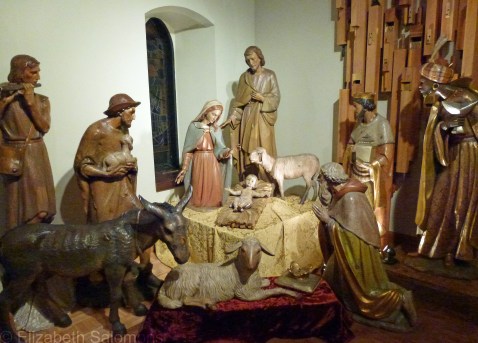

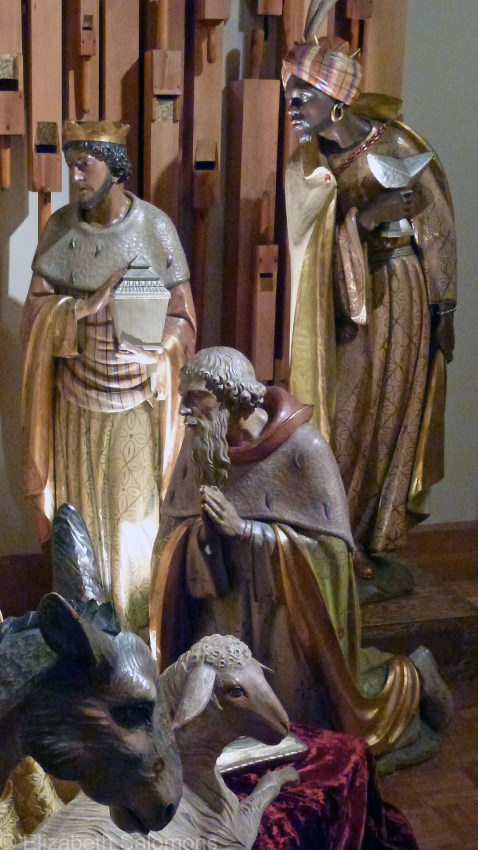
I’ve been to the cathedral for many a worship service ― these photos were taken last night after the Festival of Nine Lessons and Carols ― as well as several concerts and author readings for which the cathedral is a popular venue. After arriving very early many years ago to get a good seat to hear Timothy Findley read from his newest novel (and, as it turned out, only months before his death), I eavesdropped while a woman seated behind me explained to her companion that Christ Church was known as the church of lawyers because the funerals for the city’s most powerful lawyers are typically held there. It was one of the more bizarre bits of trivia I have ever heard about the cathedral.
But then, I like to think that there are 125 years’ worth of weird and wonderful stories to be told about Christ Church Cathedral. If only its walls could talk.

Long Walk to Freedom
“What counts in life is not the mere fact that we have lived. It is what difference we have made to the lives of others that will determine the significance of the life we lead.” — Nelson Mandela
Nelson Mandela’s long walk is over and he is forever free. South Africa ― indeed, the entire world ― is now mourning his passing and celebrating his life.
Mandela was an ordinary man who responded to an unjust world in extraordinary ways. In the plethora of this week’s news coverage coming out of South Africa and the tributes for Mandela pouring in from around the world, the words of one Canadian TV journalist stood out for me. He reminded us that it is difficult today to imagine how the very idea of a peaceful outcome to the end of South Africa’s apartheid regime seemed like pure fantasy more than 30 years ago.
Indeed.
Mandela showed remarkable grace in finding a way to forgive and demonstrated remarkable political skills that were instrumental in birthing a new South Africa. Without him, I doubt I would have ever travelled to what for me was one of the most beautiful and most complicated countries I have ever visited.
Today was a National Day of Prayer and Reflection in South Africa. South Africans gathered in churches and mosques and synagogues to reflect on and give thanks for the man they call “Tata” ― the isiXhosa word for “father.”
One of the places where South Africans gathered was St. George’s Cathedral in Cape Town. St. George’s is known as the People’s Cathedral for its role in the resistance against apartheid. It was one of the few places during the apartheid regime where people of all races were free to worship together and it was here in 1989 that Archbishop Desmond Tutu first referred to South Africans as the Rainbow Nation. I visited this cathedral in 2011, which is when I took this photo.
If I could have been anywhere on the planet today, I would have chosen this church, this city, this country.
Bonne Fête, Notre-Dame!

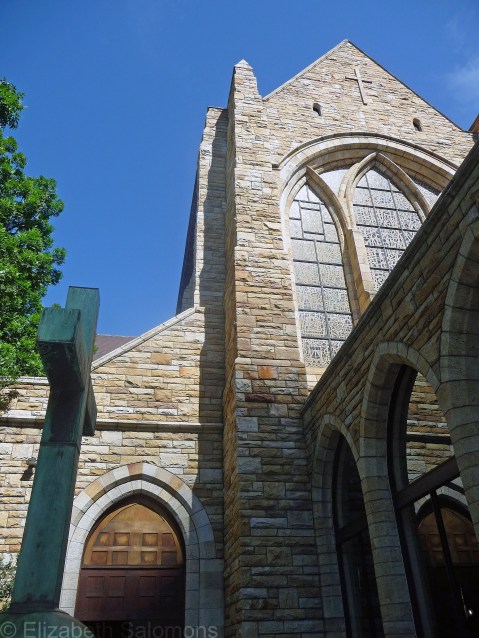
Cathédrale Notre-Dame de Paris is celebrating a pretty significant birthday this year, and, at 850 years old, I think she’s looking pretty good.
The cathedral began celebrating its Jubilee last December, and the party continues until next November. Special events have been going on all year long, including major renovations, the welcoming of pilgrims, and celebratory services. Nine new bells were commissioned, which were rung for the first time this past March, and today, on World Organ Day, the newly refurbished cathedral organ will join in on 850 organ concerts to be performed around the world within a 24-hour period.
I posted a photo of Notre-Dame’s Great Organ some time ago, so today I am posting a photo of the exterior of this grandest of cathedrals.
Happy Easter!
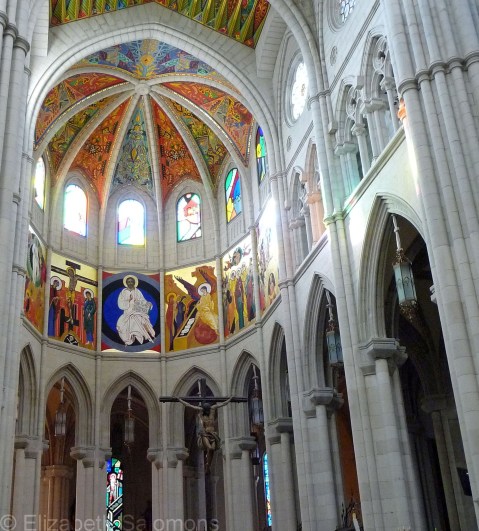
Santa María la Real de La Almudena, Madrid, November 2010
Through My Lens: Iglesia de la Vera Cruz
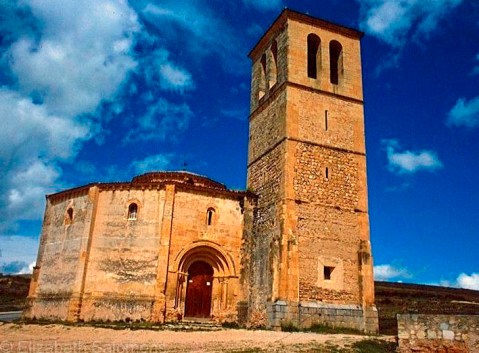
For Palm Sunday, I’m posting a photo of Iglesia de la Vera Cruz (Church of the True Cross), which is located in Segovia. This church is one of the most extraordinary churches I’ve ever set foot in.
(But then, I could say that about Córdoba’s Mezquita. Or Barcelona’s La Sagrada Família. Why don’t I just put it out there that Spain does churches in a way all its own?)
Iglesia de la Vera Cruz is a Romanesque church that was built by the Knights Templar and consecrated in 1208. Its name comes from the reason for its existence: to house a fragment of the True Cross ― the cross on which Christ was crucified. The relic has since been moved to another church in another town.
What’s so curious about this church is its twelve-sided (that’s dodecagonal to the geometry nerds among us) shape. In the centre is a two-storey chapel, called an edículo, accessible by twin staircases. The lower level of this chapel has four arches corresponding to the four cardinal directions of north, east, south, west, and the upper level contains an altar. The church is said to be modelled after the Church of the Holy Sepulchre in Jerusalem (which is where, according to legend, the True Cross was found).
It’s not a big church and its unique design allowed the knights to come in on horseback, form a circle around the chapel in the centre, and hold vigil over the relic.
Through My Lens: Mosque–Cathedral of Córdoba

Last Sunday, I promised you a photo of the nave of Córdoba’s Mezquita. Here it is, for the Fifth Sunday of Lent.
A Papal Conclave
All eyes will be on Rome tomorrow as the 75th papal conclave begins. Papal conclaves have been conducted to elect popes after it took two years, nine months, and two days to elect a successor to Pope Clement IV in the thirteenth century. To avoid a repeat of that nonsense, Pope Clement IV’s successor, Pope Gregory X, decreed that all future papal elections would take place with the voting cardinals locked in a room until they came to a decision. Cum clave (conclave) is Latin for “with a key.” And so began the papal conclaves that, for the most part, have been used to elect new popes ever since.
I think posting a photo of St. Peter’s Basilica (aka Basilica Papale di San Pietro in Vaticano) is appropriate, given the occasion. By the time I wake up tomorrow, the 115 cardinals will be getting ready to process into the Sistine Chapel. The first puffs of smoke should follow a few hours later. The conclave that elected Pope Benedict XVI in 2005 took less than 24 hours.

Through My Lens: Mezquita de Córdoba

For the Fourth Sunday of Lent, I’m posting a photo of the interior of the Mezquita de Córdoba. The Mezquita is a cathedral built inside a mosque built on top of a church. Given that back-and-forth heritage, it’s often called the Mezquita–catedral de Córdoba (the Mosque–Cathedral of Córdoba).
The original church, the Basilica of Saint Vincent, was built by the Visigoths in the sixth century. When the Moors arrived in Córdoba in the late eighth century, they built a mosque on top of that basilica. The main prayer hall of the Mezquita (shown in this photo) is filled with an impressive forest of columns supporting 400 red-and-white double arches. Even today, it is one of the largest mosques in the world.
After the Reconquista (reconquest) of Córdoba in 1236 by the northern Christian kingdoms, the mosque was reconsecrated as a Christian church. Eventually, the minaret was turned into a bell tower and a Renaissance cathedral nave was built in the middle of the mosque. Stay tuned ― next Sunday I’ll post a photo of that nave.
Through My Lens: La Sagrada Família

For the Third Sunday of Lent, we’re moving on to Barcelona.
Most European cathedrals were built centuries ago. The cornerstone of this one, Basílica i Temple Expiatori de la Sagrada Família, was laid a mere 131 years ago in 1882. Except for a stoppage during the Spanish Civil War, construction has continued ever since. The basilica is the final work of Catalan architect Antoni Gaudi, the face of Modernisme, who spent the last decades of his life working on the structure.
When finished (estimated to be in about 15 years), La Sagrada Família will have 18 spires and will be the tallest cathedral in the world. There will be three facades, two of which have already been completed: the Nativity façade and the Passion façade. The Passion façade, which faces west, was sculpted by Josep Maria Subirachs and is particularly moving.
I visited La Sagrada Família with a friend in October 2001. After we left what is essentially the largest construction site either of us had ever seen, we took the metro back to our hotel. Sitting across from us was one of the cathedral’s stone workers, covered in white dust, heading home after his work day. I marvelled at the thought of spending your entire career working on one project. And I felt honoured to be riding the metro with an old-school master craftsman.
Through My Lens: Cathedral of Ávila
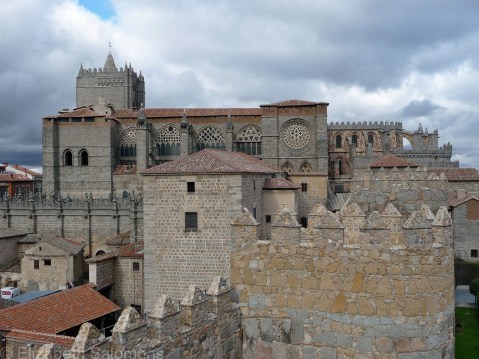
It’s the Second Sunday of Lent, and we’re still in Ávila. Today’s photo is of the Cathedral of Ávila, which, like the Basilica de San Vicente I showed you last week, was also built in both Romanesque and Gothic styles. What’s unique about this church is that its apse forms one of the 88 towers of the medieval city walls encircling the old town of Ávila. I took this photo from the top of those ramparts in November 2010.


 There and Back Again