
Through My Lens: Kaiser-Wilhelm-Gedächtniskirche

Fourteen years after my first visit to Germany, I was back. Once again, I was hopping on and off trains, but this time I was on a European walkabout with my dad.
Two significant events took place between my first two trips to Germany. The first was the fall of the Berlin Wall and the second was the reunification of Germany. My dad and I stopped for just two nights in Berlin, so my impressions of the city are fleeting, but one image stayed with me. That would be the long line of construction cranes where a string of building projects were madly underway to fill the space where the Wall used to exist.
Another image that struck me was the Kaiser-Wilhelm-Gedächtniskirche (Kaiser Wilhelm Memorial Church), located in the centre of what used to be West Berlin. A church was first built on this site in the late nineteenth century. The kaiser at the time, Wilhelm II, named the Neo-Romanesque building after his grandfather, Kaiser Wilhelm I.
After being badly damaged during World War II, a new church was constructed, but the remnants of the original building were left as a memorial to the devastation of war. The photo above shows the original spire behind the bell tower of the new church.
The Kaiser-Wilhelm-Gedächtniskirche is my photo choice for today, the Second Sunday of Lent.
Through My Lens: Kölner Dom

A lifetime ago, when I was planning my first European walkabout, I went to a travel agent (remember those?) and came home with a bunch of pamphlets from those companies that offer multi-week tours of Europe. My travel partner and I were not in any way interested in joining an organized tour, but I did want to have in my head some kind of rough itinerary before we left Canada and started hopping on and off trains.
As I flipped through the pamphlets, I came across a photo of the Kölner Dom (Cologne Cathedral) from across the Rijn River, similar to the photo shown above. What a stunning cathedral, I thought. I have to see it in person. (This would not be the only time I made a choice regarding travel based solely on a single photo, but it may have been the first.)
It turned out that passing through Cologne was already in the works. My friend and I had agreed to plan our time in Germany around a two-day Rijn cruise included with our Eurail pass, and that cruise began in Cologne.
As you see, I got my photo.
Construction of the Kölner Dom began in 1248 but wasn’t completed until 1880, due to a several-centuries’ long stoppage of the building work. This Gothic cathedral is the tallest twin-spired church in the world. My friend and I climbed one of those spires and though my knees were protesting for days afterwards, I remember that the climb gave us a bird’s-eye view of some of the damage the cathedral suffered during World War II. I later learned that the city of Cologne was pretty much flattened; only the cathedral (miraculously) survived the bombardments. It is now on the UNESCO World Heritage List.
I took you on a tour of the Aachener Dom for last year’s Lenten series. This year, I’m staying in Germany, and the Kölner Dom is my photo choice for today, the First Sunday of Lent.
Happy Easter!

Aachener Dom, Aachen, September 2017
Through My Lens: Aachener Dom Pulpit

I’m by no means a short person, so judging by the angle from which I took this photo, my best guess is this pulpit is at least ten feet off the floor of the Aachener Dom. Quite an imposing perch from which to preach a sermon or read from the gospels.
The pulpit is sometimes referred to as the Ambon of Henry II. Ambon simply means pulpit. Henry II was another of the Holy Roman Emperors, who ruled from 1014 to 1024, some two hundred years after Charlemagne.
The pulpit is just to the right of the altar of the Aachener Dom and is my photo choice for today, Palm Sunday.
Through My Lens: Behind the Altar of the Aachener Dom

Last Sunday I showed you a photo of the altarpiece of the Aachener Dom, and mentioned that the shrine containing the remains of Charlemagne was somewhere behind that altarpiece.
Here then, for the Fifth Sunday of Lent, is a view of the area behind the altar, and in the far distance of this photo, beneath the stained glass windows, is the Karlsschrein.
Through My Lens: Aachener Dom Pala D’oro

For today, the Fourth Sunday of Lent, I’m posting a photo of the magnificent Palo D’oro of the Aachener Dom, which is believed to date from 1020. Palo D’oro means golden altarpiece.
Behind the altarpiece is the Marienschrein (Shrine of Mary), which holds the four relics that make the Aachener Dom a place of pilgrimage. And behind that, not visible in my photo, is the Karlsschrein (Shrine of Charlemagne) containing the remains of Charlemagne.
Charlemagne is what you call a Big Deal for students of European history. In 768, he became king of the Franks (who lived in northern France and the German Rhineland). In 774, he became king of the Lombards (a Germanic people on the Italian peninsula). And in 800, he was crowned Holy Roman Emperor by Pope Leo III. All that is why Charlemagne is given credit for uniting Western Europe.
Charlemagne is also credited with bringing about the Carolingian renaissance, even though he himself was barely literate. Libraries and schools were established, and Charlemagne invited scholars from England, Germany, France, Italy, and Spain to study at Aachen. A new and simplified system of writing, known as the Carolingian miniscule, came into use. And he created a new currency system based on a pound of silver divided into 20 parts, which were further divided into 12 parts, for a total of 240. This three-part currency was used for many centuries throughout Western Europe. Ireland and the United Kingdom were the last to drop it when they converted to the decimal system in 1971.
Through My Lens: Barbarossa Chandelier
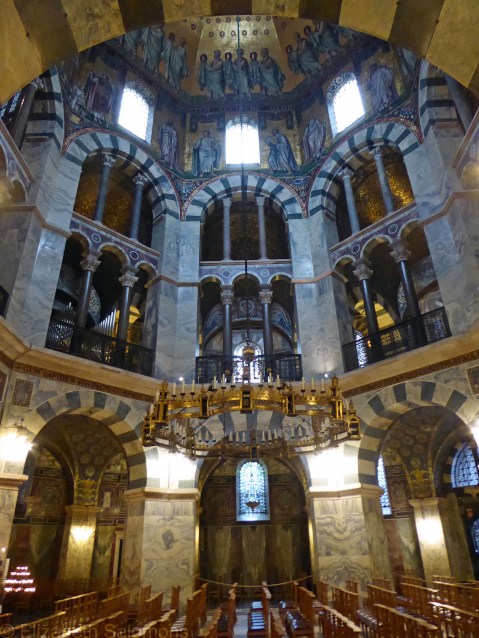
For the Third Sunday of Lent, I’m posting a photo of the Barbarossa Chandelier that hangs in Aachener Dom. Four metres in diameter and suspended four metres from the ground, this magnificent chandelier holds 48 candles. It was commissioned by Frederick I, also known as Frederick Barbarossa, who was Holy Roman Emperor from 1155 to 1190.
Through My Lens: Aachener Dom Ceiling

What sets the Aachener Dom apart from other cathedrals — and what you notice as soon as you step inside — is its shape. Unlike most cathedrals, it’s built in the shape of an octagon, not a cross. Charlemagne is said to have placed a lot of significance on the number 8. Four is another significant number in the Christian faith and, if you’re mathematically inclined, you know that an octagon can be formed by laying one square on top of another after rotating it a quarter turn, and then lopping off the protruding triangles.
For the Second Sunday of Lent, here is a photo of the ceiling of the Aachener Dom, in which the eight sides of the octagon are clearly visible.
Through My Lens: Aachener Dom

When I wrote about Aachen after my summer in Amsterdam some years back, I promised myself I would one day write about its magnificent cathedral.
Today is that day.
The Aachener Dom (Aachen Cathedral) started out as a chapel in the palace of Charlemagne way back at the end of the eighth century. It later became the coronation church of the German monarchs, with 31 kings and 12 queens having been crowned here between 936 and 1531. And Charlemagne himself was buried here; it was the Charlemagne connection that made the cathedral one of the most significant pilgrimage sites during the Middle Ages, along with Rome, Jerusalem, and Santiago de Compostela.
This year’s Lenten series will focus on the Aachener Dom, which is one of the most remarkable churches I have ever visited. For today, the First Sunday of Lent, I’m posting a photo of the only bit of the cathedral I saw from the outside. It’s pretty low key from this side, and belies how spectacular the interior is.
Which is why I was speechless after stepping inside.
Through My Lens: Portico of La Madeleine
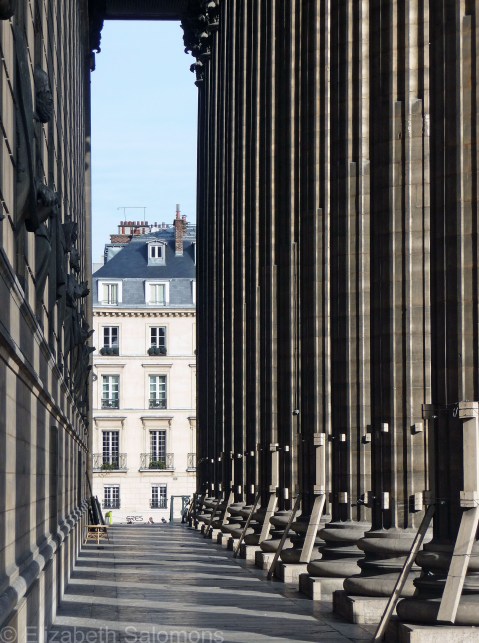
When I’m photographing my European churches, I’m always on the lookout for an unusual angle. Here’s one: from the portico at La Madeleine.


 There and Back Again