
Happy Birthday, Jane Austen!
I wasn’t planning to write about the semiquincentennial of the birth of Jane Austen, born on this day in 1775. After all, I’d already written a post on the bicentennial of her death some years ago.
But when I woke up this morning, I thought, “C’mon. It’s Jane Austen! You need to post something.”
However, I’m a bit low on photos that represent Jane. The only place I’ve been to that connects with her life is Bath — and she didn’t much care for Bath. I was planning to visit Winchester, where she died and was buried, and where the house she lived the last eight years of her life has been turned into a museum.
In fact, I left Bath fully intending to go directly to Winchester. But after changing trains in Southampton, and realizing the train I had boarded was continuing on to London after it stopped in Winchester, I changed my mind. (You can do things like that with a BritRail Pass. I have to say: it’s very freeing, travelling that way.)
And so, I ended up in London that night. Winchester — and Jane Austen — would have to wait.
I always say, when travelling, that you should leave something undone to make sure you come back. One of these days (years?), I will return to Jane Austen country.
In the meantime, in honour of Jane Austen’s 250th birthday, here’s a photo of the Roman baths in Bath. I like the idea that Jane and I have both been to these baths — even though I missed her by almost 200 years.

Happy Birthday, Canada House!
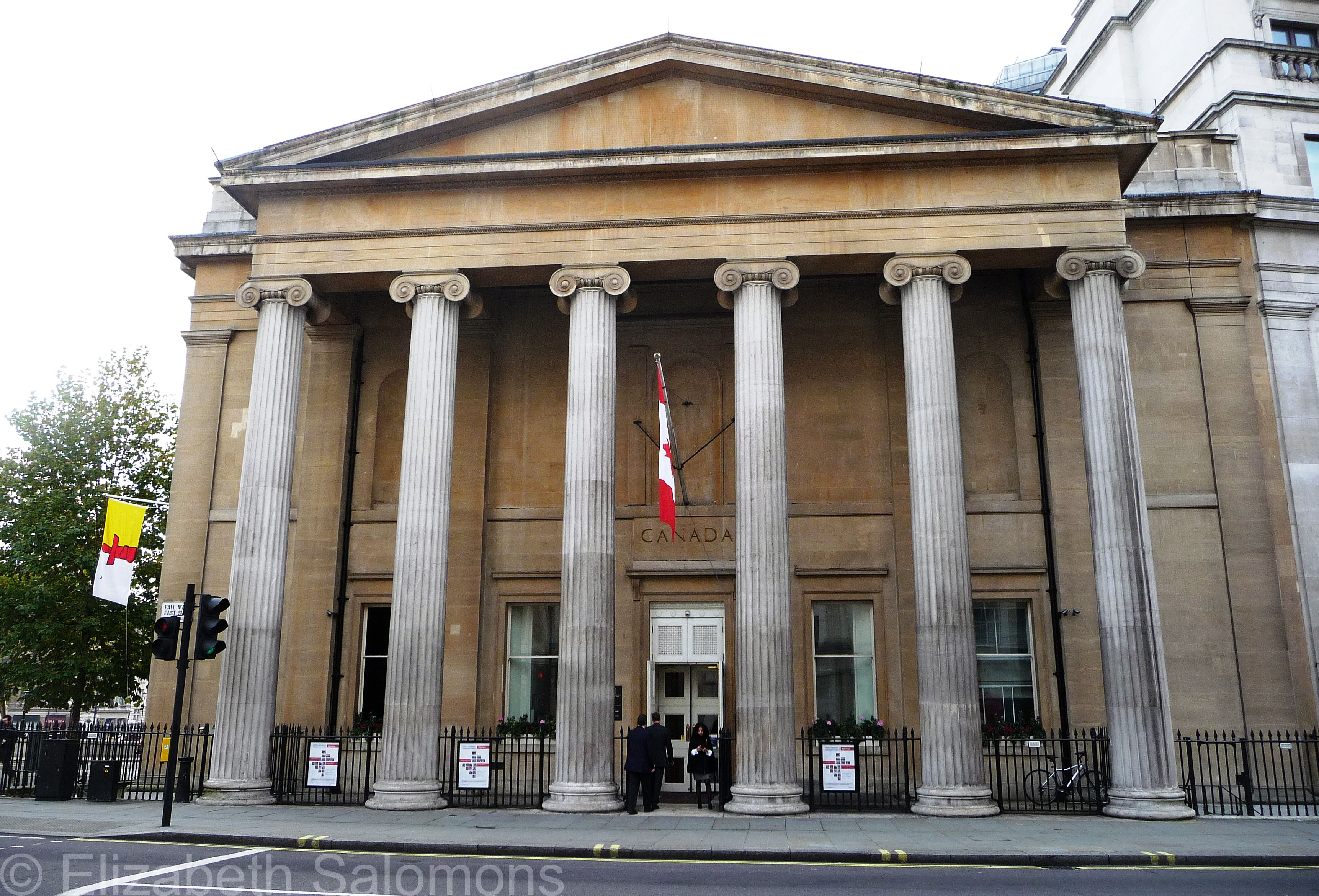
Canada is a great country: alike in the literal sense of vast extent from sea to sea and great in achievement and in promise, and it is right and necessary that its official representatives here should be housed in a manner worthy of the Dominion and adequate to the discharge of their ever-growing and important duties.”
— King George V
A hundred years ago today, King George V opened Canada House, also known as the High Commission of Canada in the United Kingdom, with these words. The building has a unique purpose in the relationship between Canada and the UK and a pretty cool address: Canada House, Trafalgar Square, London.
Completed in 1827, the building was purpose-built for a gentleman’s club known as the Union Club. Its architect was Sir Robert Smirke, designer of the British Museum and the Royal Opera House at Covent Garden. The Greek Revival style was a departure from the Regency era, and the style was adopted by many of the neighbours of Canada House, including the National Gallery, South Africa House, and St. Martin-in-the-Fields.
Canada bought the building in 1923. After extensive renovations, the High Commission moved in and has resided there ever since. London is Canada’s oldest diplomatic mission and its second largest, with a complement of 300 today. (In 1923, it numbered five.)
The reason Canada House is a High Commission, not an embassy, is because when it was established way back in 1880, Canada was still under colonial rule. (Fun fact: Canadians were considered British subjects until 1947.) Our first prime minister, Sir John A Macdonald, had a representative in London who acted on his behalf and whom Sir John A. wanted to call a resident minister. Britain said no to that idea and suggested the title of high commissioner instead. That title and the position became the standard for all members of the Commonwealth and is why Commonwealth nations send high commissioners, rather than ambassadors, to each other’s capitals.
As the Canadian diplomatic mission in London grew, it expanded into a second location on Grosvenor Square called Macdonald House, which was in use from 1961 to 2014.
In 2013, Canada bought the building next door to Canada House. Former home of the Sunlife Assurance Company of Canada, it was built at the same time as Canada House and in the same Greek Revival style. (Another fun fact: this building served as the overseas headquarters of the Canadian Army during World War II.) Renovation work converted the two buildings into one, Macdonald House was sold, and the High Commission has resided in one building since 2014.
I became aware of its centennial when I saw the coverage of King Charles and Queen Camilla’s visit to Canada House back in May. They dropped by to draw attention to their upcoming visit to Canada. That visit would be Charles’s 20th, but his first as Sovereign. The purpose of his visit was to attend the opening of Canada’s parliament and deliver the Speech from the Throne.
Given current world events, this was a pretty big deal. Indulge me as I take a moment to explain why. Some of my readers, especially the non-Commonwealth ones, might not understand.
Although Canada is an independent nation, we are a member of the Commonwealth, and one of 14 realms where, in addition to the United Kingdom, the Sovereign is also the Head of State. This means Charles III is also King of Canada.
The Throne Speech outlines the government’s agenda for the next session of parliament and is usually read by the Governor General, who is the King’s representative in Canada. But on just three occasions, the Sovereign has travelled to Canada to read the speech: King Charles last month, and his mother, Queen Elizabeth II, in 1957 and 1977.
After being sworn in as prime minister in March, Mark Carney made a quick overseas trip to Paris and London, stopping off in Iqaluit on his way back to Ottawa. Many saw this trip as symbolic; during his swearing-in ceremony, Carney pointed out that Canada was founded by three peoples: French, English, and Indigenous. While in London, he met with King Charles and asked him to open the next session of the Canadian parliament, should the Liberals be successful in the next election. Which they were.
Fast forward to May 27. Having the King open the 45th Parliament of Canada and deliver the Speech from the Throne highlighted to the world that we are a constitutional monarchy, and our system of government is much different than that of the republic to our south. Charles and Camilla were in Ottawa less than 24 hours, but were given a warm welcome by thousands of Canadians. Even anti-monarchists were heard to remark on the significance of the occasion.
About those current world events. Some people think Canada becoming the 51st state is a joke, but Canadians aren’t laughing. The Speech from the Throne reiterated Canada’s sovereignty and the need to rebuild our relationships with both the United States and the rest of the world.
The Throne Speech is always written by the government, but the Sovereign (or the Governor General, as the case may be) are expected to add a personal touch at the beginning. Charles did so with these words:
Every time I come to Canada, a little more of Canada seeps into my bloodstream — and from there straight to my heart.”
It was a bit surreal to hear King Charles speak about Canadian domestic issues such as building affordable homes and strengthening our border, but when he read the following words, his tone was heartfelt:
As the anthem reminds us: the True North is indeed strong and free.”
The entire chamber broke out in applause.
The monarchy has to remain apolitical, but they have been known to use symbols to express themselves. Canadians noticed when Charles wore his Canadian military honours while on a visit to a Royal Navy ship in early March, a day after meeting with Prime Minister Trudeau in London. The visit of Charles and Camilla to Canada House a week before their visit to Canada was another symbol.
I got up close and personal with Canada House over two days in the fall of 2010. The above photo is actually of the side entrance, not the main one by which the Royals and other distinguished guests enter. But it’s the entrance I used. See, when you’re a Canadian in London who has had her passport stolen while travelling on a crowded Tube train, you need to visit Canada House.
The wallet was stolen on a Saturday night, and I had to wait until Monday morning to get into the High Commission. By then it had been a long and stressful two nights for me, but the consular official who helped me was calming and reassuring. She had me sorted out in no time. I returned the next morning to pick up my temporary passport and was then able to leave for Paris, only one day later than scheduled.
So for me, Canada House isn’t just a symbol. And while I’m sure the people who helped me thought they were just doing their job, I needed them to do those jobs to get me home.
In the same way, asking the King of Canada to open our Parliament is more than a symbol. It’s his job. And this year, in these times, we needed him to do his job. It might not make any difference to the man sitting in the White House, but it sure reminded Canadians that we are strong and, indeed, free.
Paris 2024
I cannot lie. Paris 2024 hit all the right notes for me.
I love the spectacle of the Olympics. The biggest sporting event on the planet bringing together thousands of athletes from more than 200 countries to compete in dozens of sports never fails to catch my attention, whether it’s in my own city or in one far away.
I especially loved the historical setting of these Olympics, which were hosted by my second-favourite city in the world. The iconic competition venues with magnificent backdrops like the Eiffel Tower or Château de Versailles never let any of us forget where these games were taking place.
The Opening Ceremonies (yes, yes, I know, but les Français, they’re just so … French) weren’t held in some generic sports stadium, but in the centre of Paris itself, putting the City of Light on display. The Olympic Cauldron (like Vancouver’s Olympic Cauldron) was accessible to Parisian residents and visitors alike from its location in the Jardin des Tuileries, where it aligned with key landmarks: the Louvre, Place de la Concorde, and the Arc de Triomphe. In a nod to history, the fuel-free cauldron was built in the shape of a hot air balloon to commemorate the first-ever flight by humans, which took place over Paris in 1783.
Even the medals are historical: each one contains a piece of the Eiffel Tower. (The fragments of iron were left over from renovation work done over the years.)
And if you doubt that the City of Love has special powers, remember this record set by athletes during Paris 2024: the most number of marriage proposals ever at an Olympic games (seven).
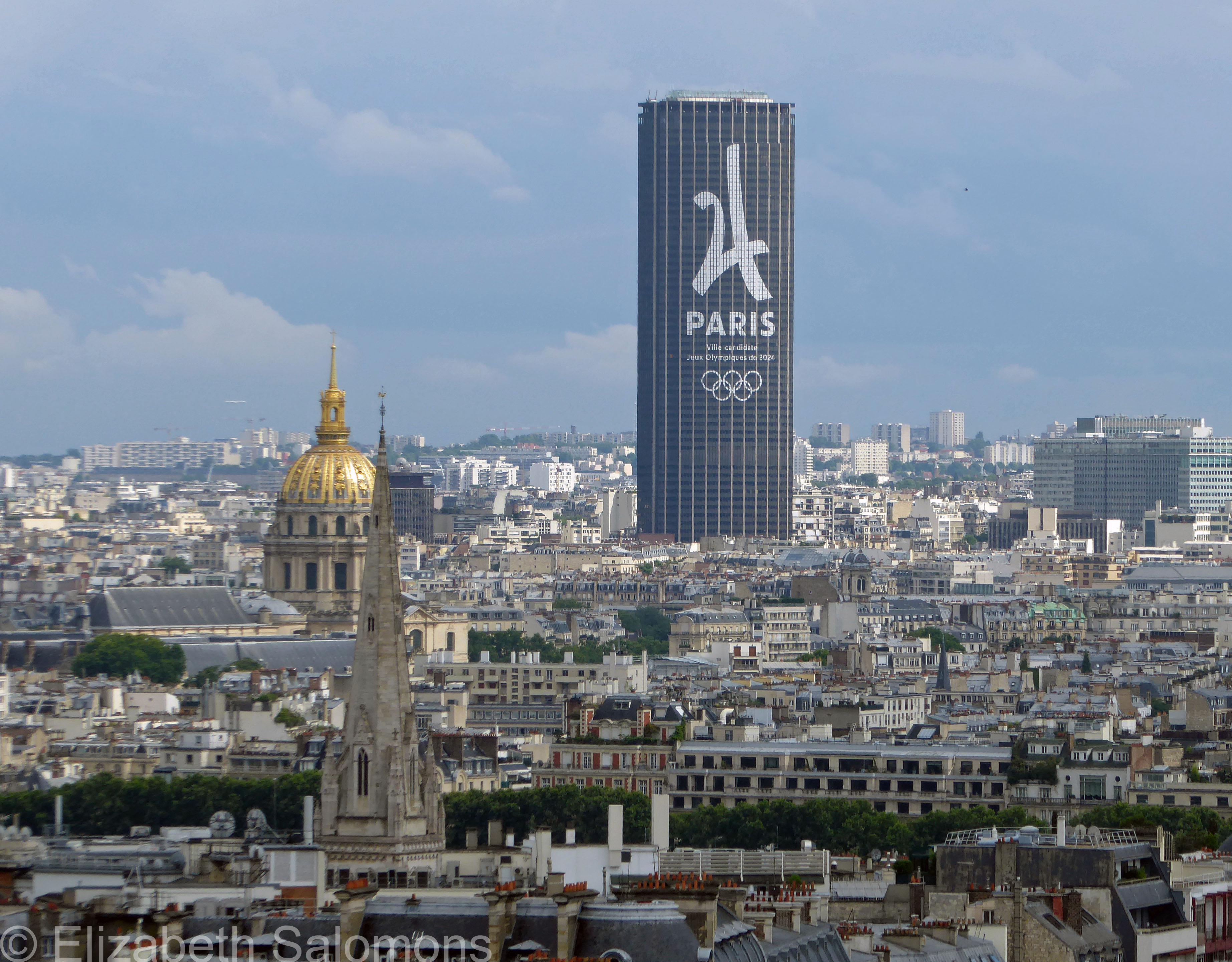
It’s always difficult for me to choose just one photo when I write about Paris, but then I found this and knew it was the one. That’s the Tour Montparnasse as seen from the Arc de Triomphe. I took this photo in the summer of 2017, mere weeks before Paris was announced as the host city for the XXXIII Olympiad.
Coronation Day

Many years ago, I toured the Tower of London with my parents and my siblings. Included in our tour was a viewing of the Crown Jewels. I remember entering a room that seemed (to me, anyways) something like a vault. I think we might even have been underground. The room was cold and quite dark, but that was so the jewels would shine. And shine they did, lit in such a way that they dazzled and shimmered. Each piece was on its own small platform covered in purple cloth, all at various heights, and all contained in one large display case. It was quite a thing to see.
I bought myself a souvenir booklet —The Crown Jewels and Coronation Ritual — which I still have. It’s worn and dog-eared because I studied that book from cover to cover.
Thanks to my viewing of the Crown Jewels all those years ago, and my souvenir booklet, I had a pretty good idea of the regalia that would be used in today’s coronation service. What I didn’t know, and what I was most curious about, was how the service would flow. It was the mix of civic and religious rites that was a mystery to me, as much as the beliefs involved are my own. The only thing I have to compare it to is a church wedding, of which I’ve been to many. But a coronation? I have no point of reference.
What I saw on my tiny TV early this morning (no, I didn’t watch it live — I recorded it on my PVR and started watching it when I woke up) was nothing like I have ever seen before. I had heard that King Charles wanted a more modern coronation, but everything I saw seem steeped in centuries of tradition.
So when the historical commentator on the CBC’s broadcast summed up what he had seen as “weird, wonderful, and wild,” I nodded in agreement. It was weird. Weird in that the ceremony seems spectacularly out of touch with our modern world. But it is also spectacularly wonderful in that a thousands-year-old tradition is still being practised. And wild in that so many of us can still find meaning in it, even as we declare ourselves citizens of a modern world.
Did you know the Dutch don’t crown their sovereigns? Apparently this is because when they regained their independence in 1815 (in the aftermath of the Napoleonic Wars), the Kingdom of the Netherlands included what is modern-day Belgium. The Dutch were Protestant and the Belgians were Catholic, so rather than fight over which religious leader would crown the king, they just skipped that part. In fact, most of the European monarchies don’t bother with coronations.
There may well come a day when the United Kingdom does away with theirs, especially as the idea of a state church becomes more and more antiquated in a world where freedom of religion is considered a human right. But I suspect the ritual will stick around for another British king or two.
The photo at the top of this post is of the towers of Westminster Abbey peeking out from behind Victoria Tower, which is part of the Palace of Westminster where the Houses of Parliament reside. I chose this photo because, well, first of all, I don’t have one of the Crown Jewels, but secondly, because it shows both church and state, the meeting of which was what today’s coronation was all about.
And thirdly, it shows continuity. The English kings and queens have been crowned at Westminster Abbey since 1066. Victoria Tower used to be known as the King’s Tower, but was renamed in 1897 to honour Queen Victoria’s Diamond Jubilee — just as the Clock Tower (where Big Ben resides) was renamed the Elizabeth Tower in 2012 to honour Queen Elizabeth’s Diamond Jubilee.
That’s a whole lot of heritage in one photo.
Queen of Canada

To you, she was your Queen.
To us, she was the Queen.
— Emmanuel Macron, President of France
I don’t remember how old I was when I became aware that I shared my name with Queen Elizabeth. But you can bet I thought it was pretty special.
I mean, what little girl wouldn’t? (Even though, in truth, I am named after my grandmother.)
My first trip overseas — the one where I caught the travel bug — included a stop in London. It was 1977, the year of the Queen’s Silver Jubilee. We were there in mid-August, long after the festivities were over, but while the Mall was still adorned in Union Jacks and silver beads. I remember those beads so vividly.

The Mall in 1977
My mother bought a tiny Silver Jubilee souvenir plate on that trip to London; somehow it ended up on my kitchen counter where it now holds my bottle of extra virgin olive oil (to keep the oil dribbles from ending up on my counter — as you do with jubilee souvenir plates).
On that trip, my first of many visits to London, I wallowed in all the pomp and ceremony that makes London unique among European capitals. I was dazzled by the Crown Jewels in the Tower of London, and I was mesmerized by the palace guards.
Last June, when I turned on my TV and watched the Trooping of the Colour and then, two days later, the Platinum Party at the Palace, I thought to myself, “Wow, I so prefer the under-stated British patriotism to the over-the-top American version.” I wondered what it must’ve been like for the Queen, grieving for her father while undertaking a massive job much earlier than she anticipated, and in a man’s world to boot. She was a young, working mother before society ever came up with the term (as if mothers are ever “non-working”). I marvelled at how the Queen found a way to make her mark so early on, surrounded by all those old men in suits.
I thought about how long seventy years is. Much has been made of the fact that Winston Churchill was her first prime minister, but I was shocked to realize she acceded the throne while Stalin was still ruling Russia. Twelve of Canada’s 23 prime ministers have served under Queen Elizabeth. She’s been our Queen for almost half of our existence as a country.
World War II and the Covid-19 pandemic bookend the second Elizabethan Age, which seems fitting. She made her first radio address in October 1940 to the children of the Commonwealth, many of them evacuees, while still a child herself. One of her last TV addresses (not counting her annual Christmas message) was in April 2020, where she referenced that 1940 radio broadcast and talked about the pain of separation from loved ones.
We’re told the Queen loved Canada. She visited us the first time as a princess, and then 22 times as Queen. I remember standing in front of Edmonton’s Government House for a chance to see her during one of those visits.
It was 1978, and the Queen, Prince Philip, Prince Andrew, and Prince Edward were in town for the Commonwealth Games. My dad rather spontaneously decided one evening that our entire family should go watch in person as the Royal Family arrived for a formal dinner. After a very long wait, we were ecstatic to see how close we were when the cars pulled up. Just feet away from us! Except, much to our disappointment, all we could see were the backs of the Royal Family as they turned away from us to be greeted by the premier and other dignitaries.
Those of us on the far side of the cars began hooting and hollering. We were noticed — the Queen and her family turned towards us and gave us that royal wave. And then — whoosh, they were swept indoors.
The crowd felt it was much too quick of a glimpse and we all began hollering again. “We want the Queen,” we yelled. And not long afterwards, the Royal Family obliged us and came out onto the balcony of Government House to give us another royal wave.
It wasn’t Buckingham Palace, but it was a balcony.
Like the rest of the country, I woke up on September 8 to news that the Queen was under medical supervision. I tried to work, but kept the live feeds of both BBC and CBC open on my computer, watching, listening, waiting. I was quite surprised at my reaction when the news came. Tears, yes, and shock. And I realized that I somewhat bizarrely thought she would live forever. How silly of me.
What hasn’t surprised me since is the outpouring of love and affection for her from all over the world. That people would queue overnight to see her lying-in-state? You only have to watch it online for a few minutes to realize what a moment that would be, walking past the Queen’s coffin in person.

Half-Mast Canadian Flags in English Bay
What has surprised me is all the ritual surrounding King Charles III’s accession. Who knew there would be so much ceremony, both in the United Kingdom and in the Commonwealth? It’s made me wonder about my monarchist tendencies for the first time ever. Yes, the rituals of accession go back thousands of years. Yes, tradition is important. But when you live in a time where change happens at lightning speed, it’s become commonplace, you might say traditional, not to hold on to traditions.
The notion of a hereditary head of state does seem pretty strange and out of date in today’s world. But when I look at countries like Japan, Norway, the Netherlands, … Canada … and then compare those democracies to republics with elected heads of state (especially the one to the south of us), well, I’m still all in when it comes to a constitutional monarchy. From where I’m standing, it looks like a stable and reasonably effective way to run a country.
I’ve always known that the Queen is Canada’s Queen, and Head of the Commonwealth, but it wasn’t until these past ten days that I clued in to what the realm is. That’s us — the fifteen countries that had Queen Elizabeth II as our Sovereign, and now have King Charles III.
I know there’s going to be a lot of rumbling about whether it’s time for Canada to become a republic, like Barbados did just over a year ago. Except for one little problem. When we patriated our constitution back in 1982 — that’s when the Queen made a special trip to Ottawa to sign what I always thought of as the divorce papers — we gave ourselves an impossible amending formula. Instead of having to go to the Parliament of the United Kingdom to amend our Constitution, we now have to sort it out ourselves. Dumping the monarch would require an amendment, and the chances of us ever coming to an agreement about how to do that are pretty much nil.
Canada is the largest realm, after the United Kingdom, and our delegation to the Queen’s funeral was also one of the largest. This morning’s procession from Westminster Abbey to Wellington Arch was led by four Royal Canadian Mounted Police on horses gifted by the RCMP to the Queen. In addition to the current and former prime ministers and the current and former governors general, the three main Indigenous leaders went along: the President of the Inuit Tapiriit Kanatami, the National Chief of the Assembly of First Nations, and the President of the Métis National Council. Their attendance goes far beyond symbolism. It’s a recognition that there is still much work to be done in terms of reconciling Canada’s colonial past. There are calls for King Charles to make a public apology to the Indigenous peoples who live in Canada. I expect it will come, eventually, because all institutions, even the British Monarchy, must adapt and change to stay relevant.
Near the end of our 1977 trip to London, I remember my dad asking each of us kids what we thought of when we heard the word “London.” I said Parliament Square.
My family was surprised. They expected me to say the Crown Jewels or the Changing of the Guard, knowing how enamoured I was with both, but Dad understood my thinking. At Parliament Square, you can see both the Palace of Westminster and Westminster Abbey — the monarchy, the parliament, and the church — in one sweeping glance.

There’s a portrait of the Queen that was taken after her coronation. You know the one: she’s wearing the Imperial State Crown, and holding the orb and sceptre, all of which adorned her coffin this past week. Behind her is a backdrop showing the Henry VII Chapel of Westminster Abbey. That’s the chapel where fifteen kings and queens, including Elizabeth I, are buried. It takes your breath away when you stand inside it.
If Parliament Square is what I think of when I think of London, then that portrait of the newly crowned Queen Elizabeth II is what I think of when I think of the Queen.
Our Queen.
Remembering John Keats
When I have fears that I may cease to be
Before my pen has gleaned my teeming brain,
Before high-piled books, in charactery,
Hold like rich garners the full ripened grain;
When I behold, upon the night’s starred face,
Huge cloudy symbols of a high romance,
And think that I may never live to trace
Their shadows with the magic hand of chance;
And when I feel, fair creature of an hour,
That I shall never look upon thee more,
Never have relish in the faery power
Of unreflecting love; — then on the shore
Of the wide world I stand alone, and think
Till love and fame to nothingness do sink.
— John Keats
Back when I was a child (no, really — I was still in my teens), I took a course on the English Romantic poets. The first semester was all about William Blake and the Lake Poets (Coleridge and Wordsworth, among others). The poets known as the Late Romantics— Byron, Shelley, and Keats — took up the second semester.
It was a challenging course; in her feedback to a paper I wrote on Keats, my professor gently suggested I was perhaps more inclined towards studying history than literature. (She was right.)
But those young poets never left me, in their way, and so, less than a year later, I found myself wandering through a Roman cemetery looking for John Keats’ headstone. He died of consumption — what we now know as tuberculosis — on February 23, 1821. Like so many ex-pats in Rome, he was buried in the Protestant Cemetery. Unlike most people, he insisted his headstone not bear his name, but rather “Here lies One Whose Name was writ in Water.”

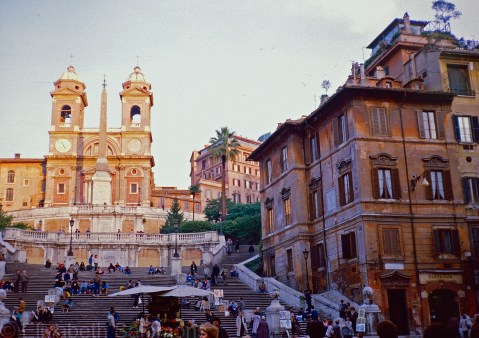
On that same visit to Rome, I also visited the Keats–Shelley Memorial House beside the Spanish Steps. It’s the house on the far right in the next photo. It was sobering to see where Keats died, but also thrilling to see the incarnation of my entire Romantic poetry course in three rooms.
I stopped by the Keats House in Hampstead, in the north part of London, on my next trip overseas. Hampstead Heath, a marvelous open space of almost 800 acres that beckons when you are museumed out, lies just behind the house.

Since I keep bumping into Keats on my travels, I thought it only right that I acknowledge the 200th anniversary of his death.
But back to the Romantic poetry course that started it all for me. One morning, my prof began class by asking who among us had life insurance. Her point was how unusual it was for someone as young as Keats to be so aware of his own mortality.
Unusual, but understandable. Keats lost both parents before he was grown and then watched his younger brother die of tuberculosis. He had also trained as a doctor. By his early twenties, Keats had seen far more death and dying than most of us will see in a lifetime. His sense of how fleeting life is inspired him to write poems like the sonnet I started this post with, which he wrote a month after his brother died.
More death and dying than most of us will see in a lifetime — that, of course, refers to those of us who will live through this pandemic more or less unscathed. And those of us who do, have far more privilege than most.
Happy Birthday, William Wordsworth!
I wasn’t planning on writing a post to celebrate the birthday of the English poet William Wordsworth, but somewhere on the Interwebs today, I came across the last verse of his most famous poem. That would be “I Wandered Lonely as a Cloud” — or, as many people call it, “that daffodil poem.”
Here’s the verse I’m talking about:
For oft, when on my couch I lie
In vacant or in pensive mood,
They flash upon that inward eye
Which is the bliss of solitude;
And then my heart with pleasure fills,
And dances with the daffodils.
What hit home for me about this particular verse today is the realization that the one-time Poet Laureate of England was doing exactly what we are all being asked to do right now: living a virtual life. Long after he wandered through those daffodil fields, Wordsworth wrote about the feelings he experienced as he did so, and how those memories sustained him.
As our memories are sustaining all of us during this pandemic.
Here then, as a nod to Mr. Wordsworth and on the happy occasion of his 250th birthday, is a photo taken back in the time of before, when we could walk side-by-side without a care along a seawall adorned with daffodils.

Red Arrows Over Burrard Inlet

Every once in a while, I manage to be in the right place at the right time.
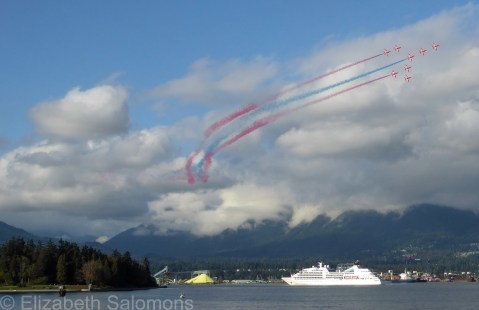
Such was the case this afternoon.
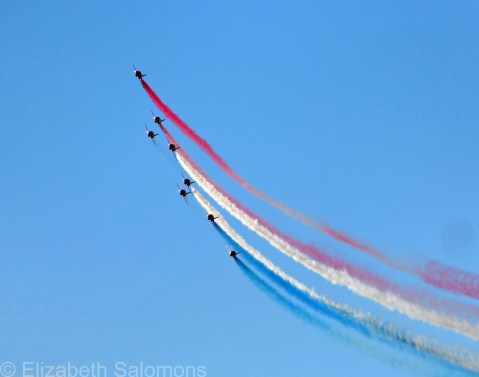
The Royal Air Force’s Red Arrows have been on a North American tour. This afternoon, they did several flypasts over Burrard Inlet.
I was there.

Happy Birthday, Queen Victoria!
Are you tired of all the royal baby talk? There’s been an awful lot of it this month. Bear with me though, because we should all take a moment to mark a significant anniversary of yet another royal birth.
Two hundred years ago today, Princess Alexandrina Victoria of Kent was born in Kensington Palace. With her birth, she became fifth in the line of succession to the British throne.
Fifth seems a long ways away from the throne these days. (Archie Mountbatten-Windsor is seventh at present.) But due to a series of monarchs and heirs to the throne dying without legitimate heirs, Princess Alexandrina Victoria ended up becoming Queen of the United Kingdom in 1837. She had just turned 18.
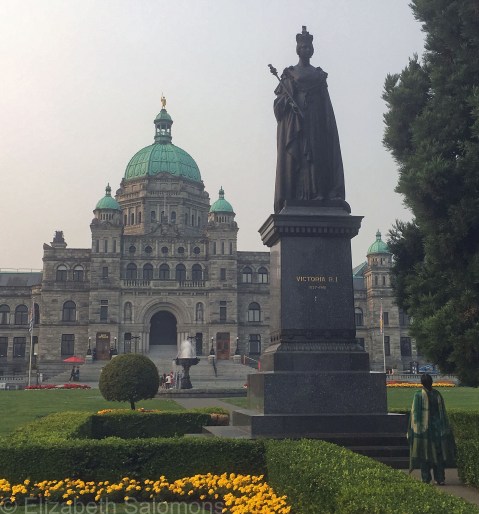
This statue of Queen Victoria stands in front of the Parliament Buildings in Victoria, British Columbia. Many places in the Commonwealth are named after Queen Victoria; Canada is the only country to honour her birthday with a statutory holiday. It falls on the Monday before May 24. I grew up referring to Victoria Day as the “May long weekend.” It wasn’t until I moved to Toronto that I first heard it called the “May two-four weekend.” For a long time, I thought that was because Queen Victoria’s birthday is actually on May 24.
But, no. It’s because beer is sold in cases of 24. I had never heard a case of beer called a “two-four” — that’s not a common term in Western Canada — and was completely oblivious to its link with beer.
And why is beer on the mind of patriotic Canadians during this particular weekend in May, you ask? It’s because the May long weekend is the unofficial start of Cottage Season in Ontario. (Don’t get me started on the whole cottage vs. cabin debate.)
Regional differences. Long may they reign. Just like British queens.
World’s Most Boring Place
The Internet is rife with rumours that Prince Harry and the Duchess of Sussex are honeymooning in Jasper National Park.
Yeah, right. And I’m the Queen of England.
What I find most remarkable is that one of the online tabloids’ headlines said the couple were honeymooning in “the world’s most boring place.”
Canadians are known around the world as polite folks, typically slow to anger. But mock our icons — like one of our oldest, most spectacular national parks — and we sit up and take notice.
That headline got noticed. And ridiculed.
As for that most boring place? Here’s what it looks like.


 There and Back Again