
Armchair Traveller: The Sharper Your Knife, The Less You Cry

Several years ago, a friend gave me a copy of Kathleen Flinn’s The Sharper Your Knife, The Less You Cry as a Christmas present. She said she knew I would like it.
She was right. I devoured the book.
I picked it up again last month when I was writing my post about the film Julie and Julia. I flipped through it, rereading bits here and there, but was stopped cold by this sentence near the beginning of the book:
With that, I lost a job I was desperate to quit.
I immediately sat down and began to reread the book from start to finish.
Kathleen Flinn wrote The Sharper Your Knife, The Less You Cry after graduating from Le Cordon Bleu in 2005. A journalist by trade, she based her account on the journal entries she wrote during her time in Paris, the audio tapes she recorded during demonstration classes, and the interviews she conducted with students, school staff, and alumni. The result is a highly entertaining and enlightening account of one American student’s experiences while studying at one of the top culinary schools on the planet.
Studying at Le Cordon Bleu is not for the faint of heart. The curriculum is daunting, the expectations are high, and the classes are taught in French. Flinn completed the three-part Diplôme de Cuisine (Cuisine Diploma); each part (Basic Cuisine, Intermediate Cuisine, and Superior Cuisine) is three months long. One can also study pastry and complete a three-part Diplôme de Pâtisserie, or do both cuisine and pastry, and receive Le Grand Diplôme.
The binder of more than a hundred recipes each student is given at the beginning of the course contains only lists of ingredients. Students are expected to make notes during the demonstration class, then repeat the recipe ― exactly ― during their practical class. Like I said, not for the faint of heart. When Flinn explains to the chef she has never filleted a fish before in her life, he replies, “I can tell. You should practice ― at home.” Another chef yells at her after a particularly trying class, “Vous perdez votre temps!” (You are wasting your time.)
I learned some interesting bits of trivia while reading this book. For instance, did you know that quiche comes from the German word for “cake”? Or that the sharper your knife when you dice onions, the less likely you are to cry? (Cue the book’s title.) Provençal cuisine ― with its olives, olive oil, tomatoes, and saffron ― has its origins from the time of the Romans, who occupied the region and named it Nostra Provincia (our province).
Back to the beginning: Flinn lost her job and enrolled in Le Cordon Bleu (using up all her savings to do so) with the encouragement of her then-boyfriend (now husband) who remembered it was something she had always said she wanted to do. When she protests that she knows no one in Paris, he merely says, “You’ll know me. If you want me to, I’ll go with you.”
(Sigh. Not only is this book a food/travel memoir, but it’s a love story as well.)
“Living is like driving. You have to pick a lane,” Flinn’s grandmother used to tell her. At the start of Basic Cuisine, Flinn wonders if she picked the right lane, but by the end of this book, you know she has. The chef who told her she was wasting her time becomes her greatest mentor and she thanks him, in the end, for being so tough on her. She was already an accomplished food journalist before studying at Le Cordon Bleu; her culinary studies only cemented that career and proved to her she had found her bliss.
So why did the sentence I read earlier this summer (“With that, I lost a job I was desperate to quit”) make me drop everything and reread this book in pretty much one sitting?
It’s because earlier this summer I found out I was going to lose my job ― a job I didn’t know I was desperate to quit until I lost it. This past winter I was sinking deeper and deeper into a funk about what to do about this job I thought I wanted, and the only thing that was giving me any enjoyment was cooking.
Yup. I’ve been spending my weekends recuperating from my day job by hunkering down in my tiny condo-sized kitchen. Sadly, the most appealing aspect of all this cooking was that I was alone. Somewhere around Easter I realized I needed to avoid all contact with people on weekends, for the simple reason that when you’re an introvert, and you work in a small, high-energy office, it takes you two days minimum to recover before you are ready for Monday morning. Obviously, that’s not a tenable situation if you want to have any kind of social life.
Yesterday was my last day at work. I don’t exactly know what I will be doing next, although I’m pretty sure I won’t be running off to Paris to go to cooking school anytime soon. But this much I do know: there will be a lot more writing and travelling in my future.
And probably some cooking, too.
If you’re even minimally interested in cooking, I recommend you read The Sharper Your Knife, the Less You Cry. (Yes, there are recipes, too.) And if you’re at a crossroads in your life and are wondering what lane to choose next, I highly recommend you read it.
Through My Lens: Père Lachaise Métro Station
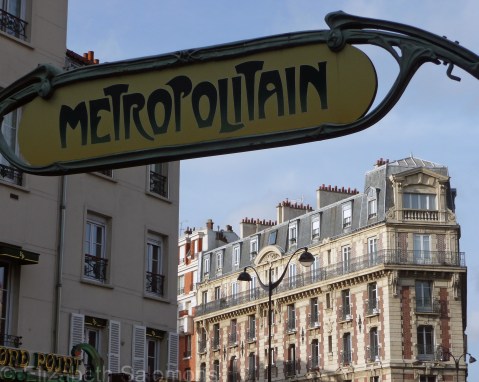
No sense fighting it. I’ve got Paris on my brain this week. So here’s another photo from the City of Light.
This was taken by the entrance to the Paris Métro at Père Lachaise.
E. Dehillerin
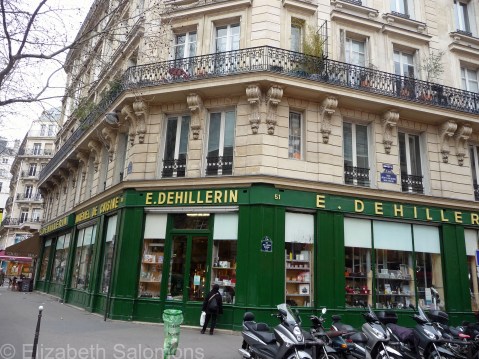
There is one scene in Julie & Julia that cracks me up every time I watch the film because it’s so far off from the truth. It’s when Julia Child, Simone Beck, and Louisette Bertholle are (supposedly) shopping in E. Dehillerin, the famous cookware store that has been supplying French chefs with the tools of their trade since 1820. The store in the movie is pristine and light and airy, with lots of room for Julia Child to wildly swing her shopping basket.
That scene wasn’t filmed in the actual store, as anyone who has ever shopped at E. Dehillerin can tell you. The actual store is much darker and dingier and more cramped than the one shown in the film.
In the words of David Lebovitz, the only way to enter E. Dehillerin is to “brace yourself and step inside.” My sister and I stumbled upon it quite by accident one afternoon in December 2010, moments after we had stumbled ― also by accident ― into Saint-Eustache, a magnificent church in the 1er arrondissement.
Here’s how I described my introduction to Dehillerin in the journal I kept that winter:
We came around a corner and there was heaven: E. Dehillerin, which I had read about. It’s the cookware store in Paris where all the pros shop, including (it’s been said) Julia Child.
But it was massively packed; I’ve never been in such a crowded store. The basement was dusty and musty and filled with massive industrial-sized stock pots (and not as crowded as upstairs).
Upstairs, I tried to look at the knives, but you could barely get past anyone to get near the counter where they were displayed. (And “display” is a bit generous. They were simply plunked in wooden bins of various sizes and in various groupings.) We got out of there and decided on lunch in a place in Rue Montorgeuil.
A week later, I returned, this time with a friend who was spending Christmas with my sister and me. Not only did I want her to experience the store for herself, but I had decided I was going to buy me some knives as a Christmas present to myself. We wandered in and out of several cookware and bakeware stores that morning ― they are all congregated near E. Dehillerin because there used to be a giant market nearby where all the Parisian restaurateurs used to shop for their daily menus. The market is long gone, but the shops ― and the restaurants ― remain.
Dehillerin was insanely crowded on my second visit as well and my friend and I quickly gave up on my plan to buy some knives.
But, I was determined. I did some online research and learned that persistence was the only way to get results when shopping at E. Dehillerin. And so, I returned.
Back to my journal:
January 29. Saturday. I still wanted my knives from Dehillerin and, as they are closed on Sundays and I was leaving on Monday, this was the last possible day I could buy them. I’d put it off as long as I could as it seemed so intimidating, given everything I’d read about the place, and how crazy crowded it had been on my two previous visits. But … I persevered. In I went, and it seemed a bit crowded at first, but then all of a sudden it emptied out and I had all the room I wanted to pick out the knives I wanted.
I checked the price of one in the book at the end of the aisle, went back to the bins of knives, decided on another knife and then thought, “Oh, I don’t care how much it costs. This is the one I want.” That was the 20 cm chef knife. I then chose a 10 cm paring knife, and a sharpening steel, and took them to the table where they wrapped your purchases.
The clerk said something to me in French. When he realized I hadn’t understood a word, he said, “English?” “Yes,” I replied. He then explained that the sharpening steel I had selected was too small for the size of my knife. For only a few euros more, I could get the right-sized steel made by the same company. I said, “OK,” he went to grab the right-sized sharpening steel, looked up the codes in his book posted on the pillar at the end of the aisle, wrote them down on a slip of paper and handed it to me.
I took the slip of paper to the woman behind the counter and she took my payment. Two knives and a sharpening steel for 86 euros. Earlier that month, I had checked the prices of knives in the housewares department at Galeries Lafayette and a chef knife there went for 100 euros alone.
So, very pleased with myself, I took the receipt back to the table, another clerk jammed each knife tip into a wine cork and then wrapped the knives in brown paper. Off I went, the happy owner of some proper kitchen knives at last. The fact that I bought them in Paris, and that they have the Dehillerin name engraved on the blade, is a bonus.
That afternoon is one of my favourite shopping memories while travelling.
No, wait. It is one of my favourite shopping memories ever. And the best part? I get to take an imaginary walk through Dehillerin every time I use those knives.
Which is every day.

Reel Life: Julie & Julia
 I had the opportunity this past week to introduce some friends to the film Julie & Julia. I was secretly pleased when they selected that DVD out of the pile I had brought, but I had no idea when I grabbed it at the last minute that most of the group had never seen the film.
Julie & Julia was Nora Ephron’s last film and stars the legendary Meryl Streep and the charming Amy Adams. It was Ephron’s producer who had the brilliant idea to combine into one screenplay two memoirs published around the same time. Julia Child’s My Life in France is about her life in post-war France, and Julie and Julia: 365 Days, 524 Recipes, 1 Tiny Apartment Kitchen evolved from Julie Powell’s blog about cooking her way through Julia Child’s Mastering the Art of French Cooking in post-9/11 Queens, New York. Beyond their names, Julie and Julia had in common the love and support of a devoted husband, a love of food, and the need to find some meaningful work to fill their days.
Early in the film, Julie Powell’s husband declares that “Julia Child wasn’t always Julia Child” ― and that’s precisely what makes the film so entertaining. Although I’m as fascinated as the next traveller about the daily routine of life as a New Yorker, the depiction of Julie Powell’s long subway commute and soulless work cubicle ring a little too close to home. But when the action switches to France, you’re transported to another time and place to witness the transformation of Julia Child, ex-pat American wife, to Julia Child, chef, author, and TV star.
Julia Child’s introduction to French food ― mere hours after she arrives in France ― is sole meunière. The epiphany she experiences in the look, smell, and taste of that first meal is, for me, the essential moment of the film. And it reminded me of the moment when I had my own epiphany about French cuisine. It was in a small restaurant in Perpignan where two friends and I shared a meal after a long day of sight-seeing. I ordered a tomato salad. It looked so simple ― a single layer of tomato slices on a small plate, sprinkled with an herb vinaigrette ― but I knew with my first bite that I was tasting something unlike anything I’d ever tasted before. The French don’t make simple tomato salads; they create spectacular tomato salads.
As much as my friends enjoyed Julie & Julia, they were a little more circumspect than I about the film; one remarked that she wouldn’t have reacted nearly as well as Julie Powell if the first words out of her partner’s mouth after disappearing for two days following a heated argument were, “What’s for dinner?”
As for me, whenever I’m homesick for French food, I’ll be (re)watching Julie & Julia.
Recipe Box: Boeuf Bourguignon
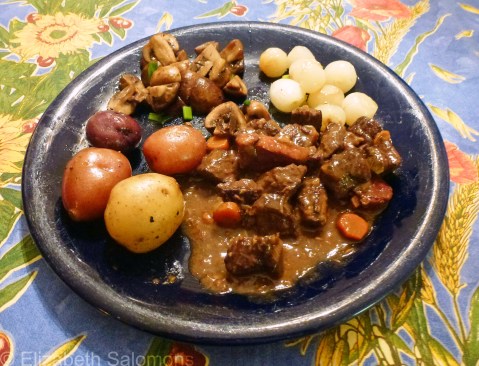
Before we get too far into spring, I need to fill you in on how I spent my non-winter.
(Because when one hasn’t the means for a mid-winter getaway, and there’s no snow to play in, how does one entertain oneself in Vancouver through a long non-winter that is most definitely not summer?)
Me? I entertain myself by taking French cooking classes. That way I enjoy some armchair travel (is it still considered “armchair” when you are run off your feet for three hours?) and learn something new about France.
This winter I chose a class focused on the food of Burgundy, and one of the dishes on the course syllabus was boeuf bourguignon.
Confession: I’ve never actually eaten boeuf bourguignon in France, but a friend made it for a dinner party she hosted in my honour before I headed off to spend the winter in Paris some years ago. It was my first encounter with the braised stew and it was delicious.
Like coq au vin, boeuf bourguignon is a former peasant dish that has made its way into fine dining; cheap (read: tough) cuts of meat are softened to a delicate texture by stewing them in wine.
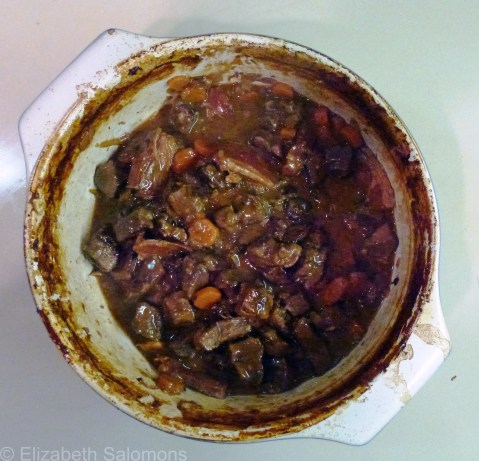
The classic wine choice for making boeuf bourguignon is Pinot Noir, given that the prevalent grape grown in Burgundy is Pinot noir. My French cooking instructor provided us with BC Pinot to make our stew ― French wine was too dear for his budget. To speed up the cooking time, he had us cut the beef into smaller cubes, and cook the stew on the stove instead of in the oven.
Bon appétit!
Boeuf Bourguignon
3 pounds stewing beef cut into 2-inch cubes
4 garlic cloves, peeled and cut in half
2 bay leaves
2 sprigs fresh parsley
2 springs fresh thyme
2 sprigs fresh rosemary
2 carrots
2 onions
1 bottle Pinot Noir
6 ounces bacon cut into lardons (1/4 inch wide and 1 1/2 inches long)
1 tablespoon olive oil
1 teaspoon salt
1/4 teaspoon pepper
2 tablespoons flour
2 to 3 cups brown beef stock
1 tablespoon tomato paste
2 cloves mashed garlic
1/2 teaspoon thyme
1 crumpled bay leaf
2 tablespoons chopped parsley
brown-braised onions (see below)
sautéed mushrooms (see below)

1. Peel 1 carrot and cut into sticks. Peel 1 onion and cut into quarters.
2. Place the beef in a large non-reactive bowl. Add the carrot, onion, garlic, bay leaves, parsley, thyme, rosemary, and wine. Marinade overnight. (Note: In my humble opinion, marinating the meat is optional. My French cooking instructor taught us to do it, but Julia Child doesn’t bother with this step.)
3. Preheat oven to 450°F.
4. In a large sauce pan, Dutch oven, or cocotte, brown the lardons in butter. Remove from pan.
5. Strain the beef and vegetables, reserving the marinade, then dry the beef cubes with paper towels.
6. Reheat the bacon fat until it is almost smoking, then brown the beef in the fat. (Note: My French cooking instructor tried to get me to stir the beef by shaking the pan with a forward motion to flip the cubes from back to front. It was a heavy pan. But if you can manage it, go for it. It will make you feel like a real chef.)
7. Remove the beef from pan and add it to the bacon.
8. Peel and slice the remaining carrot and onion. Brown them in the bacon fat, then pour out the fat.
9. Return the beef and bacon to the pan and sprinkle with the salt and pepper and flour to coat lightly.
10. Put the uncovered pan in the preheated oven for four minutes. Toss the meat, then return to oven for another four minutes. (This step cooks the flour and gives the beef a light crust. Do not skip.)
11. Remove the beef from the oven and turn the oven down to 325°F.
12. Stir in the reserved marinade (or bottle of Pinot Noir if you didn’t marinate the beef), and enough stock to just cover the meat.
13. Add the tomato paste, mashed garlic, and herbs.
14. Bring to a simmer on top of the stove, then cover and return to oven.
15. Braise the beef for 2 1/2 to 3 hours, checking to ensure the liquid is gently simmering. When the beef is tender, remove from the oven.
16. While the beef is in the oven, prepare the onions and mushrooms (see below).
17. Strain the beef from the liquid.
18. Skim any fat from the liquid remaining in the pan, and simmer for a minute or two. Bring to a boil and reduce to 2 1/4 cups. To thicken, it may be necessary to add beurre manié ― a paste made of equal parts butter and flour. Use a whisk to mix the beurre manié into the liquid.
19. Return to heat and simmer for a few minutes until sauce has thickened, then remove from heat.
20. Return the beef to the sauce to reheat. The onions and mushrooms can be added to the sauce or served on the side. Sprinkle chopped parsley over top and serve with oven-roasted or boiled new potatoes.
Brown-braised Onions
12 to 18 white onions about 1 inch in diameter, or 24 pearl onions
1 1/2 tablespoons butter
1 1/2 tablespoons oil
1/2 cup stock, dry white wine, red wine, or water
salt and pepper
one herb bouquet (4 parsley springs, 1 bay leaf, and 1/4 teaspoon thyme tied in cheesecloth)
1. Bring a pot of water to boil, immerse the onions for about a minute, drain, then cut off the root and peel.
2. Place a skillet over high heat with the butter and oil. When hot, turn the heat down to moderate and brown the onions.
3. Add the liquid, salt and pepper, and the herb bouquet.
4. Cover and simmer slowly for 40 to 50 minutes until the onions are tender and the liquid has evaporated. The onions should retain their shape. Remove the herb bouquet.

Sautéed Mushrooms
2 tablespoons butter
1 tablespoon oil
1/2 pound fresh mushrooms (cut into quarters if large)
1 to 2 tablespoons minced shallots or green onions (optional)
salt and pepper
1. Place a skillet over high heat with the butter and oil. When hot, turn the heat down to moderate and add the mushrooms. Remove from heat as soon as mushrooms are lightly browned.
2. If using shallots or green onions, add to the mushrooms, and sauté over moderate heat for 2 more minutes.

Through My Lens: Cloister of Abbaye Saint Michel de Cuxa

For the Second Sunday of Lent, we’re hopping across the Channel to France. This photo is of the Cloister of Abbaye Saint Michel de Cuxa, a Benedictine abbey located in the French Pyrenees.
The abbey was built in 878, abandoned during the French Revolution, and restored to a monastic community in 1919. Its cloister dates back to the twelfth century, but many of the columns were removed in the early twentieth century by an American sculptor and are now on display at The Cloisters Museum and Gardens in New York.
I took this photo in November 2000. It was on this jaunt around southern France that I came to realize how much I value the beauty and the silence of monastic cloisters. I’ve been on a mission to photograph them ever since.
Buna-Monowitz-Auschwitz III Memorial at Père Lachaise
I think these photos, which I’m posting today in honour of the 70th anniversary of the liberation of Auschwitz, pretty much speak for themselves.

I took them in December 2010 at Père Lachaise Cemetery in Paris. There are almost a dozen Holocaust memorials in Père Lachaise, each of them as moving and sombre as this one, which is dedicated to Buna-Monowitz, also known as Auschwitz III.

Built to house slave labour for the Buna Works industrial complex, Buna-Monowitz was part of the Auschwitz series of camps and, like Auschwitz-Birkenau, was liberated 70 years ago today.
Liberté, Égalité, Fraternité
To know Paris is to know a great deal. What eloquent surprises at every turn of the street. To get lost here is an adventure extraordinary. The streets sing, the stones talk. The houses drip history, glory, romance. — Henry Miller
I’ve been struggling to write this post all week long. I wasn’t sure what to say (if anything) and I wrote (and discarded) multiple drafts (all of them in my head).
Then I saw the pictures of the millions of Parisians gathered today in the streets of Paris. Once I saw those photos, I knew which of the thousands of photos I had taken in Paris I should post.
And once I had a photo, I had the words.
Paris is close to my heart. I’ve had the privilege to visit this beautiful, amazing, perplexing, and frustrating city five times over three decades. My first visit lasted less than 24 hours; my last, just shy of three months. After Vancouver, it is my favourite place in the world.
But it wasn’t always.
I remember the exact moment I fell in love with Paris ― ironically, it was in Place de la République, the square where thousands of Parisians have gathered throughout this awful week. I was eating dinner with my father on a raised terrace overlooking the square. We had arrived in Paris just that afternoon after travelling by Eurail throughout Germany. Earlier in the week, we had had a conversation about which European city each of us could see ourselves living in. I couldn’t choose ― not one said “home” to me in the way I wanted it to.
Until that moment. As I gazed out at the trees along the boulevard, I thought to myself, “I can see myself living here” ― and before the thought had fully formed in my brain, my dad said it out loud for me. “You’d like to live here, wouldn’t you?” To my knowledge, he’s never read my mind before (or since), but he did that summer evening.
I’ve been in love with Paris ever since.
This week, my heart has been aching for Paris while I struggled to find the words to express my feelings and thoughts.
Today, Parisians took to their city’s streets in unprecedented numbers. The first reports described it as the largest demonstration since Paris’s liberation from Nazi Germany in August 1944. By the end of the day, the news media described the rally as the largest demonstration ever in French history. Ever. That is indeed unprecedented.
Tomorrow, Paris will begin to redefine itself, as it has so many times before after so many other violent, horrific events in its long and storied history. We don’t ― none of us ― have the distance and perspective necessary to understand what this week has done to the city. That will come, in time.
And so, for now, all I have is this photo, which I took on Armistice Day, 2010.

Les Fenêtres de Printemps
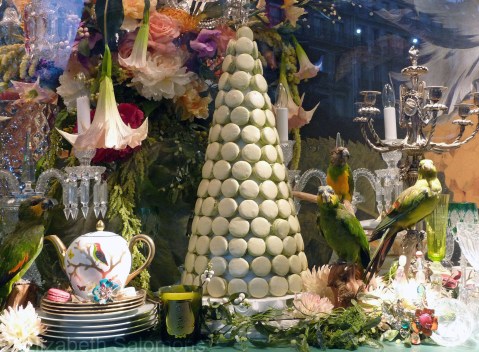
One thing the spectacular Parisian department stores do spectacularly well are its Christmas windows. They are so popular that the crowds in front of them extend from window to curb.
Which means it takes a great deal of patience to see them properly. After rather a lot of waiting and a little bit of clever maneuvering, I was able to get in close enough to take these photos of the Printemps department store windows on Boulevard Haussmann during the 2010 Christmas season.
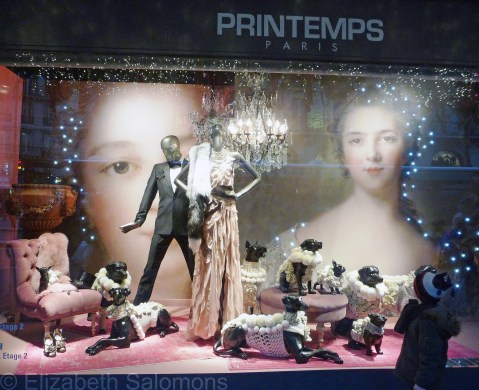
Often the Parisian department store windows have holiday themes related to Broadway musicals or animated films. (Yes, Disney has taken hold of Paris, too. I hear the windows of Galeries Lafayette are filled with, um, monsters this year.)
But these Printemps windows, not so much. I liked them especially because they were so quintessentially French. Created in collaboration with the Lanvin fashion house, the theme was Noël au Château (Christmas at the castle). Each window represented a different room in the château, lavishly decorated in that way the French do best and transporting me back to another century.
Which century? Why, the eighteenth, of course. When fashion was at its most opulent and France’s Ancien Régime was in its dying days.
Un noël XVIIIe siècle. Now there’s a theme I can get into.

Galeries Lafayette
I hate shopping.
I especially hate shopping this time of year. I’m sure I’m not the only one.
But … there’s one place on this planet where I love to go shopping.
Do I need to say it?

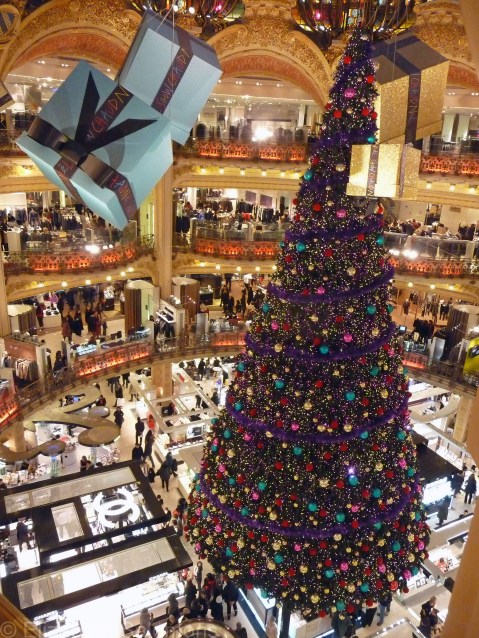
Paris has some spectacular department stores. This one, Galeries Lafayette, opened its doors in 1912. When you get there (because, really, everyone should go shopping in Paris at least once in a lifetime), be sure to check out the atrium with its glass dome.
And the food hall. Don’t forget to visit the food hall.


 There and Back Again