
Through My Lens: Oude Kerk

My photo choice for the Fourth Sunday of Lent is Amsterdam’s Oude Kerk.
With Oude Kerk being Dutch for “old church,” this church is, as you’d expect, Amsterdam’s oldest. At 800 years, it is also the city’s oldest building. I wish I had thought to cross the canal to get enough distance for a proper photo because this one shows only a small part of the building, which has been extended many times since it was consecrated in 1306. Those are houses attached to the church — houses attached to the outer walls of a church seems to have been a common practice in the Netherlands.
The Oude Kerk stands in the heart of De Wallen — Amsterdam’s red-light district — which can take you by surprise if you’re not expecting it. Every tourist has a story about their first encounter with the red-lit windows in which the prostitutes stand. Mine was many years ago while on a walking tour of old Amsterdam with my much older, much more conservative Dutch cousin. She wanted to show me the Oude Kerk, but all I was noticing were the windows of women facing the church.
Which I pretended I hadn’t noticed. As difficult as that was.
Through My Lens: Inside the Westerkerk
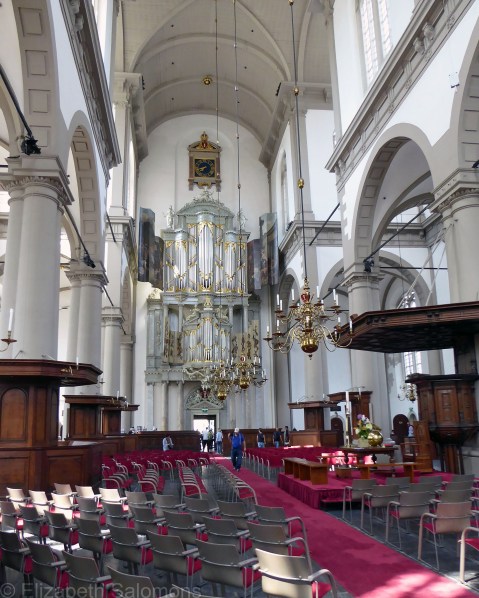
Last week I showed you the Westerkerk, and for today, the Third Sunday of Lent, here is what it looks like on the inside.
European Protestant churches have quite a different feel on the inside than their Catholic counterparts, with the most noticeable difference being how much lighter they are. It’s refreshing in one way, but with fewer stained glass windows and no artwork, some might consider them a bit dull.
Initially there was no organ in the Westerkerk — the Calvinists frowned on musical instruments of any kind — but some 50 years later one was commissioned and installed in the church. In the summers, the Westerkerk offers free lunchtime organ concerts on Fridays, and for one week in August a concert series they call Geen dag zonder Bach (“No day without Bach”), consisting of a daily concert of music by my go-to organ guy: J. S. Bach.
Through My Lens: Westerkerk

For the Second Sunday of Lent, here is a photo of what is probably the best-known church in all of Amsterdam: the Westerkerk. (Westerkerk is Dutch for “western church.”) Built between 1620 and 1631 in the Dutch Renaissance style, it too, like the Noorderkerk, was built as a Protestant church and in the shape of the Greek cross, except its design consists of two crosses placed side by side. Because of this, it has a long rectangular shape similar to a Catholic basilica, but its transepts are wider than in a Catholic church, and there are two of them.
The Westerkerk is about a five-minute walk from the Noorderkerk. It too is situated on the Prinsengracht, and is right across the canal from the Jordaan neighbourhood. Like the Noorderkerk, the Westerkerk was built to fulfill the pastoral needs of that fast-growing neighbourhood, but it ended up being the church of the upper and middle classes, whereas the Noorderkerk was where the working classes tended to go.
The reason the Westerkerk is likely the best-known church in all Amsterdam? Because Anne Frank wrote in her diary how its bells used to reassure her, especially at night. The carillon chimes every quarter hour and today is the only carillon in the city to do so 24/7 (at the request of the residents of the Jordaan).
I listened to those same bells chime through the night my first week in Amsterdam, as I tossed and turned, trying to get adjusted to the time zone. I could see the tower of the Westerkerk from my bedroom window, and when you climb that tower, your guide will point out the Achterhuis (where Anne Frank and her family hid for two years during World War II) and the window from which Anne could see the church tower.
Through My Lens: Noorderkerk

Last summer was about a lot of things, but one thing I made sure to do was take lots of photos of the dozen or so European churches I was able to visit. And now that it’s once again the Season of Lent, I am so happy I get to share those photos with you.
For today, the First Sunday of Lent, here is a photo of the Noorderkerk. (Noorderkerk is Dutch for “northern church”). This church was built in the early 1620s in the Jordaan neighbourhood, right on the Prinsengracht, the outermost canal of Amsterdam’s Canal Belt. The Jordaan was growing fast at the time, and its residents were in need of another place of worship.
The Noorderkerk was purpose-built as a Protestant church (unlike older church buildings throughout the Netherlands that were originally Catholic, but were transformed into Protestant churches after the Reformation.) As such, its shape looks quite different from the traditional long nave of a Catholic church. It was instead built in the shape of the Greek cross, with four naves of equal length, and a small tower at the centre. The idea was that the building was centred around the pulpit, a type of church design that eventually become quite common throughout Calvinist Holland.
I have a lot of affection for the Noorderkerk as it was only a ten-minute walk from where I was living, and I passed it regularly, often daily, on my walks around Amsterdam. To my regret, I didn’t have a chance to see it on the inside — the church is still in use as a congregation and the hours it is open to the public are limited. But though it might look like a quiet, sleepy church, there was always a lot going on outside. On the square surrounding the church are the twice-weekly markets: a flea market on Mondays and a food market on Saturdays. There is nothing like a weekly market to give a church square a sense of being the heart of the neighbourhood.
Which to my mind is kinda cool.
The Netherlands by Train
I had lunch last month with a couple of friends who were in town for the holidays. One of them grew up not far from where I was living last summer, and naturally our conversation turned to my summer in Amsterdam. We had a very nice discussion about the differences between the Netherlands and North America. Our topics? The weather, table service, and, erm, the bike culture.
I looked out the window for a moment, thinking about what else I had noticed about life in Amsterdam, and then turned back to face my Dutch-born friend.
“You know what the Dutch do really well?” I said. “Trains.” I then marvelled aloud that I was able to travel by train from Amsterdam to another town for lunch, to yet a different town for dinner, and still be back in Amsterdam by midnight.
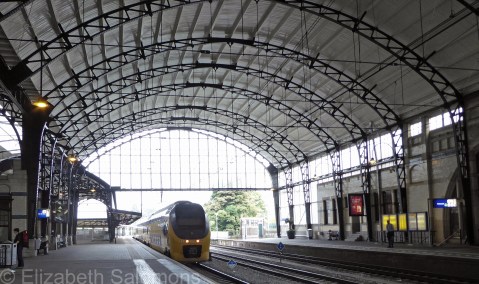
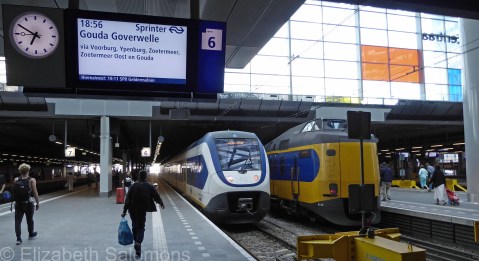
Yes, the Dutch have an excellent and comprehensive train system. What do I mean by “comprehensive”? I mean there are 3000 kilometres of railway in a country that is scarcely 400 kilometres from one end to the other. Along that rail network are nearly 400 train stations. That’s right: 400. Few Dutch towns are without a train station.
That kind of rail network isn’t possible in a country like Canada, of course, thanks to the fact that we “have too much geography.” I know that. Yet I still couldn’t help but wonder the other week, as I schlepped by Greyhound from Calgary to Red Deer to Edmonton, how much more pleasant my journey would have been by high-speed train.
Discovering the Netherlands by train was one of the highlights of my summer and I had lots of fun photographing the dozen or so Dutch trains stations I travelled through.
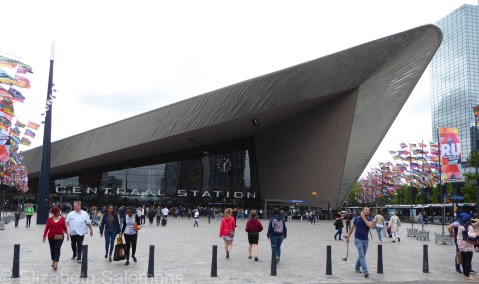
I don’t have a photo of the station I used most often (that would be Amsterdam Centraal) because the building was enshrouded in scaffolding all summer long. But here’s a look at the imposing entrance to Rotterdam Centraal, a station that was rebuilt only five years ago and, like Amsterdam, is one of the country’s busiest rail stations.
Den Haag Centraal is another of the country’s busiest stations. Note the Mondrian windows at the top right.
This is Leiden Centraal, another spectacularly designed station.

Most of Holland’s train stations date back to the nineteenth century, however, like this one in Kampen. It’s one of Holland’s smallest train stations. Only one train stops here, a small two-car train that does the ten-minute journey between Kampen and Zwolle three times an hour.
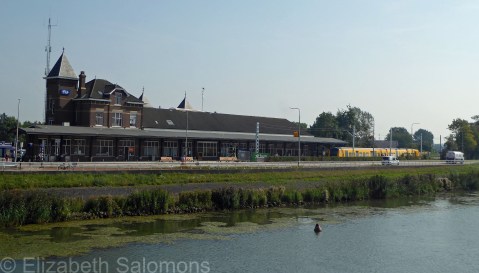
This is the entrance hall to the Maastricht station. See those ticket machines? There’s one for each national rail service: Belgium, Germany, and Holland. How efficient (and multinational) is that?
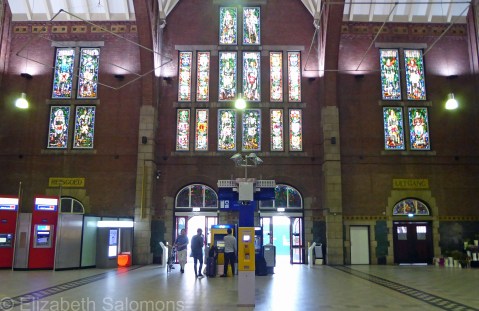
And this photo is from one of my favourite stations: Haarlem. Haarlem is on the Amsterdam–Rotterdam route, the oldest railway line in the country. The current building was built in the Art Nouveau style between 1906 and 1908 and is a national heritage site.
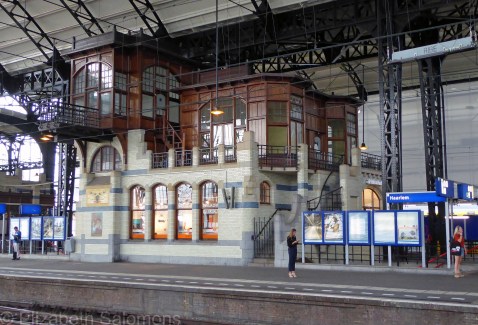
The sign above this doorway reads “Waiting Room First Class.”

I was especially intrigued by this plaque in Delfts Blauw tile on one of the walls in the Haarlem station. It’s from 1939 and commemorates 100 years of Dutch rail service. Train buffs know that the 1840s were the tech boom of the nineteenth century — railway lines were being laid down all over the place. In Canada, too.
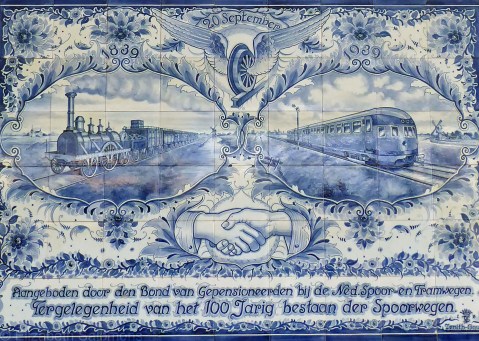
I don’t know how many kilometres of rail travel I did last summer, but I do know this: it is such a civilized way to travel and I loved it.
Merry Christmas!
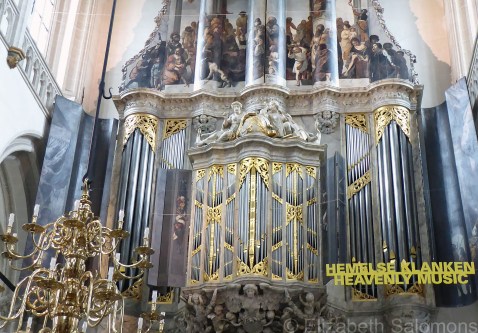
Nieuwe Kerk, Amsterdam
The Begijnhofs
So here’s another cool feature about the Low Countries that I want to share with you.
Those would be the Begijnhofs. Until the eighteenth century, most cities and large towns throughout Holland, Belgium, and northern France had a least one begijnhof. The Beguines (the French word for begijnhof is béguinage) were lay religious orders of the Late Middle Ages and Renaissance. These women were not nuns, and the communities they lived in were not convents. They did not take vows of poverty — some of them had servants. They did not marry while they lived in community, but were free to leave at any time. They supported themselves by teaching or by working as labourers. And they lived in houses surrounded by a walled courtyard (hof is Dutch for “court”). The gates were locked at night, and the community usually included a church and sometimes an infirmary.
One of the reasons these communities came about was simply due to the demographics in Europe at that time: there were more women than men. But also, living in community like this offered these women freedom and independence and choice in how they lived — basic rights that today we all take for granted.
I was introduced to the Amsterdam Begijnhof a long time ago by my Dutch cousin. Amsterdam is full of hofjes, most of which are private, but this one — one of the city’s oldest, dating back to the fourteenth century — is open to the public.
The Begijnhof was allowed to continue to exist as a Catholic institution during Calvinist rule because the homes were private property. The Beguines lost their chapel, however, and today it is the English Reformed Church. Later, they built a “hidden church.” (For the period of time when Catholic churches were banned in Protestant Amsterdam, Catholics built their churches behind the façades of regular houses. From the outside, they look like ordinary houses, but on the inside, they look just like a church.)
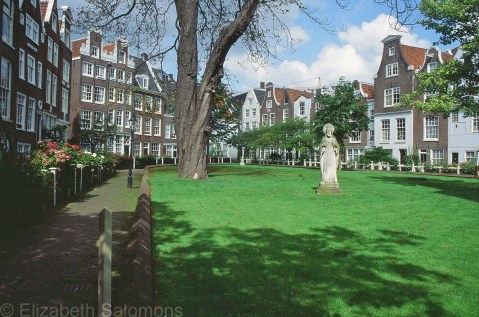
One curious fact about the Begijnhof: it is at medieval street level, which is about a metre below the rest of the city. What I also find particularly curious is how its entrance backs onto the Kalverstraat, one of the city’s busiest shopping streets. The last Beguine died in 1971, but the Begijnhof continues to be occupied by about 100 women.
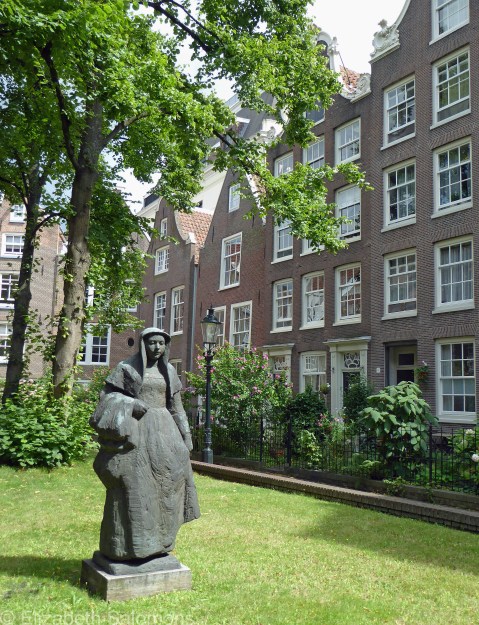
It was my familiarity with the Amsterdam Begijnhof that led me to explore the ones in Belgium. The Prinselijk Begijnhof Ten Wijngaerde (Princely Beguinage of the Vineyard) is located next to Brugge’s Minnewater. Dating back to the mid-thirteenth century, it is one of the best-preserved begijnhofs in the country. You enter it through this gate.

It contains a church and about 30 white painted houses.

For the last 90 years, it has been the residence of a community of Benedictine nuns.

The Oude Begijnhof in Gent, also built during the mid-thirteenth century, is no longer walled. During the French Revolution, the city acquired property rights to the Begijnhof and then, in the eighteenth century, it wanted to take it over to use as housing for labourers. The Beguines moved to a new purpose-built begijnhof in the suburbs. The houses in the original begijnhof became worn and run-down, but were eventually restored in the twentieth century.

None of the original medieval houses are still standing in any of the begijnhofs throughout Belgium and Holland, although the layout of the communities remains essentially the same. Wooden houses were rebuilt in brick or stone from the sixteenth century onward. An exception is the single wooden house in the Amsterdam Begijnhof (the oldest wooden house in the centre of Amsterdam and one of only two still standing).
What I find fascinating about the begijnhofs is the witness they bear to a long tradition of women living independently in times when few were permitted to do so. As communities, they developed an architectural style of their own, which fortunately has been preserved.
And for the tourist overwhelmed by the chaos of central Amsterdam or on a whistle-stop tour of Belgium, they are a welcome oasis from the hustle and bustle of a tourist-overrun city.
Maastricht
OK, trick question. Look at this photo and tell me where it was taken.
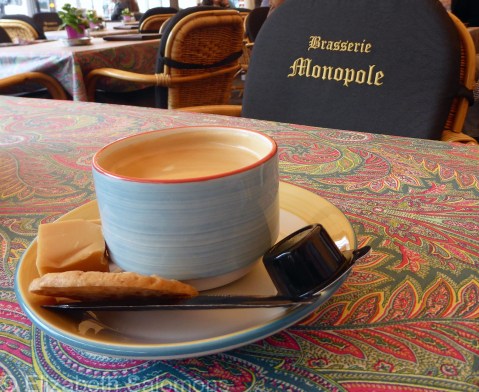
Nope, not France.
Not Belgium either.
It’s Holland!
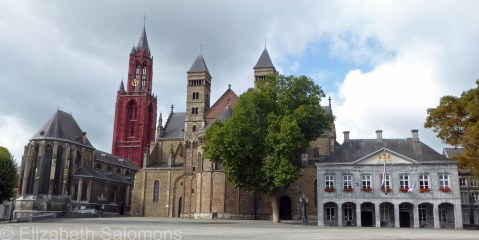
This cup of coffee was my way of saying good-bye to the Netherlands (within an hour of drinking it, I was on my way to Belgium by train), although ironically it looks less like a Dutch cup of coffee than any I had all last summer. And that’s because I was in Maastricht.
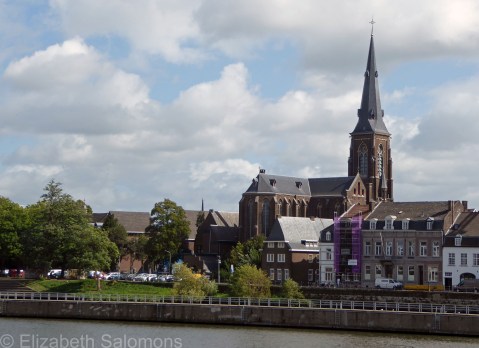
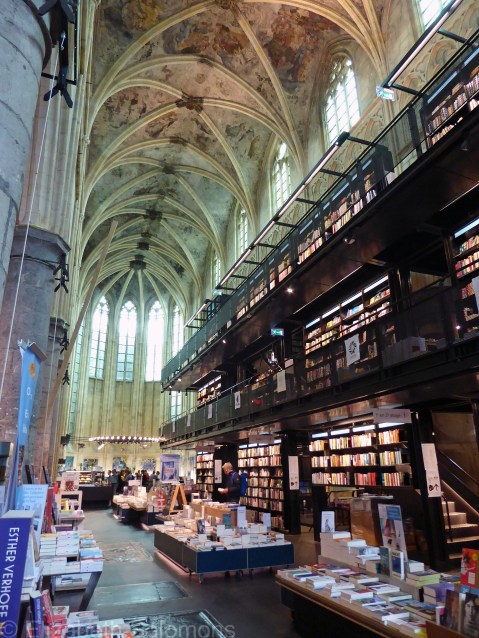
When it came time to say good-bye to my German friends, I headed west, and decided to break my journey, so to speak, in Maastricht. I wanted to spend one last night in Holland. And I had just enough time for a long, exploratory walk in the late summer evening, and a whirlwind tour the next morning of three churches, two of which are still in use, and one which has been converted into the most beautiful bookstore I have ever seen.
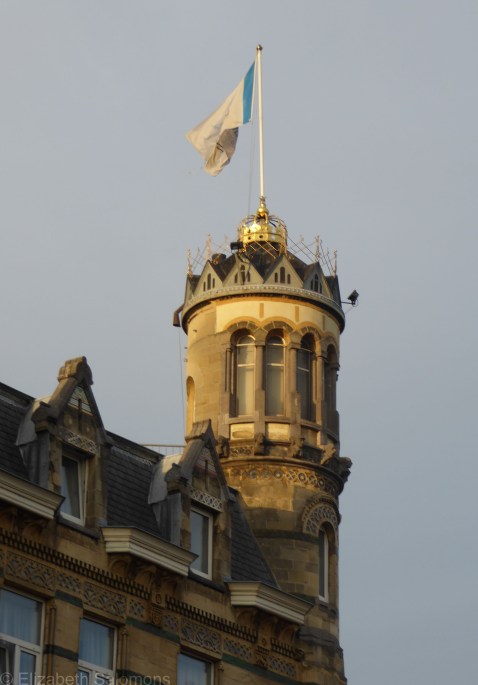
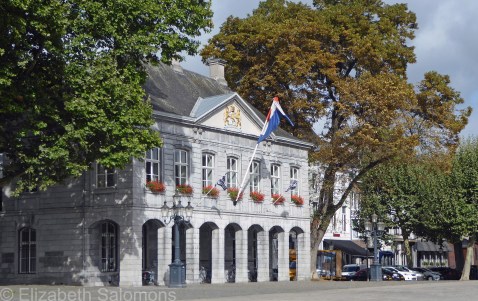
Maastricht has a distinct look that sets it apart from the rest of the Netherlands. It is next door to Aachen, in that same tiny little corner of Europe where three countries come together. This part of Holland has been occupied by the Romans, the Spanish, the Prussians, the Austrians, and the French. The last time the French were here, a little general by the name of Napoleon was in control of the region.
I knew even before I arrived in Maastricht that 24 hours would not do the city justice, but I stopped in anyways. Next time, I will be sure to stay long enough for a proper visit.
Oh, and a bit of trivia that you might find interesting, given all the speculation about the future of the European Union: it was 25 years ago this year that the Maastricht Treaty was signed (in Maastricht, of course) by 12 European nations to indicate their intent to create an economic and monetary union.
Kampen
I started off my summer in Amsterdam by hanging out with my nieces for a couple of weeks. If you are ever jaded about travel (and I’m not, but, I dunno, some of you might be … ), go travelling with a couple of teenagers. It lets you look at a foreign country with fresh eyes. I felt privileged to be able to introduce those two to Europe and I am pretty sure they went home with the travel bug firmly planted.
My own travel bug was also firmly planted on a trip to Europe while a teenager. Coincidentally, I ended my summer in Amsterdam with a day trip to where it all began.
That would be Kampen.

Kampen is a small city in the province of Overijssel, about 90 minutes from Amsterdam by train. Overijssel means “over the IJssel” — the IJssel being the river that runs beside Kampen. Because of that river, and its proximity to the Zuiderzee, Kampen became an important trading town and it joined the Hanseatic League (a loose union of towns that controlled the maritime trade of Northern Europe during the Middle Ages).
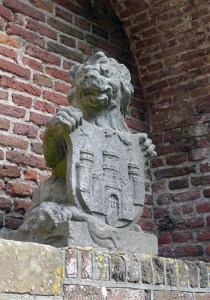 Which means Kampen is just one more well-preserved medieval Dutch town.
Well, not exactly. Kampen is more than that. It’s where I first learned how to live in a foreign country.
Kampen is not quite as pretty as Leiden or Delft — it doesn’t have as many cute canals and bridges that those other cities have. What it does have are three poorten, which is Dutch for “gates.” They are what’s left of the city’s walls.
Kampen also has a bunch of churches. The Bovenkerk stands out because of its height (boven means “above”) and it makes for a pretty picture from across the IJssel River. Below is the view you have when you arrive in Kampen by train.

Once you cross the IJssel, you are immediately immersed in the historic centre of Kampen. This is the stadhuis or town hall.
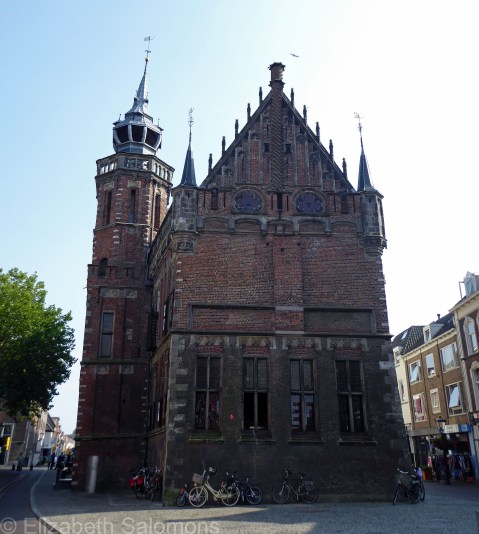
And this is Oudestraat (Old Street), the main shopping street. When we lived in Kampen, cars and delivery trucks were still allowed to drive up and down Oudestraat. Total chaos, it was.

The tower at the end of Oudestraat is the Nieuwe Toren (New Tower). If you look closely, you see a cow hanging from the tower. (Not real, I assure you.) The story goes that the fine people of Kampen wanted to get rid of the grass growing on the roof of the tower. Someone had the bright idea of putting a cow up there (to eat the grass), but she died on the way up. They hang a replica every summer to remind themselves of how clever they were.
And yes, that is probably the weirdest story I can tell you about any place I have ever lived.
About those city gates. Facing the IJssel River is the Koornmaarktpoort. It is the oldest of the three gates.

This is the Cellebroederspoort.
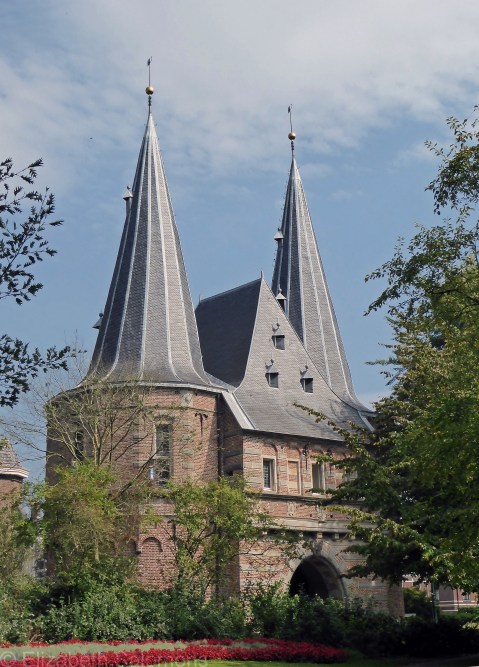
And this is the Broederspoort.

Here it is from the other side.

On the one side of the Cellebroederspoort and the Broederspoort is a rather large and lush park, full of geese and ducks and rather large trees. I have always thought that the Netherlands made such an impression on my first visit not so much because it was a foreign country (though there was that, too), but because I had grown up on the North American prairies where large, leafy trees are few and far between.
We kids spent a lot of time in that park, if I am remembering correctly. Our mornings were spent studying, our books spread across the dining room table with the French doors wide open to the garden behind the house. But in the afternoons, we were free. We had our bikes and we had that park and we had an entire town to explore. We also went to the weekly market with our mother, and on drives through the Dutch countryside with both of our parents.
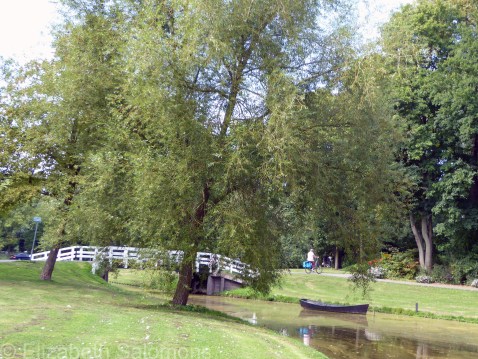
I am sure my memories are romanticizing the experience. I do remember feeling homesick for Canada, and I am sure we drove our mother around the bend, not going off to school every morning. But even so, I feel blessed that our family had that time together.
There is a lot to be said for visiting the European capitals when you go to that continent for the first time — and I’m so glad my nieces had their chance this summer. But I also know they found the traffic and the people (and the bikes!!) a little overwhelming. And so, there is also a lot to be said for exploring a small, Dutch medieval town on your own when you’re just a kid, as an introduction to Europe.
On your own on a bike.
Amsterdam’s Canal Houses
And then there are the canal houses.

Google “unique European architecture” and Amsterdam is sure to be on the list. That’s because of its unique canal houses.
Amsterdam’s canal houses are narrow, they are tall, and they are deep. Although the place where I stayed in Amsterdam is a modern house by Dutch standards (a mere 125 years old) and doesn’t face a canal, it too was built in the Dutch canal house style. And let me tell you: you don’t appreciate how narrow, tall, and deep these houses are until you’ve climbed a narrow, vertigo-inducing staircase all the way up to the fifth floor.
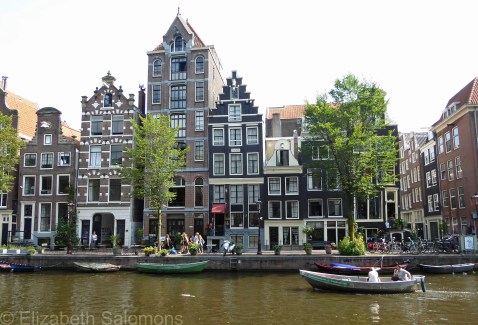
A typical canal house is only six metres wide. The reason why they are so narrow? It’s because canal houses were taxed on their width. The city governors needed money to pay for the massive canal expansion of the seventeenth century (when most of the canal houses were built), and knew they could raise the money by taxing the most desirable properties, which the canal houses were.
The Dutch are notoriously thrifty, shall we say, and anything they can do to save a cent, they will do. So they built narrow houses.
Many canal houses were multi-functional: they served as both family home and warehouse for the merchants who lived in them. The first storey was where the company’s office was located (at front) and where the family lived (at back). The upper storeys were the warehouse. At the top of each house was a beam with a hook. When the merchant needed to haul his trade goods into the warehouse, he attached a pulley and rope to the hook. Those same hooks are still used today when moving furniture or during renovations when building materials need to be brought into a house.
Amsterdam’s canal houses are still in use as family homes, but also as restaurants, hotels, museums, and offices. I lost count of how many times I walked past a canal house, its doors open wide to the street so I could look right in on an open-concept office, with rows of white computer-laden tables or groups of people gathered around a long meeting table. The offices all looked like remarkably relaxed work environments.
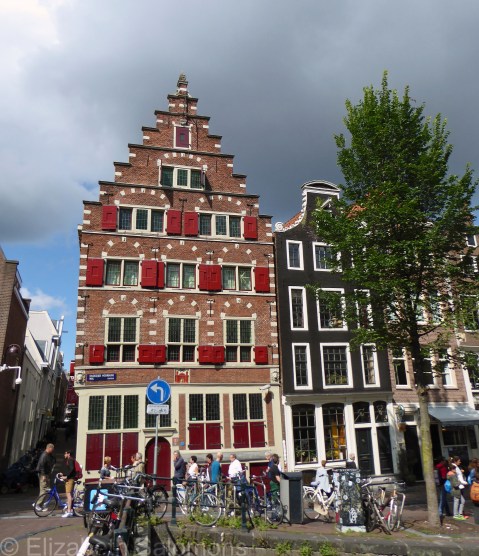
Although the canal houses follow a pretty similar cookie-cutter style from one to the next, where they do differ is in the style of their gables.
There’s the step gable.
And there is the spout gable. It looks like an inverted funnel, and indicated that the canal house was a warehouse rather than a residence.
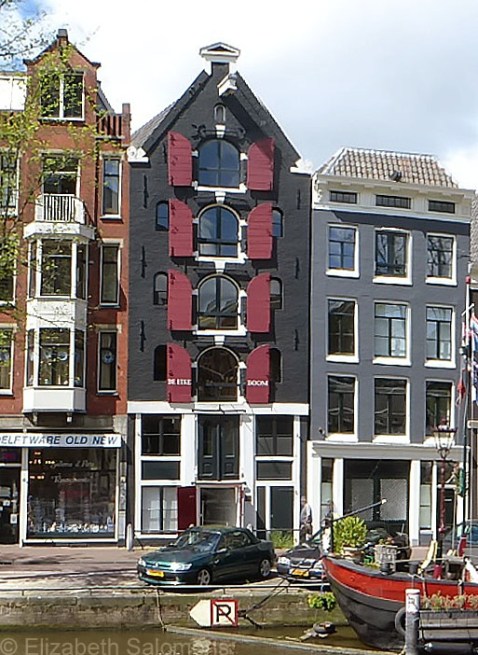
The neck gables allowed for the most individualization. The corners created by the 90-degree angle of the facade were filled in with ornate decoration that reflected the Baroque style of the time.

Sometimes the neck gables were built in identical pairs.
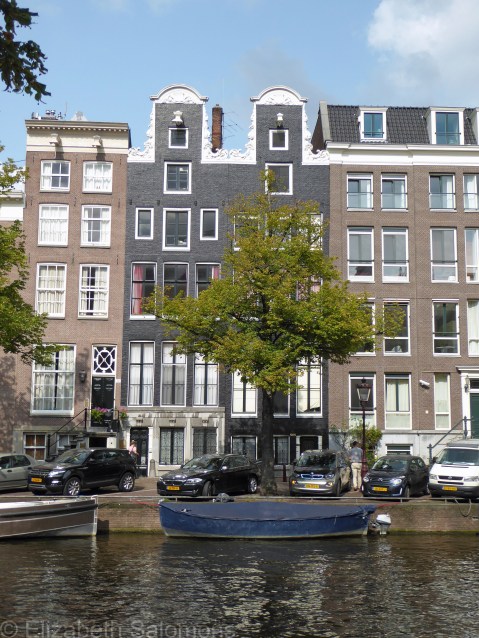
But often you see a row of canal houses with each gable different from the next. In this photo, from left to right, is a neck gable, a spout gable, and a bell gable. The bell gables are called that because the shape of the top of the gable resembles a church bell.
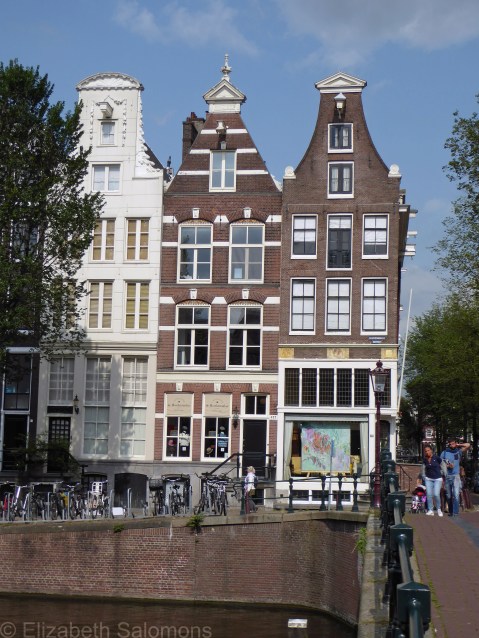
Here is a row of mostly bell gables. Note how the houses are tilted. Amsterdam’s canal houses are built on top of wooden piles that were pounded into the swampy peat bog until solid sand was reached. But as the land shifts through the centuries, so too do the houses. This particular row is known as the Dancing Houses.
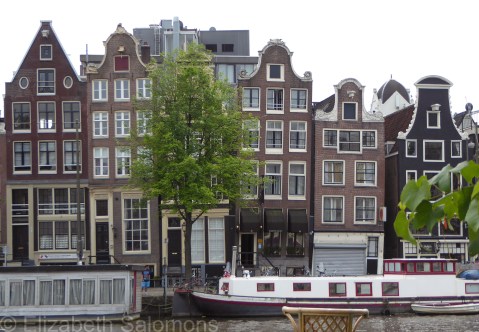
Here’s another thing I learned last summer. Marvelling at the Amsterdam canal houses is a whole lot more fun when you have a house builder along with you. My brother would shake his head, chuckle, and say, “There are no straight lines.” I don’t know if he was unsettled by the lack of straight lines, or merely fascinated, but after he left, for the rest of the summer, I walked around the city looking for straight lines.
I didn’t find many.


 There and Back Again