
Through My Lens: Pike Place Market Mushrooms

Look at these beauties!
One drawback of arriving in Seattle by cruise ship is you’re looking for something to do early on a Sunday morning when most attractions are still closed.
But one advantage of arriving in Seattle by cruise ship is you get Pike Place Market all to yourself ― before the crowds arrive.
Which is where I was last Sunday morning.
Through My Lens: Moon Over Los Angeles
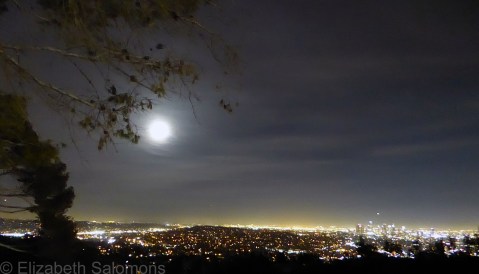
Before I went to Los Angeles last month, a friend told me to be sure to check out the view from the Griffith Observatory.
Here it is. That’s downtown Los Angeles to the right and, yes, a full moon to the left.
The Getty

I first read about The Getty in a magazine article, well before it opened, and knew I had to see the place if I ever made it to Los Angeles. And so, during my first-ever visit to Los Angeles some years ago, I made a beeline for The Getty. I was so enamoured with the architecture that I barely made it inside to look at the art.
Last month, on my second-ever visit to Los Angeles, I made a beeline for The Getty. This time I did make it inside, where I enjoyed some fine art, but, once again, I was awe-struck by the architecture of this world-class art museum.
The Getty sits atop a hillside in the midst of the Santa Monica Mountains (well, Angelenos refer to these hills as the Santa Monica Mountains, but, you know….). It overlooks the San Diego Freeway and offers a spectacular view of downtown Los Angeles. Look west, and you see the Pacific Ocean. Look east, and you see the San Gabriel Mountains.
Richard Meier was the architect and it was The Getty that catapulted him into the starchitect stratosphere. It was built from 1.2 million square feet (that’s 16,000 tons, folks!) of Italian Travertine stone. There are five pavilions of galleries, linked together with exterior courtyards and terraces.
I expect on my next visit to Los Angeles to yet again be making a beeline to The Getty.
Here’s why.


City of Angels
Question: What do Los Angeles and Vancouver have in common?

Venice Beach
Answer: Both cities have beaches. (But the beaches in Los Angeles are a lot bigger and the surf is a lot higher.) Both cities have palm trees. (But the palm trees in Los Angeles are more varied and much taller, and the palm trees in Vancouver ― well, I am being kind when I say they look a little ridiculous. I mean, palm trees do not belong in Canada. Right?)
And both cities are surrounded by mountains. (Here, I think we win, as our mountains are a lot closer. I think ours are taller, too.)
But there is one area where Los Angeles and Vancouver have absolutely nothing in common. Hands down, the weather in Los Angeles is waaaay better than in Vancouver, and a whole lot more dependable. I know this because I spent last weekend in Los Angeles, soaking up some badly needed Vitamin D.
And now I can’t wait for summer to arrive in my home city.
Through My Lens: Holiday Wreath
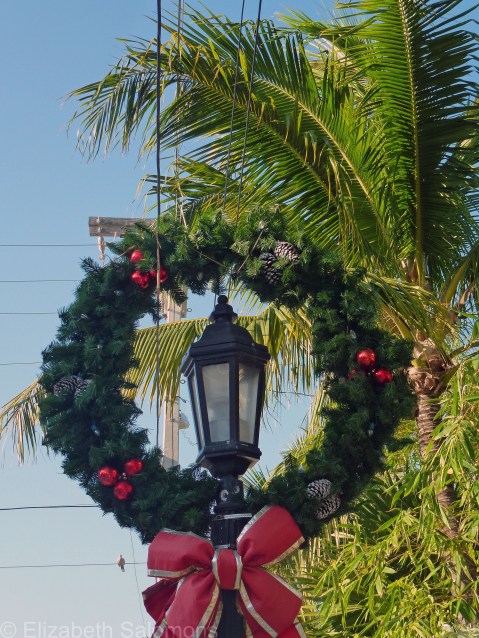
Oh, look! It’s another holiday photo.
I know, I know. You thought I was done for the season ― so did I ― but then I found this photo. I took it two years ago almost to the day when I was exploring Key West, Florida. I liked the incongruity of the various bits of greenery in this shot.
Team USA
There are an awful lot of Americans wandering around town this weekend.
How do I know they’re Americans?
Well, they are wearing a lot of Stars and Stripes. On their T-shirts. On their caps. Even on their footwear. That American flag is everywhere. And if they aren’t sporting a flag on their clothing, they’re dressed in red, white, and blue.
Why so many more American tourists in town than is usual for a July 4 holiday weekend?
It likely had to do with a certain soccer match that Vancouver hosted today at BC Place.
Yup, it’s a World Cup summer once again. Congratulations, USA!
To commemorate the victory of Team USA, here’s a photo of the biggest American flag I have ever seen. I photographed this one hanging on the building that houses the New York Stock Exchange on my last visit to New York.

Reel Life: Julie & Julia
 I had the opportunity this past week to introduce some friends to the film Julie & Julia. I was secretly pleased when they selected that DVD out of the pile I had brought, but I had no idea when I grabbed it at the last minute that most of the group had never seen the film.
Julie & Julia was Nora Ephron’s last film and stars the legendary Meryl Streep and the charming Amy Adams. It was Ephron’s producer who had the brilliant idea to combine into one screenplay two memoirs published around the same time. Julia Child’s My Life in France is about her life in post-war France, and Julie and Julia: 365 Days, 524 Recipes, 1 Tiny Apartment Kitchen evolved from Julie Powell’s blog about cooking her way through Julia Child’s Mastering the Art of French Cooking in post-9/11 Queens, New York. Beyond their names, Julie and Julia had in common the love and support of a devoted husband, a love of food, and the need to find some meaningful work to fill their days.
Early in the film, Julie Powell’s husband declares that “Julia Child wasn’t always Julia Child” ― and that’s precisely what makes the film so entertaining. Although I’m as fascinated as the next traveller about the daily routine of life as a New Yorker, the depiction of Julie Powell’s long subway commute and soulless work cubicle ring a little too close to home. But when the action switches to France, you’re transported to another time and place to witness the transformation of Julia Child, ex-pat American wife, to Julia Child, chef, author, and TV star.
Julia Child’s introduction to French food ― mere hours after she arrives in France ― is sole meunière. The epiphany she experiences in the look, smell, and taste of that first meal is, for me, the essential moment of the film. And it reminded me of the moment when I had my own epiphany about French cuisine. It was in a small restaurant in Perpignan where two friends and I shared a meal after a long day of sight-seeing. I ordered a tomato salad. It looked so simple ― a single layer of tomato slices on a small plate, sprinkled with an herb vinaigrette ― but I knew with my first bite that I was tasting something unlike anything I’d ever tasted before. The French don’t make simple tomato salads; they create spectacular tomato salads.
As much as my friends enjoyed Julie & Julia, they were a little more circumspect than I about the film; one remarked that she wouldn’t have reacted nearly as well as Julie Powell if the first words out of her partner’s mouth after disappearing for two days following a heated argument were, “What’s for dinner?”
As for me, whenever I’m homesick for French food, I’ll be (re)watching Julie & Julia.
The Cloisters
As you may have, um, noticed from this year’s Lenten series, I’m rather partial to cloisters. The simple truth is: I just can’t get enough of them.
So, given my love of cloisters, why were my expectations of The Cloisters ― a branch of New York’s Metropolitan Museum of Art ― so low? I didn’t bother to make the trek all the way to Fort Tryon Park until my fourth visit to New York; even then, I debated whether or not to make the effort. (Though, in the end, I was glad I did as I decided the park alone is worth a visit. As you can see here.)

The thing is, I’d always been under the impression that the buildings that make up The Cloisters are all reconstructions. Purist that I am, I figured since I’ve seen many a real cloister ― in France, and Spain, and Italy ― why would I want to see a mere imitation?
Turns out I was completely misinformed. The Cloisters aren’t reconstructions; they’re the real deal. (And let that be a lesson to me: I didn’t do my homework before dismissing The Cloisters and almost passed on what is a marvellous opportunity for anyone in the vicinity of New York who cannot get themselves over to Europe.)

The Cloisters had its origins in the private collection of American sculptor George Grey Barnard, who lived in Paris for more than a decade in the late nineteenth century. In the decade before World War I, he got into the habit of collecting and bringing home with him pieces of medieval architecture from French villages. John D. Rockefeller bought the collection from him in 1925, and later donated it to the Metropolitan Museum of Art. Rockefeller also donated to the city of New York the land that now makes up Fort Tryon Park.

Open to the public since 1938, the museum is a chronologically arranged ensemble of remnants from five French abbeys: Saint Michel de Cuxa, Saint Guilhem le Désert, Trie-sur-Baïse, Froville, and Bonnefont-en-Comminges. In addition to the buildings, there are more than 2000 works of art, including illuminated manuscripts, stained glass windows, and tapestries.
Here, take a look.


If medieval history is your thing, I highly recommend a visit to The Cloisters.
As for me, I can’t wait to go back.

Through My Lens: Byodo-In Temple
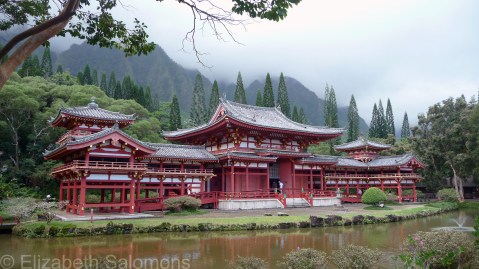
I’ve been searching for the balm in Gilead this week, so I thought of this photo, which I took on O’ahu in December 2008. It’s the Byodo-In Temple, a non-practicing Buddhist temple, which was built in 1968 to celebrate the centennial of the arrival of the first Japanese settlers in Hawaii.
Through My Lens: Cloister of Abbaye Saint Michel de Cuxa

For the Second Sunday of Lent, we’re hopping across the Channel to France. This photo is of the Cloister of Abbaye Saint Michel de Cuxa, a Benedictine abbey located in the French Pyrenees.
The abbey was built in 878, abandoned during the French Revolution, and restored to a monastic community in 1919. Its cloister dates back to the twelfth century, but many of the columns were removed in the early twentieth century by an American sculptor and are now on display at The Cloisters Museum and Gardens in New York.
I took this photo in November 2000. It was on this jaunt around southern France that I came to realize how much I value the beauty and the silence of monastic cloisters. I’ve been on a mission to photograph them ever since.


 There and Back Again