
Road Trip: Tamiami Trail & Overseas Highway No. 1
 Like most kids who grow up on this continent, my first travel adventures were road trips with my family during the summer holidays. Now, as an adult, road trips have become few and far between.
So, for that reason, I was excited to include a coast-to-coast road trip on my recent visit to Florida. Coast to coast? Yup. That would be from the Gulf Coast to the Atlantic Ocean.
Now, there are two ways to get from Tampa (on the Gulf Coast) to Miami (on the Atlantic Ocean). The quick and fast way is over the interstate (I-75). There’s also the more scenic route: the Tamiami Trail (that’s Tampa → Miami). Guess which route I took?
The Tamiami Trail cuts right through the middle of the Everglades. My intent was to stop here and there and do a bit of looking around, maybe take a walk or short hike through the swamp.
It didn’t happen. Because it rained. A lot. All the way from Fort Myers to Homestead, in fact.
So instead I saw a lot of this.

And my motivation to stop and get out of my rental car and do some exploring dwindled the farther I got from Tampa and the closer I got to the Florida Keys.
What I did do was make a mental note to one day come back with my tent and sleeping bag and leave myself enough time to stop over for a couple of nights. Camping in a swamp ― how cool would that be? I was impressed enough with what I did manage to see between swipes of my windshield wipers to know I would enjoy a closer look at the United States’ largest subtropical wilderness.
Enough about what I didn’t see in the Everglades.
I am happy to report that the weather cooperated once I got into the Florida Keys. The sun shone for the entire drive and the temperature hovered around 80°F for my entire visit. As evidenced by the next photo.

The Florida Keys is an archipelago of more than 1700 islands (called “keys”) strung like a broken string of pearls below the Florida peninsula. Forty three of the keys are connected by the Overseas Highway No. 1 ― a 200-km length of roads and causeways stitched together by bridges. A lot of bridges. A lot of long bridges. This one here is called the Seven-Mile Bridge. I learned that it’s exactly seven miles long by carefully watching my odometer.

Every key has a name. Some are well known (Key Largo, Key West), some are pretty original (Teatable Key, Bahia Honda Key, Sugarloaf Key), and some, well, it seems like they ran out of inspiration (No Name Key).
The keys vary in size and development. The bigger ones are lined with roadside diners, restaurants, and motels, and the odd strip mall; the lack of big box stores and fast food chains made it feel like I had stepped back in time about 40 years. Other keys are so small they have only a few houses, and no commercial development at all. The smallest keys are completely undeveloped.
As you drive along the Overseas Highway, you are never far from the water. In addition to the street address, directions are given as “Mile Marker [fill in a number],” Bayside or Oceanside (with Key West being Mile 0). So, MM 59 Bayside faces Florida Bay, and MM 73 Oceanside faces the Atlantic Ocean. Nifty, huh?


The Florida Keys is known as a destination for fishing, snorkeling, and diving ― none of which I do ― but if you are looking for an idea for your next road trip, I can highly recommend a drive along the Overseas Highway. As road trips go, it’s pretty spectacular.


And Then There Were the Reptiles
Wanna know the No. 1 question I’ve been asked about my trip to Florida?
“Did you see any alligators?”
Why, yes, yes I did.
Although they are not nearly as photogenic as my feathered friends, I found Florida’s reptiles equally fascinating. I suppose the simple reason for that is because native reptiles are few and far between in my neck of the woods.
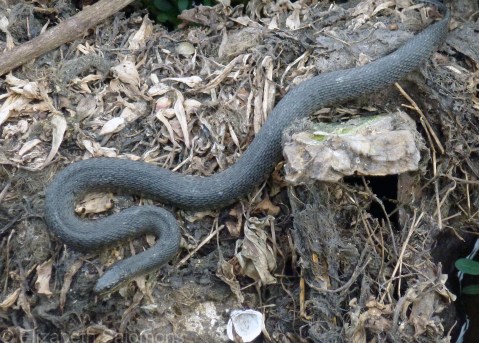
We do have snakes in Canada. And I saw a snake or two in Florida, which I found somewhat interesting.
But we don’t have geckos, which I found adorable.

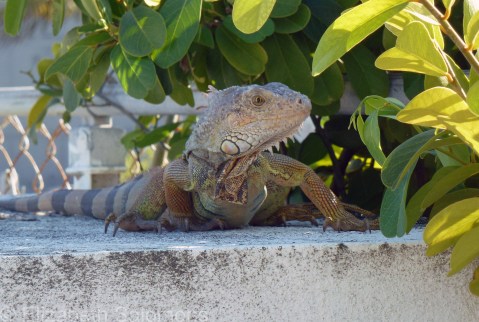
And we don’t have iguanas, which I found mesmerizing.

And we certainly don’t have alligators. (In case you can’t tell, all the floating logs in this photo aren’t. Logs, I mean.)

Here’s what one of those logs looks like up close.

What I really don’t get is why people would want to canoe right up to one of those floating logs.
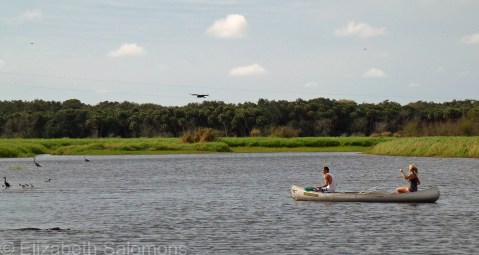
I suppose it’s no different than me sleeping in a tent in the middle of the Rockies knowing full well that bears tend to wander around campsites just before dawn.
Sleeping with bears? Canoeing with alligators?
Bears? Alligators?

I’ll take my chances with the bears, thank you.
Florida: A Birder’s Paradise
Who knew there were so many different kinds of birds in Florida?
Well, that’s a silly statement, isn’t it? I’m sure a lot of people did ― just not me. I learned a lot while I was in Florida by hanging out with some avid birders, and, with their help, I was able to spot 35 different species during my two weeks in the Sunshine State.
As I was ticked each species off my list, my photographer gene went into overdrive. And so, here are one or two photos to share with you.
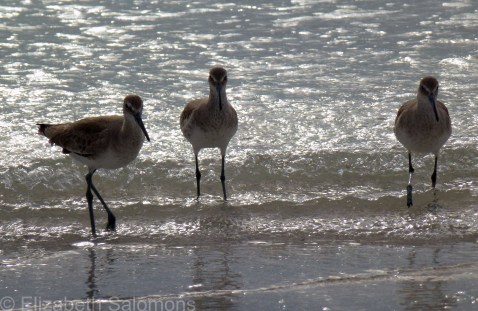
First up are the shore birds I told you last post were so much fun to play with on the beach. The first ones I met were Willets.
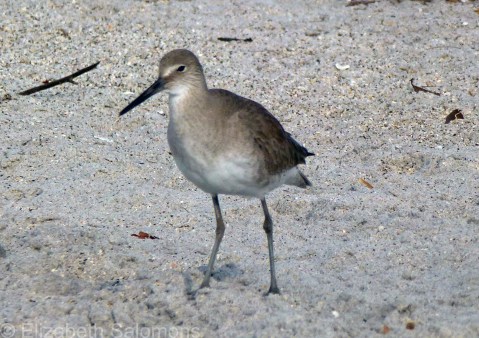
Here is a Ruddy Turnstone …

… and this one is a Sanderling. Sanderlings are tricky to photograph because they zip around at warp speed. Not to mention they blend pretty well into the background.

The Royal Terns were my favourite of the terns.

When they turn their heads, it’s pretty obvious why they’re called “royal.”

Here’s a bunch of them in formation: heads turned away from the wind and beaks tucked into their wings.

This one’s a Least Sandwich Tern, which is smaller than the Royal.

One Black Skimmer …
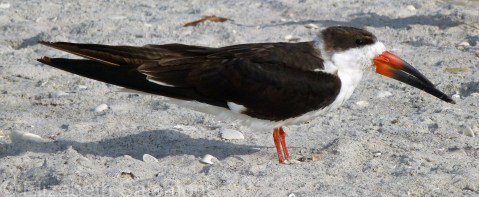
… three Black Skimmers …
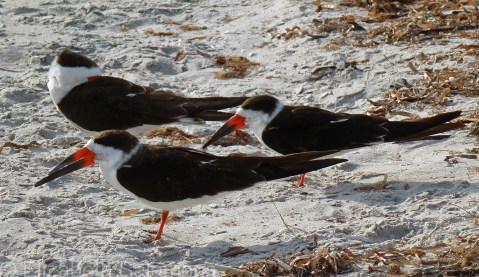
… and a whole flock of Black Skimmers.
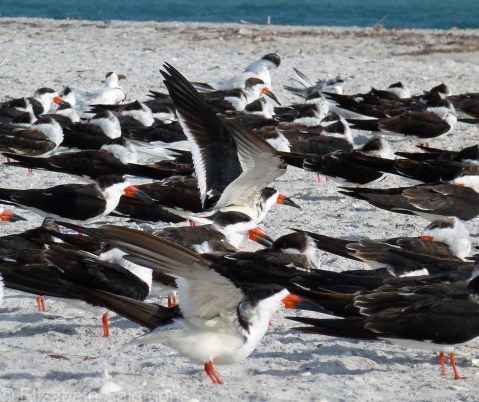
A Laughing Gull An immature Ring-billed Gull on the beach …
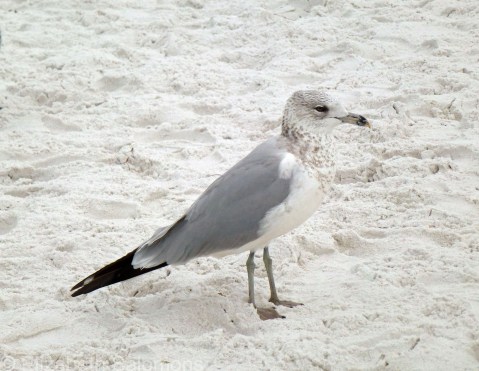
… and a whole row of Laughing Gulls preening themselves on a fence.

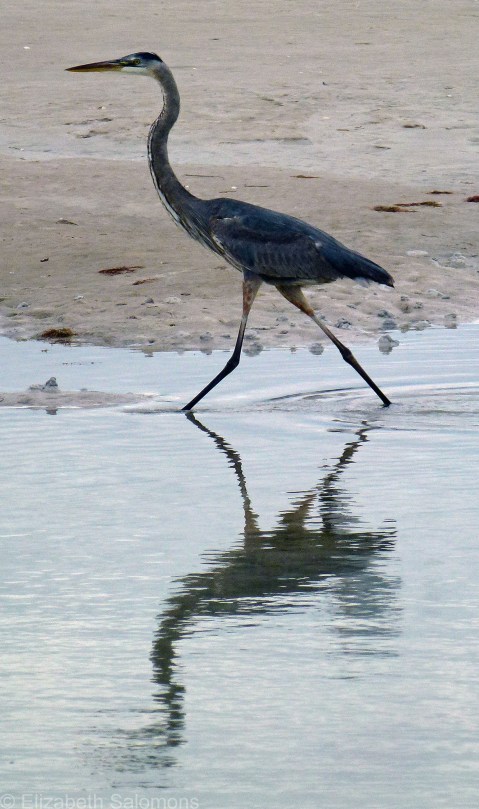
I was really happy to meet up with my friends, the Great Blue Heron. I know when they leave Vancouver every fall they go somewhere ― it never occurred to me I’d find them in Florida. Here’s a male …

… and here is a female.
This Snowy Egret was kind enough to strike a pose for me.

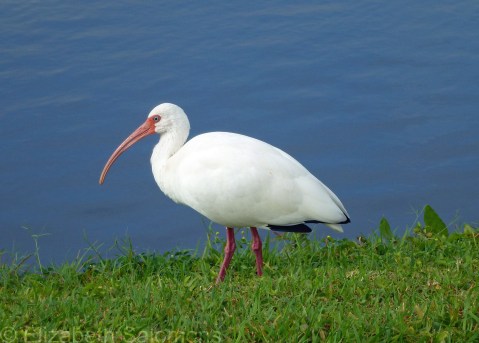
The White Ibis (left) is being stalked by a Great Egret (right).

Here’s a better photo of the White Ibis.
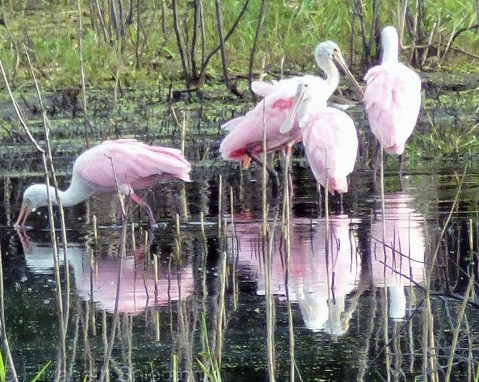
These are Roseate Spoonbills. Apparently they aren’t so common and we were lucky to see them. If you look carefully at the beak of the second bird from the right, you can make out its spoon shape.
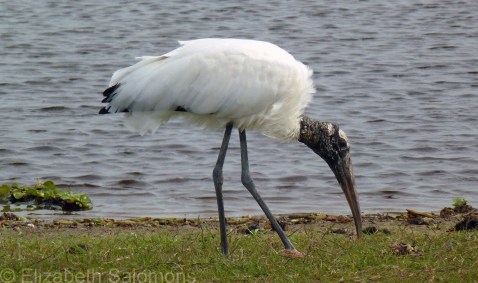
This bald-headed fellow is a Wood Stork ― the only stork that breeds in North America.
The Anhinga is quite the exhibitionist. Here’s one passing the time of day …

… and here’s one showing off. Anhingas stretch out their wings like this to dry off the feathers.

These are two juvenile Anhingas.

I don’t think a day went by during my time in Florida when we didn’t see vultures circling high above us. This Black Vulture is almost hidden by all the Spanish moss in the tree.

Another frequently sighted bird is the Brown Pelican.

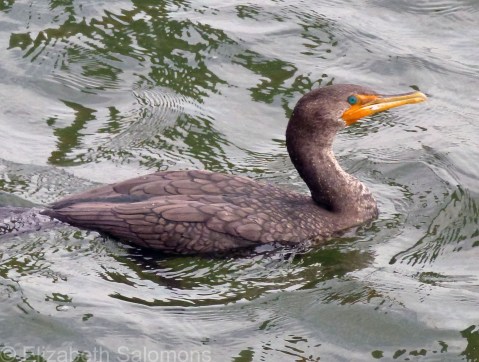
Here is a Double-crested Cormorant …
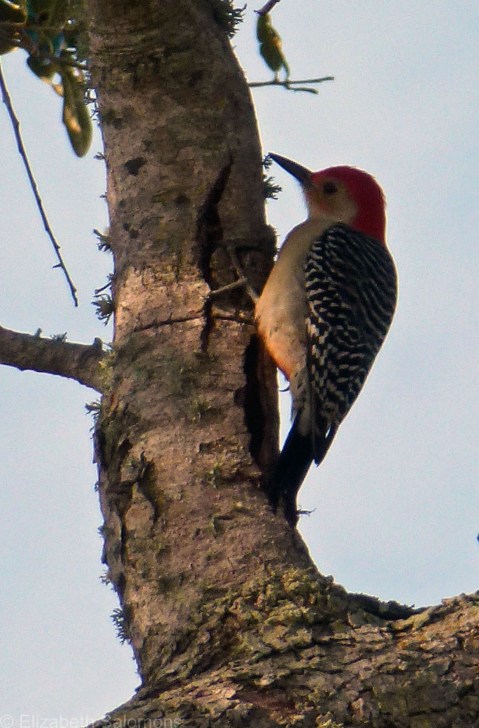
… a Red-bellied Woodpecker …
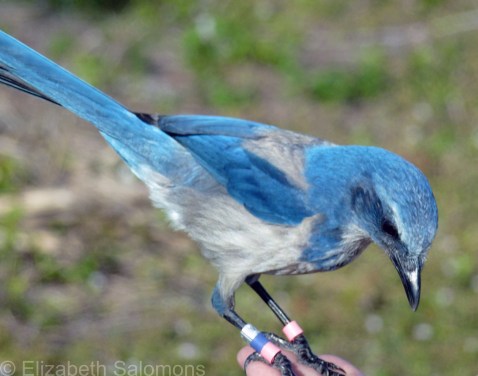
… and a Florida Scrub-Jay.
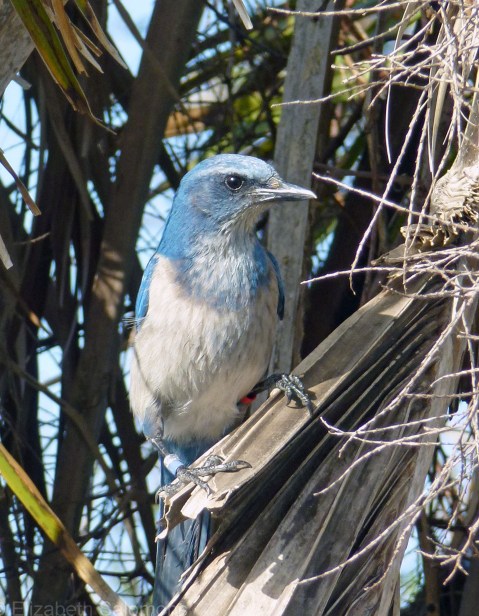
The scrub-jays will eat from your hand if you’re patient enough. (The surge of intense love I felt for this tiny creature as it stood on my hand was electric. No exaggeration.)
This Red-winged Blackbird kept me company one morning in the Keys while I ate my lunch.

And I met this handsome fellow on one of my strolls through Key West. Chickens are everywhere in that town ― and I mean everywhere.

I am sure I goofed up some of the identifications, so do let me know if I did. And, as if I need another reason to travel, I am now thinking that choosing destinations based on their potential for birdspotting is not a bad idea. Not at all.
Sun, Sand, and Surf on the Gulf Coast
I fully expected to spend a lot of time at the beach on my recent trip to Florida’s Gulf Coast; I had no idea I’d be swimming in the Gulf of Mexico within three hours of landing at Tampa International Airport. But that is exactly what happened. (Nothing ― and I mean nothing ― cures jet lag like a swim in the ocean.)
Unfortunately, the temperatures cooled off and the wind picked up after that first day (polar vortex, anyone?), so my friend and I stuck to beach walking for the rest of my visit. Beach walking is good fun and great exercise; the shore birds we played with made it even more fun, and if you keep your eyes to the ground, you never know what treasures you’ll find.

Playing with the shore birds
What’s amazing about Florida’s Gulf Coast is that you can visit a different beach every day of your holiday and still not hit all of them. After we had been to a few, my friend and I decided to rate the beaches we had walked. Her mother suggested (rather wisely, I thought) that beaches shouldn’t be rated, but simply enjoyed. We considered that ― and then went ahead and rated them anyways.
And so, here are my top three of Florida’s Gulf Coast beaches.
# 1: Stump Pass Beach: This beach gets my top rating simply because it is so beautiful and so unique. Scattered along the waterline are the dead stumps of Australian Pine ― an invasive species that the park rangers decided had to be killed off. The stumps have been carved by the surf into artistic lengths of driftwood, which offer terrific opportunities for photographers (see below).
Stump Pass Beach is south of Englewood on Manasota Key. Because it is a state park, it has an entry fee. The parking lot is minuscule, so get here early or come in the late afternoon.


# 2: Siesta Beach: In 2011, this beach was designated No. 1 Beach in America, and it’s not hard to guess why. Its sand is made of quartz so it’s icing-sugar fine and doesn’t get hot. I’ve never felt anything like it ― my toes were screaming in delight.

Look how far the feet of this Royal Tern sink into the soft sand at Siesta Beach
Siesta Beach is south of Sarasota on Siesta Key. Because it has all the facilities you could possibly need, it’s the beach I would choose if I were going to spend the entire day at the beach or if I had a pack of kids in tow. It’s also massive ― incredibly wide and long ― so I would think there’s room for everyone, even on the hottest of days. (Let me know if I’m wrong about that!)


# 3: Caspersen Beach: This is the beach where I was swimming within hours of my arrival in Florida, so I’ve rated it third because it was my best swim (well, technically, my only swim) on the Gulf Coast. Caspersen is located in Venice and has something for everyone: swimming, beach walking, trail walking, bird watching, shell hunting, shark-tooth hunting (yes, you read that right) …

Hunting for sharks’ teeth on Caspersen Beach
Fossilized sharks’ teeth millions of years old are so common along this part of the Gulf Coast that Venice is known as the Shark Tooth Capital of the World. And it was at Caspersen where I saw the serious shark-tooth hunters ― the ones with their wire-mesh shovels who carefully sift and sort through shovelfuls of sand, looking for all the world like panhandlers mining for gold in the Klondike. I myself have a shark’s tooth ― my friend’s mother picked it up within minutes of our arrival at Caspersen and handed it to me as a souvenir of my visit.
So, there it is: my top three beaches. My goal for my next visit to the Gulf Coast? To come up with a top ten list.
Through My Lens: Pelicans on the Pier
I have lots of photos to post about my jaunt around the Florida peninsula, but this one here is the best shot of the entire trip. It deserves a post all of its own, I’m thinking.
If only these guys could talk.

Through My Lens: The Sunshine State
Is there a better way to beat a Canadian winter than by flying south? I think not. I’m on my first ever visit to Florida, the Sunshine State, and let me just say that this part of the United States has far exceeded my expectations.
The weather ain’t half bad, either.

Golden Gate Bridge
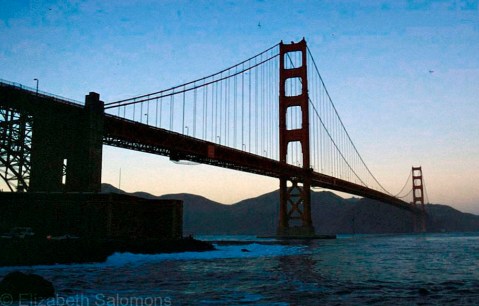
The first time I saw the Golden Gate Bridge, I was in a plane. Only its two towers were visible; the rest of the bridge was hidden in the fog. I found out later that fog is a common weather phenomenon in San Francisco and the two towers of the Golden Gate Bridge are often as much as you ever see of it from an airplane.
I didn’t get any closer to the bridge that time ― or see anything of the city ― as I was merely on a stop-over on my way to somewhere else.
The second time I saw the Golden Gate Bridge, I was in a car driving over it. I’d been visiting a friend in the Sonoma Valley and, after a couple days of touring wineries and wine-tasting, we decided we should spend a day in San Francisco. When you drive from the Sonoma Valley to San Francisco, you enter the city by crossing over the Golden Gate Bridge.
I couldn’t stop marvelling at the bridge; I may even have giggled. My first thought was probably, “Wow!” I know for sure my second thought was, “The Lions Gate Bridge is just a toy compared to this one!”
The Golden Gate Bridge opened in 1936, and I like to think of it as the Lions Gate’s older, more grown-up sister. At six lanes, it’s twice as wide as the Lions Gate and it’s a kilometre longer. Those three additional lanes are what impressed me ― it feels more like an expressway in the sky than a bridge.
It I don’t know if the Golden Gate Bridge would have impressed me as much had I not been so familiar with driving over the Lion’s Gate Bridge. But I do remember I asked my friend to drive over it again, just for the thrill of it.
Happy Thanksgiving!
I missed Thanksgiving the year I backpacked around Europe with my girlfriend. We joked about what we thought was our Thanksgiving dinner (bratwurst and sauerkraut in the Munich train station) on the day we thought was Thanksgiving, but we later found out we had the wrong day. I think we even had the wrong week. That’s what happens when you hop on and off trains and check in and out of hostels on a daily basis: the days become a blur.
I remember telling the story of our missed Thanksgiving to two Nebraskan sisters we had met on a train. They looked at me, puzzled. “You can’t have Thanksgiving,” they said in unison. “You didn’t have pilgrims!”
Uh, yeah. Right.
It never made sense to me why turkey had to be eaten with cranberries until my first trip to Massachusetts. There, while camping on Cape Cod, I found wild cranberries growing every which way I turned. And Cape Cod, of course, is just around the corner from Plymouth, where the aforementioned all-important pilgrims first landed on America soil.
“Aha!” I said to myself. “It’s all those pilgrims’ fault that we are stuck eating cranberries every holiday dinner.”
Cranberries grow in British Columbia, too. In fact, this province produces 12 percent of North America’s cranberry supply.
I will have Thanksgiving dinner tonight with my family. There will be cranberries. And pumpkin. But no turkey.
And no, Canada didn’t have pilgrims. We are thankful, none-the-less.
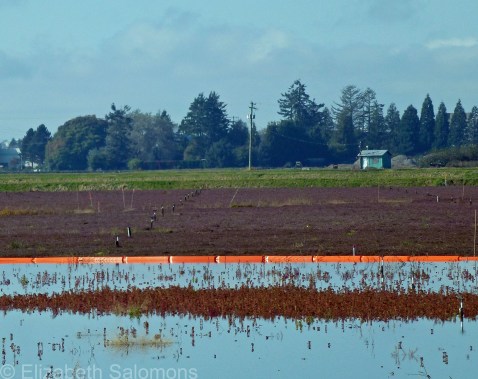
Cranberry Bog, Richmond, BC
Anacortes Murals
One delightful discovery of our weekend in Anacortes were the town’s murals. These have been painted on to wood cut-outs and fastened to the sides of the buildings that line Commercial Avenue, Anacortes’ main drag. The murals are based on photographs taken in Anacortes over the past century, and offer a colourful glimpse into the local history.
They’re worth the drive to Anacortes.


Anacortes
Anacortes, I discovered, is one of those places people drive through on their way to somewhere else. To be honest, I myself wouldn’t have spent a weekend in this town on Fidalgo Island had I not arranged a home exchange with a couple of Washingtonians who wanted to spend a weekend in Vancouver.
As far as home exchanges go, it was one of the easiest I’ve ever arranged. We agreed to take care of each other’s cats, I asked my sister and a couple of friends to join me, and off we drove one Friday afternoon after work. In less than two hours, we pulled up to a house on a bay: our home for the weekend.

Unfortunately, we had to ditch the outdoor activities we had planned when the weather didn’t cooperate. Instead, we hid from the rain by doing a bit of antiquing, some book-shopping, and a lot of wine-buying in what my home exchangers told us was the “best wine store in the state.” The highlight of our many conversations with the Anacortes’ shopkeepers was hearing the story of Byron and Larry’s decades-old friendship after I asked the barista making up our lattes what they had done to rate windowside chairs with their names on them.
It was in the next shop, as I was paying for my purchase, that the shopkeeper asked me, “How do you Canadians find Anacortes?” I sure hope she was curious about what brought us to Anacortes, rather than astonished that we can read a map. At any rate, that’s how I took her meaning and that’s when it occurred to me that most people must zip through the town on their way to the San Juan Islands ferries.
Back in Vancouver, another friend told me she’s only been to Anacortes by boat. Whatever your means of transport, it’s a nice place for a mini-break.


