
Gouda
In the house where I grew up, we had two kinds of cheese: Dutch cheese … and everything else. And by Dutch cheese, I of course mean Gouda cheese. (Which is pronounced GHOUW-da, with a guttural “g,” not GOO-da. If the “g” is too much for you, think HOW-da, and stress the “h.”)
But the town of Gouda, I learned last week, has a whole lot more to it than just its cheese.

For one, there’s a pretty impressive Stadhuis, or Town Hall, built way back in the middle of the fifteenth century in the Gothic style.

For another, there’s a pretty impressive church, known as the Grote Kerk (Great Church) or Sint Janskerk. At 123 metres, it is the longest church in the Netherlands.

Hugging the church’s perimeter are many tiny little streets filled with tiny old houses.

These streets are a delight to wander through.

Naturally, Gouda cheese does play a big role in Gouda’s tourism, and the city does a fine job of using it to promote itself.

During the summer months, there is a weekly cheese market (which we did not see) that takes place in front of the Waag or Weigh House.
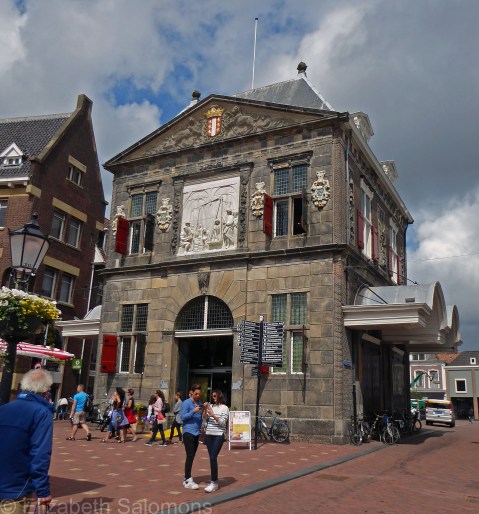
But I did buy some cheese at the regular Saturday market that was going on in the Markt or market square.

People were first attracted to the area around Gouda by the peat that was plentiful in the nearby swampy marshland and which they harvested. This was back in the eleventh and twelfth centuries. By 1272, Gouda was granted city status. It is less than an hour from Amsterdam by train and well worth a visit.
Even if you’re not as crazy about cheese as I am.
Kinderdijk
There’s a saying in the Netherlands that I quite like: “God created the earth, but the Dutch made Holland.”
It refers of course to how much of the Netherlands is reclaimed land. Netherlands (or Nederland) means “Low Countries,” which it is. About half of the country lies barely a metre above sea level, and a quarter of the country is reclaimed land that would flood if not for the dykes. The larger areas of reclaimed land are called polders.
Reclaiming land from the sea involves an intricate drainage system of dykes, canals, and pumps. In days gone by, windmills were the pumps.
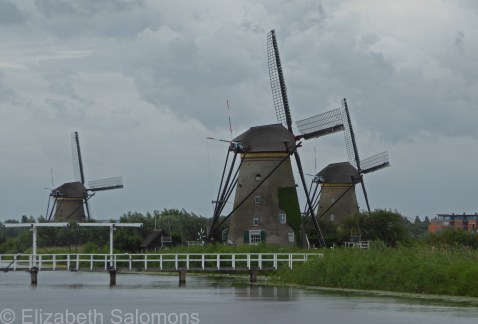
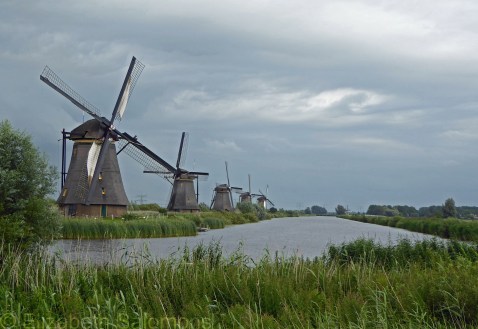
And that’s the lesson you learn when you visit Kinderdijk. This UNESCO World Heritage site is home to 17 windmills that have been pumping water for almost three hundred years. They were supplemented by steam pumps during the nineteenth century, and then, in the last century, they were replaced by electrical pumps.
But now the windmills — the largest concentration of old mills in the Netherlands — remain as a living museum.
Kinderdijk means “children’s dyke” and there are a number of stories about how the name came to be. The one I like best is a simple one: the dyke that was lower than the surrounding dykes was smaller, like a child, and became known as the Kinderdijk.
The Kinderdijk windmills are called “ground sailers” because the sails almost reach the ground. I expect it was a risky business, living in a windmill, as one wrong step could easily end your life.
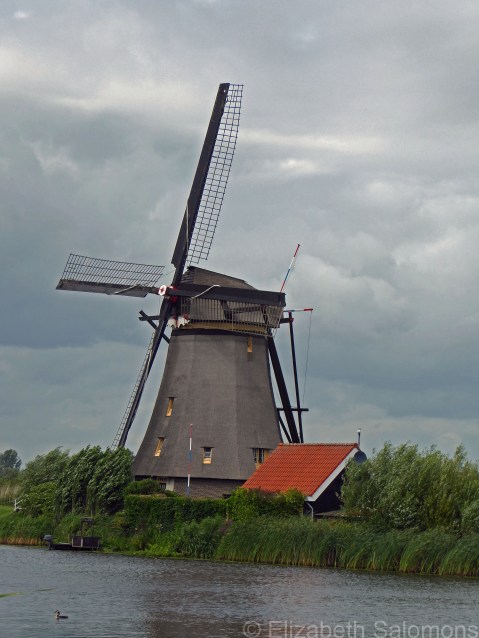
There are three kinds of windmills at Kinderdijk. The Nederwaard mills (at right in the photo below) were built in 1738 and are made of brick, except for their caps, which are thatched. This cap can be turned, which allows the miller to move the sails so they face the wind. The mills are staggered to make sure they do not steal the wind from the sails of the other mills. One of them has been turned into a museum, furnished as it was during the 1950s when the last miller lived there.
I learned there is nothing quite like the sound of being inside a windmill as its sails turn. Let’s just say there was a whole lot of creaking going on.
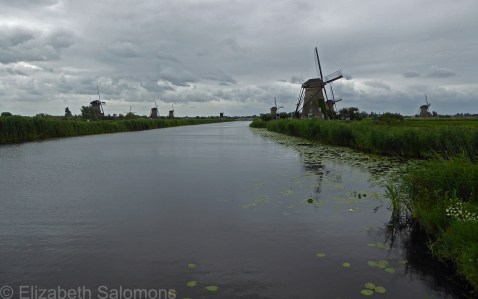
The Overwaard mills (at left in the photo above) were built in 1740. They are thatched mills and are not staggered because they are spaced further apart.
The last type of windmill is a wipmolen (hollow post mill), which is the oldest type of windmill in the Netherlands. There is just one of these at Kinderdijk and it too has been turned into a museum.

The wipmolen can also be rotated, which is exactly what this miller is doing.

If you want to see windmills in the Netherlands, Kinderdijk is where you need to be. It is easily accessible from Rotterdam by bus or waterbus and can done as a day trip from Amsterdam.
And if the wind is blowing, as it was when we were there, be assured you will see many of the mills in action.

Through My Lens: De Gooyer Windmill

Nothing says “Holland” quite like a windmill. De Gooyer Mill is located on the Nieuwe Vaart canal in the eastern part of Amsterdam. It used to be a flour mill and is the tallest wooden mill in the Netherlands.
Amsterdam Canal Parade
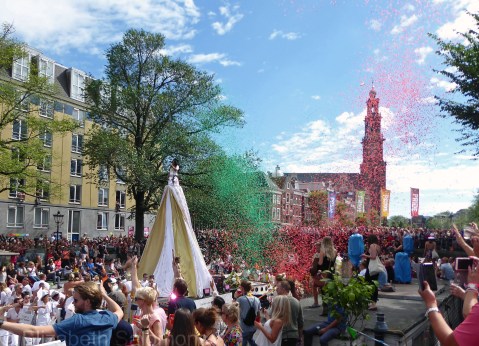
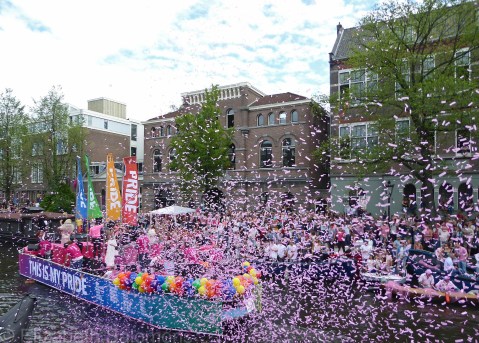
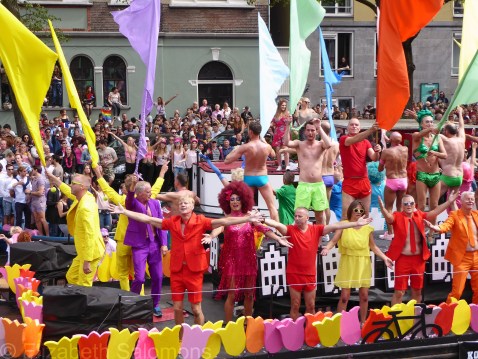
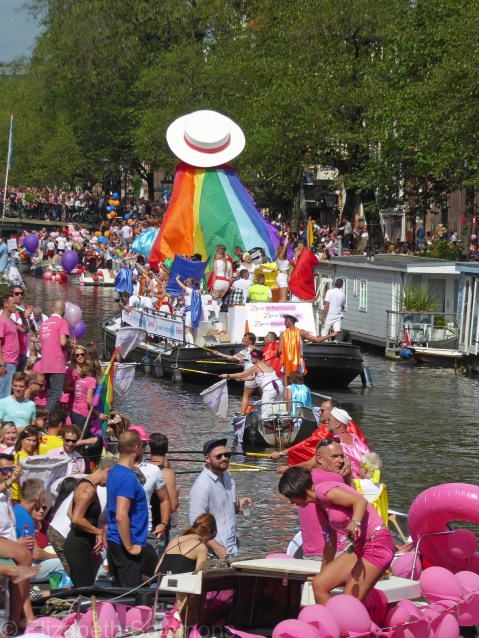
I’ve seen a few Pride parades in my time, but will probably never see one quite like the Amsterdam Canal Parade. This year’s version took place yesterday along the Prinsengracht. The best way I can summarize it is to simply say that the Dutch sure know how to have fun.
If you don’t believe me, check out these photos.



A Month in Amsterdam
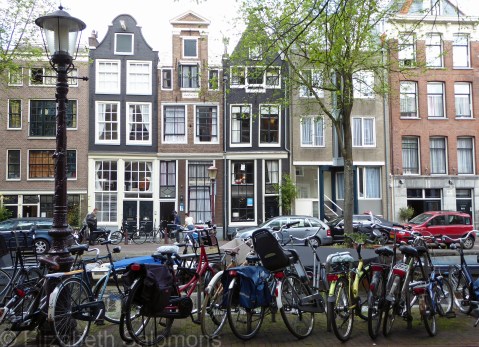
Earlier this week, as I watched the crazed Dutch cyclists zip past each other along the tiny streets of the Jordaan district next to where I am living, I wondered if a summer is long enough to figure out Amsterdam’s traffic rules. I’ll let you know, but at the moment, one month in, I’m still bewildered.
While I was pondering the mysteries of the Amsterdam traffic, I began to reflect on the stages of adjustment I always go through when I relocate to a new city, even when it’s just for a short while.
At first, everything you see and smell and taste is delightful. You can’t believe you are where you are and you notice and marvel at every little detail. On my shorter trips, I rarely move past this phase.
The second phase is when the differences you first marvelled at start to annoy you. Why do those cyclists have to go so fast? Why don’t Dutch store clerks ever smile? Why are there so few ticket machines in the Metro at Centraal Station?
The third phase is when you start to adjust to the differences. For me, an important step in reaching this phase is when I’m comfortable navigating the city without a map and stop noticing that I don’t understand the language.
The fourth and final phase is acceptance. This doesn’t mean that you feel completely at home or you have become fluent in a new language. Rather, you understand and accept that you may never feel at home — and you’re OK with that. How long it takes you to reach this final phase is the big unknown. In Paris, it took me only a few months. In other cities, it took me years. (Toronto, I’m looking at you.)
I’ve been in Amsterdam for a month now, and I’m most definitely in the second phase, inching slowly towards the third.
I’ll let you know how it goes.
Canada 150: Prince Edward County
As a follow-up to my previous post, here’s a thought: one thing that makes living in Toronto so much more pleasant is having access to a cottage during the summer. The entire city (it seems) exits Toronto on Friday afternoons and doesn’t return until Sunday evening.
Many employers cater to this lifestyle by implementing summer hours, where you come in a half hour early every morning, but get to leave early on Fridays. It’s a great perk if you are lucky enough to work for such an employer.
I was.
And, as it happened, I also had access to a “cottage” — my parents’ home, who along with my much younger brother lived in Ontario for five years of the decade I lived in Toronto. Like the rest of the city, I would throw an overnight bag into my car on Friday mornings and leave the office at 1 p.m. sharp, heading east along the 401. It was always heavy traffic, but not as heavy as what you’d encounter at 5 p.m. (If for some reason I couldn’t get away early, I waited until 8 p.m. to start the trek.)
The minute I exited the 401, I literally felt the weight of the week lift from my shoulders. (I write “literally” quite deliberately as it was a profound feeling.) My turn-off was Highway 33, also known as the Loyalist Parkway. I would drive around the Bay of Quinte through villages with names like Carrying Place and Consecon and Wellington. If it was May, I’d roll down my window and breathe in the heady scent of lilacs in full bloom.
Finally, about three hours or so after leaving the office, I would pull into my parents’ driveway for a weekend of garage-saling and antiquing with my mother and afternoons on the beach with my little brother.
Loyalist Parkway is called that because it runs through the middle of the area where people loyal to the British Crown (the United Empire Loyalists) were encouraged to settle in the years following the American Revolution. The British gave the Loyalists land grants, and the peninsula that juts out into Lake Ontario was created a county in 1792 by the lieutenant governor of Upper Canada. It was named Prince Edward County after one of George III’s sons, but those who live there call it, simply, “The County.”
In my mind, it’s one of the prettiest corners of Ontario.
I look this photo in the old Quaker Cemetery across the road from where my parents used to live. The cemetery epitomizes for me the history of the area. How could it not, with headstones that date back 200 years?
If only they could talk.

Canada 150: Toronto
I think it would be terribly irresponsible of me not to acknowledge in my Canada 150 series the city that Canadians love to hate.
And that would be because I gave ten years of my life to that city. They were a great ten years and I have a lot of affection for Canada’s largest city.
To celebrate Toronto, here is a photo of the Gooderham Building, also known as Toronto’s Flatiron Building, which is located in the St. Lawrence area of downtown Toronto. Completed in 1892, it was built for the distiller George Gooderham and served as the headquarters of the Gooderham and Worts distillery until 1952.

Art Talk: Musée Rodin

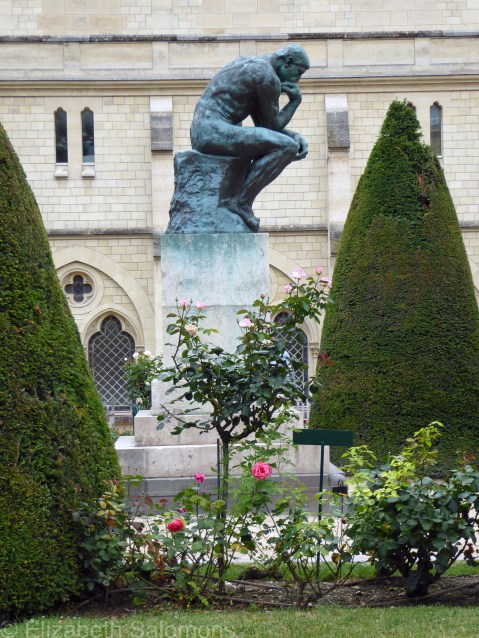
Every time I am in Paris, I make sure to stop by the Musée Rodin. It is, in my opinion, the most perfect of art museums.
I love the Musée Rodin because I love Rodin’s work, for one, but I also love it because it is located in such a beautiful setting and because it is the perfect size for an art gallery: it’s neither too big nor too small.

There are a number of similar, smaller museums in Paris — the Musée Picasso and the Musée Delacroix come to mind — and if you have a particular artist you want to explore in depth, you would do well to spend your time in one of these smaller museums and avoid the larger museums where the tourists tend to gravitate.
The Musée Rodin is housed in an eighteenth-century mansion known as the Hôtel Biron. At various points in its lifetime, the mansion was home to a Roman Catholic cardinal, the Russian ambassador to France, and three nuns who opened a boarding school for girls. In the twentieth century, the owners began to rent space in the building to artists, including Henri Matisse, and then, in 1908, Auguste Rodin. Rodin took over the entire building in 1911.

Also in 1911, the French government became the new owners of the Hôtel Biron, and after exacting a promise from the government that the building would be turned into a museum of his work, Rodin donated most of his sculptures. In 1919, two years after the death of Rodin, the Musée Rodin opened to the public.
Art Talk: Centre Pompidou

In contrast to the Louvre, the Centre Pompidou is a much more manageable art museum. For one thing, its permanent collection is displayed on two levels that are easily covered in one visit. And for another, its emphasis is much more focused: modern and contemporary art from 1905 to present day.

There are a couple of bonuses to the Centre Pompidou as well: the splendid view from the fifth floor, and the incredibly fascinating architecture of the building, which opened in 1977.

If the crowds of the Louvre prove to be too much for you, I recommend a visit to the Pompidou as the perfect antidote.
Art Talk: Musée du Louvre

When you spend a week in Paris with a couple of art students, it’s inevitable that you end up spending much of that week in the city’s art museums.
And when you choose to visit the world’s largest and most-visited art museum, it’s inevitable that you end up spending a considerable amount of time in line waiting your turn to enter.
That art museum would be the Musée du Louvre.

Rebellious Slave by Michelangelo
The line was long. Very long. And here’s a pro-tip: if you neglect to ensure you’re in the correct line before you begin your wait, you may well end up having to go to the back of yet another line, thus doubling your wait time.
Which is what happened to us.
Here’s another pro-tip: do not try to see the entire museum in one go. It is physically impossible. The Louvre used to be a royal palace, and the result is a confusing layout that is more maze than museum. If you were to walk through every one of its 403 galleries and down every one of its corridors, you’d cover 14.5 km and 15 acres containing more than 38,000 objects and pieces of art dating from ancient civilizations to the mid-nineteenth century.
I’m exhausted just from typing out that last sentence.

Dying Slave by Michelangelo
My nieces and I started in the sculpture galleries and the girls were both awestruck by what they saw and overwhelmed by the crowds around pieces such as the Venus de Milo. Because we knew we had to pace ourselves, we stopped to have a bite to eat in one of the Louvre’s many cafés, intending to tackle the Italian Renaissance paintings after our break.
But fate intervened, and an announcement over the PA system in French and English that the Louvre had to be evacuated due to a “security incident” thwarted our plans. We never did find out what the incident was — I suspect it may have been due to the record-breaking rain storm earlier that morning — but when I told the story to a friend who had been in Paris a year earlier, she recounted her experience of being evacuated from Versailles for what they eventually discovered was a thermos inadvertently left unattended.
We had waited more than two hours to spend scarcely an hour inside the Louvre. But we also wanted to be safe, and these days, in Paris, you cannot blame the museum or the police for being overanxious and overcautious.

Venus de Milo
We never did go back to the Louvre — we had other museums to visit and the girls decided they had seen as much of the Louvre as they needed to see. For myself, I’m glad we didn’t make it as far as da Vinci’s Mona Lisa. That gallery is a bit of a gong show and unless you’re small enough to squeeze to the front of the crowd or tall enough to see over the selfie sticks, you will walk away disappointed. At least my nieces were spared that.

The Louvre as seen from the top of the Arc de Triomphe


 There and Back Again