
Canada 150: Edmonton
Canadians are known for playing hard in the summers. We like to spend as much time outdoors as we can, which is easy, because the days are long, and necessary, because the season is short.
Also, for the most part, the weather is awesome. Not too hot, not too humid.
One of the ways we play hard is by going to outdoor festivals. We’ve got a few, ranging from the traditional fairs and exhibitions and rodeos to theatre (from Shakespeare to fringe) to music of all sorts, including jazz, blues, and folk.
One of the best festival cities in the country, in my opinion, is Edmonton. And one of the best outdoor music festivals in the country, in my opinion, is the four-day Edmonton Folk Music Festival held every August at Gallagher Park. The park is a ski club in the winter, but in the summer, its hill serves as a natural amphitheatre with spectacular views of the city’s skyline.
The Edmonton Folk Fest is one of the largest and best-attended folk music festivals in North America, and attracts musicians from around the world who, once they’ve played the Folk Fest, are always eager to come back. Celtic, country, blues, gospel, soul, and world music — you name it, they’ve got it. It sells out every year, typically within minutes.
If you’ve never been, you don’t know what you’re missing. Seriously.

Canada 150: Banff National Park
My Canada 150 series would not be complete without a post about Canada’s oldest national park. But since every single one of my previous posts on Banff consists of a photo of a mountain, I’d thought I’d mix it up this time. (Otherwise you might get the idea that the only thing to see in Banff National Park are mountains.)
There’s wildlife, too!
Of course, say “wildlife” and “Banff” in the same sentence and most people will start listing off which of the Big Five — deer, elk, moose, bear, and wolf — they’ve seen. The big animals do deserve the attention they get, but it is often the little animals, which are far easier to get up close and personal with, that lead to the best photo ops.
Like this Columbian Ground Squirrel.
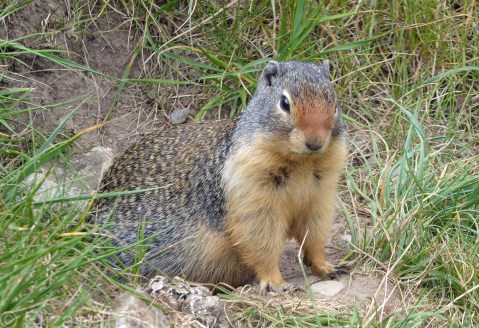
We Albertans call these gophers. They live in underground burrows and spend much of the year hibernating. As far as rodents go, they’re kinda big — typically about a foot in length.
I took this photo last summer.
Happy Easter!

Fountains Abbey Church, Yorkshire, England, October 1996
Canada 150: Cavell Glacier
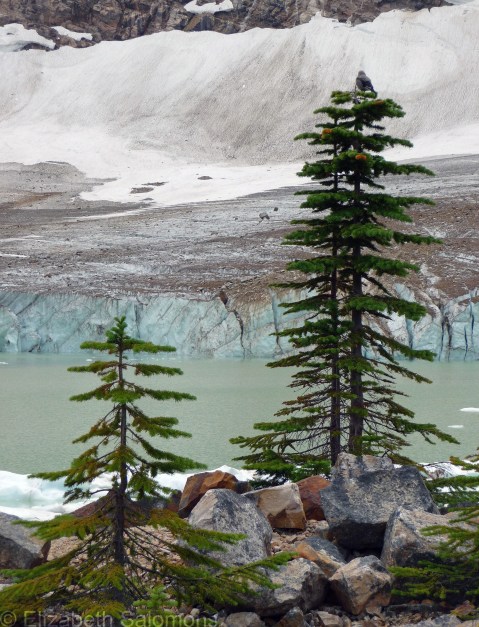
Cavell Glacier in Jasper National Park is one of the most easily accessed glaciers in all of Canada. It lies at the bottom of Mount Edith Cavell and can be reached by a short (less than 1 km) hike. Cavell Pond was formed from the glacier’s meltwater. It’s turquoise because of all the glacial silt suspended in the water.
I spent every summer of my childhood exploring the Rocky Mountains with my family. The mountains are a pretty spectacular playground for kids, but I don’t think I truly appreciated them until I returned on my own as an adult. Now, I don’t take them for granted. Ever.
If you’ve been to Banff or Jasper, you know what I’m talking about. If you haven’t, put the parks on your bucket list. You won’t regret it.
Through My Lens: Fountains Abbey Windows
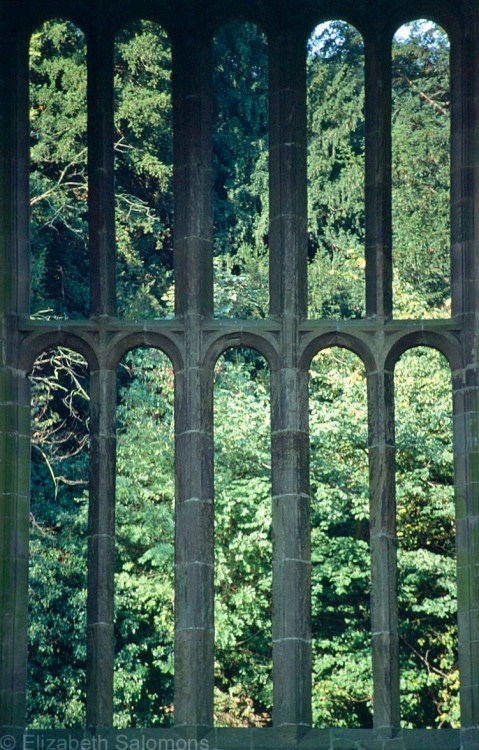
For Palm Sunday, I’m posting a photo of a wall of windows from Fountains Abbey. These windows are located on the bottom level of the abbey’s tower, which was built not long before the abbey was surrendered to the Crown. As I explained last Sunday, after the surrender, the lead and glass were removed from all of the abbey’s windows, allowing in the elements and causing the abbey to quickly fall into ruin.
The Crown sold Fountains Abbey to a merchant from London. Eventually, it was purchased by Sir Stephen Proctor, who used stone from the abbey to build a home for his family. It took from 1598 until 1611 to build that house, which he named Fountains Hall.
What was left of the abbey became the estate’s “folly” — essentially a giant lawn ornament. Such features were common in formal English gardens.
Since 1983, Fountains Abbey has been owned by the National Trust. It was declared a World Heritage Site by UNESCO in 1986.
Through My Lens: Fountains Abbey Narthex
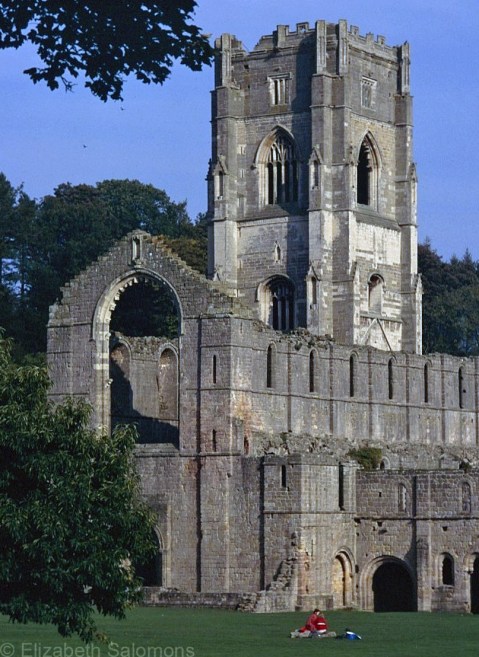
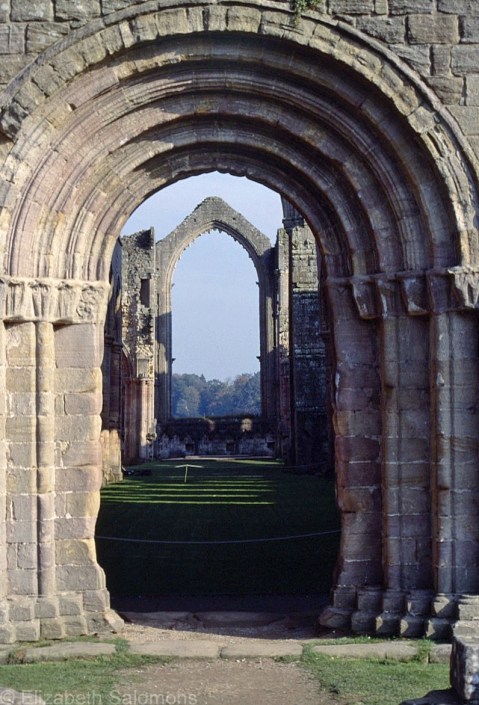
Here is a photo of the narthex of Fountains Abbey, which I am posting for the Fifth Sunday of Lent. A narthex is the entrance to a church. Nowadays, we usually call it a foyer.
You get an idea of the size of the church at Fountains Abbey from this photo. It wasn’t until I visited this abbey that I began to understand why so many of England’s abbeys lie in ruins. Which is ironic, considering that Fountains Abbey is one of the best-preserved abbeys in all of England.
It’s because once you take away the roof, the building doesn’t stand a chance against the unpredictable English weather.
Why is there no roof? That’s easy. When the deed of surrender was signed at Fountains Abbey in 1539, the abbey had to be made unfit for worship. The roof was torn off, and the windows were stripped of their lead and glass. Some of the stone was carted off to be used for building projects elsewhere; the rest was worn down by the elements. During the Dissolution, many of the abbeys were also burned to ensure that the monks would leave.
The Dissolution came about because of Henry VIII’s break with the Catholic Church. More than 900 religious houses — home to some 12,000 people — were destroyed between 1536 and 1541. Initially, the proceeds from the monasteries was intended to provide an income for the Crown, but eventually many of them were sold off to fund Henry’s wars.
Canada 150: Tr’ochëk

Here is one last photo from North of 60. This is fireweed, the official flower of Yukon. It takes its name from the fact that it is one of the first plants to grow after a forest fire.
I took this photo at Tr’ochëk, a former settlement of the Tr’ondëk Hwëch’in First Nation. It’s also known as Moosehide. Located about 5 km down the Yukon River from Dawson City, the settlement was abandoned in the 1960s after its only school was closed. Today, it is an important gathering place and a seasonal fishing camp for the Tr’ondëk Hwëch’in First Nation.
Canada 150: Inuvik
Our road trip up the Dempster led us, eventually, to Inuvik. Located 200 km north of the Arctic Circle, Inuvik was built in the 1950s in its present location in the Mackenzie River delta to function as the region’s administrative centre.
Inuvik is the northernmost point of Canada that I’ve ever been to. Until this year, it was also the northernmost point in Canada that you could drive to in the summer. In the winter, the Dempster Highway continues north to Tuktoyaktuk for another 194 km along an ice road formed on the channels of the Mackenzie River delta and the Arctic Ocean. This ice road was only open during the winters, but is being replaced by a new all-season road scheduled to be finished by the end of next summer.
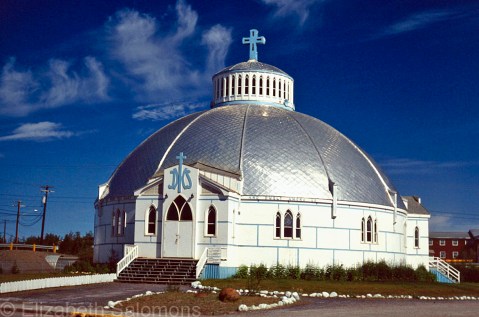
Our Lady of Victory Parish, or the Igloo Church as it is often called, is the community’s Catholic church. It was designed by Brother Maurice Larocque, a missionary from Quebec who spent his entire ministry working in the North. Before he became a priest, he was a carpenter, and he used his skills to design a church that reflected the people who would worship in it. The church was built in the shape of an igloo to be able to deal with the shifting permafrost it stands on.
The Igloo Church is the most photographed building in Inuvik. Naturally, I had to take a photo, too.
Through My Lens: Fountains Abbey Nave
Without the lay brothers who built the abbey and did all the daily chores necessary to keep body and soul together, Fountains Abbey would never have become as wealthy as it did. At the time of Dissolution, the abbey’s land holdings had increased to 500 acres, making it one of the richest religious houses in England.
Which also made Fountains Abbey awfully attractive to Henry VIII, who used the proceeds from dismantling England’s abbeys to fund his military campaigns. (More on that next week.)
For today, the Fourth Sunday of Lent, I’m posting a photo of the nave of Fountains Abbey. Imagine, if you will, that the roof is still in place and the monks are singing and chanting as they process down this nave towards the Great East Window.
Canada 150: Tsiigehtchic

This photo is of Tsiigehtchic, which is where the Mackenzie River meets the Arctic Red River, and where the Dempster Highway crosses the Mackenzie River. Vehicles cross by ferry in the summer. In the winter, there is an ice crossing.
Tsiigehtchic is the Gwich’in word for “mouth of the iron river.” Iron river (Tsiigehnjik) is their name for the Arctic Red River.
Nagwichoonjik, or “river flowing through a big country,” is what the Gwich’in call the Mackenzie River. The Dene call it Deh Cho, which means “big river.” And its Inuvialuktun name is Kuukpak, which means “great river.”
In case there is any doubt, the Mackenzie is a big river. At 4241 km long, it’s the largest and longest river in Canada, and the second largest and longest in North America. (Only the Mississippi is longer.) The Mackenzie River’s watershed covers one-fifth of Canada’s land mass.
The river got its English name from Alexander Mackenzie, who followed its length to the Arctic Ocean in 1789. He hoped the river would empty into the Pacific Ocean. When he realized it did not, he is said to have named it Disappointment River.
That’s an awful lot of names for one river. Whatever you call it, it’s worth crossing.


 There and Back Again