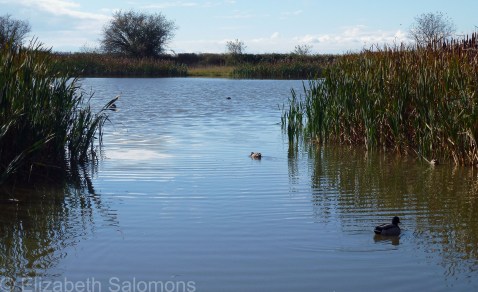
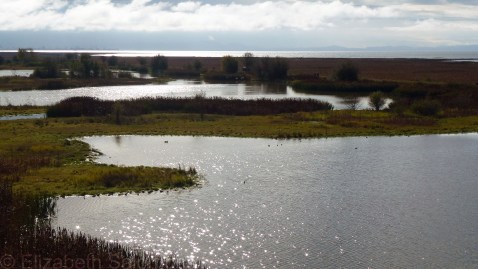
Through My Lens: Nitobe Memorial Garden in the Fall

More than a year ago, I posted a photo of Nitobe Memorial Garden in all its spring glory.
Here it is in the fall. Glory.
Through My Lens: Zaanse Schans

To finish out the month, here’s a photo of the windmills at Zaanse Schans. Zaan is the name of the river that runs past the village and Schans comes from the Dutch word for “earthwork.” The Dutch are fond of moving earth, but what’s special about this one is it dates back to the Eighty Years’ War when the Dutch and the Spanish were going at it.
Zaanse Schans is a popular spot with tourists as it’s only a 15-minute train ride from Amsterdam and has several working windmills. Although I once spent part of a summer in the nearby town of Zaandam on my first-ever home exchange, this photo was taken several years prior to that visit, in late autumn.
A lovely corner of Holland any time of year, to be sure.
The Chan Centre
When I was blogging about spectacular European opera houses last spring, it occurred to me that spectacular Canadian opera houses are few and far between.
No matter. We do have some spectacular concert halls.
This is a photo of the Chan Centre. Located on the Point Grey campus of the University of British Columbia, it was designed by the Vancouver-based architect Bing Thom. Its main concert hall is shaped like a cello and the acoustics are state of the art.
This time of year, the Chan looks particularly spectacular.

Nelson Park
Stanley Park gets a lot of attention from Vancouver’s visitors, but it’s not the only park in Vancouver’s West End. One of my favourite parks ― so much so I try to walk through it each and every time I head downtown ― is Nelson Park.
Nelson Park is a small park, but it’s a busy park. Only one city block big, it shares that space with Lord Roberts Annex (a K–3 primary school) and its playground, which takes up about a quarter of the block. Several dozen community garden plots line the park’s walkways and the West End Farmer’s Market is held alongside the park every Saturday from May to October. Because the park is located kitty-corner to St. Paul’s Hospital and across the street from the Dr. Peter Centre (an assisted-living residence for adults living with HIV/AIDS), it’s not unusual to see patients making use of the park on warm, summer days.
But my favourite corner of Nelson Park is the fenced-in off-leash dog park, one of a handful in Vancouver’s West End. Walk past it after work any day of the week to witness Doggy Happy Hour ― complete with wagging tails.
Here is a photo of Nelson Park in all its fall glory.

Highway 2

A week ago today, I hitched a ride down Highway 2 from Edmonton to Red Deer with my brother and his family. As we left the city’s outskirts, I had some fun teasing my nieces that they were doing a good job of ignoring their old aunt. (Their noses were glued to their devices.) Even my brother was planning to spend the two-hour drive alone ― with his book.

No matter. Within minutes, I was enthralled.
Eventually, my brother, too. His book lay forgotten in his lap.

Someone once told me they thought Highway 2 was the most boring stretch of road anywhere in Canada.
I beg to differ. I think it’s the most beautiful.
Through My Lens: Capri

I can’t help myself.
It’s not like I need a reason to post a photo from Italy ― give me five minutes and I can come up with the slightest excuse.
Today’s pretext? Two friends of mine are on their way to the Amalfi Coast for what I’m sure is a much-needed and well-deserved taste of la dolce vita.
I took this photo from the top of the island of Capri in October 2002. That’s the Sorrento Peninsula off in the distance.
Salt Spring Island Fall Fair

Yup. It’s another cow.
And no, this hasn’t turned into a Bovine Blog.

I took these photos a couple of weeks ago at the Salt Spring Island Fall Fair. My friend had been urging me to come over for the island’s annual fair, which, she claims, is the social event of the year for Salt Spring Island.

“Will there be cows?” I asked.
“Yes,” she said.
“I’m there,” I said.

Salt Spring Island has a long history of farming ― the island was first known for its fruit harvests, then the dairy and poultry farmers arrived. These days, Salt Spring is famous for its lamb …

… and for its cheese made from goats’ milk.

In keeping with that history, the Salt Spring Island Fall Fair has been an island institution since 1896. This year’s theme was Celebrating Family Farming to coincide with the United Nations declaring 2014 the International Year of Family Farming. (I so wish I had made it to last year’s fair: its theme was Pirates of the Carrots and Beans.)
It seems like everyone on the island has something to exhibit at the Fall Fair ― from livestock to produce to baked goods to flowers to handcrafts.

Although the sheepdog demonstration was fascinating and the zucchini races were, um, unlike any race involving green vegetables I’ve ever seen, my favourite event was the sheep shearing.

The shearer showed us how shearing used to be done ― with a big, shiny pair of blade shears …

… and then he showed us how it’s done today ― with powered machine shears.


The Salt Spring Island Fall Fair takes place every September. If I’m feeling in a year that my blog needs more cow photos, I now know where to go.

Through My Lens: Irish Cow

Now that I have cows on my mind, I can’t resist posting this photo. This cow was happily munching away when I rode past her, again on a bike, but this time in Galway, on the west coast of Ireland.
(And no, I did not lie on the ground to take this shot — the road and pasture were at slightly different elevations, about four feet apart. At the bottom left of the photo, you can just see the top of the stone wall that lined the road my friend and I were cycling along.)
Echte Nederlandse Koe

I’ve taken the train from Paris to Amsterdam many, many times. One of those times, I spent much of the journey eavesdropping on the idle talk of a Dutch couple sitting behind. From the way they spoke to each other, I surmised they might be brother and sister.
I’m by no means fluent in Dutch, so much of their conversation was way over my head. Except for shortly after we crossed the Belgium–Dutch border, when the woman said something I understood perfectly.
Nu is ere en echte Nederlandse koe. (Now there is a real Dutch cow.)
I smiled to myself. Could a cow seen from the window of a high-speed train possibly look more Dutch than Belgium or French? Really?
Really.
I knew what she meant. She was home ― back in her own country ― and everything looked familiar again. Oddly enough, I’ve always had the same feeling when travelling to the Netherlands from somewhere else by train ― only because, out of all the countries in western Europe, the Netherlands is the most familiar to me. It’s not my home, but crossing the Dutch border always feels like a home-coming of sorts.
I took the above photo while cycling through the Dutch countryside just outside of the city of Arnhem ― only because these cows struck me as particularly fine-looking specimens of Nederlandse cows.
Arnhem
On my first ever trip to the Netherlands ― the one that instilled in me my rampant travel bug ― our family visited Arnhem, the city where my mother was born and lived for the first ten years of her life before immigrating to Canada.
One morning, we went for a walk in a wooded park known as the Rozendaalse Bos. I noticed many damaged trees and asked Mom what the scars were from.
“Oh, those are probably from the war,” she said. “There was a lot of fighting around here.”
She said it so casually that I was shocked. The war (and by “the” war she meant World War II) was distant history ― so I thought ― and yet here was concrete evidence in trees still living. Maybe not such distant history after all.
That walk in the woods sparked in me a lifelong interest in learning more about World War II and what happened in Holland during those years. But it wasn’t until after my visit to the Normandy beaches with my dad that I began to do some serious research into exactly what happened to my mother’s family during the war.
I began by showing my uncle some letters my grandmother had written to me (at my request) about her childhood and experiences in Holland during the war. To my surprise and delight, he translated them for me (they were written in Dutch). After I read them, he and I spent a sunny, summer afternoon in his backyard, talking about the war and, in particular, his own personal experiences. He was able to fill in a lot of the gaps in the stories my grandmother had written down for me and the others that my mother had told me.
After I had exhausted my uncle with my questions, I began to read books. Many books. Much has been written ― is still being written ― about what happened in Arnhem during the war. Eventually I stopped reading and decided I had to visit Arnhem on my own.
I made several trips, each time exploring the quarter where my mother grew up as well as the rest of the city. I walked some of the streets I had read about in all those books. Much of what my uncle had told me, and much of what I had read about, came alive for me in the way that can only happen when you visit a place in person.
In 1944, Arnhem was the site of a major offensive by the Allied forces called Operation Market Garden. It was the largest airborne operation ever attempted, and was meant to hasten the end of the war by having the Allied forces leapfrog over the German lines into Holland. Once there, they would be in range of the industrial heartland of Germany. Capturing and holding three bridges over the Rhine River ― one at Eindhoven, one at Nijmegen, and one at Arnhem ― was the key to the whole operation. The American 82nd and 101st airborne divisions landed respectively at Nijmegen and Eindhoven and the British 1st Airborne Division landed at Arnhem.

Despite holding the bridge for days longer than planned, the British paratroopers ultimately had to withdraw. The bridge at Arnhem turned out to be “a bridge too far.” (That was the name given to Sir Richard Attenborough’s Hollywood film about Market Garden, which I watched on TV with my mother and grandmother not long after my first visit to Arnhem. And, yes, I peppered them both with questions during the entire movie.)
My mother’s family came through the battle relatively unscathed. Although their house was less than three kilometres from the bridge and they could hear the fighting, they were free to walk through the streets of their neighbourhood even while the centre of the city was under fire.
It was after the battle, when the Nazis evacuated the entire city, that things got rough. My mother remembered living in a barn ― my uncle told me it was only for a week. When the Germans told them to leave the area, they said, “But what about our cows?” The Germans replied, “Oh, you can go live over there,” and waved them off. “Over there” was a neighbourhood near the edge of the city that had already been evacuated.
They lived there, in someone else’s house, for almost a year. Not only did they and all the citizens of Arnhem have to wait for the city to be liberated by the Canadians, but it took months for the soldiers to clear the city and the houses of all the mines and booby traps left behind by the Nazis. My grandparents hid all of their canned goods under the floorboards before they left their home, but none of it was there when they returned. The Nazis had systematically looted most of the city.
My uncle spent most of that winter trying to evade the Nazis who were rounding up boys for the arbeitsdienst. (Military training with a shovel, he called it.) The Nazis took him once while he was taking care of the family’s cows, and another time during a razzia (raid) when he went for a short visit to the house where the rest of the family was living. He escaped both times, the second time by lying down in a ditch and pretending to be dead. He told me he was lucky he wasn’t shot.
And the final, most awful hardship of the war for my mother’s family was losing a son and brother (another of my uncles) who was killed by a piece of shrapnel from a shell that exploded in front of the house where they spent that winter. He was thirteen years old and Arnhem had been liberated just the day before.
It wasn’t until after I wandered through the neighbourhood where my mother’s family spent the winter of 1944 to ’45, on one of my visits to Arnhem, that all the pieces of the stories I had been told by my mother and grandmother and uncle came together for me ― the Rozendaalse Bos, which is the wood where my mother told me was the scene of so much fighting, was only a couple of kilometres distant. It was not hard to imagine how a stray shell ended up in front of their house, killing my uncle.
I’m writing this post because today is the 70th anniversary of the start of Operation Market Garden. Arnhem commemorates the anniversary every year, but it’s not the battle they’re celebrating. They’re celebrating the British paratroopers who tried so hard to end the war early for them. Annual events include a service at the Airborne Cemetery at Oosterbeek and a parachute drop by serving British paratroopers at Ginkel Heath (one of the drop zones during the battle).
I was in Arnhem in 2004 for the 60th anniversary. That year there was also a veterans’ parade across John Frostbrug and a convoy of vintage military vehicles from Oosterbeek to Arnhem. The applause for the soldiers never stopped; watching the Dutch people respond to the British vets, I couldn’t help but wonder what it would have been like to watch the Allied soldiers march past at a time when the Dutch were so desperate for the war to be over.
I watched the TV news that evening; one of the vets interviewed talked about what a mess they had made of the city and how it had pretty much been destroyed. “And yet,” he finished, “they love us!” While watching the parade on the bridge, I overheard another vet tell his family how he hadn’t paid for a single meal or drink since his arrival ― the Dutch kept picking up the tab.
And that was the moment. I realized then, finally, while eavesdropping on a vet and his family, that the hardships my mother’s family endured weren’t much different from what a lot of Dutch families ― and the Allied soldiers and their families ― went through during the war.
Each of us travels for a variety of reasons; researching your family’s history can be a powerful one. A walk through a battle-scarred wood set me off on a journey to find out what happened to my mother’s family during the war, culminating in a visit to Arnhem on the 60th anniversary of Operation Market Garden. They’re all gone now ― my mother and her family. But I’m so very glad I thought to ask them so many questions when I had the chance.