
Recipe Box: Bitterballen
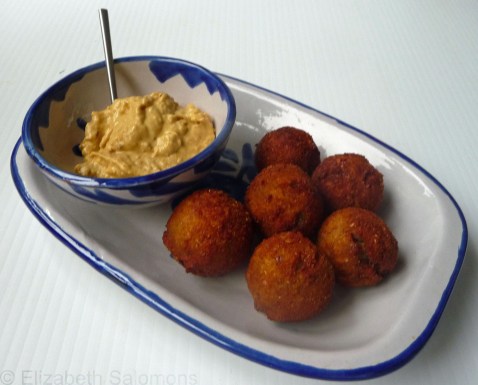
Every year around the holiday season, my mother used to make bitterballen. These little morsels are a savoury Dutch meat snack that (in our household at least) disappeared faster than Mom could make them.
In the Netherlands, bitterballen are served as bar snacks alongside alcohol. (A direct translation of bitterballen would be “balls to eat with bitters.”) I’ve had tapas in Spain that look exactly like bitterballen but are made with fish. (Which makes me wonder if the Spanish introduced the snack to the Low Countries. You know, back when they were the boss of them between the sixteenth and eighteenth centuries?)
Another version of the same Dutch snack in cylinder form are called kroketten (croquettes). These you can buy for a couple of euros in vending machines all over the Netherlands. You can imagine our delight when my brother and sisters and I saw kroketten so readily available on our first ever trip to Holland as kids. Christmas treats in a vending machine!?! How cool was that?
There’s a story behind the first time I made bitterballen myself. I was going to a party hosted by an Italian-Canadian friend of mine where there would be many other Italian-Canadians, and I wanted to bring something special. Now, I have to confess that, as a child of Dutch immigrants, I didn’t always like identifying myself as Dutch-Canadian. I would firmly tell my mother when she insisted I was Dutch that I was not. I was just a plain Canadian. No hyphens, please.
But back to the party. Hanging out with my Italian-Canadian friends had shown me a group of Canadians who completely and firmly embraced their heritage in a way that I had not been comfortable doing. Following their example, I decided it was time for me to embrace my heritage. And so, I brought a plate of bitterballen to the party and proudly placed them on the table beside the cannelloni and tiramisu.
The bitterballen were a hit and I’ve made them every Christmas since, sharing them with my friends of all ethnic origins. I find it ironic that it took a bunch of Italian-Canadians to help me appreciate my Dutchness, but there it is. I’m grateful to them for it.
Eet smakelijk!
Bitterballen
2 tablespoons butter
1 small onion, chopped
3 tablespoons flour
1 cup milk
1 tablespoon dried parsley
1 teaspoon salt
1 teaspoon Worcestershire sauce
1/4 teaspoon curry powder
2 cups ground cooked meat*
1 1/2 cups grated Gouda cheese**
2 eggs***
2 tablespoons water
1 1/2 cups bread crumbs
vegetable oil
1. Melt butter in a saucepan.
2. Sauté onion in the butter until soft.
3. Add flour, blend well, and cook for 1 minute.
4. Slowly add the milk. Cook until thickened, stirring constantly.
5. Add parsley, salt, Worcestershire sauce, curry powder, cooked meat, and cheese. Cook for another 5 minutes, then allow mixture to cool.
6. Mix the eggs and water together in a small bowl, and pour the bread crumbs into a second small bowl.
7. Shape the cooled meat mixture into small bite-sized balls about an inch in diameter.
8. Roll the balls in bread crumbs, the egg-and-water mixture, and bread crumbs again. (If you intend to freeze them, use three coats of bread crumbs.) Chill balls for at least an hour.
9. Heat the vegetable oil in a small sauce pan, then fry the bitterballen until golden brown (about 2 minutes). Drain on paper towels, and serve with your favourite mustard for dipping.
Notes:
*Ground roast beef is traditional, but use whatever type of meat or seafood you fancy. My mother used ground beef because there was rarely leftover roast beef in our home, and I do the same.
**Mom didn’t add Gouda cheese, but the recipe I use does and I like the flavour. The cheese also gives the meat mixture a firmer consistency for rolling.
***I find I usually need more than 2 eggs. Simply add another egg and tablespoon of water to the bowl as needed.
Dishing: Monk McQueens

Last night was one night I regretted showing up late to the party. Monk McQueens at Stamps Landing on the south side of False Creek has been a Vancouver landmark ever since it opened during Expo 86. And yet, I’d never been. The announcement that it was shutting its doors for the last time on December 31 of this year was what finally motivated me to experience this famous fresh seafood and oyster bar for myself.
I made an occasion of it by reserving a table for the same night a friend from Boston was going to be in town. And so, five of us gathered last night to enjoy a leisurely dinner and a bit of a catch-up. Our table in one of the corner windows gave us a terrific view of False Creek.
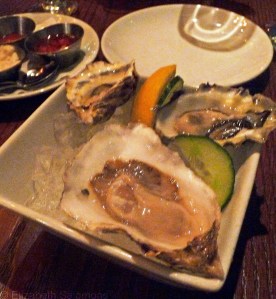
The food was delicious. My Bostonian friend and I shared a half dozen oysters on the half shell. For our mains, our party of five sampled almost every type of seafood on the menu: halibut, sea bass, sablefish, lobster, and scallops. We washed it all down with a very nice bottle of wine, and finished with coffee, brown sugar vanilla bean cheesecake, and Calvados. I can’t think of a nicer way to spend four hours with good friends on one of the last nights of the year.
Mahony & Sons Public House is moving in after Monk’s vacates the premises and will open sometime next summer. As much as I enjoy a good public house, it won’t be the same. Last night was proof that just because an establishment has been around since the Dark Ages (aka the 1980s) doesn’t mean it should be taken for granted. Pity I did.
Merry Christmas!
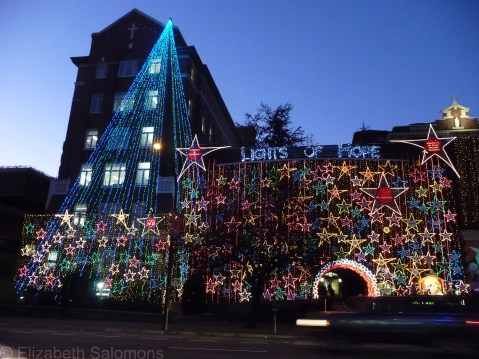
St. Paul’s Hospital, Vancouver
Christmas Markets
A co-worker of mine went to the Czech Republic earlier this month. When I found out where she was going for her holidays, my eyes lit up.
“The Czech Republic?!” I said. “Are you going to the Christmas markets?”
She smiled. “Of course!” she said.
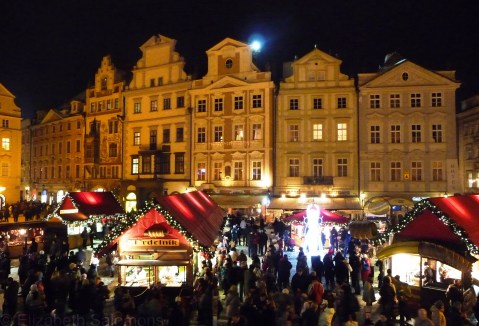
Christmas Market, Prague
She explained that the main purpose of the trip was to visit her grandmother who lived somewhere out in the Czech countryside, but her family also had plans to stop off in Prague, and were going to make a special trip to Nuremberg, Germany, just to see its Christmas market.
Christmas markets have been around since the Middle Ages. They are common throughout Western Europe and are especially prevalent in Central Europe. In recent years, they’ve been popping up all over England and North America, too. Common elements include chalet-like stalls set up in town squares, which sell handicrafts, toys, Christmas ornaments, lots of tasty treats, and the ubiquitous Glühwein (mulled wine).
I can’t remember when or where I first heard of Christmas markets, but a couple of years ago when I knew I would be spending the winter in Paris, I was determined to experience as many as I could.
The first Christmas market I came across that winter was unexpected, as it was mid-November and Christmas was far from my mind. I was in Seville, Spain. The market was in the square near the massive cathedral, and contained stall after stall selling wooden nativities. The nativities were works of art, truly. Each figure was sold separately and cost far more euros than I had to spend.
In Madrid, the Christmas market in Plaza Mayor dates back to 1860. It too was filled with stalls selling wooden nativity figures.

Plaza Mayor, Madrid
Steps away from Plaza Mayor, I stumbled across a smaller market in Plaza Santa Cruz with a more light-hearted carnival atmosphere. Its stalls were selling costumes, wigs, and accessories for Dia de los Santos Inocentes on December 28. (This is the Spanish equivalent to our April Fool’s Day, though its origins are rather sombre: the day commemorates the massacres of the “Holy Innocents” ― the children murdered by Herod in his search for the newborn king the wise men had told him about.)

Plaza Santa Cruz, Madrid
In Paris, there are Marchés de Noël in almost every arrondissement. I made it to three. The market at Trocadéro is probably the most picturesque as it’s situated across the Seine from the Eiffel Tower. It also has a popular skating rink.

Trocadéro, Paris
Saint-Germain-des-Prés is a much smaller market, with stalls nestled along Boulevard Saint-Germain and around the church of Saint-Germain-des- Prés.

Saint-Germain-des-Prés, Paris
The market along Avenue des Champs-Elysées is massive, and runs all the way from the giant Ferris wheel at Place de la Concorde to the Franklin D. Roosevelt métro station. It consists of several blocks of stalls selling vin chaud, crêpes, chocolate, sausages, and all sorts of handicrafts. Every block or so there was a heater where you could warm your hands. We walked the entire length of this market on Christmas Eve.

Christmas market stalls along the Champs-Elysées, Paris

All the chocolate you could wish for along the Champs-Elysées, Paris
Although Paris is a magical time to be in December, the Christmas markets I was most excited about seeing were in the Czech Republic. I was thrilled to see the Old Town Square of Prague once again, but I could never have imagined how pretty it would look at Christmastime.
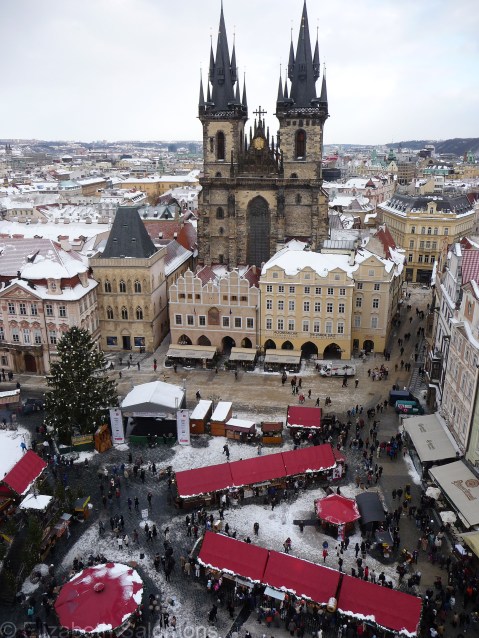
Christmas Market, Old Town Square, Prague
The lights were impressive, and there was an enormous Christmas tree as well as a nativity, a stage where children were singing Christmas carols, and hundreds of red-roofed stalls selling food and toys and ornaments.

Old Town Square with the Old Town Hall and St. Nicholas Church behind

Children singing carols
I enjoyed a trdelník ― a sweet pastry baked over hot coals and sprinkled with sugar and nuts ― and later a massive slab of spit-roasted ham. To keep warm, I bought mug after mug of Glühwein ― in Czech, it’s called svařené víno. There was another, smaller market in Prague’s Wenceslas Square with much of the same, although not as prettily lit.
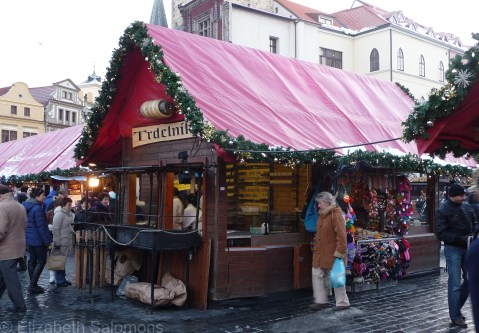
Trdelník stall
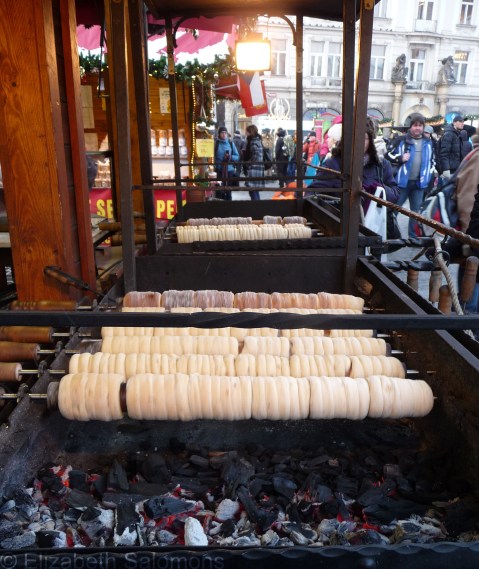
Trdelník baking over hot coals

Hams roasting on spits
The next day, I travelled to Český Krumlov. Its small, intimate Christmas market had the feeling of a neighbourhood bazaar, with local artisans selling their handiwork, and the local school putting on a Christmas concert after dark.

Old Town Square, Český Krumlov
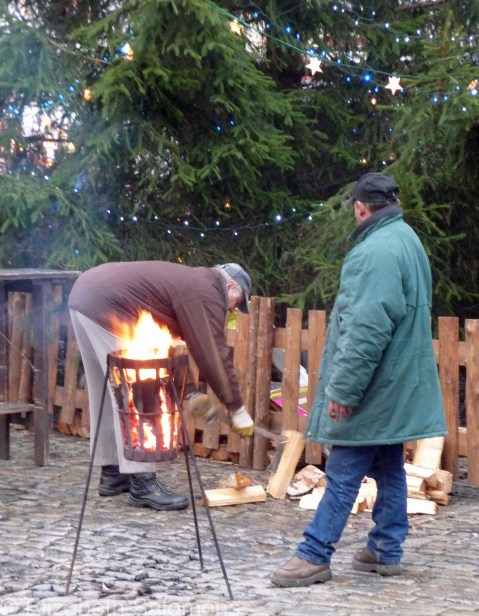
Keeping warm in Old Town Square, Český Krumlov
I don’t know if I will ever make it to Nuremberg, the granddaddy of all Christmas markets ― my co-worker said there were over 200 stalls there ― but, even so, seeing the Spanish, French, and Czech Christmas markets was something already. If you need an excuse to visit Europe in December (seriously? who ever needs an excuse to go to Europe?), I highly recommend going for the Christmas markets.

Christmas trees and Church of Our Lady before Týn, Prague
There and Back Again Is One Year Old
 Yup. It’s been a year. That’s 89 posts posted, 282 photos uploaded, and who knows how many words written.
To celebrate, I’ve bought the domain for thereandbackagain.ca. If my tech skills are any good, you all should be able to find me there within a day or two. (The old address will continue to work, but traffic will automatically be redirected to the new address.)
And if I can just say this for the record: I had no idea when I started this blog and picked the name There and Back Again that Peter Jackson was intending to release his first Hobbit film the same weekend I’d be celebrating my first blogiversary. All I can say is: very odd coincidence, that.
After a year, however, I can also say that I still like the name very much, despite the teasing from a friend who, a few days after my first post a year ago, looked at it on his iPhone and said to me, “You started a blog about hobbits??”
The name There and Back Again suits what I envisioned this blog to be: a place to post photos and tell stories about my adventures while off on walkabout, but to also show off my town to anyone on the Interweb who’s considering a visit to Vancouver. It’s a beautiful world out there, and it’s a beautiful city right here.
So, here’s to a year of blogging. I hope you’ve enjoyed the journey as much as I have. Stay tuned: there are lots more photos and stories to come.
Through My Lens: Snow on the Mountains

Every once in a while, this time of year, the rain stops for a day, and you get a peek at what all that precipitation has done to the local mountains. I took this photo two days ago.
Through My Lens: December
I’m always glad to see the back side of November. I know, I know ― it’s a miserable month everywhere in Canada, not just here, but for some reason, out of all the places in Canada (and elsewhere) I’ve wintered, I find Vancouver’s Novembers the hardest to get through. Which is pretty ironic given the Lower Mainland’s nickname: “The Tropics of Canada.”
As soon as I flip the calendar over on the morning of December 1st (metaphorically speaking, of course, since I don’t actually have a wall calendar anymore), I feel so much better. December is when I shake off my November blues, and realize that the city has put on its glad rags when I wasn’t looking. Even the Scroogiest of Scrooges cannot help but feel a little festive.
Here’s an example: Robson Square. I’ve loved its light displays since my first ever office job in downtown Vancouver as a fresh university grad, when I would wander through the square after dark on my way to catch the bus home. The ice rink ― shut down for many years ― was refurbished for the 2010 Olympics, and has been open every winter since.

Through My Lens: Vancouver in Fall
Before the calendar flips over to December, and I have to finally, reluctantly, grudgingly admit that it really is winter, here’s one last photo showing Vancouver’s fall colours at their best. I took this photo from Burrard Bridge in mid-October 2011.

Fort McHenry and Fort York
This year being the bicentennial of the War of 1812, we Canadians have been bombarded with what strikes me as an odd media campaign celebrating our nationhood. Odd, because we Canadians don’t typically yell and shout out our patriotism. Odd, because videos like this one
seem to be doing a pretty good job at celebrating our nationhood at the expensive of the other guys. You know, the ones who are suppose to be Canada’s Best Friend. Longest undefended border and all that.
Truth is, I don’t remember ever being taught anything in school about the War of 1812. That might be because I was (mostly) educated in Alberta, and the war took place in Upper Canada (what we now call Ontario), Lower Canada (what we now call Quebec), and the United States. Or maybe it’s because we Canadians don’t really give that war much thought.
What little I know about the War of 1812 is that it had something to do with the British boarding American merchant ships and drafting American sailors into the British Navy. (Britain was busy fighting Napoleon at the time and needed all the sailors it could get its hands on.) The Americans didn’t like that much (who would?) and they declared war on the British.
What little I have read about the War of 1812 says that nobody actually won. It more or less came to a stalemate, and sometime in 1814 the powers that be worked out an agreement called the Treaty of Ghent that more or less left everything pre-war as the status quo. And ― oh yeah ― we burned the White House. That was in retaliation for the Yanks burning our Parliament Buildings in York (what we now call Toronto), which was then the capital of Upper Canada.
(As an aside: burning government houses was considered bad form back then, and trashing non-military targets simply wasn’t done in the age of the Gentlemen’s War. Which is why the Brits got a tad upset and why they turned around and burned the White House. I find it ironic that everybody remembers the Brits burned the White House, but nobody seems to remember that the Americans burned York.)
(And, just one more aside: I found out during my visit to Washington DC last summer that the White House came to be called that because, after said burning, it was painted white to cover up all the soot marks. President Theodore Roosevelt made it official almost a hundred years later by having stationery printed with the words “The White House” at the top.)
Back to the war: a more accurate assessment of the War of 1812 might be that we both won. The Americans call it their “second war of independence,” and after it was over we Canadians began to think of ourselves as a nation, and not just some fur trading post for the British.
And so (finally!), to the main topic of this blog post. On my visits last summer to Baltimore and Toronto, with the War of 1812 being foremost in my mind due to our tax dollars hard at work, I decided to visit Fort McHenry and Fort York.
 Fort McHenry, I discovered, is not just a National Historic Monument, but a National Monument and Historic Shrine. That was pretty much evident during the video presentation I watched at the Visitors’ Center. The last image of the video, with the American anthem playing after the voice-over ends, is of the American flag. At the same time, the screen rises so that you are looking outdoors at the American flag flying over Fort McHenry. I tried not to snicker, but it was a bit hokey.
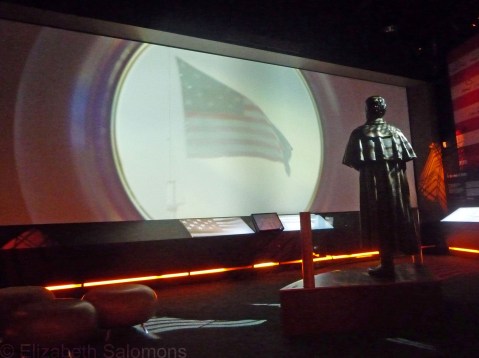
The end of the video presentation at the Fort McHenry Visitor’s Center. The statue is of Francis Scott Key, and he’s watching the Star Spangled Banner, still waving strong after the British bombarded the fort with rockets and guns for 25 hours.
Back to the War of 1812: the British knew they needed to capture Fort McHenry if their campaign against Baltimore was to succeed. They attacked the fort at dawn on September 13, 1814, bombarding the fort for a day and a night, but eventually they gave up and stopped the bombardment. The problem was, the American guns had a range of 1.5 miles, and the British guns had a range of two miles. The British navy parked itself just out of range of Fort McHenry’s guns, but that meant the shells from their guns couldn’t reach Fort McHenry accurately. Only two shells out of over 1500 fired actually hit the fort. Talk about a waste of ammunition.

Battery of guns overlooking the Patapsco River, with Francis Scott Key Bridge in the distance. During the Battle of Fort McHenry, the British fleet parked itself well past where that bridge now spans the river.

Another gun overlooking the Patapsco River

And yet another gun pointed at the Patapsco River
After the bombardment stopped, Francis Scott Key, an American lawyer who was being held by the British on a ship out in the Patapsco River, looked towards the fort and saw the large flag still flying. That told him the Americans were still in control of the fort. That same flag ― which measures an incredible 42 by 30 feet ― is now on display at the Smithsonian’s National Museum of American History.

When weather permits, an American flag the same dimensions of the original Star Spangled Banner is flown over Fort McHenry.
Francis Scott Key wrote the words to “The Star Spangled Banner” after the British released him and while he was on his way back to Baltimore. The “bombs bursting in air” line in the anthem refers to the British shells that were fired at Fort McHenry.
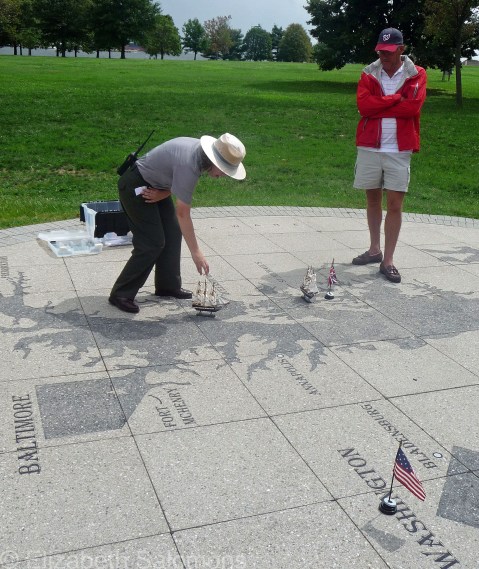
The national park ranger gives us a history lesson. I liked her model ships.
There isn’t much to see in Fort McHenry itself as it’s fairly small and there aren’t many buildings still standing. But you certainly get a feel for why its location was so important: it sits at the end of a narrow peninsula right at the entrance to Baltimore’s harbour, and is in a perfect position to defend the city. I took a water taxi out to the fort from Baltimore’s Inner Harbor, and it was a lovely, breezy way to see the harbour.

The barracks at Fort McHenry

Another view of the barracks. The barn-shaped building is the powder magazine.
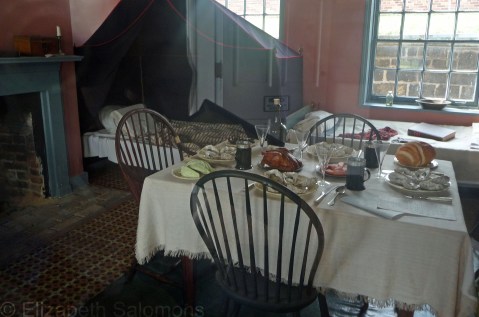
The junior officers’ quarters. Note the plates of oysters. Clearly the junior officers ate well.
Fort York, on the other hand, is located in the midst of a bustling, growing city, right beside Toronto’s Gardiner Expressway. This made for some intriguing photos as I looked for interesting angles.


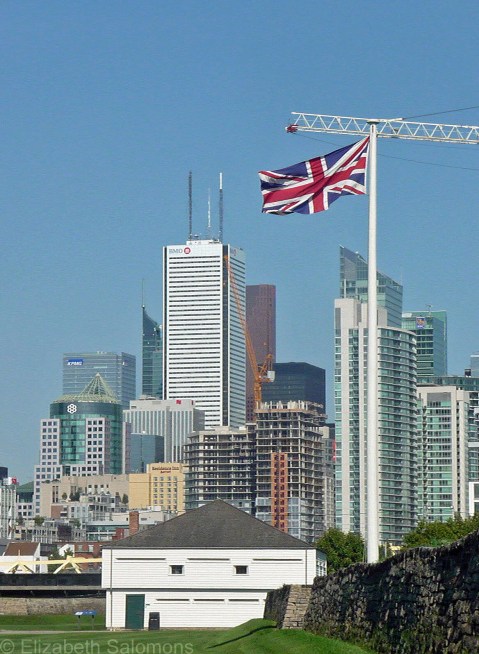


The museum displays at Fort York could use some updating, but it had many more rooms furnished in period pieces than did Fort McHenry, which makes a visit much more interesting. (Click on any of the photos below to open a slide show.)


The Americans attacked Fort York on April 27, 1813. The British were vastly outnumbered (750 British troops, 50 Mississauga and Ojibway warriors, and 12 guns vs. 2550 Americans, 15 naval vessels, and 85 cannon), and lost the battle, but the Americans suffered almost double the casualties of the British when the British blew up their own gunpowder magazine. The battle lasted six hours and cost 157 British lives and 320 American lives, including the American field commander. Afterwards, the Americans burned and looted the city of York, including the Government House and the Parliament Buildings (see above), and occupied the town for six days.

The Blue Barracks were built in 1814 to house the junior officers. These are a reconstruction.

The Brick Barracks and Mess, built in 1815, housed the unmarried officers and served as the mess for all of the garrison’s officers.

The Stone Magazine was built in 1815 and had room for 900 barrels of gunpowder. Its walls are two metres thick.
The Battle of York was a clear victory for the Americans, and marked their first invasion of British territory since the start of the war. But the battle itself wasn’t considered crucial to the outcome of the war and the Americans saw taking York merely as a stepping stone to the real prize: the Niagara Peninsula and, eventually, Kingston.
The Battle of Fort McHenry, on the other hand, was considered a turning point in the war, saved Baltimore from British invasion, and contributed to the early mythology of a nation still trying to forge its identity.
As for me, a gap in my Canadian history education has been filled, and my knowledge about the War of 1812 is now more complete. My government would be proud of me.
Through My Lens: Biomed Building
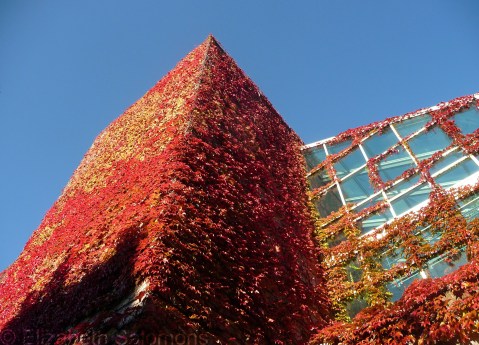
Since September, I’ve been spending most of my days at the University of British Columbia (UBC). It’s a beautiful campus located on the Point Grey peninsula of the west side of Vancouver. This is a photo I took in early October of the Biomedical Research Centre I walk by each day on my way from the bus loop to my office. I liked the contrast between the blue sky and the red ivy.


 There and Back Again