
Jour du Macaron
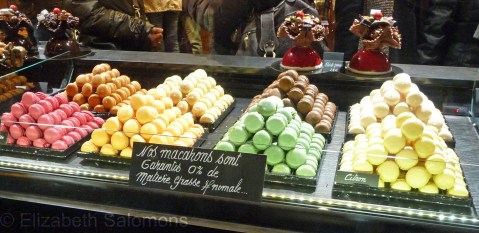
Today is Jour du Macaron (Macaron Day). The delightful French pastry is recognized every March 20 in Paris, New York, Toronto, and, for the first time this year, Vancouver.
If you’ve never enjoyed a macaron, I envy you, for there is nothing more wondrous than your first taste of this sweet meringue-based, ganoche-filled dessert. I discovered macarons for the first time two winters ago when I was in Paris. After my first bite, I moaned ― no lie ― and exclaimed, “Where have you been all my life?”
Through My Lens: Église Saint-Sulpice
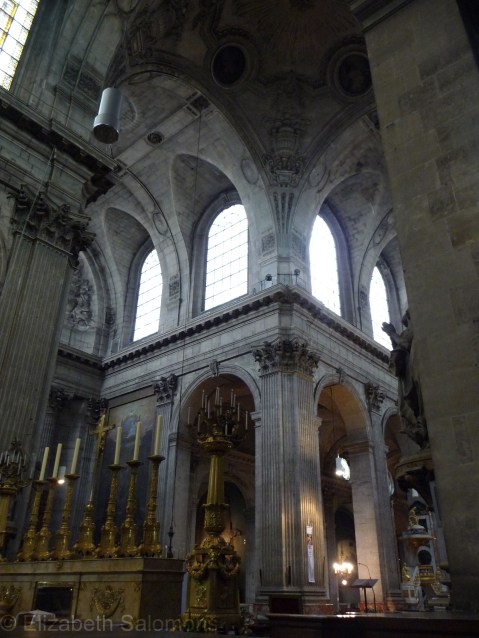
It’s the Fourth Sunday of Lent, and time for another church. This is the interior of Saint-Sulpice, located in the 6e arrondissement. Saint-Sulpice is the second-largest church in Paris ― second only to Notre-Dame ― and has one of the world’s largest pipe organs.
Through My Lens: Notre-Dame and the Basilica

For the Third Sunday of Lent, I give you not one, but two churches: Notre-Dame-de-Lorette and Basilique du Sacré-Cœur. I took this photo in January 2011 from Rue Lafitte near Boulevard Haussmann in the 9e arrondissement of Paris.
Seven Days in London

Last weekend I was out with friends who are busy planning a spring trip to England. I was pleased at how excited they are, and I had great fun answering their questions and throwing out suggestions of what I thought they had to see and do in London.
My brain kept churning after I said good-night to them, however, and by the time I arrived home I had another long list of must-sees and must-dos. At which point I said to myself, “Enough, already! There’s your next blog post half written.”
So, here it is: My ideal itinerary for a week in London.
Day 1: Direct flights from Vancouver to London arrive mid-day. Buy your Oyster card (more on that later) and take the Tube into central London. After check-in and a shower to wash the detritus of air travel off your body, set off for a few hours of sight-seeing. You’re jet-lagged, so find something simulating enough to keep you awake, but nothing too strenuous or that takes too much thought. A couple of summers ago, a friend and I zipped over to St. Paul’s Cathedral and went to Choral Evensong on our arrival afternoon. The services are held daily at 5 p.m.; for me, personally, there’s nothing more English than choral music at St. Paul’s.
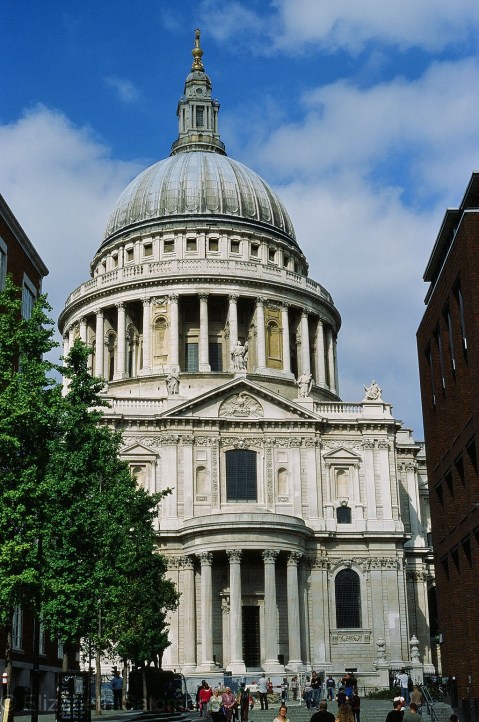
St. Paul’s Cathedral
Or, if the weather is cooperating, take a walk through one of London’s beautiful parks to stretch your legs after the long flight. St. James’s Park and Green Park are beautiful, and from either park you can catch your first glimpse of Buckingham Palace. By this point, the fact that you are in London should start to feel very real.
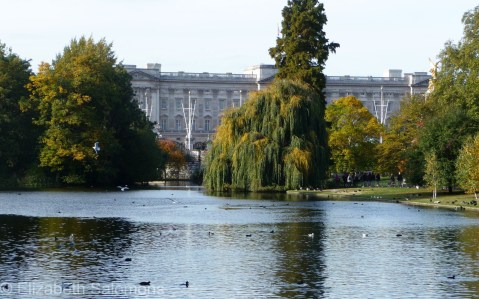
Buckingham Palace from St. James’s Park
Day 2: My friends will be in London too early to see Buckingham Palace as it’s open to the public in the summer months only. But Changing the Guard in the Palace’s forecourt takes place every second morning in the winter and daily in the summer. If you want to see this colourful ceremony, I have two words for you: Go Early. And if the crowds are too much for you, walk over to the Horse Guards Parade where you can watch a smaller change ceremony, or stake a spot anywhere along the Birdcage Walk to see the regiments as they pass by on their way to or from Buckingham Palace.
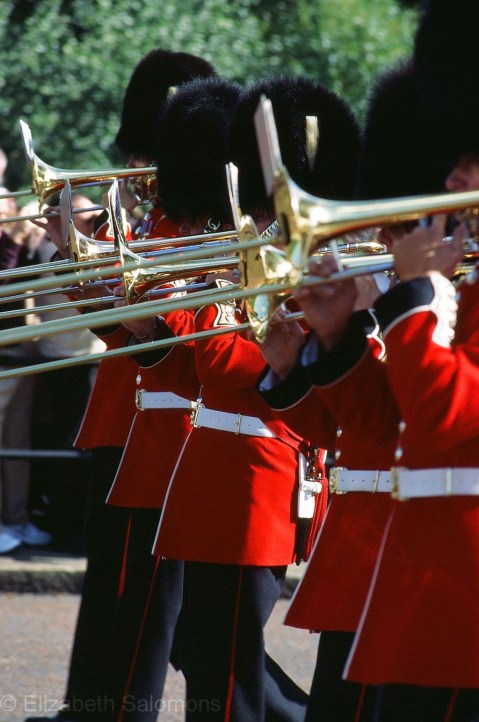
Changing the Guard at Buckingham Palace
In the afternoon, check out an art gallery. All of the major ones have free admission, so duck in and out of them throughout the week according to your mood. My advice, after you’ve decided on which gallery to go to (there are enough to suit any taste), is to choose a wing to focus on ― that’s plenty of viewing pleasure for one afternoon.
Bear with me now, as London has some heavyweights. The National Gallery houses Western European paintings from the 13th to early 20th centuries. The National Portrait Gallery is the British portrait collection from the 16th century to current day, and Tate Britain focuses on British art from the same period. (It has a particularly fine collection of works by J.M.W. Turner.) Tate Modern holds international modern and contemporary art.
If spending an afternoon looking at art is not your cup of tea, then I recommend the Churchill War Rooms located at the opposite end of St. James’s Park from Buckingham Palace. The museum is inside the actual bunker used by the British government during World War II.
Day 3: By now, your internal clock should be adjusted to Greenwich Mean Time, so you’re ready for a heavy day of sight-seeing. Buy your tickets online to avoid the long queues at the Tower of London, the highlight of which is the collection of Crown Jewels. I was 13 years old when I last saw the jewels, but I still remember how dazzling they were.
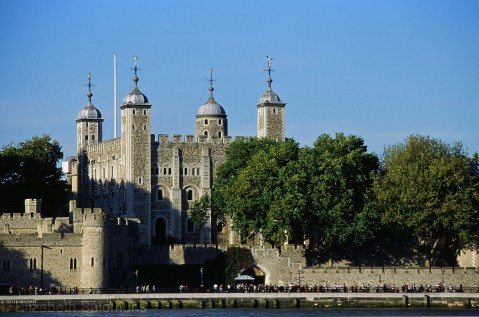
Tower of London
When you are finished touring the Tower, cross Tower Bridge and take a long walk along the South Bank of the Thames. You might stop for lunch at the many outdoor terraced restaurants. Or, treat yourself to a splendid meal at the top of the Tate Modern where you have a million-pound view of the Millennium Bridge and St. Paul’s.
Once fortified, continue walking until you reach the London Eye. If you are keen to get up high for a good view, this is the best there is. It’s pricey, but it will help you get your bearings if you’re still trying to orientate yourself in this massive city.
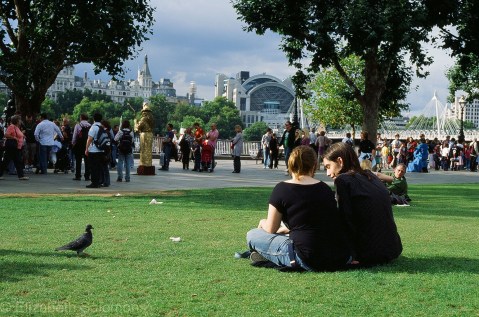
Charing Cross Station from the Jubilee Gardens on the South Bank
Day 4: If you enjoy museums, then the world’s your oyster in London. Again, they are all free admission. Head to the British Museum in the heart of Bloomsbury if history’s your thing, and don’t miss the Elgin Marbles on the main floor, just off the Great Court. When you are all mummied out, take a walking tour of what might be the most literary neighbourhood in the English-speaking world and see where Virginia Woolf lived and where T.S. Eliot worked as an editor.
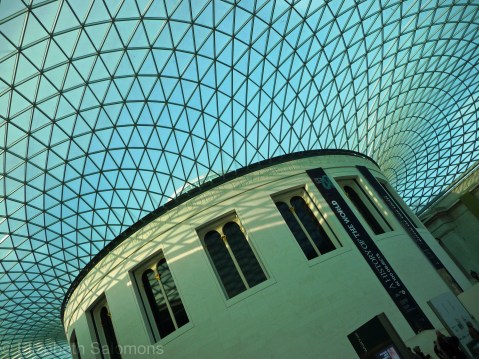
Great Court of the British Museum
For more recent history, go to the Imperial War Museum. Walk to the Thames afterwards for a photo op of the Houses of Parliament. Once there, you’re just around the corner from Westminster Abbey. Both are open to the public.

Houses of Parliament
And if art and design are where your interests lie, you need to be at the Victoria and Albert Museum. Post-V&A, enjoy everything Hyde Park has to offer: Speaker’s Corner, the Albert Memorial, and the Diana Memorial Fountain are all within this vast park.
Day 5: It’s time for an excursion. Windsor, home of Eton College and Windsor Castle, is an hour from London by coach or train. Greenwich is closer and also offers a full day of sightseeing including the Royal Observatory, the National Maritime Museum, and the Old Royal Naval College, all situated in beautiful Greenwich Park. The Royal Observatory is the home of Greenwich Mean Time and the Prime Meridian (longitude 0° ― for those readers interested in this sort of trivia).

Old Royal Naval College at Greenwich
Day 6: If you find the big museums and galleries too intimidating, then take a day to check out some of the smaller ones. I can recommend Keats House in Hampstead, where the Romantic poet John Keats lived from 1818 to 1820, after which you must take a turn on Hampstead Heath. There’s also the Handel House Museum, where the composer lived from 1723 until his death in 1759, or the Sherlock Holmes Museum at ― you guessed it ― 221B Baker Street.
These last two museums are near Oxford Street. If you’re interested in a bit of shopping, this is where you want to be, but be aware that Oxford Street on a Sunday afternoon is as busy as any North American mall in December. Charing Cross Road is the street for bookstores, Portobello Road for antiques, and Camden Market is where you’ll find that one-of-a-kind souvenir to bring home to your kids.

Shops on Portobello Road
Day 7: Your last day! I’m sure there’s something on your list you still haven’t gotten to, so this is your chance to squeeze it in.

Westminster Abbey
Wondering what to do in the evenings? If you’re into theatre, be sure to check out the board at the half-price ticket booth in Leicester Square. The deals are great, and the acting in London’s West End is the best I’ve ever seen. I still get goose bumps when I think of the mesmerizing performance I witnessed of Derek Jacobi, Trevor Eve, and Imogen Stubbs in Chekhov’s Uncle Vanya, which I watched from the front row of the Albery Theatre on St. Martin’s Lane. Or, bring back memories of your high-school English classes by taking in a play at Shakespeare’s Globe, the modern reconstruction of the original Globe Theatre.
My friend’s husband is a jazz musician, so they’ll be checking out some jazz clubs. Another option for live music is the opera; tickets to the Royal Opera House at Covent Garden are a bargain at £9 if you don’t mind sitting in the upper slips (and aren’t afraid of heights!). Book your tickets online before you leave home. Or find something you’re interested in hearing at Royal Albert Hall, if only to get a look at the inside of this magnificent concert hall.

More than 5000 Brits belting out “Land of Hope and Glory” in Royal Albert Hall
A suggestion to help you save money on transit: buy an Oyster Card to use on London’s Underground. They are valid on both the Tube and the buses, and are much cheaper than buying individual fares. And remember, although the Tube is faster, nothing beats seeing London from the top of a double-decker bus. The Heritage Routemaster service (Route 15) is a fun way to get from Trafalgar Square to the Tower of London.

One of London’s iconic double-decker buses
So there you have it: my ideal itinerary for a week in London. One last bit of advice: leave something on your to-do list to make sure you come back. Because London is a city that requires repeat visits.

Nelson’s Column and fountains in Trafalgar Square
Through My Lens: Inside Saint-Eustache
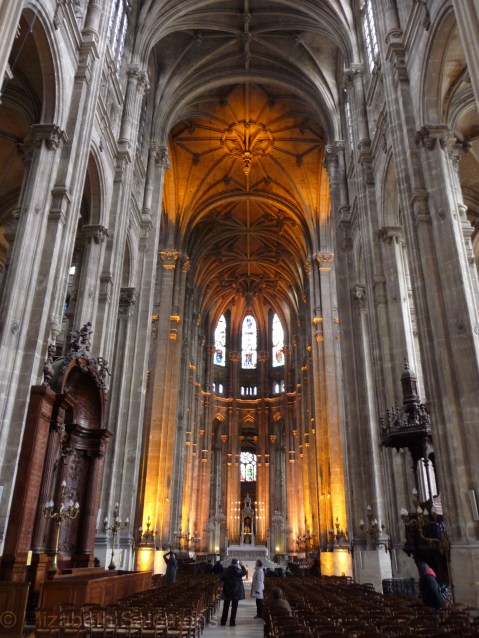
Last Sunday, I posted a photo of the exterior of Église Saint-Eustache. For the Second Sunday of Lent, here’s a look at what’s inside.
Dishing: Market
My second Dine Out outing of 2012 was to Market with my Book Club. Market is a Jean Georges restaurant at the Shangri-La Hotel, Vancouver’s newest luxury hotel and, since its completion in 2009, the tallest building in the city.
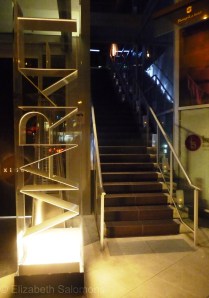
I first went to Market about a year ago with my sister. We were celebrating our birthdays and on that night enjoyed a sublime six-course tasting menu. It took us several hours to eat our way through the meal, but we enjoyed it immensely and appreciated the effort and time our server took to explain the rationale behind the wine pairing chosen to accompany each course.
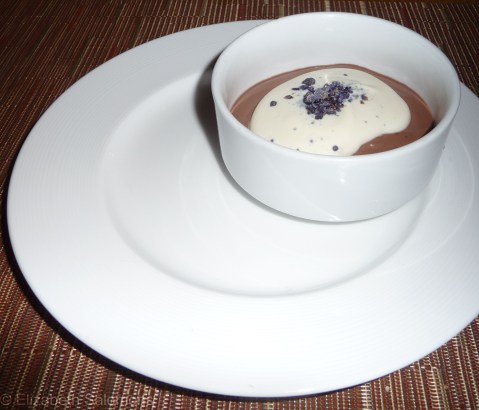
Market’s Dine Out menu offered a choice between two items for each course. I started with a roasted carrot and avocado salad with sour cream, citrus, and seeds. The carrots were slender and deliciously crunchy, cooked just long enough to not be raw. For my entrée, I choose the fish: slow-cooked snapper on a bed of sautéed spinach with a sweet garlic lemon broth. The lemongrass in the broth totally made this dish. Dessert was chocolate pudding with a light, foamy dollop of whipped cream, topped with candied violets. Can one ever go wrong with chocolate pudding? I think not.

Being Book Club, my friends and I chatted long after our coffees were gone about every topic under the sun except the book we had read. There was absolutely no rush on the part of our server to get us to leave, despite the crowded room, which was thanks to the draw of Dine Out. A most enjoyable evening; I highly recommend Market during Dine Out … or on any night of the year.

Through My Lens: Église Saint-Eustache
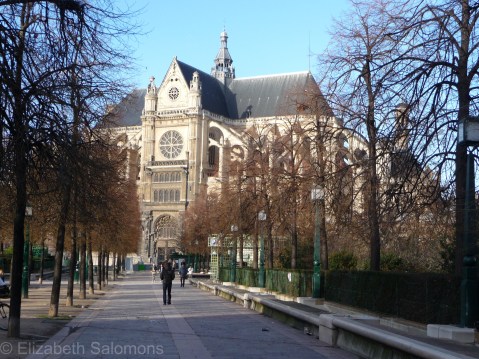
This being the Season of Lent, I think it’s appropriate that I troll through my collection of photos of European churches. For today, the First Sunday of Lent, I’m posting a photo of Saint-Eustache in Paris.
My sister and I discovered this church almost by accident in December 2010 when we set out for shopping and lunch in the 1er arrondissement. We were walking along Rue Montorgueil, somehow ended up on a tiny side street, which turned into an alley of sorts, saw a door, opened it, and suddenly were inside this immense church. Only upon leaving through another exit did we realize how massive it is. This photo was taken from Forum des Halles.
Snowy Owls at Boundary Bay
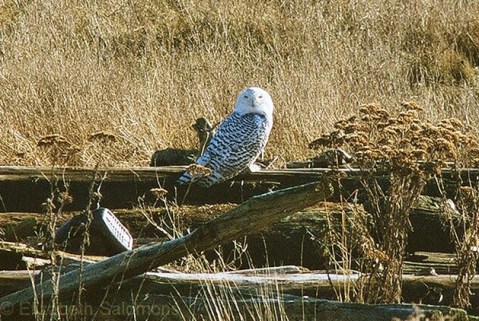
One sunny afternoon a couple of week ago, I headed down to Boundary Bay with my camera. A colony of Snowy Owls has taken up residence on the shores of the bay this winter. They got a lot of media attention when they arrived last December, and I wanted to see them for myself.

Apparently the owls make a regular appearance on the bay every four or five years. Their migration from their home north of 60° to all points south is linked to the lemming population, which makes up 90 percent of their diet. When the lemming population declines, the snowies head south.

The last time they were seen at Boundary Bay was in 2007.
 This year, however, the Snowy Owls migrated south in unprecedented numbers. Scientists think the large migration is the result of an abundance of lemmings during the last breeding season, encouraging a one-year “chick boom.” Breeding pairs raised as many as seven chicks, when normally they raise only two.
But then, come winter, there were simply too many owls and not enough lemmings. Thousands of snowies, mostly young and male, have left the north in search of food; they’ve been seen as far south as Oklahoma.
 About 28 are at Boundary Bay, while many others have been spotted all over the Lower Mainland. I counted eight owls myself.
Snowy Owls are up to 70 cm tall and can have a wingspan of about 150 cm, making them one of the largest species of owls.
I haven’t been to Boundary Bay in, well, decades. I’d forgotten how beautiful it is.

The bay is enclosed by Point Roberts, Washington, and Tsawwassen, BC, on the west; Blaine, Washington, and White Rock, BC, on the east; and Delta, BC, to the north.

It’s an important stop on the Pacific Flyway. I had no idea how serious some birders can be. There were fellows out there in full camouflage, with camera lenses as long as my arm. I wouldn’t have minded a longer lens myself, but, even so, it was a great photo opportunity and I intend to go back.
Through My Lens: Vancouver in Spring
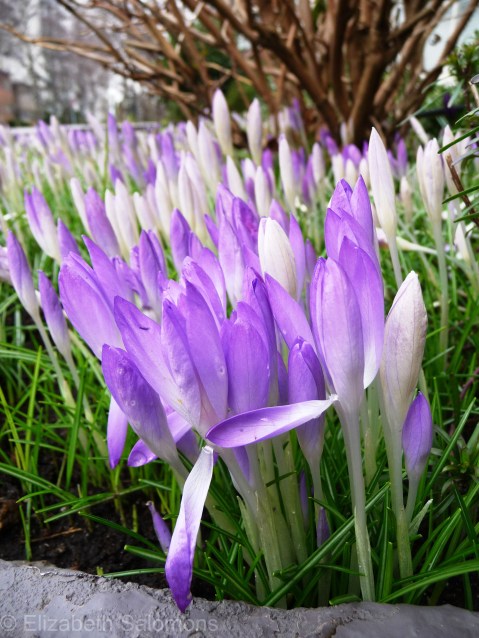
Spring is Vancouver’s longest season. It’s always a bit of a shock to me when I see the first crocuses (I took this photo yesterday), but summer temperatures rarely arrive before the end of June.
Dishing: L’Abattoir

Dine Out Vancouver, which just finished its tenth year, is an annual culinary celebration when Vancouverites get to, well, dine out. The deal is: you order from a three-course set menu for a set price. It’s incredibly good value and lets you try out higher-priced restaurants you might not get to otherwise. And the restaurants that participate benefit as well: they are booked solid for 17 days in the dead of winter.
This year, my friend and I decided to head down to L’Abattoir, rated by enRoute magazine as Canada’s third-best new restaurant of 2011.
L’Abattoir’s French name means “slaughterhouse.” The name is not in reference to its menu, however, but to Vancouver’s original meat-packing district. The restaurant is located in Gastown, just around the corner from Blood Alley, and the building itself stands on the site of Vancouver’s first jail.

The setting is more bistro than fine dining, but don’t let the decor fool you ― there is nothing casual about the food at L’Abattoir. Chef Lee Cooper’s menu is French-influenced West Coast ― a description heard frequently about Vancouver’s best restaurants.
I ordered a starter of poached egg over potato gnocchi with a leek, mushroom, and pecorino sabayan. The combination of egg and gnocchi was unique and a nice surprise upon first bite, although I would have preferred it if the yolk had been slightly softer. The sabayan was light and airy and not too cheesy. I really enjoyed the dish. To be honest, the country-style pork patê on toast ordered by my friend looked a bit dull in comparison.
Next was a spicy chorizo–crusted Pacific cod over white beans cooked in red wine. The cod was perfectly moist and the texture and flavor of the chorizo crust added a nice kick to the fish. My friend enjoyed her roast tenderloin with ravioli stuffed with braised lamb shoulder; the combination of red meats worked really well.
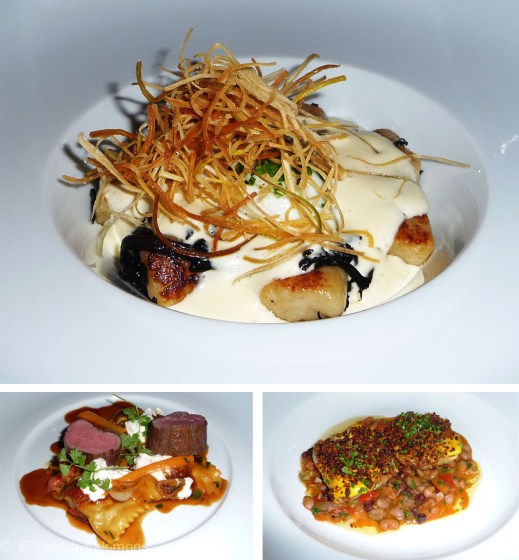
Each course was paired with an Okanagan wine ― a crisp cold Tantalus Riesling for the starter and the 2008 “Adieu,” a pinot noir from Le Vieux Pin, with the entrées. We both ordered the chocolate caramel bar with banana ice cream and chocolate yogurt ― the most popular dessert on the menu, according to our server.
Innovative décor + good wine + excellent food + impeccable service = a delightful evening. I’ll be back.


 There and Back Again