
The Chan Centre
When I was blogging about spectacular European opera houses last spring, it occurred to me that spectacular Canadian opera houses are few and far between.
No matter. We do have some spectacular concert halls.
This is a photo of the Chan Centre. Located on the Point Grey campus of the University of British Columbia, it was designed by the Vancouver-based architect Bing Thom. Its main concert hall is shaped like a cello and the acoustics are state of the art.
This time of year, the Chan looks particularly spectacular.

South Beach by Night

One advantage of being in South Beach on a rainy day, I was pleased to discover, is that the wet made for some nice reflections when the lights came on after dark. Here, again, are a few of the many, many photos I took during my one evening in South Beach.


Editing these photos made me realize I should make more of an effort to do night photography in Vancouver. Since, you know, we do get a lot of the wet stuff here.

South Beach

Living in a beach town, as I do, I’m always keen to check out other beach towns. Some remind me of Vancouver (sort of ― that would be Cape Town), some don’t make me think of Vancouver at all (that would be Barcelona), and some make me think I could still be in Vancouver (almost ― Waikiki, I’m talking ’bout you).
South Beach is in a category all its own. Separated from the city of Miami by Biscayne Bay, it’s located on a series of barrier islands that front the Atlantic Ocean. The beach itself is massive ― unfortunately for me, the one day I had to spend in South Beach was stormy and windy, scuttling my plans to spend my last afternoon in Florida lying on the beach.

No matter. I had a second reason for visiting South Beach: its architecture. South Beach was developed quickly during the 1920s and ’30s and many of its buildings were built in a similar style. As a result, South Beach has one of the finest collections of Art Deco and Streamline Moderne buildings, with more than 900 of them considered to be of historical significance. The Miami Art Deco District was added to the list of US historic districts in 1979, but many credit the 1980s TV show Miami Vice with providing the incentive to clean up what had become a run-down and crime-ridden neighbourhood.
If you are a regular reader of this blog, you might have figured this out about me: give me a subject to photograph and I’m content, no matter the weather. And so, as it turned out, I had a great time exploring South Beach in the wind and the rain. Here are a handful of the more than 100 photos I took that day.
Happy Birthday, Christ Church Cathedral!

And it’s yet another birthday post, this time for Vancouver’s Christ Church Cathedral. The congregation worshipped together for the first time 125 years ago today at 720 Granville (which, funnily enough, is now the site of a Starbucks) and was made the Cathedral Church of the Diocese of New Westminster of the Anglican Church of Canada in 1929.
Although Christ Church is not the oldest congregation in Vancouver, it does worship in Vancouver’s oldest church building. That would be the stone building standing at the corner of Burrard and West Georgia. It was constructed on land bought from the Canadian Pacific Railway, but for several years the congregation didn’t get much beyond finishing the basement, which was nicknamed the Root House. When the CPR objected to what they called an eyesore, the current building was built in the Gothic Revival architectural style. The exterior is sandstone, its ceiling is cedar, and the beams and floor are made from old growth Douglas fir. The building was dedicated in February 1895.

Christ Church is located right in the centre of Vancouver’s downtown district. In the 1970s, the congregation voted to tear down the existing building and replace it with an Arthur Erickson–designed high-rise tower, but public opposition was so strong that in 1976 the cathedral was declared a heritage building. The building has been renovated six times; its most recent renovation was completed in 2004 with the installation of a new Kenneth Jones organ. The congregation had plans to build a bell tower, but before it had the chance to do so, the city passed a by-law restricting church bells. Christ Church is the only church in downtown Vancouver without a steeple.
A special treat this Christmas season is the almost life-sized nativity figures on display in the west alcove of the church; these are on loan from the Hudson’s Bay and are the same nativity figures that used to be displayed in the store’s windows at Christmas time. They were carved in Italy in the 1950s and belonged to Woodward’s before they were passed on to The Bay. Christ Church Cathedral asked to borrow them this Christmas season as the congregation begins a year-long celebration of its 125th anniversary.
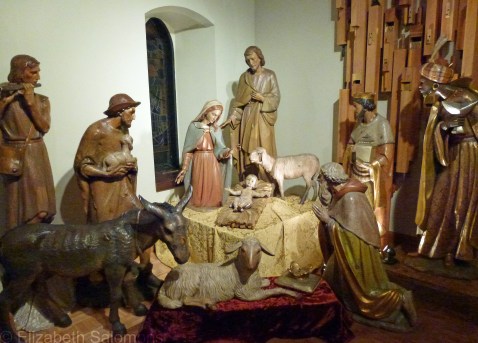

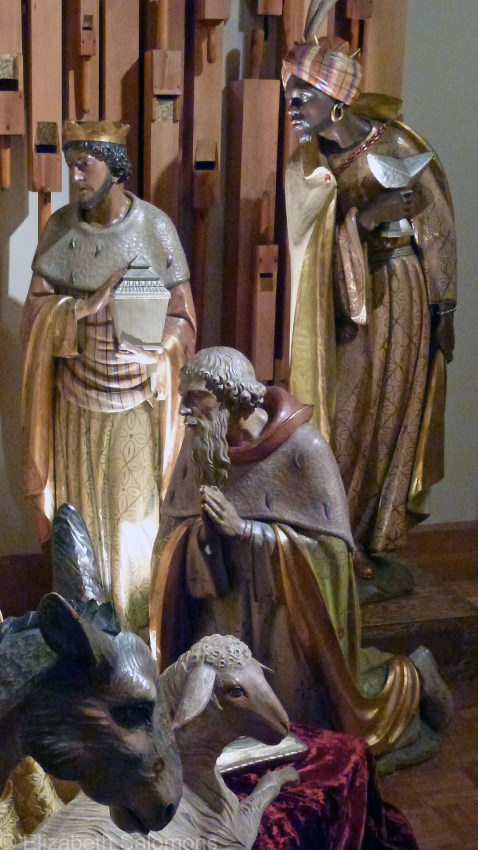
I’ve been to the cathedral for many a worship service ― these photos were taken last night after the Festival of Nine Lessons and Carols ― as well as several concerts and author readings for which the cathedral is a popular venue. After arriving very early many years ago to get a good seat to hear Timothy Findley read from his newest novel (and, as it turned out, only months before his death), I eavesdropped while a woman seated behind me explained to her companion that Christ Church was known as the church of lawyers because the funerals for the city’s most powerful lawyers are typically held there. It was one of the more bizarre bits of trivia I have ever heard about the cathedral.
But then, I like to think that there are 125 years’ worth of weird and wonderful stories to be told about Christ Church Cathedral. If only its walls could talk.

Lacombe
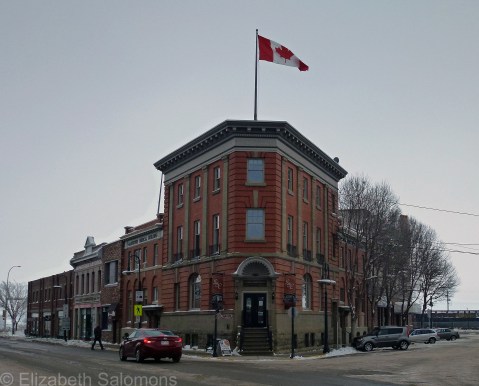
I used this month’s long weekend (November 11 is a stat holiday in Alberta and BC), plus a few of my vacation days, as an opportunity to fly to Alberta for a bit of family visitation. On one afternoon of that extra-long weekend, I was driving through the town of Lacombe with my dad en route to visit my various aunts and uncles and I thought to myself, “What a pretty little town this is!”
I don’t know the town of Lacombe very well, even though a whole passel of my relatives still live there and even though I spent a good chunk of my summers in the Lacombe area when I was growing up. That’s because we always parked our family tent trailer on the dairy farm of my aunt and uncle and there were far too many fun things to do on the farm for any of us kids to want to go into town. (I highly recommend spending summers on a dairy farm when you’re a kid.)
Anyways, the very same day (is that a weird coincidence or what?) that my dad and I were driving around Lacombe, its Historic Main Street (50th Avenue) was selected by the Canadian Institute of Planners as Canada’s Great Street for 2013. (Who knew there was a Canadian Institute of Planners? Not me.) The story made the local TV news that night, and it gave me an excuse to go back the next day and take some photos for this blog.
The architectural style of the buildings on Lacombe’s 50th Avenue is Edwardian ― that’s the style that was in vogue during the first decade and a bit of the last century. Lacombe’s Flatiron building (see above photo) was opened in 1904 and is the oldest flatiron in the province.
Lacombe started out as a boxcar train station on the Canadian Pacific Railway. It was incorporated as a village in 1896 and as a town in 1902. In 2010, it became Alberta’s 17th city (and, with of population of 11,000, its smallest).

University of British Columbia
The last school I want to show you on my tour of schools I’ve photographed is the University of British Columbia. Like Simon Fraser University, UBC is situated a ways away from the hustle and bustle of the city centre ― its main campus is located at the western tip of Point Grey, a peninsula to the west of Vancouver’s toniest neighbourhoods.
UBC is a hodge-podge of architectural styles. For one, it’s got your neo-Gothic. This is the Chemistry Building, one of the first three buildings constructed on the Point Grey campus. That was back in 1925.

For another, it’s got your Brutalism. The Buchanan Tower was built in 1972.

And it’s got your postmodernism. This is the Koerner Library, which was designed by Arthur Erickson and completed in 1997.

UBC is fond of combining architectural styles when it builds additions to existing buildings. The Main Library, another of the three buildings constructed in 1925, morphed into the Irving K. Barber Learning Centre in 2008. The neo-Gothic centre is the original building, now surrounded by a postmodern glass structure.
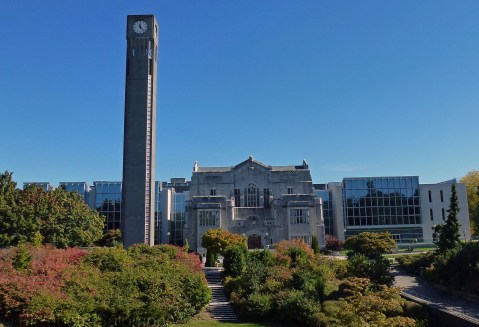
Here’s a look at it from another angle.

Four wings were added to the Chemistry Building between 1959 and 1989. This is a corner of one of those wings, built in the Brutalist style.
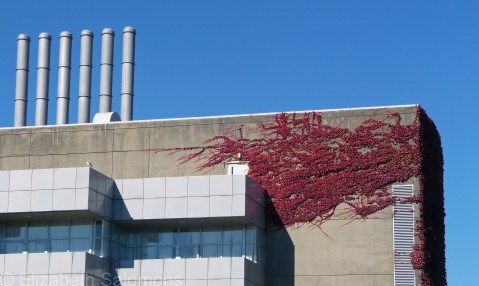
And this postmodern structure is an addition to the Henry Angus Building, which houses the Sauder School of Business. The addition, which opened in 2012, is wrapped around the original building, which was built in 1965 and expanded in 1976.

With 50,000 students, UBC is Canada’s fourth largest university and the largest in Western Canada. These days, the Point Grey campus is one massive construction site. In the past year, work was completed on a new trolley bus loop, upgrades to primary pedestrian corridors (which for some reason I have yet to figure out are called “malls” here), and a new fountain in Martha Piper Plaza. Building construction currently underway includes a new Student Union Building, the new Centre for Brain Health at UBC Hospital, and expansion of the UBC Bookstore. A new building that will house the Faculty of Education is scheduled to break ground this winter.
UBC’s Class of 2016 fittingly calls itself the Class of Construction.
Simon Fraser University
And now, for something completely different.

Unlike the universities I wrote about in the previous four posts, whose campuses are all situated smack in the middle of a city, Simon Fraser University sits above the city, on top of a mountain. (Which, in my humble opinion, takes the notion of an Ivory Tower a tad too literally.)
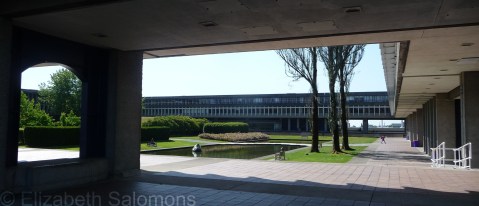
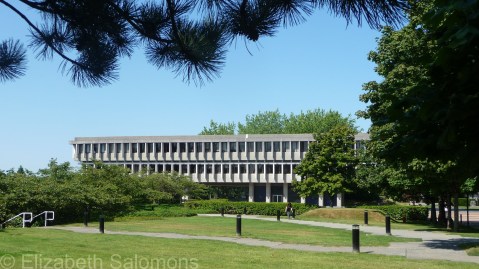
Construction of SFU’s Burnaby campus was begun in the spring of 1964, and the university welcomed its first 2500 students in September 1965.

The architects were Arthur Erickson ― probably Vancouver’s best-known and most influential architect ― and Geoffrey Massey. The campus atop Burnaby Mountain is in the Brutalist style of architecture, and won the 2007 Prix du XXe siècle from the Royal Architectural Institute of Canada, which recognizes buildings of significance to Canada’s architectural history.
University of Cambridge
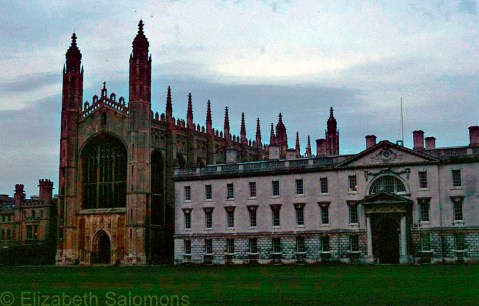
I went to Cambridge for one reason and one reason only: to hear the King’s College Choir.
I got to hear them sing a Choral Eucharist service in this chapel, the King’s College Chapel of King’s College of the University of Cambridge. Quite the chapel. Quite the choir.
I don’t remember much else of the University of Cambridge or the city of Cambridge. It was a quick one-night stop at the end of a three-week English walkabout and I was weary of sight-seeing.
But I’m never weary of choral music. It was worth the stop.
University of Oxford
When I applied to and was accepted at the University of Toronto, I enrolled as a student at Woodsworth College. I didn’t get the whole college-thing they had going at U of T, and didn’t much care what college they stuck me in, but eventually I discovered that all unclassified and part-time students (I was both) were lumped together at Woodsworth.
When I would introduce myself to my fellow undergrads, the first question after “What’s your major?” was always: “What college are you?” I quickly figured out that each college at U of T had its own personality, and prestige, and Woodsworth didn’t rank very high with respect to either.
This all seemed rather strange and unusual to me. In Western Canada, you applied to and enrolled in a faculty; in my case, I was a student in the Faculty of Arts at the University of Alberta. Colleges were independent entities, completely separate from the universities; I had attended one of those as well before transferring to U of A.
Like I said, I didn’t “get” the whole college-thing they had going at U of T.
Until I got to Oxford, that is.
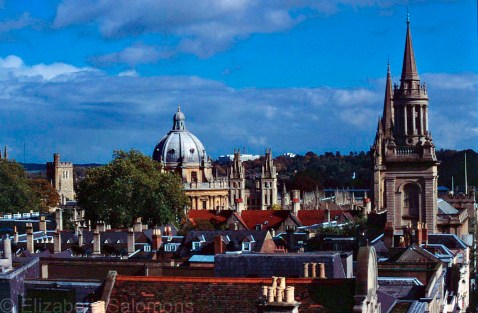
Oxford is chockfull of colleges ― 38 of them, in fact ― and as I wandered around the “city of dreaming spires,” I came to the realization that the University of Toronto is modelled after the University of Oxford. So that’s where U of T got the idea for all those colleges, I said to myself.
Many of the colleges of Oxford University are open to the public, and I walked reverently through several of them. I happened to walk by the entrance to the chapel of Magdalen College (where C.S. Lewis taught) and was warmly invited to attend the Choral Evensong service that was about to begin. In the Great Hall of Christ Church College, I was greeted by an elderly gent whose sole job seemed to be pointing out the “Alice” window to visitors. (That would be the stained glass window put in to commemorate the author Lewis Carroll, who had been a Christ Church scholar.)
Oxford is a beautiful town. I explored it while on walkabout in the English countryside some years ago, fell in love with it, and made a promise to one day return to it.


University of Toronto
Next up on my tour of schools I’ve photographed: the University of Toronto. I was a student here myself a long time ago, just for a year, and to this day I consider it the prettiest of all the schools I’ve attended (and there’ve been a few).
When I commented to my sister on the architectural style of the buildings at Johns Hopkins, she asked me what the buildings at U of T looked like.
“They’re neo-Gothic,” I said. Also called Gothic Revival, you see neo-Gothic buildings all over Canada ― our Parliament Buildings in Ottawa are probably the best-known example.
The University of Toronto has been around since 1827, has a dozen colleges on three campuses, and is the largest university in Canada with an enrollment of 75,000 students. I took these photos of the St. George campus when I was in Toronto exactly a year ago this week.


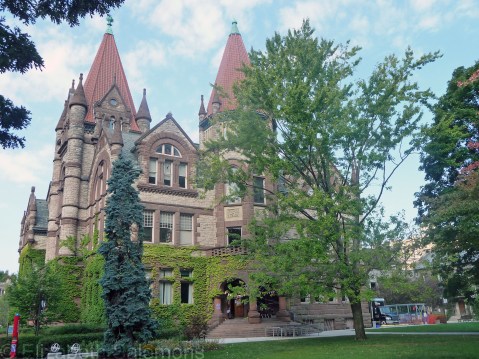
Not all of the buildings on the St. George campus are neo-Gothic. The main building of Victoria University, shown below, is called Richardsonian Romanesque, after its architect, Henry Hobson Richardson.
Trinity College is in the Jacobethan style.

And this monstrosity, Robarts Library, was built in the 1970s in what is known as Brutalist Architecture. Appropriate name for the look, I should think. It’s not-so-affectionately known as “the Turkey” by the students of U of T; I’m sure you can figure out why.


 There and Back Again