
Through My Lens: Autumn Ride

I like to think of this photo as a companion piece to a photo I took a year ago in almost the exact same spot. This is along the north side of False Creek.
Love these colours.
Through My Lens: Four Trees
Something shifted for me last week. It started on Thursday when the provincial health orders announced on November 7 for Metro Vancouver were extended to the entire province and until December 7. (And I have no illusions they won’t be extended again.)
And then, on Friday morning, our prime minister reverted to work-at-home and did his media appearance from the stoop of his home in Ottawa.
It feels like we’re right back where we were last March.
The second wave (or, as I like to call it, the Long Winter) that we’ve been talking about since last summer is starting to feel very, very real.
What does this mean for me personally? Pretty much the same as the last eight months: I will hunker down and do everything I can to stay healthy, both physically and mentally.
I’ll start by posting a series of photos from my recent daily walks. Because they make me happy. Maybe they’ll cheer you up too.
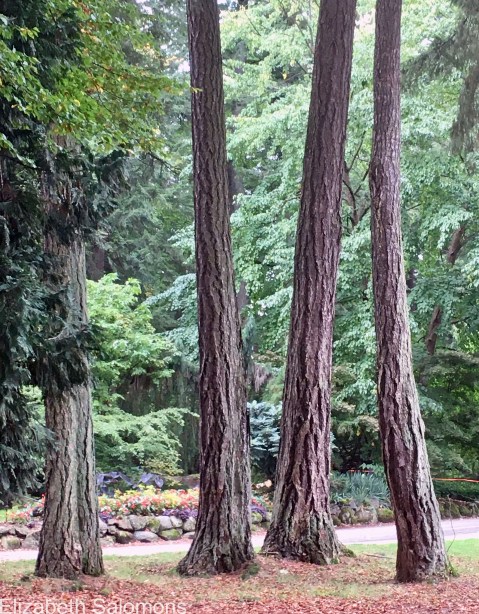
Here, then, are four trees I took notice of one Saturday afternoon about a month ago. I think they’re Douglas fir, but I could be wrong.
Enjoy.
Through My Lens: Paris in the Fall
Well. That was … a week. I can’t remember another time when the world held its collective breath for four days. The tension reminded me of double overtime during Game 7 of a Stanley Cup final. In this age of instant communication and fast results, we aren’t used to having to wait so long for an outcome.
Along with yesterday’s news about the US election results came an announcement from BC’s Provincial Health Officer of new orders limiting in-person social interactions. The restrictions — the latest effort to combat the rising number of Covid-19 cases — went into effect last night and will last for two weeks.
For the first time during this pandemic, the orders apply to only two health regions of the province: Metro Vancouver and the Sunshine Coast for Vancouver Coastal Health and all areas of Fraser Health (which includes the Fraser Valley).
One restriction in particular jumped out at me: travel in and out of these regions is limited to essential travel only.
It’s not like I was about to jump on a BC ferry, but these restrictions do not bode well for me seeing my friends and family who live on Vancouver Island anytime soon. It’s starting to look like making any kind of travel plans is still a long ways off.
Which means that this blog will continue to be powered by my travel memories.
Here then is a photo to acknowledge an anniversary that slipped past me while I was distracted by the goings-on south of the border.

Ten years ago this week, I arrived in Paris for the winter. It was a bit of a rough landing as my wallet was stolen out of my bag while on the London Tube a few days prior to my arrival. Getting money wired to me proved to be a challenge as all of my ID, including my passport, was gone.
And then, on top of all that, the home exchange I had arranged for the three months I planned to be in Paris fell through and I had to find another place to live for the last two months of my stay.
Let me tell you: that was four days where I was holding my breath.
In the end, everything got sorted and I had one of the best winters of my life. And I have to say, although I don’t think there is ever a bad time to be in Paris, autumn is particularly lovely. I took the above photo on my first long walk through the city — after I had started to breathe again.
Spanish Banks
It had to end, eventually.
This week marked the transition from our Summer of Covid, such as it was, to an autumn that appears to be headed towards another lockdown. I have begun mentally preparing myself for what I expect to be calling the Long Winter.
But before we spiral too far down, here’s one final beach post to share with you.
And what a beach it is.
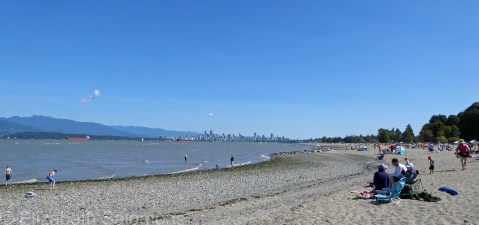
Spanish Banks is the furthest of the beaches along the southern shore of English Bay. It looks a lot like Locarno and Jericho, but with one rather significant difference. That would be the sandbank it sits on, which lets you walk far out into the bay at low tide.
Both Spanish Banks and English Bay got their names in commemoration of an accidental meeting that took place in 1792 between two expeditions: the English one led by George Vancouver and the Spanish one led by Cayetano Valdés y Flores and Dionisio Alcalá Galiano. It was an accidental meeting because the English did not know the Spanish were in the neighbourhood, nor were the Spanish aware that the English were nearby.
Awkward.
In the end, though, they all got along and spent several weeks exploring and charting the Strait of Georgia together.
Although Spanish Banks, like all of Vancouver’s beaches, has swimmers and picnickers in abundance, it is really popular with kitesurfers and skimboarders at low tide.
Locarno Beach

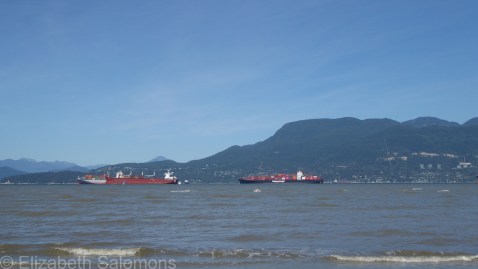
Locarno Beach is like the proverbial middle child. Sandwiched between its wildly popular sister, Jericho Beach, and its aloof and distant brother, Spanish Banks, it is easily missed and often bypassed.
The real reason Locarno is quieter, though, is because it’s a designated “quiet beach.” Meaning: no loud music. Its name comes from an unlikely source: a town in southern Switzerland right next to the Italian border.
Here’s a pro tip: being quieter and often overlooked means that Locarno is the only beach where there are no lines for either the concession or the washrooms.
Even on a hot summer long weekend.

Jericho Beach

About a half hour walk (or ten-minute bike ride) past Kitsilano Beach is another of Vancouver’s most popular beaches. That would be Jericho.
Jericho Beach got its name from a man named Jeremiah Rogers, who in the 1860s established a logging company nearby that he named Jerry & Co. Jerry & Co. eventually morphed into “Jericho.” Or the name evolved from Jerry’s Cove. (You decide which version you want to believe.)
Long before Jeremiah, or any European settlers for that matter, came along, the Musqueum Nation lived on the beach in a village they called iy’a’l’mexw, which means “good land.”
There has been a military presence at Jericho Beach since 1920, and Jericho Garrison was established during World War II as the Pacific command headquarters for the Canadian Forces. Later, some of the military buildings along the beach were repurposed: the army barracks were converted into the Jericho Beach Youth Hostel, a military gym is now the Jericho Arts Centre, and the base itself became the Jericho Sailing Centre.
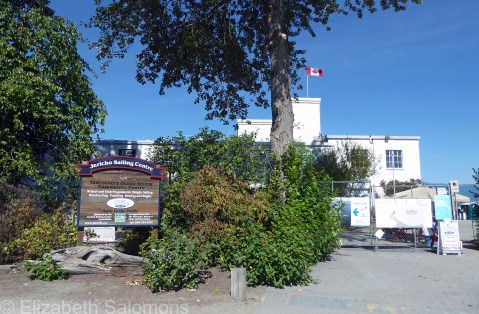
It’s the Jericho Sailing Centre that makes Jericho Beach so popular and busy today. There are schools, clubs, and rentals for all types of water sports, including sailing, kayaking, windsurfing, and paddle boarding. In addition, Jericho Beach Park, just adjacent to the beach, is the site of the annual Vancouver Folk Music Festival.
All these varied activities are enough to keep most people happy and busy, but I have to say, nothing beats knocking off work early and enjoying a beer and burger with friends on the deck of the Jericho Sailing Centre.
I should know.

Kitsilano Beach
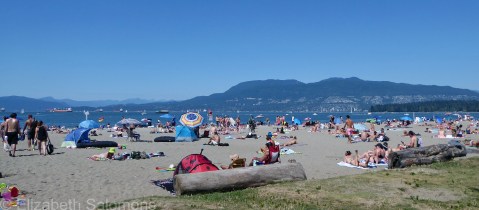
The beach generally thought to be Vancouver’s most popular has one thing in spades.
That would be attitude.
I mean, sure, Kits Beach is a great beach. You can swim in the ocean or do laps in the adjacent saltwater pool. There’s are tennis courts, if you like, or beach volleyball. If you’re hungry, there’s both a concession stand and a dine-in restaurant, or you can cross the street and enjoy Happy Hour at any number of nearby pubs.
But for me, truthfully, other than an occasional picnic with friends, Kits Beach is somewhere I always walk, cycle, or drive past on my way to somewhere else. It’s just a little too crowded for my taste.
And so, I leave Vancouver’s most popular beach to those who want to see and be seen.

Third Beach
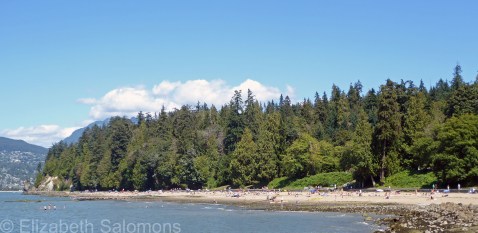
My favourite Vancouver beach is Third Beach. Like Second Beach, it’s part of Stanley Park, but it is enough of a walk from my home that it feels like a destination beach. And with its small parking lot, it’s never as crowded as some of the more popular beaches on the other side of English Bay.
Much of the forest behind Third Beach was cleared by the military during World War II to make room for an army barracks. The soldiers were there to command a gun battery at Ferguson Point and a lookout point opposite Siwash Rock, both of which overlook Third Beach. The gun installation is no longer there, but the lookout still is.
It’s odd, some 80 years later, to think of Stanley Park as a strategic military site, but because of its location at the entrance to Burrard Inlet and the Port of Vancouver, it most definitely was.
Second Beach

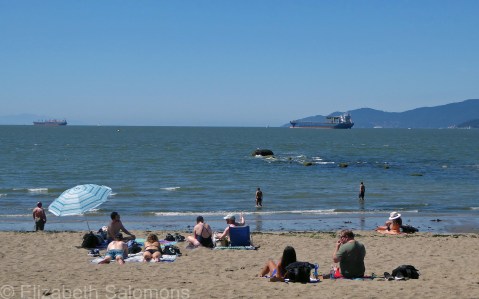
Second Beach is the smallest of Vancouver’s beaches. It’s located alongside the Stanley Park Seawall, next to Second Beach Pool and Ceperley Meadow.
The beach is a popular picnic site, especially for large, multi-generational families, because of all the amenities available. The meadow provides lots of room for kicking around a ball, and in addition to the beach and the pool, there are two playgrounds and a concession stand.

English Bay Beach
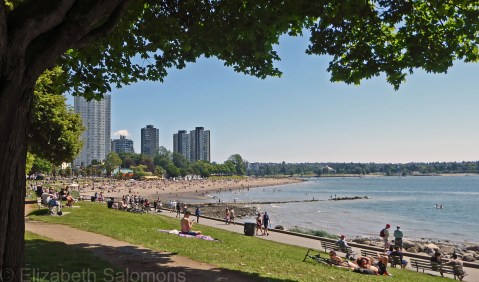
English Bay Beach is the most urban-looking of Vancouver’s beaches, thanks to its close proximity to the residential towers of the West End.
Also known as First Beach (although no one calls it that), English Bay Beach has been popular with the residents of Vancouver since the 1890s, which is when they first began building summer cottages along the bay. Two of those cottages were still standing when I moved to the neighbourhood some 20 years ago, but they’ve since been down torn down and replaced with a boutique condo.
Typically at the end of July, more than half a million people descend on English Bay Beach for three nights of fireworks competition during the annual Celebration of Light. Not this year, of course — and who would have thought I would miss all that chaos?
Instead, this year, English Bay Beach became infamous for its beach log jail when our iconic beach logs were locked up behind metal cages for the first ten weeks of the pandemic. The reason? To avoid large groups congregating on the logs.
English Bay Beach is popular with swimmers and although the lifeguards are back during this summer of Covid, the floating slide is not.
Maybe next year.


 There and Back Again