
Canada 150: Shackleton
It turns out I have almost no photos of Saskatchewan. Apparently it is a place I only drive through or fly over.
To the best of my memory, the only night I spent in Saskatchewan was the time when the car in which I was a passenger hit a deer. The car was a mess, the deer even more so. Do you know how dark it gets in the middle of the prairie? We could not see our hands in front of our faces. Eventually my parents and my sister and I were rescued by an RCMP officer who dropped us off at some motel in Estevan.
However, it also turns out that the province where I have spent so little time actually played a huge role in my family’s history. My grandparents — two people I never got the chance to meet — immigrated to Saskatchewan. They left the Netherlands by boat intending to go to Alberta, but changed their minds somewhere in the middle of the Atlantic Ocean and decided to head to Saskatchewan instead.
This was in 1928.
For those readers who don’t know much Canadian history, let’s just say the 1930s were not kind to prairie farmers. Twelve years and six children later, my grandparents abandoned the farm to the bank and made a beeline for Alberta, their original destination, where potatoes became the crop that finally turned their fortunes around.
Many decades later, I asked my dad to show me the farm where he was born and the nearby village of Shackleton. It wasn’t more than a few hours’ drive from Lethbridge, where he was then living.
I expected to learn something about my family’s history during our little road trip, but when I saw the almost-deserted village that is Shackleton today, I was surprised at my reaction. It was visceral and all I could think was: How on earth did my grandmother have the strength to not get right back on the train and insist that she and her new husband return to Holland?
The farmer who owned the land my dad’s family had farmed remembered my dad and gave us free rein to wander around. Dad had me take a photo of him standing in the middle of the vegetable garden where he estimated the house he had been born in once stood.
The house was long gone as well as all of the other buildings dating back to the 1930s — except for this shed. Dad says his father used it to store his McCormick Deering steel-wheeled tractor.

One last thought: Apart from my reaction while looking over the village of Shackleton, what struck me most about our visit was a low dike-like mound that separated the fields from the house and other farm buildings. When I asked Dad what it was for, he told me it had been formed by the dust storms. The dirt blew in across the fields, but was stopped from reaching the buildings by a row of shrubs. With each successive dust storm, the mound grew taller. Eventually, when the dust storms finally stopped, grass began to grow on top of it.
And there we were, some 70 years later, standing on land that still showed the scars of the great dust storms of the 1930s.
If that’s not one of the most powerful history lessons I’ve ever had, I don’t know what is.
Hairy Woodpecker
I was on Salt Spring Island again this past weekend, and I met a new friend.
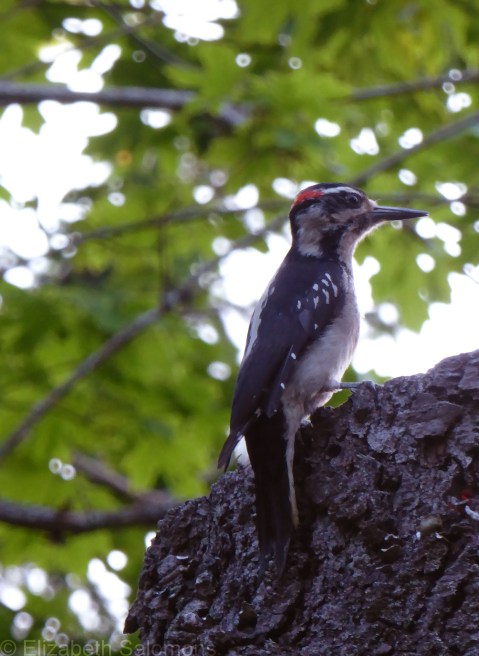
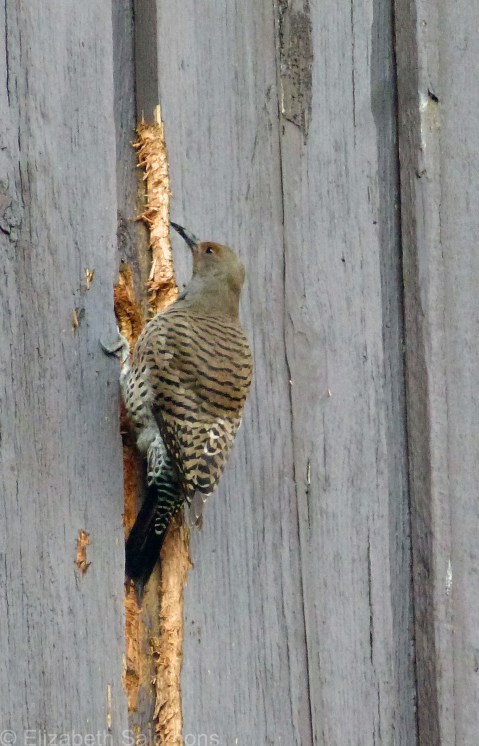
This is a Hairy Woodpecker. He’s not that big, but he sure makes a lot of noise for his size. He was busy making himself heard on the wildlife tree in my friend’s front yard, so I walked over to introduce myself.
And to take this photo.
Through My Lens: Steveston Boats

Steveston is a fishing village at the mouth of the South Arm of the Fraser River. It’s been there awhile, since the 1880s, and has a history that is equally fascinating and tragic. Nowadays, it’s the largest commercial fishing harbour in Canada.
Here’s a photo I took last night.
River Otter
In my last post, I mentioned that one of Lost Lagoon’s four remaining Mute Swans had been killed by a river otter. These furry fellows can be found in Lost Lagoon, but also like to hang out wherever there’s fish. Sometimes, that brings them to the beach in English Bay
Which is where I took this photo.
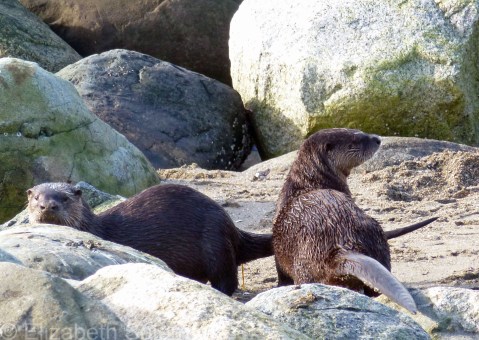
River otters are not the same as sea otters, so don’t be confused by the fact that they can be found near the ocean. They go wherever the fish are, so if that means they hang out on the beach, so be it.
Sea otters, I’ve been told, are not found in the Salish Sea. They live on the west coast of Vancouver Island or along BC’s northern coast. One clue, apparently, to tell the two types of otters apart: river otters almost never swim on their backs, while sea otters often do.
Mute Swan
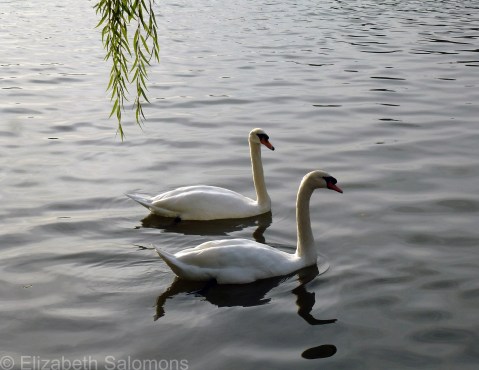
Indulge me, if you will, as I post yet another set of bird photos. This is the Mute Swan, which, until last August, was a common sight at Stanley Park’s Lost Lagoon.
The reason Lost Lagoon no longer has any resident swans is that the last three swans were officially retired and now live at an animal sanctuary somewhere in the Fraser Valley. The move came after a fourth swan was killed by river otters. The swans are geriatric, and it was decided they should live out their remaining years without the threat of predators.

The Mute Swan is not native to North American, but you see them everywhere on this continent, mainly in city parks. Back in the 1960s, there were at least 70 of them living at Lost Lagoon. These days, however, the caretakers at Stanley Park are keen to ensure that native species thrive over invasive species. (I could tell you about the blackberries, but that’s a whole other post.)
Don’t worry, though. This isn’t the last you’ll see of swans in Stanley Park. Because the park is on the Pacific Flyway, you have a good chance of seeing either the Trumpeter Swan or the Tundra Swan as they pass through when they migrate — and they are far more likely to stop in if there are no more of the territorial Mute Swans.
But, invasive species or not, aren’t they magnificent creatures?
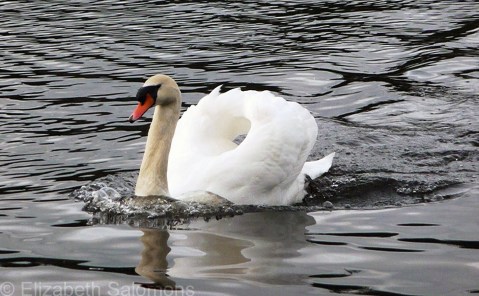
One last note: The Mute Swan is the national bird of Denmark. Does that surprise you? It sure did me. I would have guessed England, but apparently that country is still trying in the process of choosing a national bird. As is Canada.
Northern Flicker
Today is the first day of Vancouver Bird Week and to make it a little more interesting, the city is taking a vote on which of four birds should be Vancouver’s Official Bird.
Vancouver has had a City Bird for three years now. The Northwestern Crow was selected in 2014. In 2015, the honour went to the Black-capped Chickadee and in 2016 to the Peregrine Falcon. But this year is different: the honour of City Bird will become permanent.
Oh, the pressure!
None of the previous City Birds are considered eligible. Bummer, as my favourite Vancouver bird is the Black-capped Chickadee. Also not eligible are any birds that are a city, provincial/state, or national bird elsewhere. (That kinda narrows it down. Another choice of mine would have been the Bald Eagle, of which Vancouver has plenty.) Two final stipulations are that the potential City Bird cannot be viewed negatively by any cultural groups (?), and cannot be commonly found outside of the Pacific Northwest. Vancouver’s City Bird has to be uniquely West Coast.
So, which birds made the Final Four??
Those would be the Spotted Towhee (photo here), Anna’s Hummingbird (photo here), the Varied Thrush (sadly, no photo), and the Northern Flicker (below).
Which one did I vote for?
Now that would be telling.
But may the Best Bird win.
Canada 150: Edmonton
Canadians are known for playing hard in the summers. We like to spend as much time outdoors as we can, which is easy, because the days are long, and necessary, because the season is short.
Also, for the most part, the weather is awesome. Not too hot, not too humid.
One of the ways we play hard is by going to outdoor festivals. We’ve got a few, ranging from the traditional fairs and exhibitions and rodeos to theatre (from Shakespeare to fringe) to music of all sorts, including jazz, blues, and folk.
One of the best festival cities in the country, in my opinion, is Edmonton. And one of the best outdoor music festivals in the country, in my opinion, is the four-day Edmonton Folk Music Festival held every August at Gallagher Park. The park is a ski club in the winter, but in the summer, its hill serves as a natural amphitheatre with spectacular views of the city’s skyline.
The Edmonton Folk Fest is one of the largest and best-attended folk music festivals in North America, and attracts musicians from around the world who, once they’ve played the Folk Fest, are always eager to come back. Celtic, country, blues, gospel, soul, and world music — you name it, they’ve got it. It sells out every year, typically within minutes.
If you’ve never been, you don’t know what you’re missing. Seriously.

Canada 150: Banff National Park
My Canada 150 series would not be complete without a post about Canada’s oldest national park. But since every single one of my previous posts on Banff consists of a photo of a mountain, I’d thought I’d mix it up this time. (Otherwise you might get the idea that the only thing to see in Banff National Park are mountains.)
There’s wildlife, too!
Of course, say “wildlife” and “Banff” in the same sentence and most people will start listing off which of the Big Five — deer, elk, moose, bear, and wolf — they’ve seen. The big animals do deserve the attention they get, but it is often the little animals, which are far easier to get up close and personal with, that lead to the best photo ops.
Like this Columbian Ground Squirrel.
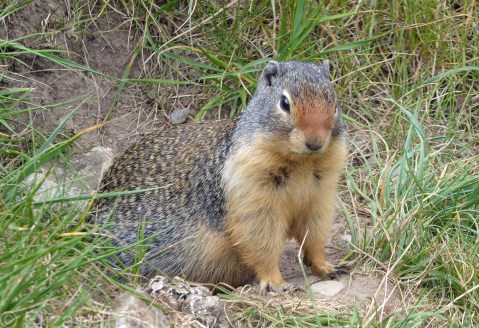
We Albertans call these gophers. They live in underground burrows and spend much of the year hibernating. As far as rodents go, they’re kinda big — typically about a foot in length.
I took this photo last summer.
Canada 150: Cavell Glacier
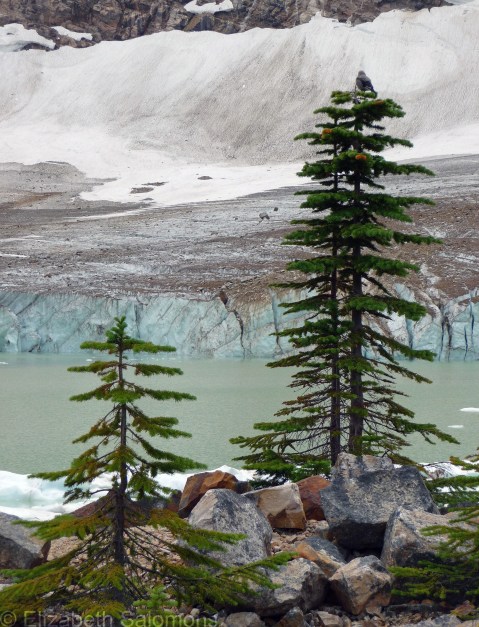
Cavell Glacier in Jasper National Park is one of the most easily accessed glaciers in all of Canada. It lies at the bottom of Mount Edith Cavell and can be reached by a short (less than 1 km) hike. Cavell Pond was formed from the glacier’s meltwater. It’s turquoise because of all the glacial silt suspended in the water.
I spent every summer of my childhood exploring the Rocky Mountains with my family. The mountains are a pretty spectacular playground for kids, but I don’t think I truly appreciated them until I returned on my own as an adult. Now, I don’t take them for granted. Ever.
If you’ve been to Banff or Jasper, you know what I’m talking about. If you haven’t, put the parks on your bucket list. You won’t regret it.
Canada 150: Tr’ochëk

Here is one last photo from North of 60. This is fireweed, the official flower of Yukon. It takes its name from the fact that it is one of the first plants to grow after a forest fire.
I took this photo at Tr’ochëk, a former settlement of the Tr’ondëk Hwëch’in First Nation. It’s also known as Moosehide. Located about 5 km down the Yukon River from Dawson City, the settlement was abandoned in the 1960s after its only school was closed. Today, it is an important gathering place and a seasonal fishing camp for the Tr’ondëk Hwëch’in First Nation.


