
Deer Lake Park
The other day I wrote that, during my time hanging out in Solo, I’ve discovered a few of Burnaby’s treasures ― delightful treasures that redeem some of the annoying and ugly aspects of suburban living. Deer Lake Park is one such treasure.
A friend introduced me to Deer Lake Park one afternoon about a week ago. Her townhouse complex backs onto the 500-acre park, so you could say the park is right in her backyard. We walked a loop around the park and I took some photos of the lake. Here are a few of them.
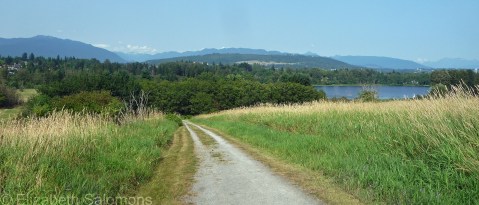
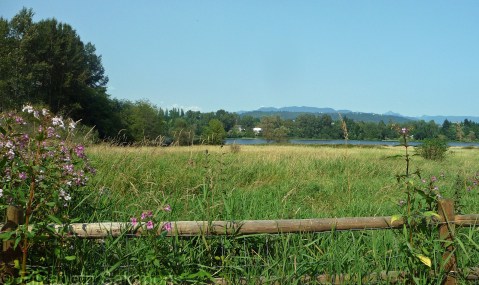

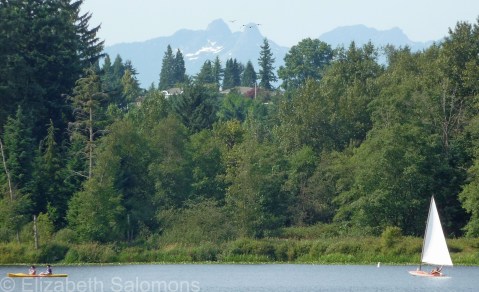
Deer Lake Park is a park for all seasons and I intend to come back to explore it some more.
Hanging Out in Solo
While my sister and her husband are busy eating, drinking, and loving their way around Italy, I’ve been on house-sitting duty. House sitting, I’m discovering, is an awful lot like home exchanging: it gives me a chance to enjoy the perks of someone else’s home for a while, and the opportunity to explore a new neighbourhood. The only difference between this round of house sitting and my previous home exchanges is that, if I need something from home, I can easily go get it.
The perks this time are pretty good. I have an enormous south-facing backyard all to myself, with a covered patio, a Rolls-Royce of barbecues, and an herb garden. Beyond that, there’s a back 40 filled with bushes dripping with almost-ripe blackberries. The herb garden has to be watered daily, as does a forest of small trees belonging to my brother-in-law. And then there are the six cats (two of them my own) who need to be fed and watered twice a day. I feel like I’m playing farmer, what with all these animals, crops, and chores, but hey, it’s summertime, and it’s pretty heavenly.
The neighbourhood, on the other hand? Not so heavenly. I’m in North Burnaby, in an area some developers are starting to call Solo ― that’s SOuth of LOugheed. (Go ahead, laugh. I did.) The subdivision where I am temporarily lodged is sandwiched between two highways: Lougheed (with the elevated SkyTrain running above it) and the Trans-Canada. That means I’m listening to the constant white noise of freeway traffic to the south, and the intermittent whirr of the SkyTrain to the north.
North Burnaby is not that attractive, in other words. It’s one mall after another, one industrial park after another, one arterial road after another. I loathe the whole car culture that is necessary here; I know it’s no different from any other North American suburb, but it’s what I hate most about suburbia and why I choose to live downtown. The other day I used a drive-through ATM for the first time in my life, and felt strangely defeated by doing so.
However, spend enough time in a neighbourhood and eventually, somewhere, somehow, you begin to discover its treasures. Burnaby has a few that are simply delightful, which I’ll write about in another post. For now, I will remind you (my faithful readers) and myself that the intent of this blog is to take a second look at our surroundings ― whether beautiful or mundane. And I’ll leave you with a photo of some marvellous engineering. After all, there is beauty in that, too, right?

SkyTrain tracks snaking their way east above Lougheed Highway
Dr. Sun Yat-Sen Park
In the heart of Chinatown is one of Vancouver’s hidden gems: Dr. Sun Yat-Sen Classical Chinese Garden and Dr. Sun Yat-Sen Park. The garden was named the 2011 Best City Garden by National Geographic. The park (where these photos were taken) is an extension of the garden and has no admission fee. If you’re in the vicinity, be sure to stop in. It’s a peaceful break from the noise and bustle of Chinatown.
Art Talk: William Kurelek
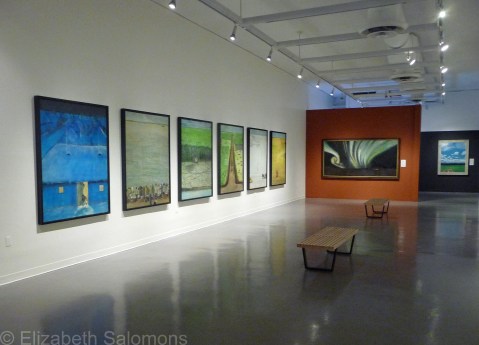
The other week when I was in Victoria, I went out of my way to stop in at the Art Gallery of Greater Victoria. I wanted to see William Kurelek: The Messenger.
I was expecting one room, maybe two, with a handful of paintings, but this exhibition completely exceeded my expectations. It is one of the largest-ever retrospectives of Kurelek’s work ― some 80 pieces ― and opened in Victoria earlier this summer after appearing at the Winnipeg Art Gallery and the Art Gallery of Hamilton.
William Kurelek was born in Alberta in 1927, moved to Manitoba as a child with his family, worked as a lumberjack as a young man to earn money for art studies, and eventually settled in Toronto, where he married, raised a family, and painted. He died there in 1977.
Before he settled in Toronto, Kurelek travelled to England because he had heard the English were doing interesting things with art therapy. He checked himself into a psychiatric hospital and spent the next seven years in and out of hospital. Some of the paintings he did as part of his therapy are included in this exhibition. They are disturbing images, filled with evidence of his illness. But in them you also see the influence of Bosch, Bruegel, and Vermeer ― artists whose work Kurelek studied while in Europe, and whose work would be life-long influences on his style.
While in England, Kurelek converted to Catholicism. At that point, he began painting Biblical scenes and subjects. Later, after his return to Canada, he took on apocalyptic themes as he reacted to world events such as the Cuban Missile Crisis. Kurelek saw himself as “the messenger,” tasked with spreading moral and Christian messages through his work. Although the prairies are a central theme in his artistic vision, even his pastoral landscapes have a mushroom cloud on the horizon, or a crucified Christ at the edge of a freshly plowed field.
Most of us know Kurelek’s artwork from his illustrated children’s books that are now Canadian classics. I don’t remember when I first was introduced to his work ― I suspect it was in grade school by one of my teachers ― but I appreciate it because I’m interested in the themes Kurelek explored: the prairies, landscape, place, memory, the immigrant experience, and Christianity. He was an avid photographer as well, and used his camera as a view finder to find subjects to paint.
Canada has a great tradition of landscape painting. Unfortunately, when asked to name a Canadian landscape artist, most of us don’t get much beyond the Group of Seven. Maybe Emily Carr. William Kurelek, I’m now convinced, is one of Canada most underrated artists. William Kurelek: The Messenger is at the Art Gallery of Greater Victoria until September 3.
London 2012
All eyes are once again on London as it’s the opening day of the 2012 Summer Olympics. Having lived in a host city, I can say from personal experience that the Olympic spirit is alive and well when you’re on the ground in the thick of it. When you’re watching the Olympics from afar, however, that spirit can be overshadowed by the politics and the commercialism and the media looking for a story. My hope is that Londoners will enjoy the party as much as I did here in Vancouver in 2010.
This time, not being in the thick of it, I will spend the next few weeks cheering for the athletes who proudly represent Canada, enjoying what glimpses of London I’ll see on my TV, and brushing up on my world geography. (Quick, everyone: Where’ s Comoros?)

Olympic Rings in Burrard Inlet, February 2010
Through My Lens: BC Ferries
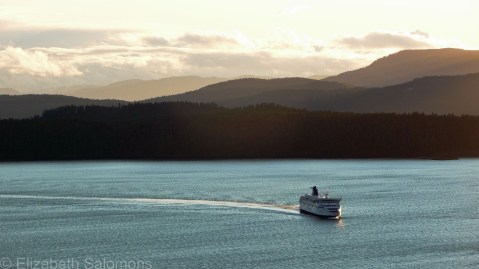
Nothing says “summer” to me like taking a ferry ride on BC Ferries. I spent last weekend island hopping as I visited friends on Salt Spring Island and Vancouver Island. This photo was taken from Galiano Island during another weekend of island hopping some months ago.
Through My Lens: Summer Sunset

Back in December, I posted a photo of a winter sunset over English Bay. At that time of year, the sun sets behind Point Grey ― that’s the land mass at the far left in this photo.
This time of year, the sun sets directly northwest of Stanley Park, behind Bowen Island. I took this photo about a week ago, one evening shortly before 9 p.m.
Engine No. 374
There is an amazing piece of Canadian history not far from where I live.
It’s Engine No. 374. Engine No. 374 is the locomotive that pulled the first transcontinental train across Canada ― from the Atlantic all the way to the Pacific ― arriving in Vancouver on May 23, 1887.
I have to admit I get a little thrill every time I walk by Engine No. 374. It’s the history geek in me.
British Columbia is a part of Canada because of the railway. The young colony joined Confederation in 1871 after Sir John A. Macdonald, our esteemed first prime minister, promised to build a railway to connect it to the rest of Canada. That was quite a promise; even more amazing was that Sir John A. said it would be done within ten years.
It took fourteen, but it got done ― an incredible engineering feat for a country not yet two decades old. There was a political scandal, which brought down the government, and there was a rebellion. But eventually, on November 7, 1885, the two ends of the railway met somewhere in the middle of BC’s Interior.
All that is now part of Canada’s national myth. Myths are great, and necessary, to a national identity. And that is why, when I walk by Engine No. 374, I get a little thrill.
I also love the romanticism of trains. Great stories begin on trains. It used to be that new Canadians began their lives in Canada by crossing the country by train. My ancestors did. And I, many years ago, travelled across Canada by train because I’d decided I needed to do it at least once in order to truly understand this vast and varied country of ours. When I finally disembarked in Quebec City after five days of coach travel from Vancouver, the conductor remarked that I had become part of the furniture.
The most surreal moment of that trip, however, was when I and the fellow who sat down across from me after boarding the train in Sudbury recognized each other, and it took us to North Bay to figure out where from. We finally put it together that we had met a couple of years earlier at the youth hostel in Baden-Baden, Germany, and then bumped into each other a few weeks later in the Venice train station, and yet again a few weeks after that in the middle of some demonstration in the centre of Athens. (Yes, the Greeks were already demonstrating back in the 1980s.) We were both criss-crossing Europe by train at the time. Great stories begin on trains.
Engine No. 374 was built by Canadian Pacific Railway in Montreal in 1886. It was completely rebuilt in 1914, and then continued in active use until 1945. After sitting at Kitsilano Beach for almost forty years, it was restored and put on display for Expo 86. Today it stands in a glass pavilion that is part of the Roundhouse Community Centre in Yaletown.
When I was taking the photos for this post, the volunteer working at the pavilion wouldn’t leave my elbow. As I knelt down to get a shot, he told me that once a year, on the Sunday closest to May 23, Engine No. 374 is taken out of its glass pavilion and moved into Turntable Plaza.
Now that’s a thrill this history geek won’t want to miss.
Happy Canada Day!
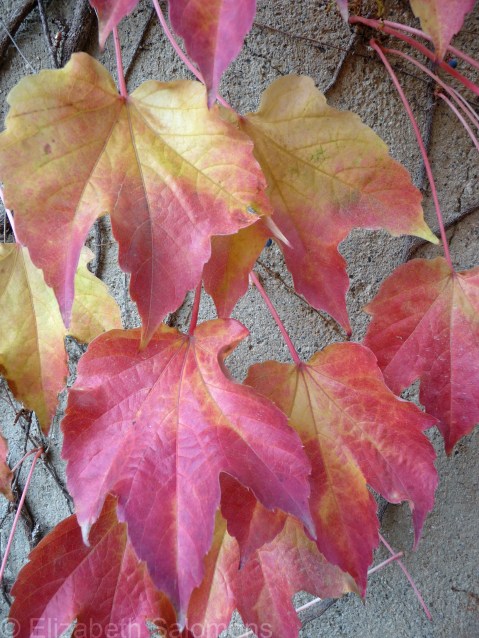
I’ve had some amazing travel opportunities, and I don’t take any of those opportunities for granted. Not one bit. But, even so, I sometimes get homesick while I’m off exploring the world.
I really missed Canada on my first long trip abroad*. I was thirteen years old and my family and I were in the Netherlands for six months. Not every kid gets that kind of an opportunity ― I’m so grateful our parents took us along. It instilled in me a travel bug I’ve not yet gotten out of my system (probably never will), but it also made me so aware of what I like love about Canada. Sometimes you have to leave home to appreciate it. And sometimes you have to leave Canada to feel Canadian.
So … Happy Canada Day! This photo was taken in Spain in November 2010. I had just spent several hours exploring the Alhambra and its gardens, and I was so pleased to discover a little piece of Canada in Granada.
*OK, this word is just begging to be researched. However did it come to mean “overseas”? Here goes: from the Old English on brede, which meant “at wide.” By the fourteenth century, abroad meant “out of doors, away from home.” By the mid-fifteenth century, it had taken on its current meaning: “to be out of one’s country or overseas.” Huh.
Dishing: ensemble
Update: ensemble closed in August 2012.
 A number of months ago, my friends took me out to celebrate my turning another year older and (this is debatable) another year wiser. I chose ensemble for the event ― it’s yet another new place on the north-east corner of Thurlow and Smithe in downtown Vancouver that has seen a high turnover of restaurants over the past few years.
  But, more than a year after its opening in May 2011, it looks like ensemble is here to stay. The executive chef is Dale MacKay, winner of Top Chef Canada Season 1, and one reason, in addition to the reviews I had read, why I chose this particular restaurant. I was curious if the judges at Top Chef Canada knew what they were doing when they gave MacKay the top prize.
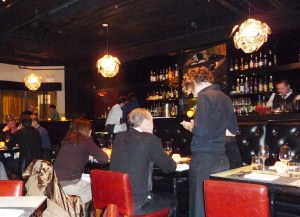
Two of my friends were waiting for me when I arrived; we ordered cocktails while we waited for our fourth companion, who finally showed up 45 minutes later. But, despite the busy room, there was absolutely no rushing us on the part of our server. The atmosphere was lively ― a perfect venue for a birthday party and for four boisterous, laughing friends who were in the mood to make a lot of noise.
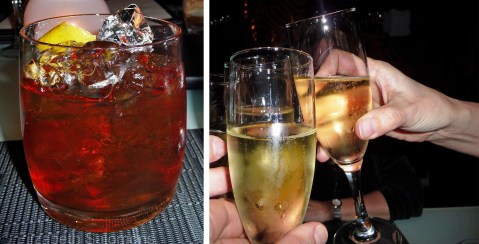
Like many of Vancouver’s fine dining establishments, ensemble characterizes its food as “Contemporary French meets West Coast.” All of the dishes are tapa-sized, and we opted for the four-course tasting menu with wine pairings.
First up was a Dungeness crab crêpe with pineapple, daikon, and avocado. This appetizer was picture-perfect, served cold, fresh, and crisp, and the pineapple gave it the smallest hint of sweetness. I absolutely loved the wine choice: a bubbly Spanish cava.

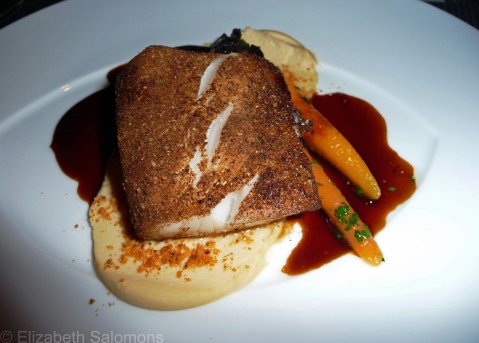
The second course was Moroccan spiced black cod, with chick peas, cashews, and black trumpet mushrooms. I’ve never had cod so delicate and light. The black trumpet mushrooms were the perfect accompaniment, as was the 2010 Pinot Gris from Penticton’s Poplar Grove winery.
The meat course was beef shin and fries, with watercress and a carrot purée, paired with the 2011 Enrique “Icque” Foster Malbec. Like the cod before it, the beef was melt-in-the-mouth quality. I’ve often eaten steak et frites in France, but have to admit that I’ve never been overly impressed with French frites. The fries that accompanied the beef shin, on the other hand, were the best any of us had had in a very long time.

To finish: chocolate fondant with hazelnut-nougatine ice cream. Chocolate fondant was a new experience for me and I loved it. Its soft pudding-like centre reminded me of a dessert a long-ago roommate used to make, with the rather ordinary name of Brownie Pudding.

In honour of my birthday, I was also presented with a cone of piping-hot sugar-dusted madeleines, which I gladly shared. For the dessert wine, we returned to the Old World with a glass of Broadbent Madeira.

By the end of the evening, both my appetite and curiosity were sated. Dale MacKay is certainly a Top Chef, and my friends and I were so impressed with our first experience at ensemble that I am sure we will be back.


 There and Back Again