
Through My Lens: Grote Kerk of Haarlem

It’s Palm Sunday, and I’m moving on from Amsterdam to Haarlem. This is the Grote Kerk, or Great Church. Dedicated to Saint Bavo of Gent, it is also known as St.-Bavokerk and has been Haarlem’s main church since the fifteenth century. It is enormous and dominates Haarlem’s skyline.
I like this photo because it shows all the goings on in the square outside the church. (This is actually the quiet side of the church — the Grote Markt, or Great Square, is on the other side and is much larger.) All the goings on include two of Holland’s national pastimes: cycling and afternoon coffee, which is always served with a tiny koekje (cookie) or chocolate. My friend and I parked ourselves at the very café you see in this photo in order to fuel up before we cycled the 20 kilometres back to Amsterdam.
Through My Lens: Inside the Oude Kerk

I chose this photo for today, the Fifth Sunday of Lent, because I love how the different features of Amsterdam’s Oude Kerk are visible in one shot.
There are the tall pillars, of course, And the pointed Gothic arches and windows.
What’s unique to the Oude Kerk is its wooden ceiling, which miraculously survived fires that swept through Amsterdam in 1421 and again in 1452 (after which wooden buildings were banned from the city). If you look closely, you can see the remains of the paintings commissioned by wealthy patrons.
And then there are the miniature ships. The Oude Kerk is steps away from the IJ and was traditionally a port church where the seamen came to pray for safety. The little ships are a testament to that history.
Through My Lens: Oude Kerk

My photo choice for the Fourth Sunday of Lent is Amsterdam’s Oude Kerk.
With Oude Kerk being Dutch for “old church,” this church is, as you’d expect, Amsterdam’s oldest. At 800 years, it is also the city’s oldest building. I wish I had thought to cross the canal to get enough distance for a proper photo because this one shows only a small part of the building, which has been extended many times since it was consecrated in 1306. Those are houses attached to the church — houses attached to the outer walls of a church seems to have been a common practice in the Netherlands.
The Oude Kerk stands in the heart of De Wallen — Amsterdam’s red-light district — which can take you by surprise if you’re not expecting it. Every tourist has a story about their first encounter with the red-lit windows in which the prostitutes stand. Mine was many years ago while on a walking tour of old Amsterdam with my much older, much more conservative Dutch cousin. She wanted to show me the Oude Kerk, but all I was noticing were the windows of women facing the church.
Which I pretended I hadn’t noticed. As difficult as that was.
Through My Lens: Inside the Westerkerk
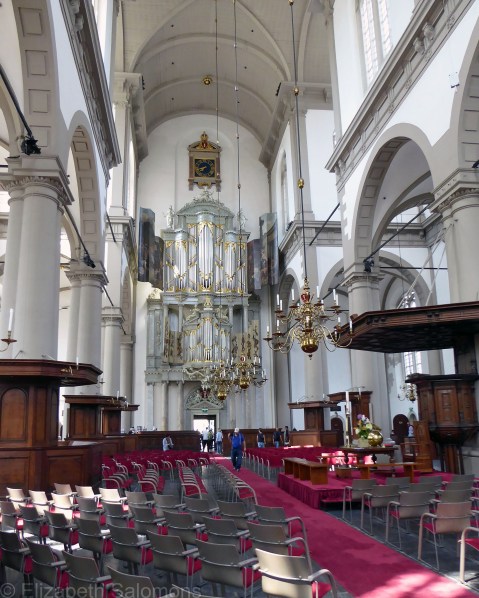
Last week I showed you the Westerkerk, and for today, the Third Sunday of Lent, here is what it looks like on the inside.
European Protestant churches have quite a different feel on the inside than their Catholic counterparts, with the most noticeable difference being how much lighter they are. It’s refreshing in one way, but with fewer stained glass windows and no artwork, some might consider them a bit dull.
Initially there was no organ in the Westerkerk — the Calvinists frowned on musical instruments of any kind — but some 50 years later one was commissioned and installed in the church. In the summers, the Westerkerk offers free lunchtime organ concerts on Fridays, and for one week in August a concert series they call Geen dag zonder Bach (“No day without Bach”), consisting of a daily concert of music by my go-to organ guy: J. S. Bach.
Through My Lens: Westerkerk

For the Second Sunday of Lent, here is a photo of what is probably the best-known church in all of Amsterdam: the Westerkerk. (Westerkerk is Dutch for “western church.”) Built between 1620 and 1631 in the Dutch Renaissance style, it too, like the Noorderkerk, was built as a Protestant church and in the shape of the Greek cross, except its design consists of two crosses placed side by side. Because of this, it has a long rectangular shape similar to a Catholic basilica, but its transepts are wider than in a Catholic church, and there are two of them.
The Westerkerk is about a five-minute walk from the Noorderkerk. It too is situated on the Prinsengracht, and is right across the canal from the Jordaan neighbourhood. Like the Noorderkerk, the Westerkerk was built to fulfill the pastoral needs of that fast-growing neighbourhood, but it ended up being the church of the upper and middle classes, whereas the Noorderkerk was where the working classes tended to go.
The reason the Westerkerk is likely the best-known church in all Amsterdam? Because Anne Frank wrote in her diary how its bells used to reassure her, especially at night. The carillon chimes every quarter hour and today is the only carillon in the city to do so 24/7 (at the request of the residents of the Jordaan).
I listened to those same bells chime through the night my first week in Amsterdam, as I tossed and turned, trying to get adjusted to the time zone. I could see the tower of the Westerkerk from my bedroom window, and when you climb that tower, your guide will point out the Achterhuis (where Anne Frank and her family hid for two years during World War II) and the window from which Anne could see the church tower.
Through My Lens: Noorderkerk

Last summer was about a lot of things, but one thing I made sure to do was take lots of photos of the dozen or so European churches I was able to visit. And now that it’s once again the Season of Lent, I am so happy I get to share those photos with you.
For today, the First Sunday of Lent, here is a photo of the Noorderkerk. (Noorderkerk is Dutch for “northern church”). This church was built in the early 1620s in the Jordaan neighbourhood, right on the Prinsengracht, the outermost canal of Amsterdam’s Canal Belt. The Jordaan was growing fast at the time, and its residents were in need of another place of worship.
The Noorderkerk was purpose-built as a Protestant church (unlike older church buildings throughout the Netherlands that were originally Catholic, but were transformed into Protestant churches after the Reformation.) As such, its shape looks quite different from the traditional long nave of a Catholic church. It was instead built in the shape of the Greek cross, with four naves of equal length, and a small tower at the centre. The idea was that the building was centred around the pulpit, a type of church design that eventually become quite common throughout Calvinist Holland.
I have a lot of affection for the Noorderkerk as it was only a ten-minute walk from where I was living, and I passed it regularly, often daily, on my walks around Amsterdam. To my regret, I didn’t have a chance to see it on the inside — the church is still in use as a congregation and the hours it is open to the public are limited. But though it might look like a quiet, sleepy church, there was always a lot going on outside. On the square surrounding the church are the twice-weekly markets: a flea market on Mondays and a food market on Saturdays. There is nothing like a weekly market to give a church square a sense of being the heart of the neighbourhood.
Which to my mind is kinda cool.
Merry Christmas!
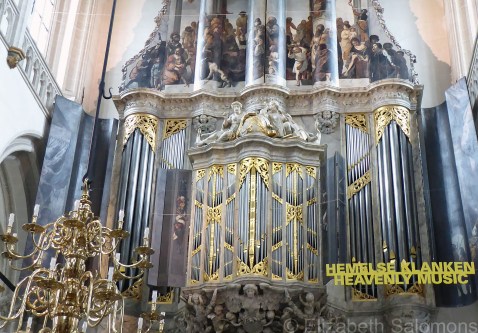
Nieuwe Kerk, Amsterdam
The Wittenberg Door
So I learned something the last time I was in Berlin. My dad and I were trying to take the train to Wittenberg, but almost ended up in Wittenburg.
Who knew one vowel could make such a difference? (And yes, this is why God made editors.) Wittenberg with an “e” is about 100 km southwest of Berlin. Wittenburg with a “u” is about 200 km northwest of Berlin.
In other words, we were headed in pretty much the opposite direction of where we wanted to be going.
After a quick chat with the train conductor, my dad and I disembarked at the next station, took a train to somewhere in the middle of nowhere, and waited there for yet another train that would take us south. We eventually did reach Wittenberg (with an “e”).
Why Wittenberg? Because we wanted to see this door.
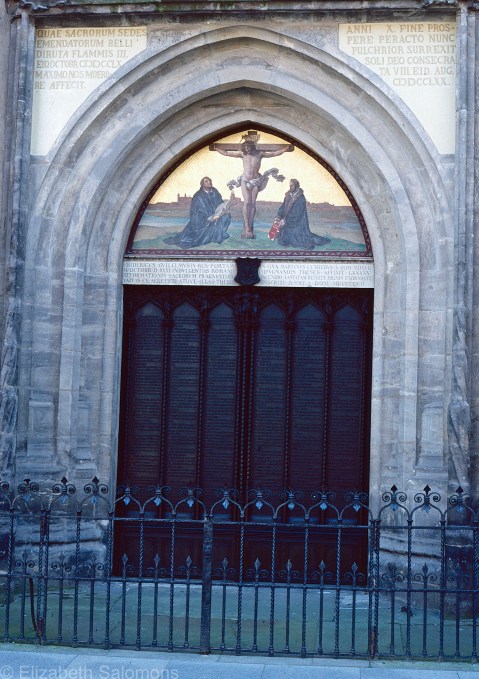
That would be the door to the Schlosskirche or Castle Church to which Martin Luther is said to have nailed his 95 theses 500 years ago today, on October 31, 1517. You can see the tower of the Schlosskirche in the photo below.
Luther’s theses went viral, you could say, and caused a bit of an uproar in the Christian church. Wars ensued — lots of wars — and, well, a lot of general mayhem. The world has never been the same since.
Some might say a little reformation, now and then, is a healthy thing, but I doubt that Luther had any idea of what he was starting when he picked up that hammer.

Happy Easter!

Fountains Abbey Church, Yorkshire, England, October 1996
Through My Lens: Fountains Abbey Windows
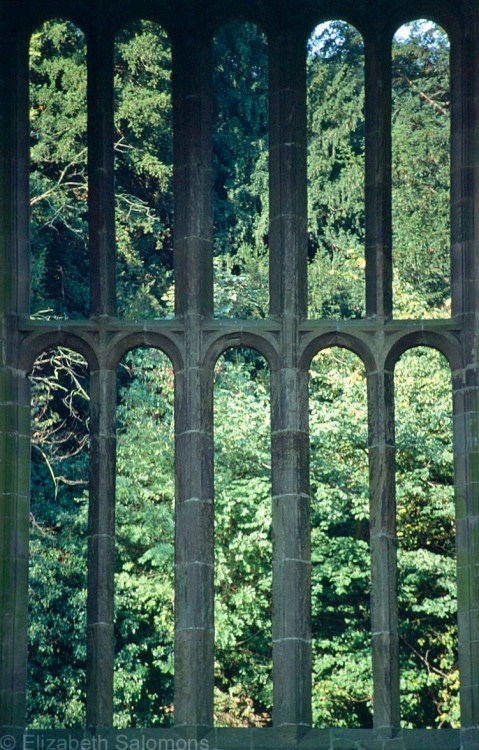
For Palm Sunday, I’m posting a photo of a wall of windows from Fountains Abbey. These windows are located on the bottom level of the abbey’s tower, which was built not long before the abbey was surrendered to the Crown. As I explained last Sunday, after the surrender, the lead and glass were removed from all of the abbey’s windows, allowing in the elements and causing the abbey to quickly fall into ruin.
The Crown sold Fountains Abbey to a merchant from London. Eventually, it was purchased by Sir Stephen Proctor, who used stone from the abbey to build a home for his family. It took from 1598 until 1611 to build that house, which he named Fountains Hall.
What was left of the abbey became the estate’s “folly” — essentially a giant lawn ornament. Such features were common in formal English gardens.
Since 1983, Fountains Abbey has been owned by the National Trust. It was declared a World Heritage Site by UNESCO in 1986.


 There and Back Again