
Through My Lens: Fountains Abbey Narthex
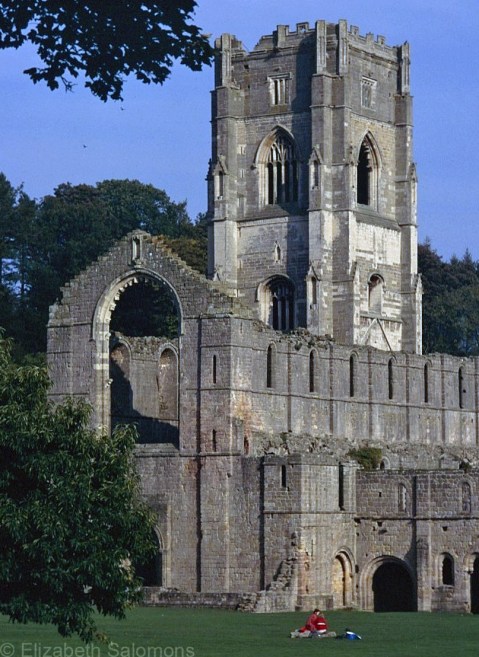
Here is a photo of the narthex of Fountains Abbey, which I am posting for the Fifth Sunday of Lent. A narthex is the entrance to a church. Nowadays, we usually call it a foyer.
You get an idea of the size of the church at Fountains Abbey from this photo. It wasn’t until I visited this abbey that I began to understand why so many of England’s abbeys lie in ruins. Which is ironic, considering that Fountains Abbey is one of the best-preserved abbeys in all of England.
It’s because once you take away the roof, the building doesn’t stand a chance against the unpredictable English weather.
Why is there no roof? That’s easy. When the deed of surrender was signed at Fountains Abbey in 1539, the abbey had to be made unfit for worship. The roof was torn off, and the windows were stripped of their lead and glass. Some of the stone was carted off to be used for building projects elsewhere; the rest was worn down by the elements. During the Dissolution, many of the abbeys were also burned to ensure that the monks would leave.
The Dissolution came about because of Henry VIII’s break with the Catholic Church. More than 900 religious houses — home to some 12,000 people — were destroyed between 1536 and 1541. Initially, the proceeds from the monasteries was intended to provide an income for the Crown, but eventually many of them were sold off to fund Henry’s wars.
Canada 150: Inuvik
Our road trip up the Dempster led us, eventually, to Inuvik. Located 200 km north of the Arctic Circle, Inuvik was built in the 1950s in its present location in the Mackenzie River delta to function as the region’s administrative centre.
Inuvik is the northernmost point of Canada that I’ve ever been to. Until this year, it was also the northernmost point in Canada that you could drive to in the summer. In the winter, the Dempster Highway continues north to Tuktoyaktuk for another 194 km along an ice road formed on the channels of the Mackenzie River delta and the Arctic Ocean. This ice road was only open during the winters, but is being replaced by a new all-season road scheduled to be finished by the end of next summer.
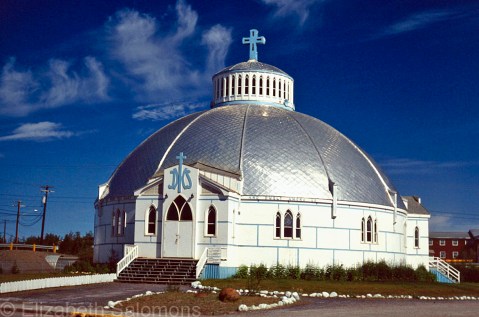
Our Lady of Victory Parish, or the Igloo Church as it is often called, is the community’s Catholic church. It was designed by Brother Maurice Larocque, a missionary from Quebec who spent his entire ministry working in the North. Before he became a priest, he was a carpenter, and he used his skills to design a church that reflected the people who would worship in it. The church was built in the shape of an igloo to be able to deal with the shifting permafrost it stands on.
The Igloo Church is the most photographed building in Inuvik. Naturally, I had to take a photo, too.
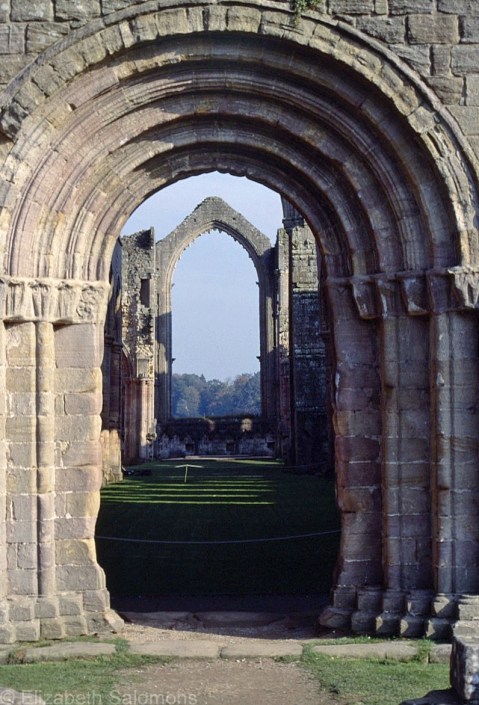
Through My Lens: Fountains Abbey Nave
Without the lay brothers who built the abbey and did all the daily chores necessary to keep body and soul together, Fountains Abbey would never have become as wealthy as it did. At the time of Dissolution, the abbey’s land holdings had increased to 500 acres, making it one of the richest religious houses in England.
Which also made Fountains Abbey awfully attractive to Henry VIII, who used the proceeds from dismantling England’s abbeys to fund his military campaigns. (More on that next week.)
For today, the Fourth Sunday of Lent, I’m posting a photo of the nave of Fountains Abbey. Imagine, if you will, that the roof is still in place and the monks are singing and chanting as they process down this nave towards the Great East Window.
Through My Lens: Fountains Abbey Cellarium

For the Third Sunday of Lent, I’m posting a photo of the cellarium at Fountains Abbey. Cellarium is a fancy monasterial word for “storeroom,” and this one was located beneath the dormitory where the lay brothers slept. It was used mainly to store food.
Fountains Abbey had two orders of monks: choir brothers and lay brothers. The choir brothers did all the praying and singing, while the lay brothers did all the manual labour required to run the abbey, including stonework and metalwork, tanning hides and making shoes, brewing and baking, and herding sheep.
Through My Lens: Fountains Abbey Great East Window
Fountains Abbey was founded by 13 rebel Benedictine monks from St. Mary’s Abbey in York. They were sent packing because they wanted to live by a stricter rule than the Rule of St. Benedict that the monks in York followed.
The rebel monks were given 70 acres of land in a valley near Ripon in North Yorkshire. They decided to establish a Cistercian order, which is a French monastic order. Cistercian monks supported themselves by farming. The land near Ripon had everything the rebel monks needed: a valley setting to shelter them from the North Yorkshire weather, stone and timber for building, and plenty of water. The name of the abbey, St. Mary of Fountains, is thought to have originated from some nearby springs.
Not long after founding their abbey, the monks built a church out of stone. The Great East Window above the Chapel of Nine Altars behind the High Altar is featured in this photo, which I am posting for the Second Sunday of Lent.

Through My Lens: Fountains Abbey and the River Skell
For this year’s Lenten series, I’m going to follow up on last year’s series of photos of Mission Abbey with photos of another abbey. This time, though, we are once again back on the other side of the pond.
This year’s abbey is Fountains Abbey in North Yorkshire, England. It was founded in 1132 and operated as a religious house until 1539 when it was surrendered to the Crown during the Dissolution of the Monasteries under Henry VIII.
For the First Sunday of Lent, here is the view of Fountains Abbey when walking towards it from the west. All that is visible of the abbey is the church tower, which is reflected in the River Skell.

Abbaye Notre-Dame de Sénanque

It’s the last day of the most miserable month of the year! When I woke up this morning to yet another torrent of rain, all I could think was, “It’s the last day of November. Tomorrow, I will feel so much better.”
And so, to celebrate, here is one last photo from Provence. This is the Abbaye Notre-Dame de Sénanque. It’s a Cistercian abbey not far from Gordes and was founded in the twelfth century.
It’s quite possible you’ve seen a photo or two of this abbey before as it’s one of those scenes of Provence that is on all the postcards, except that the photos in the postcards are all taken when the lavender is in full bloom. (That’s what those long rows of plants are in front of the abbey.) The monks sell that lavender and raise honey bees to support themselves.
We didn’t get to see the inside of this abbey or its cloisters (and you all know how much I love cloisters) because it’s a working abbey. Admittance is only with a tour and we showed up at the wrong time. No matter, as I always like to leave something to do for a return visit. And so, this abbey will be top of my list on my return visit to Provence.
Which will be when the lavender is in full bloom.
Happy Easter!

Mission Abbey Church, Mission, British Columbia, April 2012
Through My Lens: Mission Abbey Church Interior
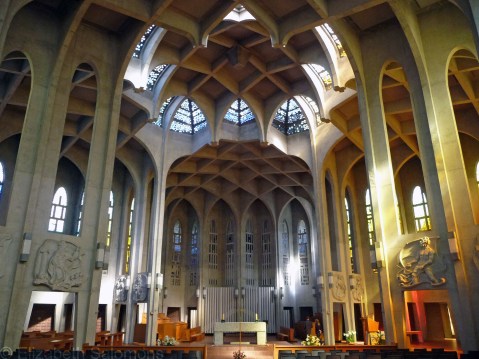
It’s Palm Sunday again. To celebrate the day, I’m posting a photo of the interior of Mission Abbey Church.
The architectural structure of the church is based on the Greek cross: there are four arms of equal length. At the end of each arm are windows that correspond by their colour (blue, red, brown, and grey) with the four elements I mentioned the other week: water, fire, earth, and air.
Through My Lens: Mission Abbey Bas Relief
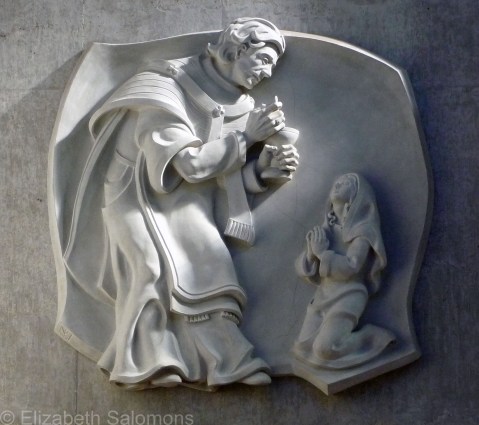
It’s the Fifth Sunday of Lent and today’s photo is of one of the bas reliefs that adorn the interior of the church of Mission Abbey. These bas reliefs were created by resident monk and artist Father Dunstan Massey.
Father Massey began his art studies at age 15 under Jack Shadbolt at the Vancouver School of Art. At 18, he began his journey towards the priesthood by entering the monastery at Mission Abbey. Although he was willing to give up his art to devote his life to God, the Abbot had other ideas and made him the Abbey’s resident artist.
In addition to these bas reliefs in the church, Father Massey’s sculptures, paintings, and frescoes are displayed throughout the Abbey’s buildings.


 There and Back Again