
Through My Lens: Nitobe Memorial Garden in the Fall

More than a year ago, I posted a photo of Nitobe Memorial Garden in all its spring glory.
Here it is in the fall. Glory.
Through My Lens: Zaanse Schans

To finish out the month, here’s a photo of the windmills at Zaanse Schans. Zaan is the name of the river that runs past the village and Schans comes from the Dutch word for “earthwork.” The Dutch are fond of moving earth, but what’s special about this one is it dates back to the Eighty Years’ War when the Dutch and the Spanish were going at it.
Zaanse Schans is a popular spot with tourists as it’s only a 15-minute train ride from Amsterdam and has several working windmills. Although I once spent part of a summer in the nearby town of Zaandam on my first-ever home exchange, this photo was taken several years prior to that visit, in late autumn.
A lovely corner of Holland any time of year, to be sure.
The Chan Centre
When I was blogging about spectacular European opera houses last spring, it occurred to me that spectacular Canadian opera houses are few and far between.
No matter. We do have some spectacular concert halls.
This is a photo of the Chan Centre. Located on the Point Grey campus of the University of British Columbia, it was designed by the Vancouver-based architect Bing Thom. Its main concert hall is shaped like a cello and the acoustics are state of the art.
This time of year, the Chan looks particularly spectacular.

Nelson Park
Stanley Park gets a lot of attention from Vancouver’s visitors, but it’s not the only park in Vancouver’s West End. One of my favourite parks ― so much so I try to walk through it each and every time I head downtown ― is Nelson Park.
Nelson Park is a small park, but it’s a busy park. Only one city block big, it shares that space with Lord Roberts Annex (a K–3 primary school) and its playground, which takes up about a quarter of the block. Several dozen community garden plots line the park’s walkways and the West End Farmer’s Market is held alongside the park every Saturday from May to October. Because the park is located kitty-corner to St. Paul’s Hospital and across the street from the Dr. Peter Centre (an assisted-living residence for adults living with HIV/AIDS), it’s not unusual to see patients making use of the park on warm, summer days.
But my favourite corner of Nelson Park is the fenced-in off-leash dog park, one of a handful in Vancouver’s West End. Walk past it after work any day of the week to witness Doggy Happy Hour ― complete with wagging tails.
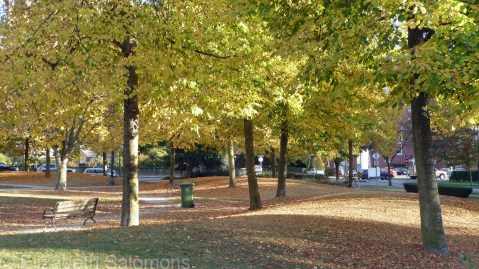
Here is a photo of Nelson Park in all its fall glory.
Highway 2

A week ago today, I hitched a ride down Highway 2 from Edmonton to Red Deer with my brother and his family. As we left the city’s outskirts, I had some fun teasing my nieces that they were doing a good job of ignoring their old aunt. (Their noses were glued to their devices.) Even my brother was planning to spend the two-hour drive alone ― with his book.

No matter. Within minutes, I was enthralled.
Eventually, my brother, too. His book lay forgotten in his lap.

Someone once told me they thought Highway 2 was the most boring stretch of road anywhere in Canada.
I beg to differ. I think it’s the most beautiful.
Salt Spring Island Fall Fair

Yup. It’s another cow.
And no, this hasn’t turned into a Bovine Blog.

I took these photos a couple of weeks ago at the Salt Spring Island Fall Fair. My friend had been urging me to come over for the island’s annual fair, which, she claims, is the social event of the year for Salt Spring Island.

“Will there be cows?” I asked.
“Yes,” she said.
“I’m there,” I said.

Salt Spring Island has a long history of farming ― the island was first known for its fruit harvests, then the dairy and poultry farmers arrived. These days, Salt Spring is famous for its lamb …
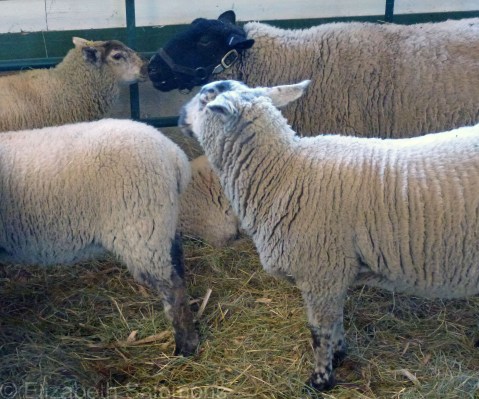
… and for its cheese made from goats’ milk.

In keeping with that history, the Salt Spring Island Fall Fair has been an island institution since 1896. This year’s theme was Celebrating Family Farming to coincide with the United Nations declaring 2014 the International Year of Family Farming. (I so wish I had made it to last year’s fair: its theme was Pirates of the Carrots and Beans.)
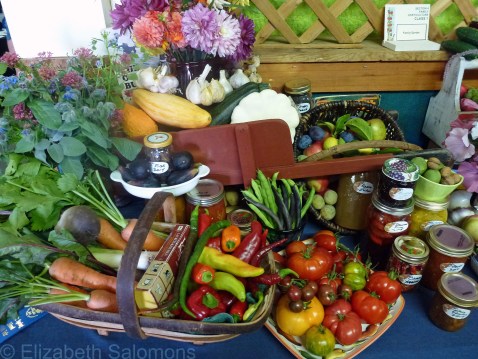
It seems like everyone on the island has something to exhibit at the Fall Fair ― from livestock to produce to baked goods to flowers to handcrafts.
Although the sheepdog demonstration was fascinating and the zucchini races were, um, unlike any race involving green vegetables I’ve ever seen, my favourite event was the sheep shearing.
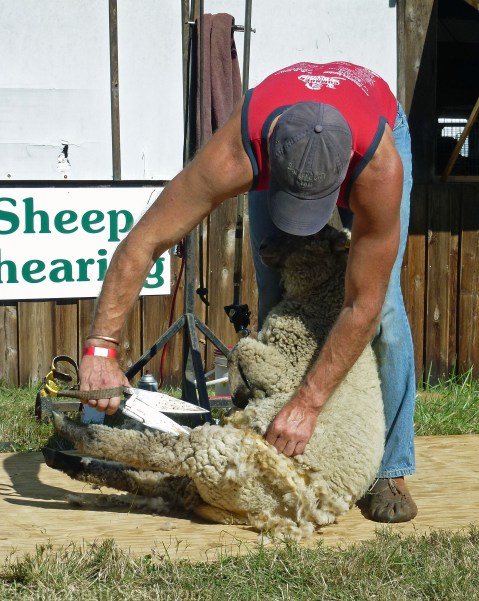
The shearer showed us how shearing used to be done ― with a big, shiny pair of blade shears …

… and then he showed us how it’s done today ― with powered machine shears.


The Salt Spring Island Fall Fair takes place every September. If I’m feeling in a year that my blog needs more cow photos, I now know where to go.
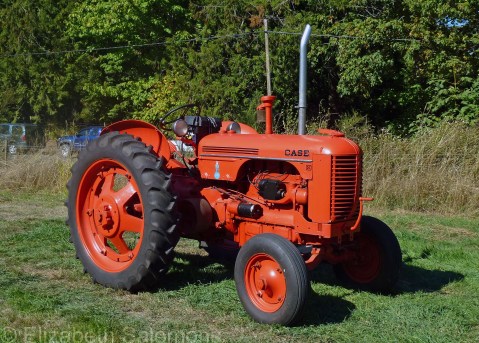
Through My Lens: Foggy Vancouver
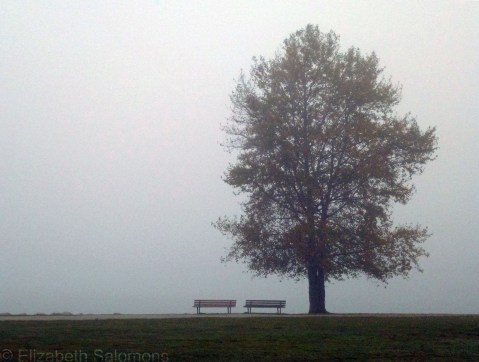
Vancouver has been awash in a pea-soup thick fog the past few days. It’s supposed to lift tomorrow. Apparently the sun is out there somewhere.
Here is a photo I took this afternoon at Vanier Park.
Happy Thanksgiving!
I missed Thanksgiving the year I backpacked around Europe with my girlfriend. We joked about what we thought was our Thanksgiving dinner (bratwurst and sauerkraut in the Munich train station) on the day we thought was Thanksgiving, but we later found out we had the wrong day. I think we even had the wrong week. That’s what happens when you hop on and off trains and check in and out of hostels on a daily basis: the days become a blur.
I remember telling the story of our missed Thanksgiving to two Nebraskan sisters we had met on a train. They looked at me, puzzled. “You can’t have Thanksgiving,” they said in unison. “You didn’t have pilgrims!”
Uh, yeah. Right.
It never made sense to me why turkey had to be eaten with cranberries until my first trip to Massachusetts. There, while camping on Cape Cod, I found wild cranberries growing every which way I turned. And Cape Cod, of course, is just around the corner from Plymouth, where the aforementioned all-important pilgrims first landed on America soil.
“Aha!” I said to myself. “It’s all those pilgrims’ fault that we are stuck eating cranberries every holiday dinner.”
Cranberries grow in British Columbia, too. In fact, this province produces 12 percent of North America’s cranberry supply.
I will have Thanksgiving dinner tonight with my family. There will be cranberries. And pumpkin. But no turkey.
And no, Canada didn’t have pilgrims. We are thankful, none-the-less.
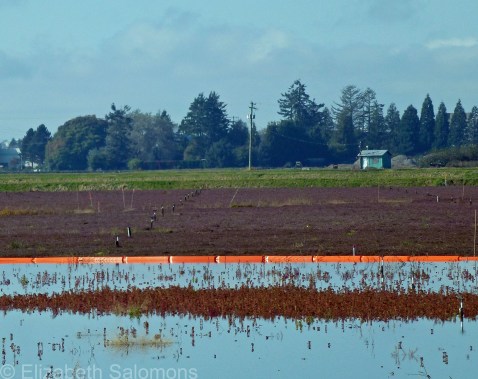
Cranberry Bog, Richmond, BC
University of British Columbia
The last school I want to show you on my tour of schools I’ve photographed is the University of British Columbia. Like Simon Fraser University, UBC is situated a ways away from the hustle and bustle of the city centre ― its main campus is located at the western tip of Point Grey, a peninsula to the west of Vancouver’s toniest neighbourhoods.
UBC is a hodge-podge of architectural styles. For one, it’s got your neo-Gothic. This is the Chemistry Building, one of the first three buildings constructed on the Point Grey campus. That was back in 1925.

For another, it’s got your Brutalism. The Buchanan Tower was built in 1972.

And it’s got your postmodernism. This is the Koerner Library, which was designed by Arthur Erickson and completed in 1997.

UBC is fond of combining architectural styles when it builds additions to existing buildings. The Main Library, another of the three buildings constructed in 1925, morphed into the Irving K. Barber Learning Centre in 2008. The neo-Gothic centre is the original building, now surrounded by a postmodern glass structure.
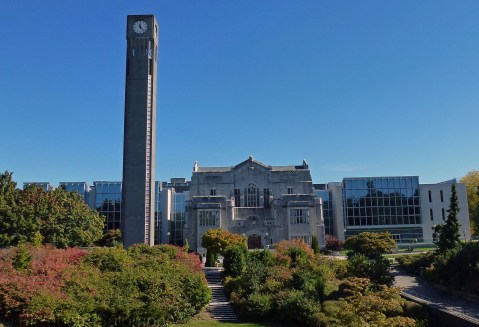
Here’s a look at it from another angle.

Four wings were added to the Chemistry Building between 1959 and 1989. This is a corner of one of those wings, built in the Brutalist style.
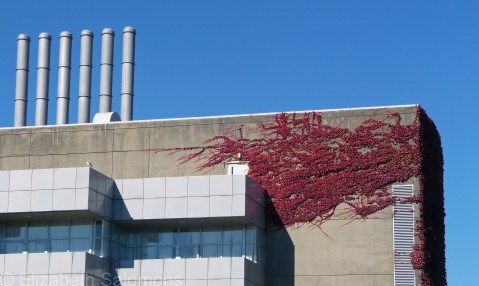
And this postmodern structure is an addition to the Henry Angus Building, which houses the Sauder School of Business. The addition, which opened in 2012, is wrapped around the original building, which was built in 1965 and expanded in 1976.

With 50,000 students, UBC is Canada’s fourth largest university and the largest in Western Canada. These days, the Point Grey campus is one massive construction site. In the past year, work was completed on a new trolley bus loop, upgrades to primary pedestrian corridors (which for some reason I have yet to figure out are called “malls” here), and a new fountain in Martha Piper Plaza. Building construction currently underway includes a new Student Union Building, the new Centre for Brain Health at UBC Hospital, and expansion of the UBC Bookstore. A new building that will house the Faculty of Education is scheduled to break ground this winter.
UBC’s Class of 2016 fittingly calls itself the Class of Construction.
Simon Fraser University
And now, for something completely different.

Unlike the universities I wrote about in the previous four posts, whose campuses are all situated smack in the middle of a city, Simon Fraser University sits above the city, on top of a mountain. (Which, in my humble opinion, takes the notion of an Ivory Tower a tad too literally.)
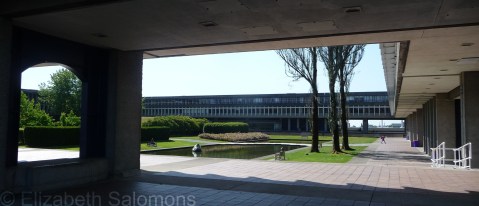
Construction of SFU’s Burnaby campus was begun in the spring of 1964, and the university welcomed its first 2500 students in September 1965.

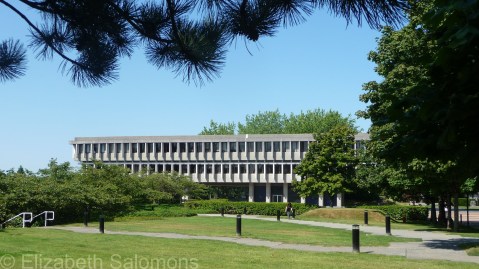
The architects were Arthur Erickson ― probably Vancouver’s best-known and most influential architect ― and Geoffrey Massey. The campus atop Burnaby Mountain is in the Brutalist style of architecture, and won the 2007 Prix du XXe siècle from the Royal Architectural Institute of Canada, which recognizes buildings of significance to Canada’s architectural history.


 There and Back Again