
Through My Lens: Notre-Dame Basilica of Montreal

This year, for Lent, I’m taking you on a tour of Montreal’s Notre-Dame Basilica.
For the First Sunday of Lent, here’s a photo of the basilica taken from Place d’Armes, in the heart of Vieux-Montréal. The statue in front of the basilica is of Paul de Chomedey de Maisonneuve, co-founder along with Jeanne Mance of the first colony of French settlers on the island of Montreal.
The first church on this site went up in 1672. The present-day building, designated a basilica in 1982 by Pope John Paul II, was built between 1824 and 1829. The two spires took an additional ten years and are modelled after Notre-Dame de Paris and Saint-Sulpice.
Notre-Dame Basilica is the first church in Canada to be built in the Gothic Revival style. The architect was an American from New York named James O’Donnell. He converted to Catholicism before his death and he is buried in the crypt.
Vieux-Québec
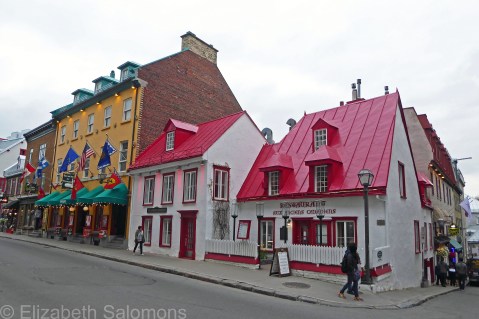
I’ve written before about my summer in Quebec City — and how six weeks is a nice chunk of time to get to know a place. Even so, I was surprised last year during my visit to Vieux-Québec at how familiar the place was.
Still. After all these years.

I arrived from Montreal by train around midday, and the funny little man at my budget hotel offered to outline a nice walking tour for me on his map.
“Non, merci!” I said, smiling. I knew exactly where I wanted to go.
He looked up from his map, a little surprised and, I think, a little insulted. But he shrugged, handed me the map, and off I went.

Encircled by its original ramparts, Vieux-Québec (Old Quebec) is divided into an Upper Town and a Lower Town. I chose to stay in the Lower Town, just a few steps from the train station to make my arrival more convenient for me, but it turned out to be a serendipitous choice.
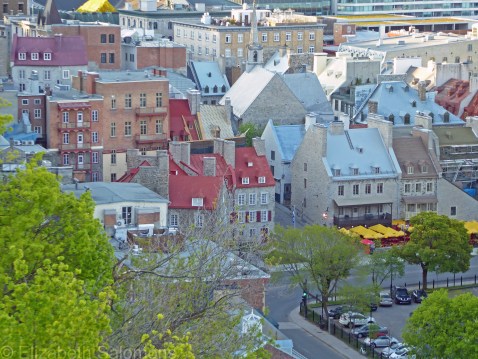
I was close enough to the action, so to speak, but far enough away that I had some enjoyable late evening walks back to my hotel through quiet streets.

The name “Quebec” comes from an Indigenous word meaning “where the river narrows.” That narrowing river is the mighty Saint Lawrence.
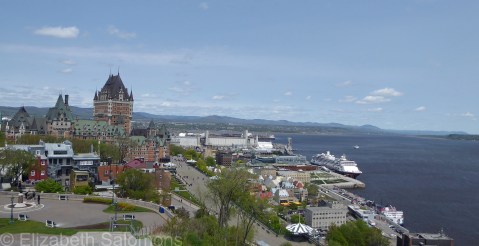
The first permanent European settlement at Quebec City was established in 1608 by Samuel de Champlain. Le Petit Champlain, the oldest quarter of Vieux-Québec, is named for him, and Rue du Petit-Champlain (shown in this next photo) is its main drag.

Vieux-Québec is filled with stone buildings dating back to the seventeenth century, with their characteristic French-style roofs.

Notre-Dame-des-Victoires, in Place-Royale, is the oldest stone church in North America. It was built in 1688.
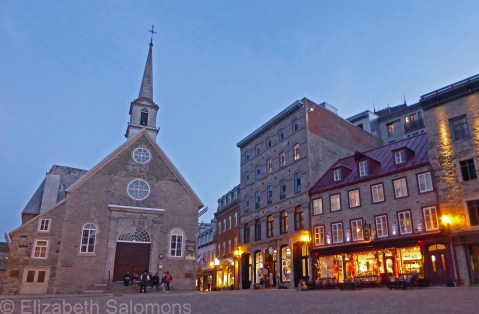
At the edge of the Upper Town, Dufferin Terrace lets you walk from the foot of the Citadelle to Chateau Frontenac, and provides a magnificent view over the Saint Lawrence River, the Lower Town, and, on a good day, the Laurentian Mountains.
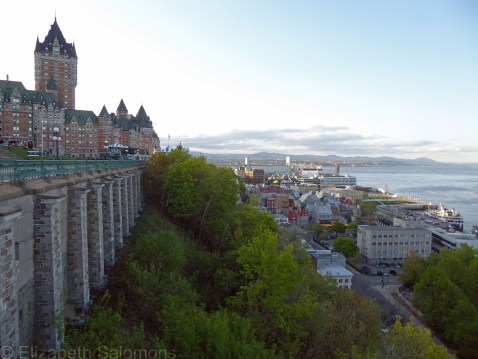
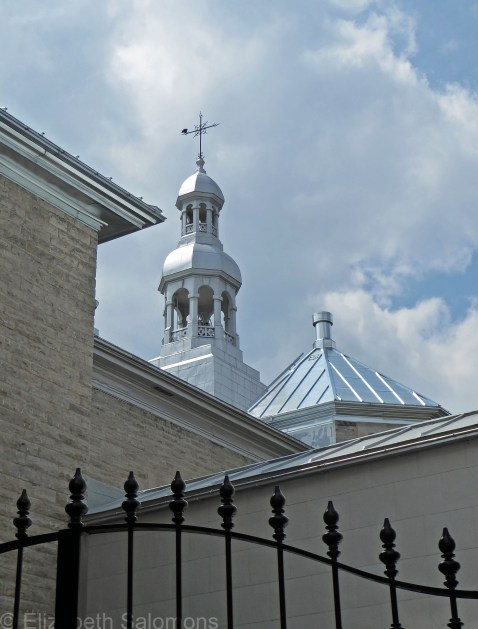
A sign of the not insignificant role of the Catholic Church in Quebec’s history are the many church spires scattered throughout Vieux-Québec.
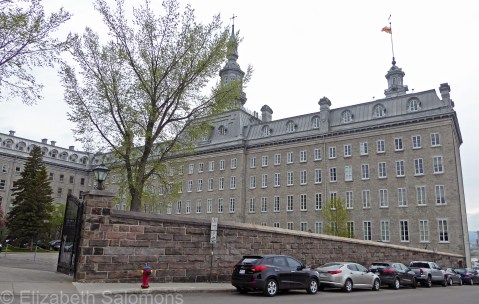
And then there’s this grand building, the Séminaire de Québec, which takes you by surprise when you round the corner. The seminary was founded in 1663, and this building declared a national historic site in 1929.
Vieux-Québec is the only walled city in Canada or the United States.


I wrote above about how familiar Vieux-Québec was for me, even after all these years. For my mother, not so much. I happened to be with her on her first time back in Quebec City, some 40 years after her arrival by immigrant ship. I remember watching her as she leaned over the railing that lines Dufferin Terrace, intently scanning the waterfront below us. I could see how much she wanted to recognize something … anything.
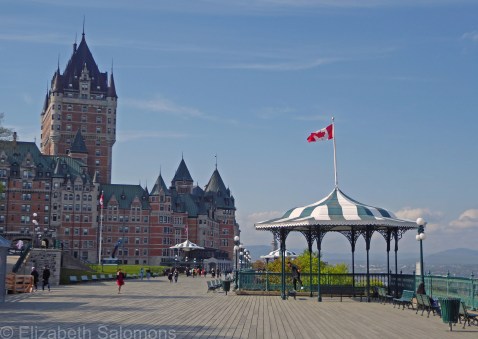
Finally she stepped back and shook her head. It was no good; nothing about the port looked familiar to her.
I doubt it was because she was too young to remember — a child’s memories can be quite vivid, and I suspect that her first impressions of a new country were imprinted on her mind. What it does speak to is that there are parts of Vieux-Québec that have changed over the years, after all, and a port that greeted new Canadians for more than 200 years looks quite different from the port that now greets tourists arriving by cruise ship.

Vieux-Québec was declared a World Heritage Site by UNESCO in 1985. It is indeed a special place and should really be visited by every Canadian.
Six weeks, if you can. But if that’s not possible, then a couple of days will do nicely.
Welcome World
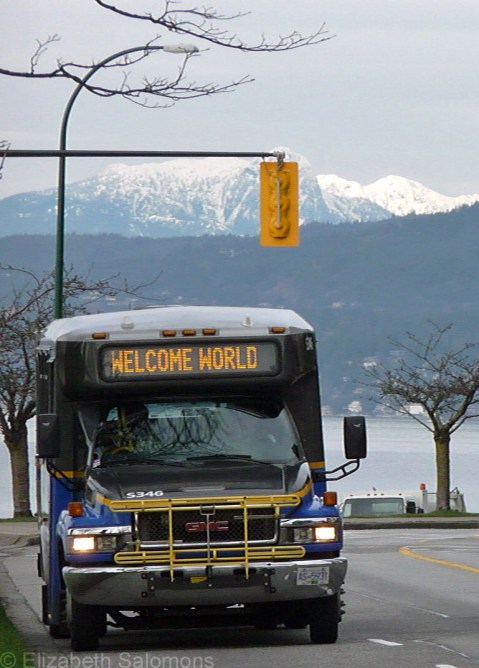
Whoosh.
And there goes another decade.
Ten years ago today, the Vancouver 2010 Olympics got underway. It’s difficult to explain to people who weren’t here the feelings of anticipation we all had going into the Games, and the euphoria we experienced throughout.
We were nervous at the beginning, to be sure. The weather did not seem to be cooperating. A mild, rainy winter meant there was very little snow on the local mountains and the cherry blossoms were starting to bloom weeks earlier than usual. A key moment of the opening ceremonies, the lighting of the Olympic cauldron, was goofed up by technical difficulties. And earlier that same day, a Georgian athlete died while on a luge training run. It really felt like everything that could go wrong would.
I believe that many of the nerves we were feeling were simply related to the insecurities we Canadians tend to have about holding our own on the world stage.
But then things started going right. The events got underway, a small army of volunteers in blue jackets (affectionately known as the Smurfs) made sure everyone got to where they needed to be, and Canadian athletes started to win. And they kept winning. I remembered lamenting that I didn’t have enough red in my wardrobe (although I did have a coveted pair of red mittens — an impulse purchase made many months earlier — that you couldn’t get for love or money during the Games themselves).
I was happy to get to a couple of hockey games, but you know what was the most fun about the Vancouver 2010 Olympics? Taking in all of the excitement in the streets, and at the various pavilions and celebration houses around town. The atmosphere was electric. By the end of the Games, the world media was calling them the most successful Winter Games ever.
The photo above, taken in early February 2010, pretty much captures my feelings about Vancouver 2010. Several weeks before the Games started, the international media began arriving in droves. Next came the athletes and their coaches. And then, in the last week before the start of the Games, it was as if the flood gates had been opened and the tourists arrived en masse. They were everywhere.
Welcome world, indeed.
Through My Lens: Lost Lake Trail

Whoosh!
And there goes another month.
I took this photo on what turned out to be the highlight of my month: a weekend in Whistler. It snowed pretty much the entire time we were there, and my friend and I pretty much walked out our door with our snowshoes on and were upon this scene within minutes.
Magical.
You Know It’s Cold When …
I know, I know. Here I go again, talking about the weather.
For the benefit of my non-Canadian readers (in case you haven’t figured this out yet), talking about the weather is a bit of a national obsession.
The western part of Canada is in the middle of a polar vortex. I got outside today to tramp through the deep snow that arrived overnight in Vancouver, but in this post, I’m going to talk about the next province over. That would be Alberta, where a lot of my family lives.
They’re cold, to put it mildly. My sister in Calgary was faced with a commute this morning in temperatures of –40° C.
Ouch!
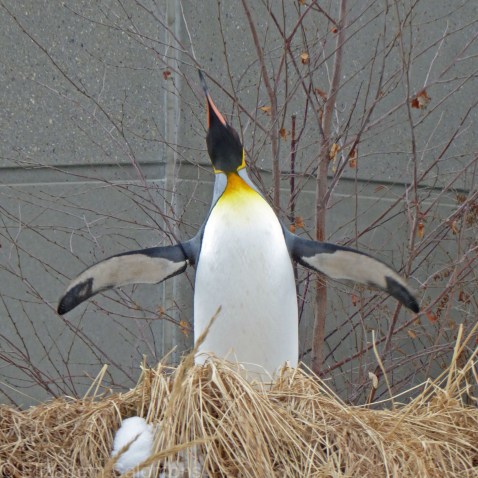
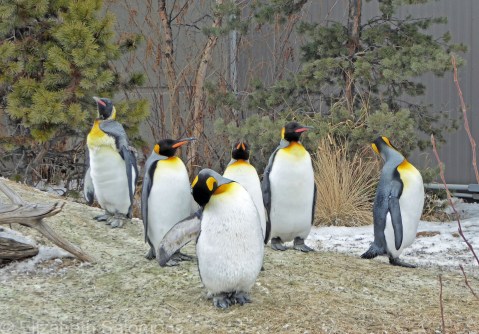
In fact, it’s been too cold all week for the Penguin Walk at the Calgary Zoo. That’s right. The zoo’s king penguins, native to the sub-Antarctic, had a Snow Day. And Calgary today was colder than Antarctica.
Double ouch!
I took these photos of the Calgary Zoo penguins almost a year ago, when I visited the zoo on a much balmier day than today.
The Chanteur of Montreal
Some say that no one ever leaves Montreal, for that city, like Canada itself, is designed to preserve the past, a past that happened somewhere else.
— The Favourite Game, Leonard Cohen
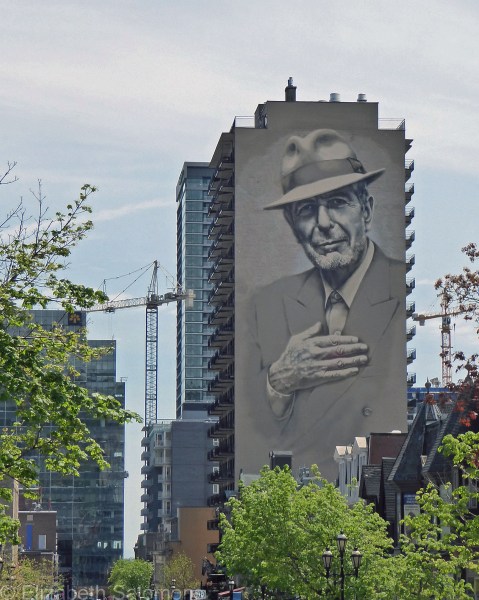
I can’t leave Montreal behind without writing a word about Leonard Cohen. Because, even though the man spent much of his life living elsewhere, Leonard Cohen is Montreal.
You can’t avoid him when you are there. Stand on any street corner in the city centre and his face stares down at you. When the news broke of Leonard Cohen’s death in November 2016, an impromptu memorial sprang up on the doorstep of his Montreal home. Vigils took place in the square just opposite. Like a pilgrim, I visited both.
I also read The Favourite Game, his first novel, to prepare for my visit to Montreal last spring. The members of my book club were not happy — none of them enjoyed the thinly disguised autobiography. I thought it was laugh-out-loud hilarious.
I’m still making it up to them.
This was a rough year, on so many levels. Almost everyone I know is counting the hours until 2019 is over. All are hopeful that 2020 will be better. I myself had a pretty good year, more or less. But I find it tough to feel joy and gratitude when everyone around me is hurting and weary and sick. Some people call that empathy.
I call it exhausting.
And that’s before we even bring up the news cycle.
In times like these, some of us turn to prayer, some of us turn to poetry, and some of us turn to music. Leonard Cohen — poet, novelist, songwriter, chanteur — gives us all three.
To close out 2019 as well as my series of posts on Montreal, I’m going to finish with these words:
Ring the bells that still can ring
Forget your perfect offering
There is a crack in everything
That’s how the light gets in.
May we all see more of the light in 2020.

Merry Christmas!
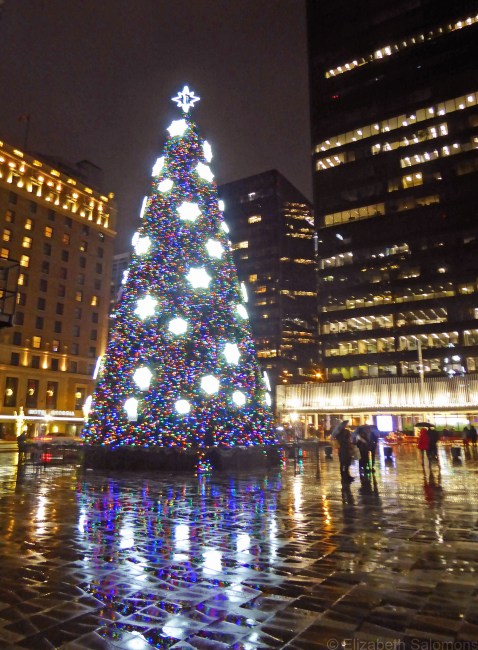
šxʷƛ̓ənəq Xwtl’e7énḵ Square, Vancouver
Lachine Canal
After I had explored Vieux-Montréal to my heart’s content, I decided to walk the length of the Lachine Canal. This was solely to satisfy my curiosity about a canal I had read about when I was doing a degree in Canadian history (a long time ago) and editing history textbooks (much more recently).
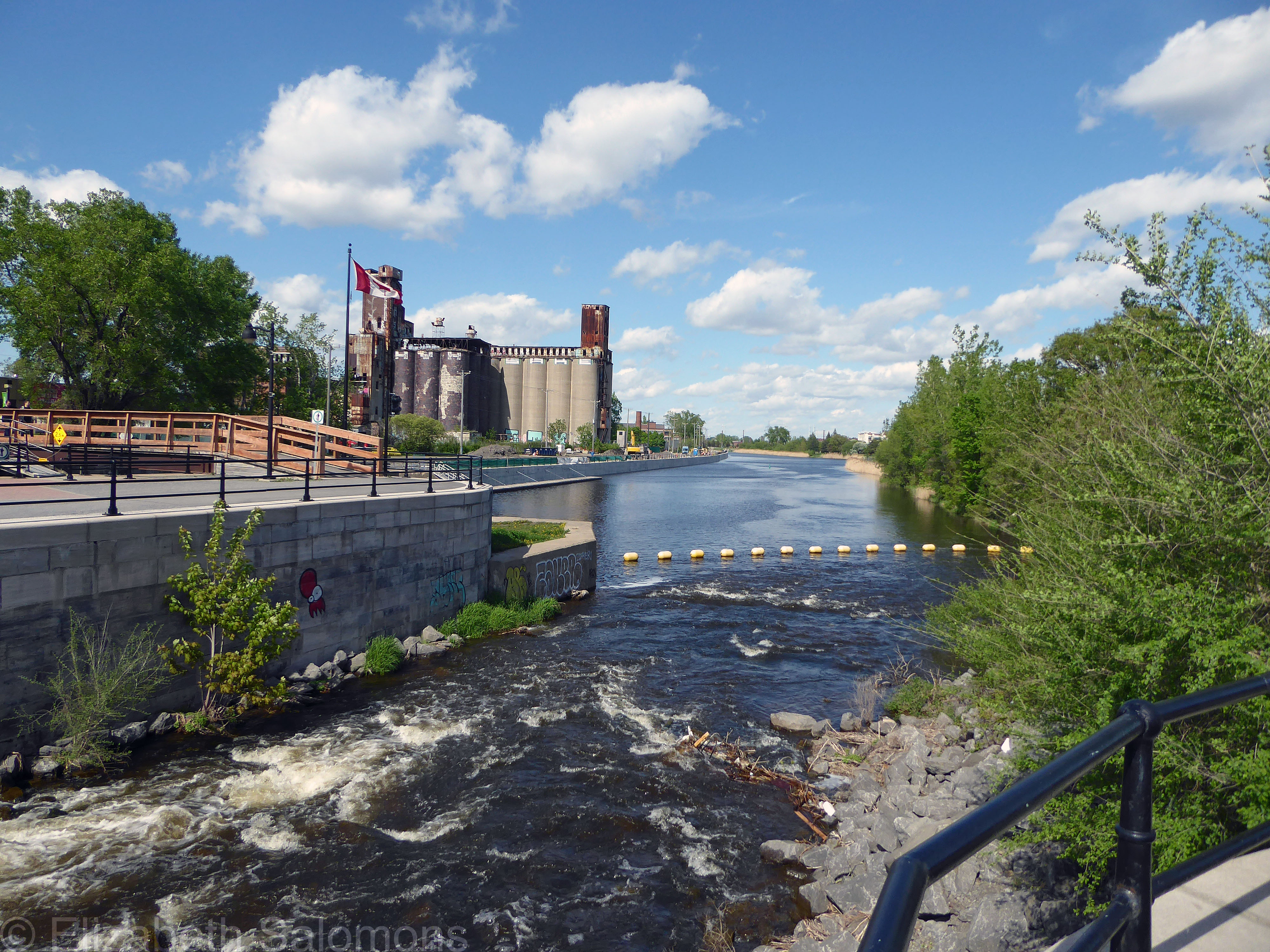
The Lachine Canal was built across the southwest part of the island of Montreal to allow ships to bypass the Lachine Rapids on the Saint Lawrence River. The name comes from the French for China (La Chine) and reflects the original goal of those early European explorers: to find a route across the continent and on to China.

Digging 14 kilometres of canal and building seven locks took four years. Most of the work, completed in 1825, was done by Irish immigrants. After the canal was widened and deepened in the 1840s, its entire length became the centre of Montreal’s industry, and the city became the centre of Canada’s manufacturing and trade. Montreal soon quadrupled in size and remained Canada’s largest city until the 1970s.
Eventually though, after the opening of the Saint Lawrence Seaway in 1959 that could accommodate larger ships, the canal lost its significance. It was closed to shipping in 1970.
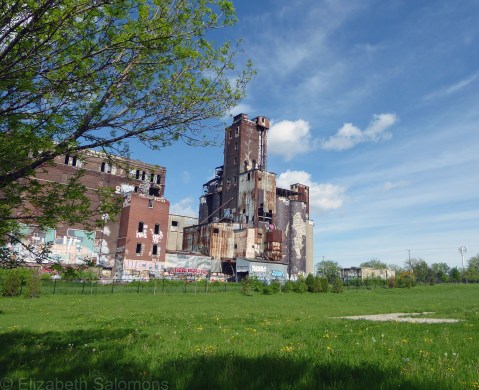
It reopened to pleasure boats in 2002 and a bike path lining the canal was also completed. The Lachine Canal was declared a National Historic Site in 1996.
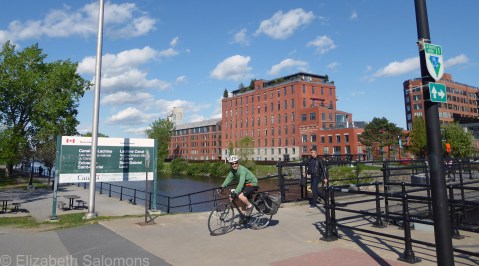
The warehouses and factories that line the canal have been converted to residential lofts and condos.
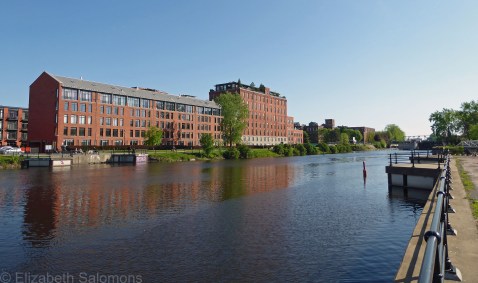
I wanted to walk the Lachine Canal from one end to the other, but after taking the Metro to the end of the line, my starting point was somewhere around its mid-point. As I walked all the way back towards Vieux-Montréal, I realized a better option might have been to rent a bike in the Old Port area and cycle as far as possible before turning around.

Which means I already have my first activity planned for when I return to Montreal.
Vieux-Montréal
I may have mentioned before (just once or twice) that my favourite way to get to know a city is by walking it.
I may have also mentioned (just, erm, once or twice) that I’m a history geek. And so, getting to know Vieux-Montréal (Old Montreal) last May by walking it was a real treat for me. Like a moth to a flame, I set out on my first day for the oldest part of Montreal.
I should make it clear that when I say “oldest part,” I am referring to the part of Montreal first settled by Europeans. Long before the first Frenchman arrived on what we now call the island of Montreal, Indigenous peoples were living there. They called their settlement Hochelaga. That first Frenchman was Jacques Cartier, and he in turn named the mountain near Hochelaga Mount Royal, or, in sixteenth-century French, Mont Réal. That was in 1535.
The first French settlers, about 50 of them, arrived in 1642. They were led by Paul de Chomedey de Maisonneuve and Jeanne Mance, who are considered the co-founders of Montreal. Their interest was evangelical; they intended to convert the Indigenous peoples to Christianity. However, the fur trade soon became the focus of the new colony. To protect the French interests, Louis XIV sent over 1200 French soldiers. The Filles du Roi (the King’s Daughters) followed, also sent out by Louis XIV, to provide wives for all those fur traders and soldiers. And with that, it could be said, the colony of New France was off to the races.
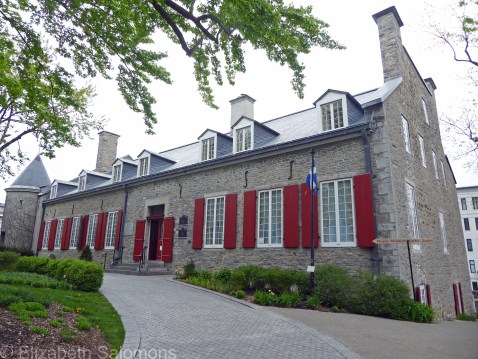
Colonies need governors, and the building in the above photo, Château Ramezay, was the home of one of the early governors of Montreal, a chap named Claude de Ramezay. Built in 1705, it is one of Montreal’s oldest buildings and is located on Place Jacques-Cartier, the centre of Vieux-Montréal. The house was sold by his descendants, and at one time served as the Canadian headquarters of the Continental Army (that would be the army of the American colonials who fought the British during the American Revolution). It is said that Benjamin Franklin was a one-time guest in this house in 1776 when he came looking for military help from New France in the way of soldiers.
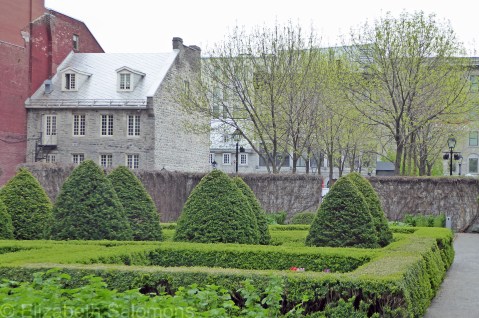
Eventually, the château was turned into a museum, which it remains today. The restored gardens behind the château are particularly lovely.
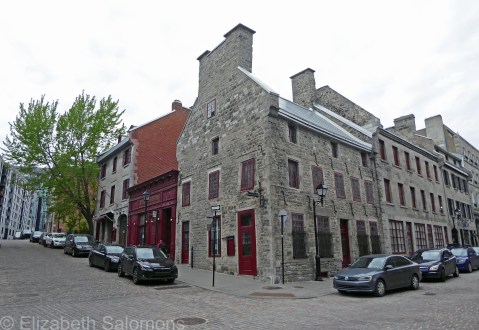
This next house, Maison du Calvet, was built in the 1700s. It looks like it was lifted right out of Brittany. Most recently, it’s been a hotel, but at one time it was the home of Pierre du Calvet, a supporter of the American Revolution. He also met with Benjamin Franklin when he came to New France.
Across the street from Maison du Calvet is this church, Chapelle Notre-Dame-de-Bon-Secours (Our Lady of Good Help Chapel). Founded in 1655 by St. Marguerite Bourgeoys, it’s one of the oldest churches in Montreal. This building dates from 1771. The chapel became popular with the sailors who came through the port of Montreal.
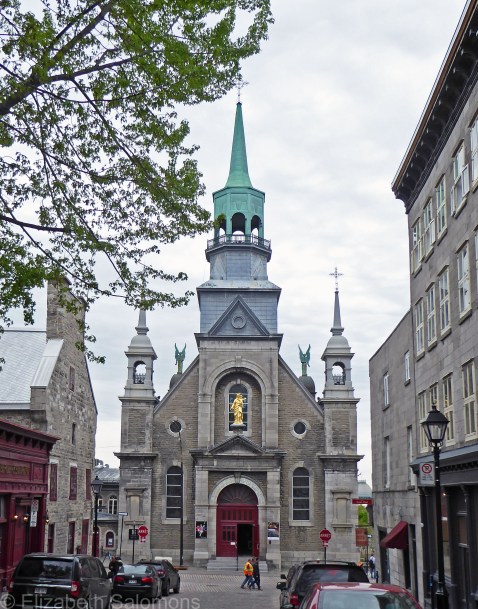
Speaking of sailors, this next building is the Old Custom House, which served a significant function in the burgeoning Montreal trade. When the city was declared an official point of entry for Lower Canada in 1832, it needed some administrative buildings, and this one was completed in 1838. It has two facades; this side faces the Saint Lawrence River. The building is now part of Montreal’s Museum of Archaeology and History.

What I like about this photo is how it shows several centuries of architectural style: directly behind the customs house are the spires of Notre-Dame Basilica (completed shortly before the customs house), behind it to the right is the Aldred Building, built in the Art Deco style and finished in 1931, and behind it to the left is the nondescript bank tower that went up in the 1960s.
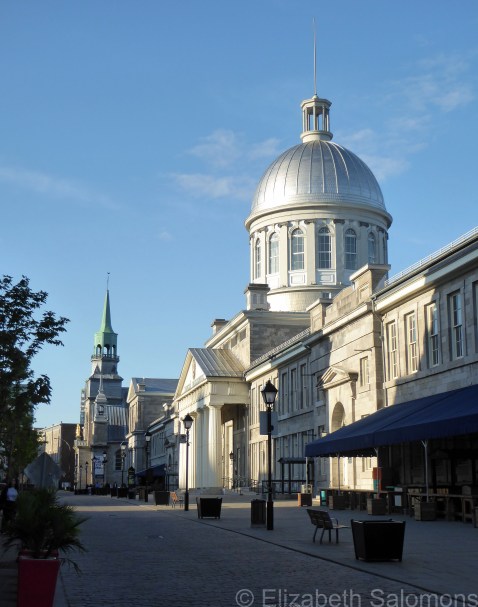
Marché Bonsecours (Bonsecours Market), below, was the public market of Montreal for more than 100 years after its completion in 1847. It also housed the Parliament of the Province of Canada in 1849 and served as Montreal’s City Hall from 1852 to 1878. It is said to have been modelled after the Custom House in Dublin, which speaks to the long history of the Irish in Montreal. The building is now home to restaurants and shops, banquet rooms, and offices.
Here is Montreal’s current Hôtel de Ville (City Hall). It was built in the Second Empire style between 1872 and 1878. For those of us who are familiar with Quebec history, it was from this building’s balcony that Charles de Gaulle, president of France, gave his infamous speech in 1967. He proclaimed “vive le Québec libre,” which then became a rallying cry for the Quebec separatist movement of the late twentieth century.

Thankfully, the movement did not succeed and Quebec is still part of Canada. And we are the richer for it.
Bienvenue à Montréal!
So. Montreal.
It had been a while since I had visited Montreal (over a quarter century, truth be told), and when you’re way out here on the western periphery of Canada, it can often feel (truth be told) as if the country stops at Toronto. My sincerest apologies to La Belle Province for my extended absence.
Having said that, I was so happy to have the chance last spring to renew my acquaintance with the second largest city in Canada. I learned a thing or two.
For one: I can’t wait to go back.
That’s in spite of the fact that my first impression of the city was this: There is an insane amount of road work going on over there. My taxi driver from the train station tried to warn me, but he used the word “construction.”
“Sure,” I nodded. “Lots of construction going on in Vancouver, too.”
But no. My taxi driver wasn’t talking about new condo developments. He meant road work. They say there are two seasons in Canada — winter and construction — and nowhere is that more true than in Montreal. Literally every street corner had a digger on it.
The other surprise for me about Montreal? That it isn’t bigger than it is. Somehow I was expecting it to be closer in size to Toronto than Vancouver, but that just isn’t so.
Here, have a look. This is the city’s skyline as seen from the top of Mont Royal.


 There and Back Again