
Through My Lens: Fountains Abbey Cellarium

For the Third Sunday of Lent, I’m posting a photo of the cellarium at Fountains Abbey. Cellarium is a fancy monasterial word for “storeroom,” and this one was located beneath the dormitory where the lay brothers slept. It was used mainly to store food.
Fountains Abbey had two orders of monks: choir brothers and lay brothers. The choir brothers did all the praying and singing, while the lay brothers did all the manual labour required to run the abbey, including stonework and metalwork, tanning hides and making shoes, brewing and baking, and herding sheep.
Through My Lens: Fountains Abbey Great East Window
Fountains Abbey was founded by 13 rebel Benedictine monks from St. Mary’s Abbey in York. They were sent packing because they wanted to live by a stricter rule than the Rule of St. Benedict that the monks in York followed.
The rebel monks were given 70 acres of land in a valley near Ripon in North Yorkshire. They decided to establish a Cistercian order, which is a French monastic order. Cistercian monks supported themselves by farming. The land near Ripon had everything the rebel monks needed: a valley setting to shelter them from the North Yorkshire weather, stone and timber for building, and plenty of water. The name of the abbey, St. Mary of Fountains, is thought to have originated from some nearby springs.
Not long after founding their abbey, the monks built a church out of stone. The Great East Window above the Chapel of Nine Altars behind the High Altar is featured in this photo, which I am posting for the Second Sunday of Lent.

Through My Lens: Fountains Abbey and the River Skell
For this year’s Lenten series, I’m going to follow up on last year’s series of photos of Mission Abbey with photos of another abbey. This time, though, we are once again back on the other side of the pond.
This year’s abbey is Fountains Abbey in North Yorkshire, England. It was founded in 1132 and operated as a religious house until 1539 when it was surrendered to the Crown during the Dissolution of the Monasteries under Henry VIII.
For the First Sunday of Lent, here is the view of Fountains Abbey when walking towards it from the west. All that is visible of the abbey is the church tower, which is reflected in the River Skell.

Anna’s Hummingbird
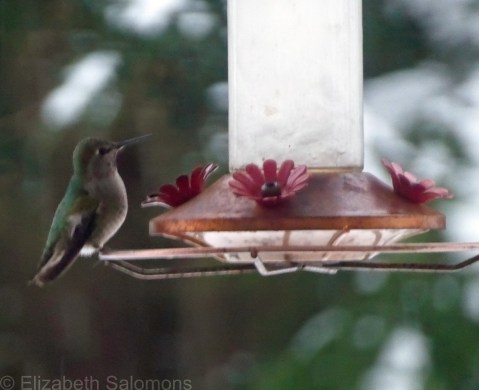
I took this photo of an Anna’s Hummingbird a few weeks ago during our last snowstorm. I was housebound during that storm because I was hanging out in Solo. If you look closely, you can see that the water in the feeder is almost frozen solid. I’m sure that hummingbird was as confused as I was by the cold weather.
Why am I posting this photo today? Because this morning I spent nearly an hour watching big fat snowflakes fall from the sky.
C’mon. It’s almost March. More snow??
Vancouver has had twice as much snow this winter as Edmonton where it’s winter seven months of the year. (I can say that because I grew up in Edmonton. I know winter. Er … I used to know winter.)
Anna’s Hummingbirds do not migrate south from Vancouver for the winter, thanks to the proliferation of backyard feeders like this one. I still can’t get my head around the fact that hummingbirds are here year-round.
I just hope all that hovering they do kept those tiny birds warm this winter.
Canada 150: Dempster Highway

If you’ve already driven some 2500 kilometres to get from Edmonton to Dawson City, what’s another 800 klicks to go to Inuvik for lunch?
That’s what we thought.
The above photo is of the Dempster Highway, the only road from Dawson to Inuvik. It’s also the only all-weather road in Canada to cross the Arctic Circle. Because of the permafrost, it is surfaced with gravel. When we returned to Dawson City, we were surprised to learn it was rare not to pop a tire or two driving the Dempster Highway to Inuvik and back.
I guess we got lucky.
There’s one place to stop for service along the Dempster Highway and that’s at Eagle Plains, which is the halfway point between Dawson and Inuvik. We filled up with gas there, but camped overnight closer to Inuvik simply by pitching our tents on the shoulder of the highway.
It wasn’t like there was much traffic to keep us awake.
Canada 150: Dawson City
On leg three of my cross-Canada road trip, I drove from Edmonton to Dawson City with a friend. And it was on this trip that I learned a valuable lesson about travelling that has stuck with me ever since.
Always (always, always!!) do your research before you leave home.
My friend and I, both living in Toronto at the time, decided to drive to Dawson City from Edmonton instead of Whitehorse because we both had people we wanted to visit in Edmonton. We flew separately, a few days apart, and I booked us a rental car at the Edmonton International Airport where I would meet her.
I still remember the exact moment the sinking feeling formed in the pit of my stomach. Spread out on the floor of my brother’s living room was a road map that I had been using to calculate how long it would take us to drive to Dawson City. (This was back in the olden days, folks, long before Google Maps.) I started at it in disbelief. Turns out that, even after flying across four provinces, my friend and I were only halfway to the Yukon from Toronto. We had a 36-hour drive ahead of us.
Oops.
But you know what? It was a stunning road trip. We spent our first night with an aunt of mine who lived on a farm in northern Alberta, stopped for a minute the next day in Dawson Creek, BC, to take our obligatory photos at Mile 0 of the Alaska Highway, and camped that night near the BC–Yukon border where we soaked our weary bodies in Canada’s second-largest hot springs at Liard River.
On our third day, we pushed on until we finally arrived at Dawson City around 1 a.m. My sister, who was working in Dawson for the summer, was up and waiting for us.
I was running on adrenalin by that point and nowhere near ready for bed, so my sister took me to the top of Midnight Dome for my first view of the town. It was early July and at that hour it was dusky, but light enough to understand why they call it Land of the Midnight Sun. I took this photo of the view of Dawson City and the Yukon River from Midnight Dome the next day.
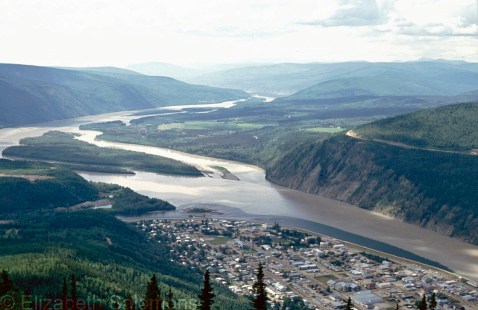
Dawson City was the epicentre of the Klondike Gold Rush. After gold was discovered in 1896, an estimated 100,000 people poured into the area, hoping to make their fortune. Almost overnight, Dawson became the largest city west of Winnipeg and north of Seattle.
It was over as quickly as it started. The miners moved on to Alaska after gold was discovered there in 1899. Gold mining still goes on in Dawson today, but most of the town’s economy is based on tourism, which celebrates its Klondike past.
The Klondike Gold Rush transformed all of Western Canada, however. The population of Vancouver doubled and Edmonton’s tripled in those few short years as both cities served as gateways to the Klondike.
Just as Edmonton did for my friend and I.
Happy Arizona Statehood Day!
Yup, it’s that day again. The day we celebrate all things Arizona.
But you knew that, right?
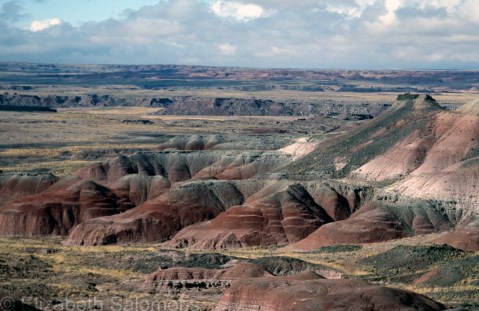
Exactly 105 years ago today, Arizona became the 48th state of the United States of America. And so, to celebrate, here is a photo of Arizona’s Painted Desert. I took this in late 2006 while on a short road trip through the northeastern part of the state.
Stunning country, isn’t it?
Happy Birthday, Laura Ingalls Wilder!
This week was the 150th anniversary of Laura Ingalls Wilder’s birth on February 7, 1867, and the 60th anniversary of her death on February 10, 1957. I’m a few days late, but I couldn’t let both dates pass by without acknowledging them.
That’s because I owe Laura Ingalls Wilder an enormous debt of gratitude. She is the author of the Little House books that I devoured as a child and that had a lot to do with shaping who I am today.
But this is not a book blog. It’s a travel blog, and you would do well to wonder what the connection is between the books I read as a little girl and the travelling I do today. It’s quite simple, really. The Little House books ignited my fascination with the past and made me the history geek that I am today. And I think I’ve mentioned once or twice on this blog how it is my interest in history that often dictates where I go or what I’m interested in seeing when I’m off on walkabout.
So that’s the connection. Like I said: simple.
I was introduced to the Little House books by family friends from Iowa. (Like Laura, I also spent part of my childhood living in the American Midwest.) For the first few years after our move to Canada, these friends would send my sisters and me a birthday box. (My two sisters and I share a birth month.) Inside that box one year, along with socks that were far too small, were two books: Little House in the Big Woods and Little House on the Prairie. I claimed one, my sister took the other, and my future as a lifelong booklover and history geek was sealed.
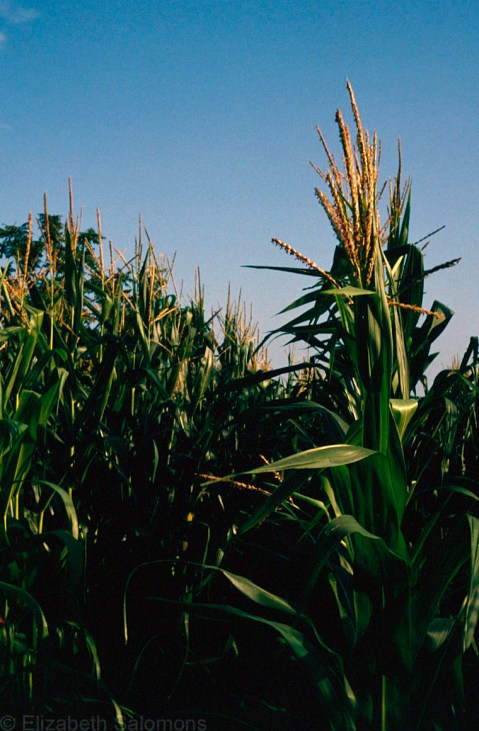
My mother used to tell us how, when we lived in Iowa, she could feed us kids platefuls of buttered corn on the cob for dinner and nothing but and we would eat it all. Laura Ingalls Wilder and her family lived in Iowa for a short time and so, based on that shared connection, here is a photo of Iowa corn, taken on the same farm where the family who introduced me to her books lived. I visited those friends with my parents some years ago, giving me the unique opportunity to reflect as an adult on what living in that community must have been like for my Canadian parents.
For the record: those stalks of corn are almost half as tall as me again. Which puts them at about ten feet high.
Now that’s fertile country. Corn Belt, indeed.
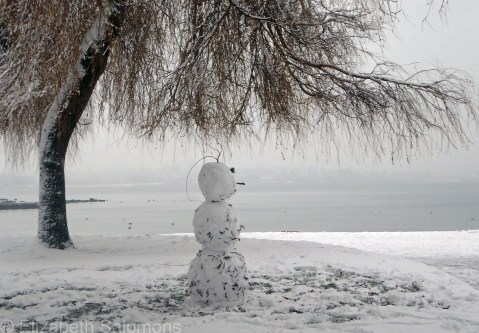
Snow Day in Vancouver
Wait, what?
Yup. Snow Day in Vancouver. Normally in February, I’m posting photos of crocuses. Or gloating about how spring is right around the corner.
Not this year. We’ve had one of the snowiest, coldest winters I can remember, and I’ve lived here off and on for a good chunk of my life. This winter we had a white Christmas for the first time in almost a decade, and for the first time ever in my memory, the snow stuck around for an entire month. It arrived in early December and it didn’t leave until after New Year’s when the temperature finally warmed up and the rain washed it all away.
I expected we would have a normal winter going forward. But no.
We got another record dump of the white stuff this past weekend. Because we don’t usually get snow, what most Canadians take for granted, like snow plows and snow tires, we do not have enough of. And without plowed roads or snow tires, you are not going to get very far. Ever been in an articulated bus that was sliding backwards down a hill? I have. It was not pleasant.
So today was a snow day for a lot of people in this town.
And there is more snow in the forecast.
Canada 150: Somewhere Near McBride
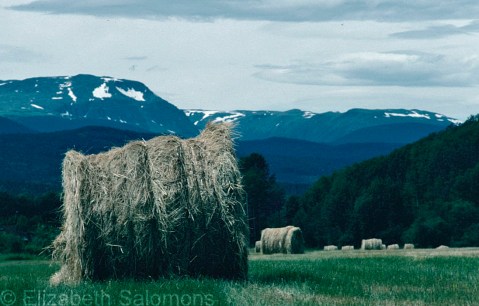
Update: My friend tells me this field is along Barrett Station Road near Houston. The mountains are the Telkwa Range. Oops! I was only off by some 500 kilometres.
On the Travel Bucket List of every Canadian should be two trips: (1) a road trip across Canada and (2) the same by train. I’ve almost completed both.
The train trip I’ll save for another post; the road trip was done in several legs, several years apart. (Since Canada is such a vast country, it is my opinion that it is not cheating if you break these trips down into manageable chunks.)
Leg one of my cross-Canada road trip was completed the summer I moved from Vancouver to Toronto. I packed as many of my meager belongings as I could fit into the back of my Honda Civic hatchback, kissed my parents good-bye, got into my car and headed … north.
North? Why not? (What’s a 24-hour detour when you’re about to spend days driving across Canada?)
Yes, I started my trek east by driving north to the Bulkley Valley where some friends of mine were living, and it was only after that visit that I pointed my trusty little car east towards the Rockies.
I took this photo somewhere along the Yellowhead. My foggy memory tells me it was near McBride, but, truthfully, it could have been anywhere between Houston and Jasper. The hay bales are what made me pull over to take a photo.
I love hay bales.


 There and Back Again