
Stanley Park Windstorm
Ten years ago today, a massive windstorm devastated Stanley Park. Hurricane-force winds off English Bay levelled 41 hectares of forest, about 10,000 trees in all, some of which were more than 500 years old. It was the most violent windstorm to hit Stanley Park in 40 years.
Although it was overwhelming to see the devastation, the forest was long overdue for a regeneration. The wide open spaces changed the look of parts of the park and increased the diversity of both plant life and animals. Woodpeckers, for example, are now thriving. More than 15,000 trees and shrubs were planted by park staff and volunteers. I was walking near Prospect Point recently and it struck me how tall those young trees are already.
I was out of town on December 15, 2006, but I remember taking a walk through the park on Christmas Day — as much as it was possible to walk through the park since every trail was blocked by fallen trees — with my mouth open wide in shock. The seawall was also extensively damaged and remained closed for some 18 months until the repairs could be finished and the cliff tops above the seawall stabilized.
This photo is of a tree that came down near the Georgia Street entrance to Stanley Park. It lies near where it fell, trimmed of its foliage, and has been left as a memorial to that storm. It is now a popular photo stop for tourists, who I am sure have no idea why it is lying there.

Pearl Harbor
Last weekend I spent an afternoon with a friend who had just returned from a week in Hawaii. Yes, it was painful, given the solid eight weeks of rain we Vancouverites have just endured. Yes, I turned green with envy when I learned it had been her fifth trip to the Aloha State. And yes, it brought back memories of my (sniff) single trip to Oahu.
Oahu is a popular destination for first-time visitors to Hawaii, and a bonus for me was that Oahu is the location of Pearl Harbor, which let me feed my inner history geek. Since today is the 75th anniversary of the attack on Pearl Harbor, I thought a post about my visit to the harbor and the USS Arizona Memorial would be timely.
The memorial straddles the wreck of the USS Arizona, which took a direct hit on December 7, 1941, and sank within minutes. The battleship burned for three days, having taken on more than a million gallons of fuel the day before. Most of the 1177 sailors and marines who died on the Arizona are entombed in the shipwreck that lies at the bottom of Pearl Harbor. Oil still seeps out of the wreck, as much as nine quarts of oil a day.
Pearl Harbor was the deadliest single attack on American soil until September 11, 2001. In just under two hours, 20 ships and 300 airplanes were damaged or destroyed and 2400 Americans lost their lives. The USS Arizona Memorial is a touching memorial to 1177 of those lives.
Abbaye Notre-Dame de Sénanque

It’s the last day of the most miserable month of the year! When I woke up this morning to yet another torrent of rain, all I could think was, “It’s the last day of November. Tomorrow, I will feel so much better.”
And so, to celebrate, here is one last photo from Provence. This is the Abbaye Notre-Dame de Sénanque. It’s a Cistercian abbey not far from Gordes and was founded in the twelfth century.
It’s quite possible you’ve seen a photo or two of this abbey before as it’s one of those scenes of Provence that is on all the postcards, except that the photos in the postcards are all taken when the lavender is in full bloom. (That’s what those long rows of plants are in front of the abbey.) The monks sell that lavender and raise honey bees to support themselves.
We didn’t get to see the inside of this abbey or its cloisters (and you all know how much I love cloisters) because it’s a working abbey. Admittance is only with a tour and we showed up at the wrong time. No matter, as I always like to leave something to do for a return visit. And so, this abbey will be top of my list on my return visit to Provence.
Which will be when the lavender is in full bloom.
Armchair Traveller: A Year in Provence
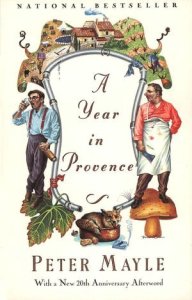 To combat the rainy day blues I get every November, I’ve been basking in my sunny memories of a week in Provence and taking you all along for the ride. At the same time, I’ve been rereading Peter Mayle’s A Year in Provence, the book that put Provence on the map for most of us English-speaking tourists.
And I have a confession to make: this book almost stopped me from ever going to Provence.
It wasn’t the book itself. In fact, when I finally got around to reading it, I loved it. It’s a delightful read.
No, it was the hype around A Year in Provence that almost stopped me from going to Provence. The book got so much attention when it was published in 1989 that it put me off. I figured if the only travel book anyone was talking about was about Provence, Provence was going to be overrun with tourists and I didn’t want to go anywhere near the place.
Heh. So what changed my mind?
It was actually a travel blog by friends of a friend who spent six months in the Luberon (the area Peter Mayle wrote about). I followed that blog faithfully during this couple’s stay in France and was intrigued by their descriptions of the region. (It was also the first time that a seed was planted in my mind that, hey, maybe I could spend six months somewhere in Europe, since my work is “have laptop, will travel.”)
But what sold me on Provence, specifically, was a post this couple wrote about Collioure in the Languedoc-Roussillon region of France, just next door to Provence, and which I had visited a few years prior to my decision to visit Provence. Collioure is a lovely little fishing village right on the coast of the Mediterranean, almost in Spain, and this couple described it as far too touristy for their taste. Too touristy? Collouire? If that was their assessment, then Provence must be far more devoid of tourists than I had been led to believe by the success of Peter Mayle’s books. Maybe I should check the place out after all.
I highly recommend A Year in Provence. As the title indicates, Mayle describes a year of living in Provence, month by month, as the seasons change, and as his visitors come and go. It’s truly a book about the people of Provence rather than a travelogue.
Apparently Peter Mayle was encouraged to write the book by his agent when he kept sending letters filled with excuses of why the novel he was suppose to be writing was going nowhere because of all the interruptions he was experiencing from his builders and his neighbours.
“Tell me more about those builders and neighbours,” his agent said.
And the rest, as they say, is l’histoire.
Recipe Box: Stuffed Provençal Vegetables
After cleaning up from our day of harvesting grapes, my friends and I met our hosts, Paul and Miriam, and our new German friends, Nils and Juliana, in the parking lot of the gîte. We got in our car and they got in Nils and Juliana’s car and off we drove to Jean-Louis’ place, which was just a short way down the road.
Jean-Louis introduced his wife (who worked in a bank and was dressed rather smartly), his mother-in-law (whom we had met earlier that day and whom we knew had been busy in the kitchen preparing our dinner), and his youngest daughter (whom I guessed to be about eight years old). After aperitifs were poured, we made ourselves comfortable in the large and spacious but homey living room.
The conversation that evening was mostly in French, with Jean-Louis’ wife and Paul as our main storytellers. Despite my limited French skills, I was able to follow along thanks to the animated way they both talked as well as Paul’s effort to speak slowly and carefully. It wasn’t long before we were invited to take our seats at the expansive wooden farm table in the next room.
I was seated next to the grandmother. As I was feeling the effects of the aperitif and also highly conscious of the fact that I was the only registered driver on our rental car (which I wasn’t 100% sure was properly insured, thanks to a communications snafu at the rental counter when we had picked up the car a week earlier), I came up with what I thought would be an ingenious way of managing my liquor intake for the rest of the evening: I would sip my wine very slowly.
But the grandmother was much too smart for me. When we were into our second course and she saw that I was still nursing my first glass of wine, she asked (in French) if I didn’t like the wine. I assured her (in French) that I thought the wine was excellent. I also realized that I needed to drink up to avoid offending my hosts. Which meant that, for the remainder of the evening, the minute my glass neared the halfway mark, the grandmother topped it up.
Dinner consisted of a simple green salad with olive oil to start, served with three types of bread. We were encouraged to wipe off our plates after every course with the bread, something I’ve noticed my French friends do automatically. The main course was zucchini, peppers, mushrooms, and tomatoes, all stuffed with a mixture of ground beef and herbs. A cheese course followed, more bread, coffee, then dessert, which consisted of fruit flans, one of which was quince, baked on cookie sheets. Brandy to finish off the evening. We ate until we could eat no more. Even Nils looked to be in pain when they tried to get him to take a third helping of the fruit flan.
The party finally broke up around midnight. As I rummaged around in my bag for the car keys, I told my friends I was slightly drunk, but thought I was OK to drive the short distance back to the gîte. However, no sooner had I poked the nose of the car into the road when one of my friends pointed out that another vehicle was approaching. I quickly reversed the car. “OK, maybe not so OK,” I muttered.
When I finally decided it was safe to pull into the road, I pointed the car in the direction we had to go. I drove very slowly and finally the gîte pulled into view. Paul and Miriam were waiting for us in the parking lot because they were worried we had gotten lost.
“That wasn’t the problem,” I said and I told them about my evening sitting beside the grandmother. And the next morning when we all said our good-byes, Nils apologized for feeling a bit hung over. He blamed the grandmother. “Oh, me too!” I said. “I had the exact same problem!”
I have tried several different recipes in an effort to replicate the stuffed vegetables we ate that night. With some tweaking, the following is the best I can come up with. It still doesn’t taste as good as I remember, but it’s a fair copy.
Bon appétit!
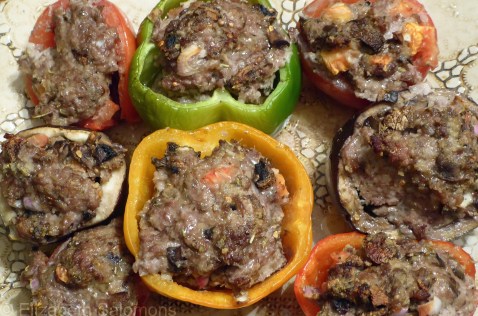
Stuffed Provençal Vegetables
1/4 cup bread crumbs or panko
1/4 cup milk
1 pound ground pork
1 pound ground beef
4 shallots, minced
2 cups mushrooms, diced
1 tablespoon Herbes de Provence
salt and pepper
2 red peppers
2 orange peppers
2 green peppers
1 eggplant
4 medium tomatoes
1. Preheat oven to 350°F.
2. Pour the milk over the bread crumbs or panko and set aside.
3. Cut the tops off the peppers and tomatoes and remove the seeds. Cut the eggplant in half lengthwise and scoop out the flesh. Alternatively, cut the eggplant horizontally into thirds and scoop out the flesh, making sure you don’t scoop all the way through so that you leave a base for each piece of eggplant. Arrange the vegetables in a baking pan.
4. Combine the pork, beef, shallots, mushrooms, Herbes de Provence, salt, pepper, and moistened bread crumbs or panko. Mix to combine.
5. Fill each vegetable with a generous amount of the meat mixture. (The meat will shrink as it cooks.)
6. Bake for about 1 hour or until meat is cooked through and vegetables are soft.
Note: The tricky part to this recipe is that the different vegetables vary in how quickly they will cook. The tomatoes need the least amount of time, while the eggplant needs the most. Other vegetables that could be stuffed include zucchini or large mushrooms.
Harvesting Grapes in Provence

When I booked a gîte for our week in Provence, I really had no idea what I’d done.
I knew I wanted to spend a week in Provence. I knew I wanted to stay in a gîte. And I knew that a gîte is a self-catering holiday home in rural France — that much I had learned on a previous visit to the south of France.
Beyond that (and a budget), I set no parameters in my search for accommodation. The place I ended up booking for myself and my friends was not our first choice or even our second choice. But when the owners of Domaine du Crestet sent such a friendly reply with so much detailed information to my inquiry about availability, we were sold.
Domaine du Crestet is a wine estate that dates back to the mid-1800s. Several stone-walled buildings have been converted into guest apartments and a home for the owners. The apartment we rented for the week was in a building that used to be a barn filled with silk worms.
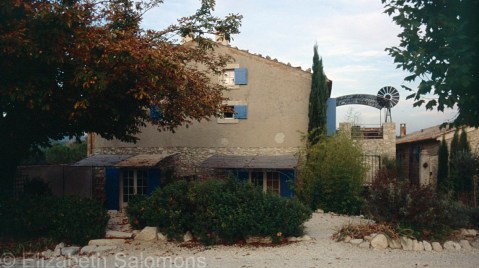
What I didn’t know about the gîte I had booked was that it is a working vineyard, known as a domaine. And, because it was a working vineyard, we had the additional bonus of a crash course in wine production as part of our stay.
Our education began the moment we arrived as a wine reception was underway for all of the guests. (Accommodation at this particular gîte was booked Saturday to Saturday, so all of the guests for the week arrived on the same day.)
It continued mid-week when we enjoyed for a small fee a wine-tasting evening put on by Paul, our host. He knowledgeably led us through nine different wines and sent each of us home with the remains of a bottle (or two) at the end of the evening. A few days later, with only one or two wrong turns, my friends and I were able to locate one of the châteaux on Paul’s list so we could purchase for ourselves several bottles of the Châteauneuf-du-Pape wine he had introduced us to.
But it was our final day at the gîte when the real learning took place. Paul offered us a deal: if we were willing to spend the day picking grapes for him and his neighbour, we would be treated to a picnic lunch as well as dinner at the neighbour’s home. It took my friends and me only a few minutes to decide. Although field work wasn’t exactly on our holiday agenda, we knew this was too interesting an opportunity to turn down.
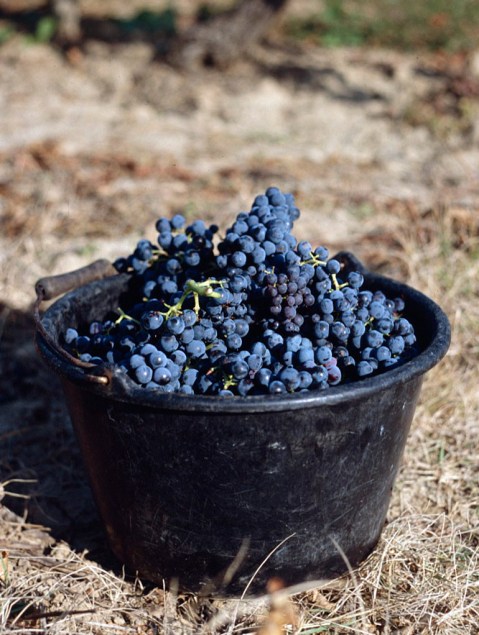
We were ready for work at 8:00 a.m. sharp. The vineyard was right beside the domaine, so we only had to walk out the door. Joining the three of us Canadians on that beautifully cool morning was a German couple, also guests at the gîte, whom we had met at the wine-tasting evening. Jean-Louis, the neighbour, soon showed up with his tractor and cart.
Jean-Louis spoke no English, so Paul translated for him. We were shown how to hold the bunch of grapes in one hand and the cutters with the other. No holding the stem ― that’s the way you end up cutting yourself. I paid careful attention. The cutters were terribly sharp and I began having flashbacks to my summers working at a tree and plant nursery that involved many long days of pruning pine trees.
Only grapes that looked good enough to eat went into the plastic containers; the dried or rotten ones were to be left on the ground. Once a container was full, we were to empty it into the cart.
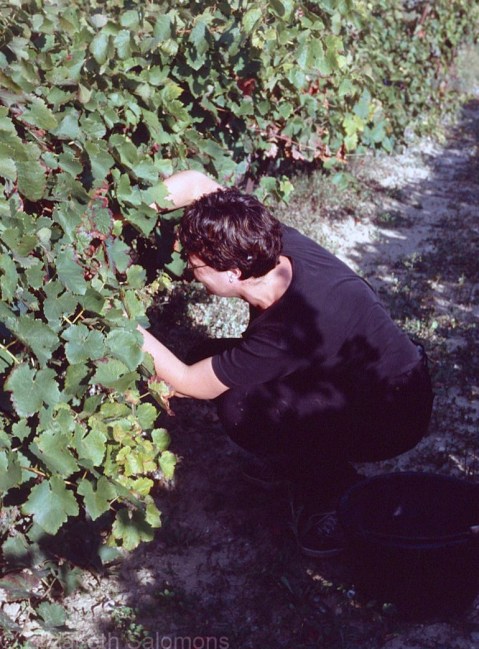
Truth be told, picking grapes isn’t nearly as tough as pruning pine trees. Or picking strawberries or planting leeks ― all of which I’ve done for days on end. It would have been easier on me had I been a tad shorter (less crouching), and it also helps to have big hands in which to hold the grape bunches.
We hadn’t been picking long when Jean-Louis stopped us. He wanted to show us how he tested the sugar level of the grapes. First he crushed a few grapes, then he poured the juice into a gizmo that Google tells me was a refractometer. We took turns looking through the eye piece to see the sugar level for ourselves. The sugar level is an indicator of what the alcohol content will be of the wine produced from those grapes.
During another break, Paul had us walk over to the next vineyard where other neighbours were picking table grapes. These grapes were much sweeter than wine grapes, and instead of dumping the grapes into a cart, they were carefully placed onto cardboard flats. One of the pickers was Jean-Louis’ mother-in-law and we learned that she was going to be cooking dinner for us that evening. She kept handing us grapes to eat until we couldn’t eat anymore.
By the time we finished at Domaine du Crestet, the sun was high above us. We changed into shorts and put on sun hats. Our picnic lunch had been brought over by Jean-Louis in his cart, which was now half filled with grapes. We put the coolers and baskets in our cars, gave Jean-Louis a head start with his tractor and cart, and then drove over to his vineyard, about 10 minutes away by car.

We parked our cars near an olive grove, put the coolers and baskets in the shade, then began picking grapes in this much older vineyard. But only 20 minutes later, Jean-Louis announced it was lunch time.
And what a lunch! We carried the coolers and baskets to the olive grove and sat down in a circle. Jean-Louis opened up the baskets and began passing out the food: two enormous quiches, baguettes, cheese, sausage, wine, water, more cheese, more wine, more quiche … I’m not exaggerating when I say it was the best picnic I’ve ever had. (And! We were picnicking in an olive grove!!)
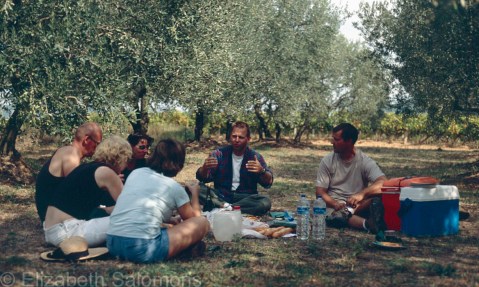
While we ate, we talked about grapes and making wine, with Paul doing all the translating from French into English and back into French.
And this is what I learned.
Most grapes in France are picked nowadays by machine. But young vineyards, like Domaine du Crestet’s, have to be picked by hand because the vines are so small. And the rows of vines in old vineyards, like Jean-Louis’, were planted too close together to allow the machines to pass through.
A vineyard can only call itself a château if it actually has a château on the property. Otherwise, it’s a domaine.
Paul and Jean-Louis are part of the same cave coopérative (cooperative cellar), which is why they were harvesting the grapes together and why it didn’t matter that grapes from two different vineyards were all mixed up in one cart. The type of grapes we were picking were called Grenache.
Jean-Louis was on the board of the coopérative, which is highly regulated. Members are told when they can start harvesting and when the harvest has to be finished by. The coopérative also regulates when the farmers can and should replant. The older the grapes, the better the wine but the lower the output, so at some point, farmers have to work out which is more cost-effective ― making more expensive wine, but less of it, or making less expensive wine, but more of it. Jean-Louis kept testing the sugar level of the grapes all day long and the sugar level of the grapes from his 60-year-old vines was nearly twice that of the grapes from the three-year-old vines at Domaine du Crestet.
Only once we’d eaten and drunk our fill, and had run out of questions, did we pack up the remains of the lunch and head back to the vines. This was the difficult bit ― who wants to do field work after a lunch like that? ― but we kept at it. I knew from my summers of working at the nursery and on an organic vegetable farm that farmers can be particular in how you work in their fields and Jean-Louis was no different. Paul muttered to me that he wondered if we would be able to finish that afternoon. It seemed like the rows went on forever. But then, all of a sudden, Jean-Louis announced we were on the last row. It wasn’t the end of the field, but it was the end of his vines. No fence, no marker, no nothing. I guess he just knew or had counted off the rows while we worked.
We had a drink or three of water from the bottles that were sitting by the dregs of our picnic lunch and then washed our hands, taking turns pouring water over each other’s hands. Jean-Louis drove off with the harvest and the rest of us admired the view for a while. It was a beautiful piece of land with a marvellous view of Mont Ventoux.

When Paul figured we’d given Jean-Louis enough of a head start, we drove to the cave where the coopérative makes its wine. We passed Jean-Louis along the way, and after we parked our cars, Paul took us around to the back where all the grapes were brought.
So much activity! The place was abuzz with farmers and tractors and carts identical to Jean-Louis’. When Jean-Louis eventually showed up, he backed his cart into the correct spot (there was a board directing the farmers as each type of grape has to go in a particular place), then the cart was lifted up by a hydraulic control on the tractor and the grapes slid into a bin. A giant screw pushed the grapes towards a small opening at the opposite end of the bin. It took about 10 or 15 minutes for the bin to empty.

We found out we had picked 2000 pounds. Jean-Louis joked that “real” pickers would have been able to pick 4000 or 5000 pounds, but Paul told us later that Jean-Louis was actually rather pleased with our work, given that we were novice pickers. He was also pleased that the alcohol content of our grapes was 14.1%, which apparently is pretty good.
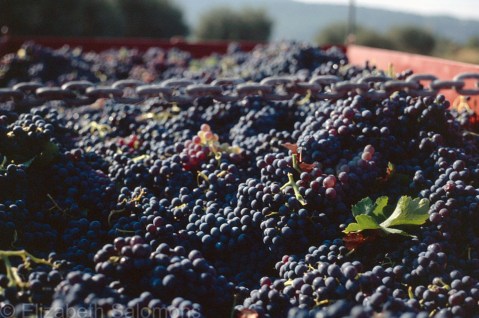
After the grapes we picked were on their way, we were given a tour of the cave. Paul started, but then another guy took over, whom we later learned was the director of the coopérative. Compared to other caves I’ve toured in France, this one was much more modern with concrete and gleaming metal everywhere, and not a single oak barrel in sight. At one point, I was instructed to take a whiff of the fermenting wine. At first I smelled nothing, so I was told to sniff harder. And then … wow! The carbon dioxide emitted by the fermentation process goes straight to your brain. Powerful stuff, and lethal, of course, if you were to fall into the vat.
When the tour was over, we went around to the front of the cave where the wine store was located to taste some wine and so Jean-Louis could choose one for our dinner. He bought six bottles and then whispered something to Paul, who later told us Jean-Louis had asked him if he thought six bottles would be enough for the evening.
Uh … yes. It most certainly would be, as I was about to find out.
But the story of how that wine tasted — and dinner with Jean-Louis and his family — will have to wait until my next post.

Le Barroux
It’s still raining, so I’m still posting.
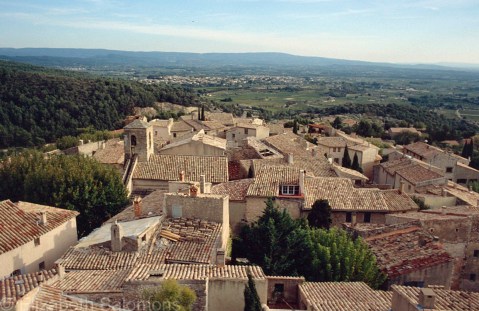
This is Le Barroux, another Provençal medieval hilltop village. It was our final stop one afternoon before we headed back to the gîte where we were staying.
Don’t you love those terracotta roofs?
Gordes

Again, just like with Saint Rémy-de-Provence, my friends and I ended up in Gordes because I had seen a photo of this hilltop village somewhere sometime that stopped me in my tracks.
Gordes is 38 km east of Avignon. The houses are built in a spiral circling the hill on which the village is set.

Hilltop settings provided medieval villages like Gordes with a natural defense against invaders. It provides tourists like me with photo-ops galore.
Plus, there is that spectacular view.

Saint Rémy-de-Provence
About 20 km south of Avignon is Saint Rémy-de-Provence. My friends and I ended up here solely because of an article I had read in some travel magazine. It was the photos accompanying the article that had caught my eye, so what’s odd is I don’t seem to have taken many photos of Saint Rémy-de-Provence myself. I must have been incapacitated by the town’s beauty.
I do have this one of the town hall. It gives you an idea. I mean, what town hall in Canada is draped in flowers?
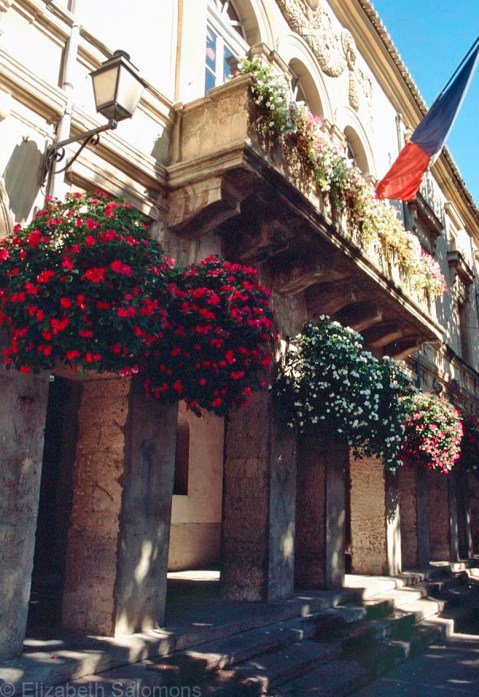
Saint Rémy-de-Provence has a bit of a gastronomic reputation, and I do remember a delicious steak with Roquefort sauce followed by profiteroles smothered in chocolate sauce and ice cream. When the waiter put the plate down in from of me, he muttered “Mon Dieu!” under his breath — more to himself, it seemed, than to me.
Just outside of Saint Rémy-de-Provence is Saint Paul de Mausole Monastery. We stopped in because it was here that Vincent van Gogh spent a year as a patient at its psychiatric hospital. It’s a beautiful, peaceful place.
On the grounds of the monastery were a series of signs identifying the olive trees that van Gogh painted during his stay. The signs were positioned in such a way that you could see the view that inspired each painting.
Like this.
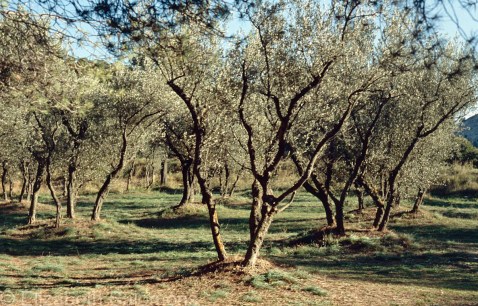
And this.

Prior to his stay at Saint-Paul de Mausole (which still functions as a hospital), van Gogh lived in Arles for a year. A sketchbook he is reported to have filled during that time, which he later gave to the owners of the Arles café where he lived, was published this week to much controversy. Which has put Vincent van Gogh at the top of the news once again.
All I can say is: The more we talk about art, the better off we’ll all be.
Avignon

The next stop on our Provençal tour is Avignon. Located about 21 km south of Orange, Avignon is the capital of the Vaucluse département. It’s a city that draws in the tourists for a goodly number of reasons:
- It’s still got its original medieval walls.
- It has a papal palace. (Yes, you read that right.)
- It’s got a bridge that every one of you will know from the children’s song. Yup, it’s that bridge. The Pont d’Avignon.
About those walls. They date back to the fourteenth century and were built by Pope Innocent VI, who decided the expanding city needed new defensive ramparts. It was at the height of the Hundred Years’ War, so you can’t really blame him.
About that papal palace. For about 70 years in the fourteenth century, seven consecutive popes lived in Avignon instead of Rome. Why, you ask? Well, it all began when a Frenchman, Clement V, was elected pope in 1305 and decided he didn’t want to leave home. So he set up house in Avignon instead, which back then was part of the Holy Roman Empire. The next six popes after him followed suit. Eventually, Pope Gregory XI moved the papal court back to Rome in 1378. (Incidentally, Gregory XI was the last French pope. I guess the College of Cardinals had good reason to never again select a Frenchman as pope.)

Palais des Papes
But Gregory XI didn’t live long, and after an Italian was elected pope, the French cardinals turned around and elected a second pope who lived in Avignon. This started a new line of Avignon popes and a period that came to be known as the Western Schism. It went on for a while, with one pope in Avignon (today referred to as the anti-pope) supported by the French and one pope in Rome supported by the English. At one point, the cardinals decided to get rid of both popes and elect a new pope, but the first two refused to step down. Which meant there were three popes in all.
What a confusing time it was. (Almost as confusing as our own!) At any rate, all was resolved by the Council of Constance of 1414 to 1418, which declared the concave of 1378 — and the anti-popes of Avignon — invalid.
Avignon remained part of the Papal States until the French Revolution. The papal palace (Palais des Papes) was built between 1334 and 1363.
Incidentally, it was because so many popes were running around Provence that we have the excellent wines known as Châteauneuf-du-Pape (literally, “new castle of the pope”). Châteauneuf-du-Pape, a town about 12 km north of Avignon, is where Pope John XXII built his castle, which has been more or less demolished since, but it was he and the other popes who planted the vineyards. (Thank you!)
And now, finally, about that bridge. Its correct name is actually Pont Saint-Bénézet, after its builder. Built in the early twelfth century, floods washed away 16 of its original arches, leaving only four still standing. It’s a bit odd to stand on the edge of this bridge, singing a children’s song to yourself, but that’s how it’s done in Avignon.
Sur le Pont d’Avignon
On y danse, On y danse
Sur le Pont d’Avignon
On y danse tous en rond

Pont d’Avignon


 There and Back Again