
Happy Easter!

Mission Abbey Church, Mission, British Columbia, April 2012
Through My Lens: Mission Abbey Church Interior
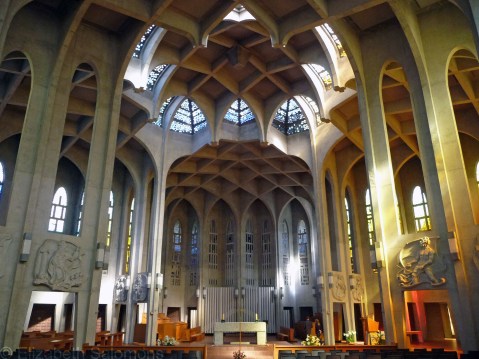
It’s Palm Sunday again. To celebrate the day, I’m posting a photo of the interior of Mission Abbey Church.
The architectural structure of the church is based on the Greek cross: there are four arms of equal length. At the end of each arm are windows that correspond by their colour (blue, red, brown, and grey) with the four elements I mentioned the other week: water, fire, earth, and air.
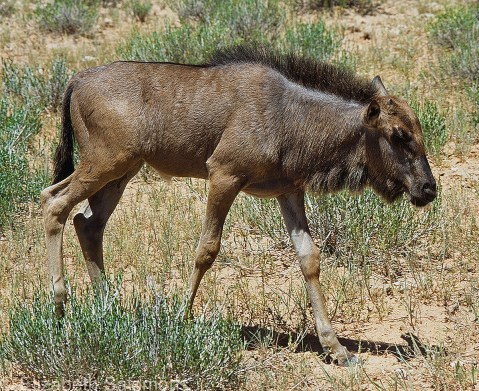
Blue Wildebeest and Red Hartebeest

And moving right along from the “boks,” we come to the “beests.” In the Kalahari, we saw blue wildebeest and red hartebeest. These too are antelopes, although the blue wildebeest (above) looks awfully cow-like to me.
You can tell them apart because the blue wildebeest (also known as the gnu) has a bluish tinge, and its horns are shaped like parentheses (once an editor …). The red hartebeest has a reddish tinge, and its horns are shaped like backwards question marks (… always an editor). The red hartebeest is smaller than a gemsbok, but larger than the springbok, while the blue wildebeest is the largest of them all.

Often we came across a solitary blue wildebeest with a herd of gemsbok, but usually the wildebeest live together in herds. Their range is throughout southern and eastern Africa.

Standing about a metre and a half at the shoulder, the wildebeest runs at speeds up to 80 kilometres per hour. It can survive in the Kalahari because it gets enough water from eating melons, roots, and tubers.
We saw a lot of wildebeest calves as well.
And hartebeest calves.
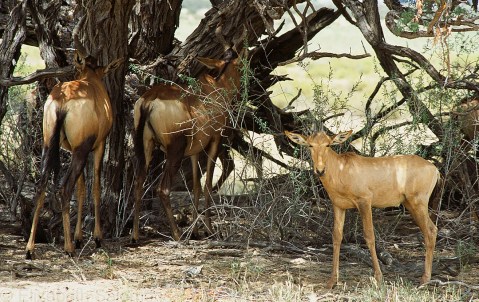
The red hartebeest is found mostly in southwestern Africa, and it too can get all the water it needs from eating melons and tubers.

It has excellent hearing and sense of smell, but poor eyesight. To get away from its predators, the red hartebeest runs in a zigzag pattern as fast as 55 kilometres per hour.
Through My Lens: Mission Abbey Bas Relief
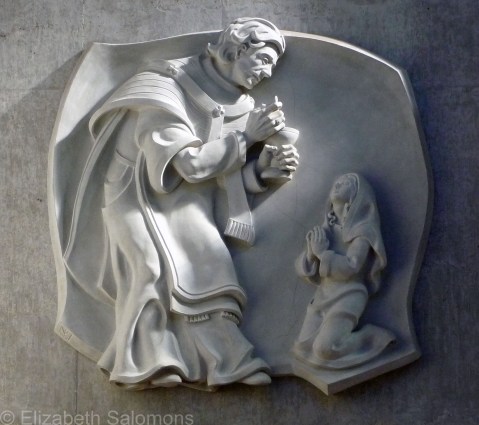
It’s the Fifth Sunday of Lent and today’s photo is of one of the bas reliefs that adorn the interior of the church of Mission Abbey. These bas reliefs were created by resident monk and artist Father Dunstan Massey.
Father Massey began his art studies at age 15 under Jack Shadbolt at the Vancouver School of Art. At 18, he began his journey towards the priesthood by entering the monastery at Mission Abbey. Although he was willing to give up his art to devote his life to God, the Abbot had other ideas and made him the Abbey’s resident artist.
In addition to these bas reliefs in the church, Father Massey’s sculptures, paintings, and frescoes are displayed throughout the Abbey’s buildings.
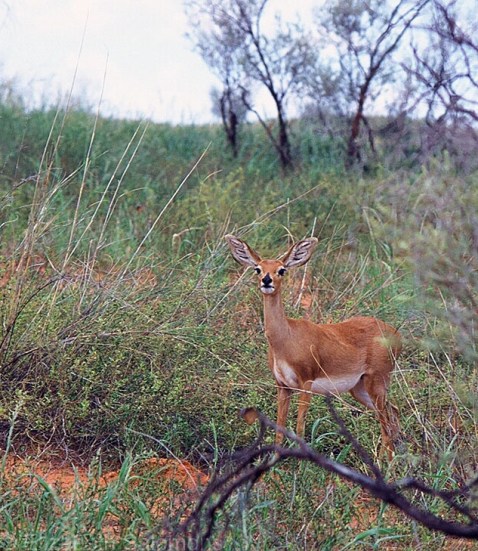
Gemsbok and Steenbok

Besides the springbok, there were a couple other “boks” we encountered on our Kalahari safari: the gemsbok and the steenbok.
The gemsbok is almost twice as large as the springbok, but they run at a comparatively much slower speed (a sluggish 60 kilometres per hour). Like the springbok, they live in herds. Their colouring is striking: mostly light brown, but with a black and white face and black and white legs. The other striking feature about the gemsbok is its horns. They are loooooooong (almost a metre) and straight. Both males and females have horns, although the female’s are slightly longer and thinner.
The great thing for the safari photographer is how the gemsbok love having their photo taken. They always struck a nice pose for me.

The steenbok, in contrast, were much harder to photograph as they bounded away as soon as they saw our car. They are a small antelope, measuring about a half metre at the shoulder. Only the males have horns. The steenbok live alone or in pairs.
Through My Lens: Mission Abbey Window
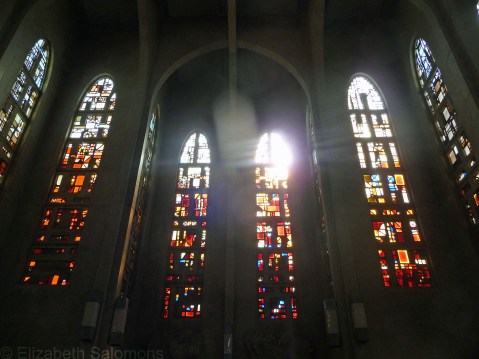
For the Fourth Sunday of Lent, I’m posting a photo of some of the stained glass windows of Mission Abbey. They were designed by Lutz Haufschild, a German-born and trained Canadian glass artist.
There are 64 windows in all, with each group of eight representing one of the four elements: the blue windows are water, red is fire, brown is earth, and grey is air.
Springbok
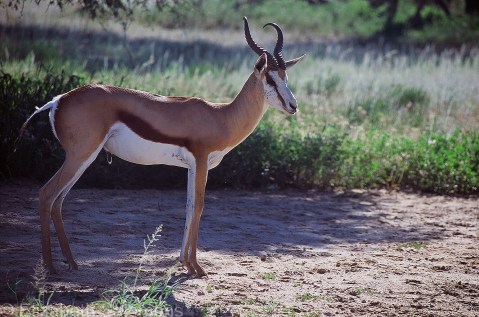
The first animal we came upon after entering Kgalagadi Transfrontier Park were the springbok, and we were to see many, many, many (!) of them over the course of our week. The springbok is the national animal of South Africa. (Even the South African national rugby team ― the Springboks ― is named after the animal.)
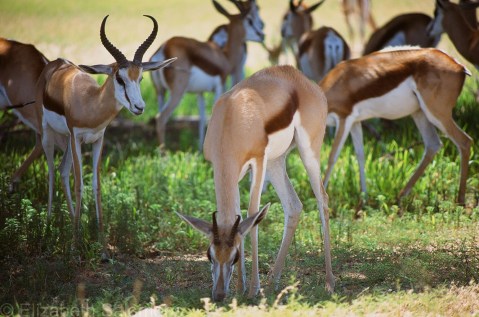
These small antelope live on the dry grasslands of northwest South Africa, Namibia, and Botswana.

They’re not big animals ― less than a metre high at the shoulders ― but they can run as fast as 88 kilometres per hour.
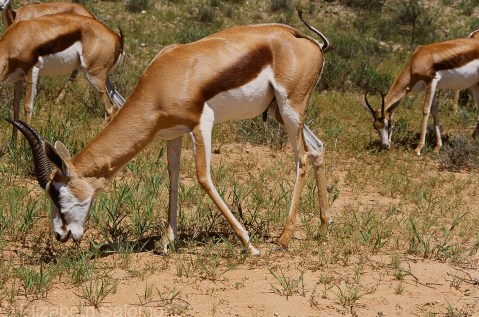
Both males and females have horns. Fawns are usually born in the spring (October and November).

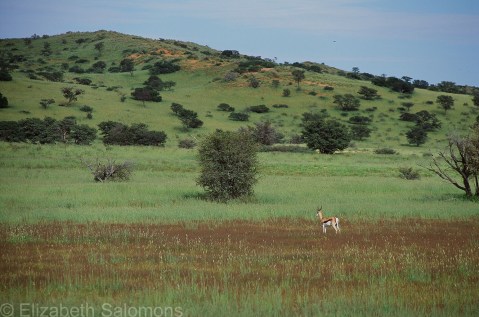
Often one springbok would be standing all on its own, some distance from the rest of the herd. Our guide said they were the look-out.
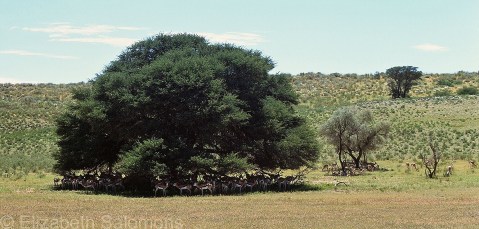
In the mid-afternoon heat, the animals squeeze together under a tree to take advantage of the shade.
Springbok comes from the Afrikaans words for “jump” (spring) and “antelope” (bok). When nervous or alarmed, the hairs underneath the tail stand up in a fan shape. The springbok can leap about two metres straight up into the air ― this is called pronging. We saw this for ourselves on the last day of our safari.

As we were driving, we saw a fawn that had become separated from its mother. The fawn was in the road ahead of us, and the mother was in the meadow, pronging up and down (literally bouncing: boing! boing! boing!) trying to find her fawn. Finally, the fawn hopped over the side of the road back into the meadow, and the two were united. We all cheered (and some of us even teared up at the happy reunion).
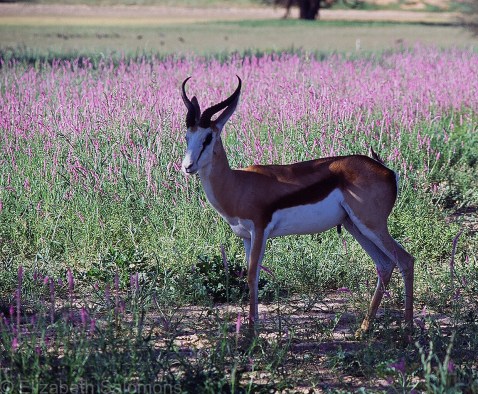
Of all the species of antelope we met on our Kalahari safari, the springbok was my favourite.
On Safari in the Kalahari
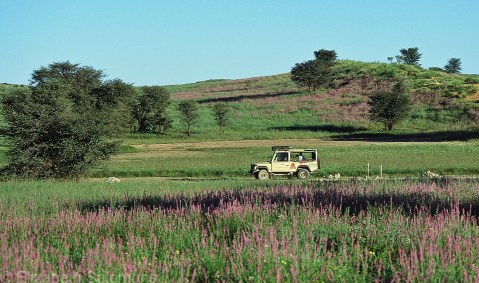
“This must not be your last time.”
So said our safari guide near the end of our time in the Kalahari and near the end of our safari ― my first ever. Never, in all my travels, did I think I would ever get the chance to go to Africa. Never, in all my dreams, did I think I would ever go on safari.
But when a friend who just happened to be travelling to South Africa invited me to meet up with her, I jumped at the opportunity. After I had worked out the details of how and where we would meet, my next step was to arrange a safari for us.
And here’s the first thing I learned: when you type the keywords “South Africa” and “safari,” the destination at the top of the list is the Kruger. Safari-goers like to talk about checking the Big Five off their list (Big Five = lion, leopard, rhino, elephant, and buffalo) and Kruger National Park, the largest game reserve in South Africa, has all of these and more. Plus, it’s conveniently located near Johannesburg. Which makes the Kruger a popular safari destination.
But with a little more digging, other choices are discovered. I began reading about the Kalahari in the northwest part of South Africa, near the Botswana and Namibia borders. It’s more remote, so it takes a lot more schlepping to get there, but I was intrigued by the descriptions of its landscape.

My friend said the choice was up to me. I went all pragmatic and made a list of pros and cons. The two options came out dead even, so I was right back where I started.
I then sought the advice of a co-worker who had grown up in Zimbabwe and had spent a lot of time in South Africa. In the end, my choice came down to her warning that, because we were going to be there in February, at the height of the rainy season, the foliage in the Kruger might be so lush and full we ran a fair chance of not seeing any game at all.
That settled it. We were going to the Kalahari.

Following a recommendation from my trusted Lonely Planet, and after several emails back and forth to South Africa, I booked us on a six-day camping safari with a small family-run operation out of Upington in the Northern Cape, the largest and least populated province in South Africa. Our safari would take us to Kgalagadi Transfrontier Park, a game reserve that straddles the border of South Africa and Botswana.
And so, on the appointed morning, our guide picked us up at our guest house in Upington. Introductions were made all around. There were only four of us on this safari and our companions were the best we could hope for: two Germans who never stopped laughing or joking around and destroyed every stereotype I ever had about Germans. By lunchtime on our first day, my friend and I realized they were going to be a lot of fun. (What was almost unbelievable, given how well they got on, is that this couple had never met before our safari.)
And our South African guide not only took very good care of us, he was a gifted tracker and a wise man. I enjoyed his stories immensely ― and I am pretty sure he enjoyed ours.
Upington to Kgalagadi Transfrontier Park is a bit of a trek and it took us most of a day to get to our first campsite. The roads inside the park are unpaved and covered in sand (which we soon learned makes them an excellent surface for tracking!).

A typical road in Kgalagadi Transfrontier Park
We also soon learned that these roads were prone to flooding because (1) it was the rainy season and (2) they follow dry river beds. Flanking the edges of these river beds were dunes. The day we drove cross country from the Nossob River bed to the Auob River bed gave us a marvellous roller-coaster ride over waves of dunes that rippled the landscape before us.
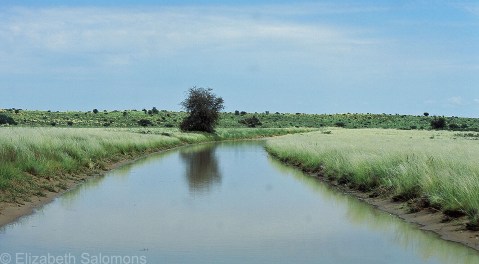
As it was the rainy season, some of the roads were completely flooded
We spent three nights camping in Botswana, in basic, unfenced campgrounds. (Basic = pit toilets and no running water. Unfenced = absolutely no leaving the tent at night without waking our guide.) There were two tents for the four of us paying customers that we quickly learned how to put up and take down ourselves. Our guide slept in a smaller tent or, when it was too windy, the back of the SUV.
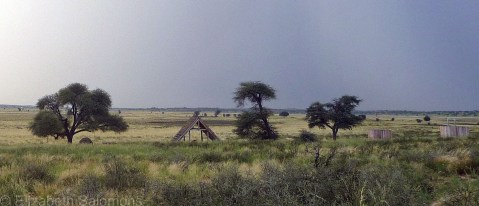
An unfenced campground on the Botswana side of Kgalagadi Transfrontier Park. You can just make out our tents below the camel thorn tree at far left.
The other two nights we camped in South Africa, in full-service campgrounds that included a gas station, small store, showers and flush toilets, and a high fence encircling the entire campground. The gates were closed from dusk to dawn, but by 6 a.m. each morning there was always a line-up of SUVs eager to start their game drives.
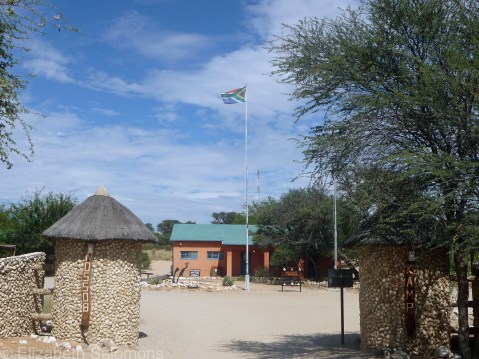
The entrance to a fenced campground on the South African side of the park
Our daily routine was rather basic. At 6:00 a.m. sharp, our guide gently woke us by calling out “morning, morning, morning.” At that hour it was scarcely light enough to see without a flashlight, but mornings were the best time to see game, so we wanted an early start.

Our evening ritual: the braai. Our guide stacked the wood to about knee-height, then lit it and let it burn down to coals. Only then was it ready for grilling meat.
Once we were on the road, we stopped anytime we saw game. On the days we moved camp, we’d reach the next campsite by early afternoon. On days we weren’t moving camp, we still went back to the campsite for the height of the afternoon as there was little to see in the way of wildlife at that time of day. There would be another game drive in the late afternoon/early evening, and then back to camp for our sundowners (gin & tonic were our drink of choice) and dinner: always a braai (Afrikaans for “grill”) prepared and served by our guide.
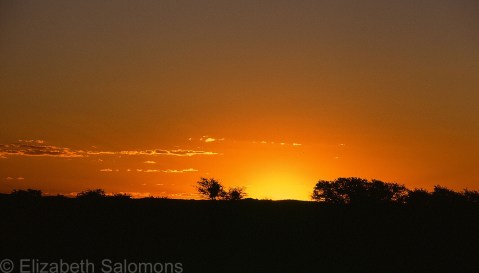
My safari experience, to put it simply, far exceeded my expectations and then some. I loved the landscape ― I blame my love of flat horizons on my Prairie upbringing ― and I loved the early mornings at dawn when the world was cool and soft. Although the Kalahari is a desert, the daytime temperatures never seemed overwhelming ― again, my Prairie temperament loves a dry heat.
As far as the main attraction of the safari went, my expectations were exceeded and then some as well: two cheetahs, 14 lions (three of them cubs), and springbok, gemsbok, blue wildebeest, and red hartebeest, including fawns and calves, by the herdful. Lots of birds as well. A handful of giraffes. A couple of jackals. And of course the barking geckos who serenaded us every single night.

A barking gecko
As we were driving back to Upington on our last day together, we teased our guide about the stories he would tell his next group about all our antics. He laughed along with us, but then turned serious for a moment and looked right at me and my friend. “This must not be your last time,” he said earnestly.
Never, in all my travels, did I think I would ever get the chance to go to Africa. Never, in all my dreams, did I think I would ever go on safari.
I can only hope and dream that I will get the chance again.
Through My Lens: Mission Abbey Door
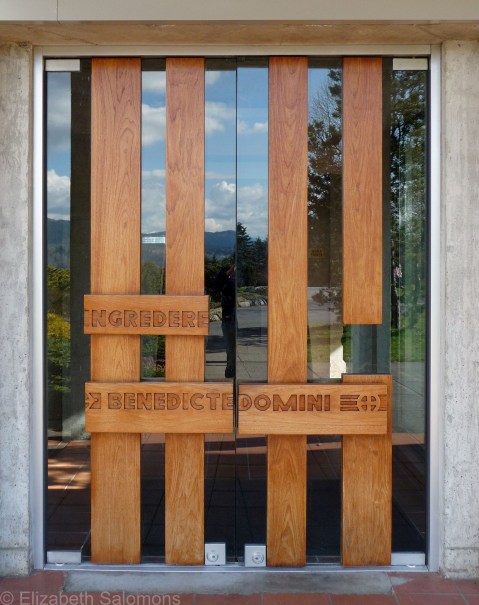
For the Third Sunday of Lent, here’s a photo of the door to the Mission Abbey church. The abbey grounds are open to the public during daylight hours, and the church as well, when not in use by the monks.
Through My Lens: Mission Abbey Bell Tower
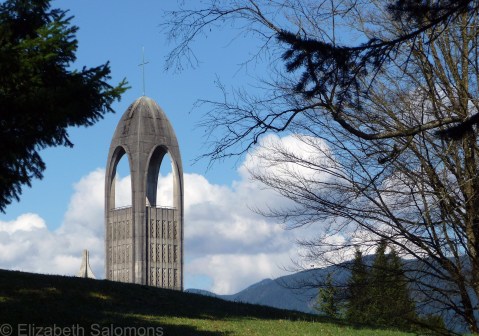
Mission Abbey is located on a 200-acre site overlooking the Fraser River. Benedictine monks have lived, farmed, and prayed here since 1954.
The abbey church, tower, and seminary were designed by a Norwegian architect named Asbjørn Gåthe and were built over a period of 25 years, culminating with the church, which was dedicated in 1982.
For the Second Sunday of Lent, here is a photo of Mission Abbey’s bell tower. It was dedicated in 1958.


 There and Back Again