
Hooded Merganser
In honour of Vancouver Bird Week (who knew we had such a week?), which started today and ends next Saturday, here are my photos of some Hooded Mergansers I found at Lost Lagoon in Stanley Park.
This is the male, much more colourful than the female, as usual.

And this is the female.

City of Angels
Question: What do Los Angeles and Vancouver have in common?

Venice Beach
Answer: Both cities have beaches. (But the beaches in Los Angeles are a lot bigger and the surf is a lot higher.) Both cities have palm trees. (But the palm trees in Los Angeles are more varied and much taller, and the palm trees in Vancouver ― well, I am being kind when I say they look a little ridiculous. I mean, palm trees do not belong in Canada. Right?)
And both cities are surrounded by mountains. (Here, I think we win, as our mountains are a lot closer. I think ours are taller, too.)
But there is one area where Los Angeles and Vancouver have absolutely nothing in common. Hands down, the weather in Los Angeles is waaaay better than in Vancouver, and a whole lot more dependable. I know this because I spent last weekend in Los Angeles, soaking up some badly needed Vitamin D.
And now I can’t wait for summer to arrive in my home city.
Happy Birthday, Charlotte Brontë!
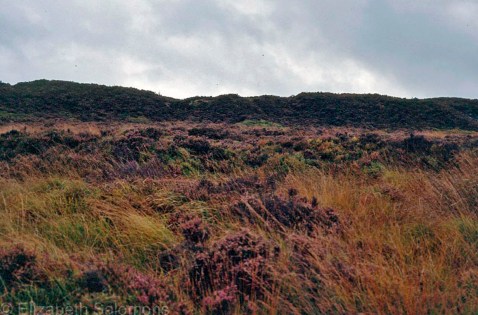
Not that I need a reason to travel, but I often select my travel destinations based on the books I’ve read. A setting comes alive in a way that it never can, quite, in a book. You don’t completely understand Sinclair Ross’s short story “The Painted Door” until you’ve witnessed a prairie blizzard. And I didn’t realize how much small-town Ontario influenced Robertson Davies’ fiction until I saw small-town Ontario for myself, many years after being introduced to his work.
And so it was when I saw the moors near Haworth.
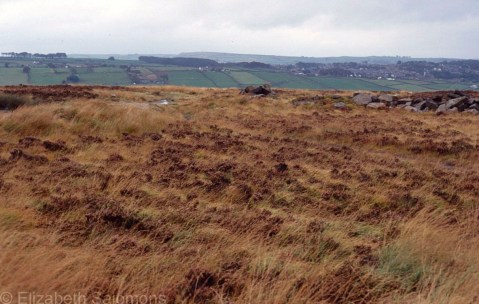
Haworth in West Yorkshire is where the Brontë sisters grew up. And the moors in Yorkshire just might be the bleakest landscape in all of England. They are certainly not what you picture when you hear the words “English countryside.”
And that is why I had a new appreciation for the Brontë novels after walking the moors by Haworth. I realized that the despair Jane felt when she walked away from Thornfield Hall was mirrored by the landscape she found herself wandering through, and I understood Heathcliff’s angst and turmoil after feeling the wind blow across the moors. (Wuthering, incidentally, is a Yorkshire word for “stormy weather.”)
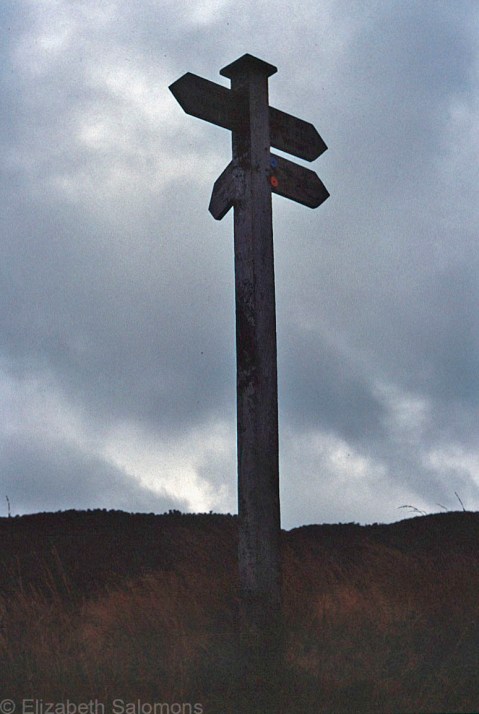
Of all the Brontë novels, Charlotte Brontë’s Jane Eyre is my favourite, and today is the 200th anniversary of her birth. Which is the reason for this post.
Happy birthday, Charlotte Brontë!
And thank you.
Skiing at Cypress

Yesterday was the last day of the ski season on Cypress Mountain ― and what a season it was! I can’t remember when I’ve seen as much snow on the mountain as I did this year. Total snow accumulation of close to ten metres and a base of almost four metres made for some spectacular skiing.
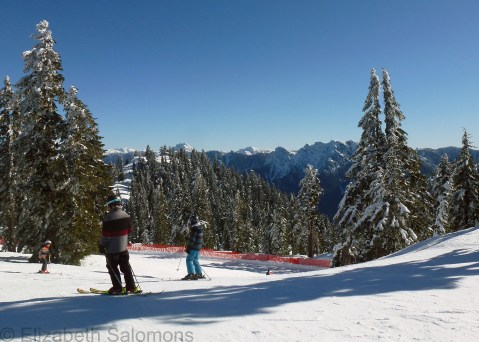
Not all years are alike on our local mountains (thank you, climate change), so I do not take a good ski season for granted. Cypress Mountain was the venue for the 2010 Olympics Freestyle Skiing and Snowboard events, but the conditions that year were close to disastrous. That snow had to be flown in by helicopter to make the mountain competition-worthy got a lot of media attention. And last year the snow conditions were just as bad, if not worse.

If you are from Vancouver, you’ve probably been skiing since before you could walk, but for those of us who grew up on the flat prairie, hurling oneself down a mountain doesn’t come as naturally. I finally decided I should give skiing a try after I spent a week hiking in the Swiss Alps with an Australian who could not stop talking about how much he loved the sport. But upon my return to Canada, and after my first few feeble attempts at skiing down a mountain, I quickly realized I badly needed expert help and should take some lessons.
And then … I promptly moved to Toronto and spent a decade there, where, yes, skiing takes much more effort than when you live in a city surrounded by mountains. (No, Blue Mountain does not count. When a friend from Collingwood showed me where she learned to ski, I laughed. And laughed and laughed.)
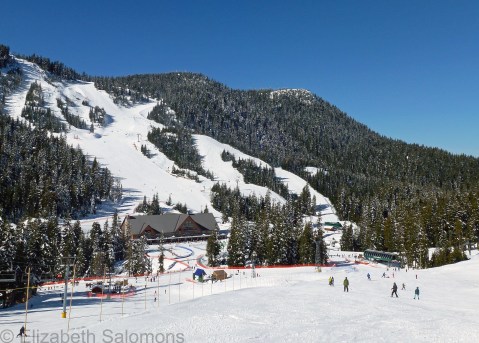
And so, after moving back west, with the urging of a co-worker who told me she was over the age of 40 when she learned to ski and assured me I could too, I found me some courage and signed up for the Adult Learn to Ski Program at Cypress. The program was a great bargain: five lessons, five full-day lift tickets, and five full-day rentals. Plus one night a week of night skiing for the entire season.
And here’s the thing I was thrilled to discovered: ski lessons are nothing like your grade school phys ed class. You remember those.

Howe Sound as seen from Lion’s Express Chair
No, ski lessons at Cypress are much different. The instructors are careful, considerate, and skilled. (After all, it’s in the resort’s interest to make sure you have fun ― they want you to come back.) I do think it helped me that I was familiar with the sensation of sliding on slippery surfaces, thanks to all those lunch hours spent on my elementary school’s outdoor ice rink. When the instructor told me to do a “hockey stop,” I knew what he meant and could do it on my first attempt. But more than all that, learning how to ski was just so much fun.
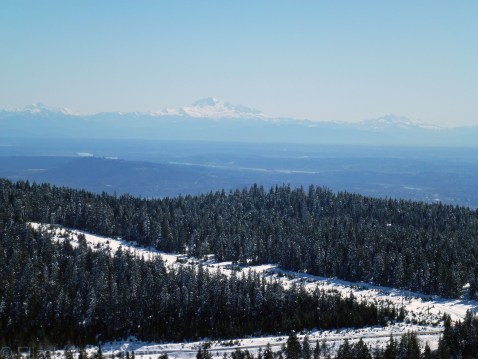
Mount Baker as seen from Black Mountain
The instructors begin by having you slide down a short incline in front of the ski lodge ― just a few metres to start. You move on to a longer incline, and before you know it, you’re on the bunny hill and learning how to turn.
After my first couple of seasons, I bought some second-hand skis and now, every year come December, I regularly check the ski report. The best are the blue bird days ― a brilliant day of sunshine after an overnight snow fall. Fresh powder is what you want. And then there’s spring skiing, which some years ― like this one ― can be awesome.
I know I’ll never be a great skier. No black diamond runs for me. But with 53 runs ― the longest is 4 kilometres ― and a vertical drop of more than 600 metres, there’s plenty on the Cypress Mountain to keep me challenged.
Vancouver can be a miserable place in the winter because of its rain. But all that rain in the city translates to snow on the North Shore mountains. So every winter, when I moan about how much it’s been raining, I only have to look up at the mountains and know that it’s going to be a great ski season.
Barring an early season Pineapple Express, of course.

Through My Lens: Vancouver Sunset

Of course, I don’t have to go all the way to Africa to see a spectacular sunset. I took this photo exactly a week ago while walking the seawall with a friend.
Kalahari Sunset
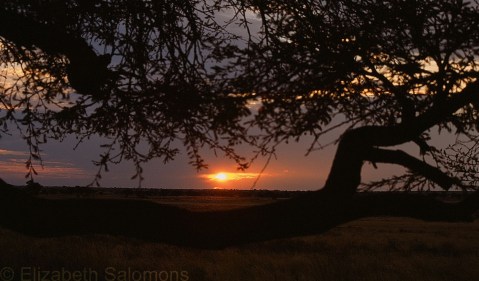
Oops. That took a bit longer than I anticipated. But, yes, all good things eventually come to their end, and I, too, have come to the end of this series on my safari in the Kalahari.
And so, to close it out, here’s one last photo, this time of the setting African sun.
Kalahari Birds

My Kalahari safari predates my interest in birding, so I wasn’t paying too much attention to the region’s feathered friends. However, I did think to take one or two photographs. And, because they are rather memorable, I learned some of their names.
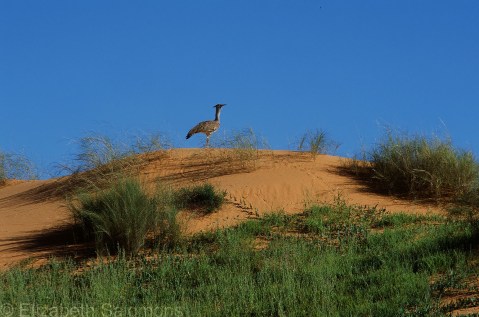
These first two photos are of the largest bird capable of flight. It’s called the Kori Bustard, but, thanks to the accent of our South African guide, I kept hearing “horny bastard.” (Believe you me, that made my head turn.)
This one is being stalked by a jackal.

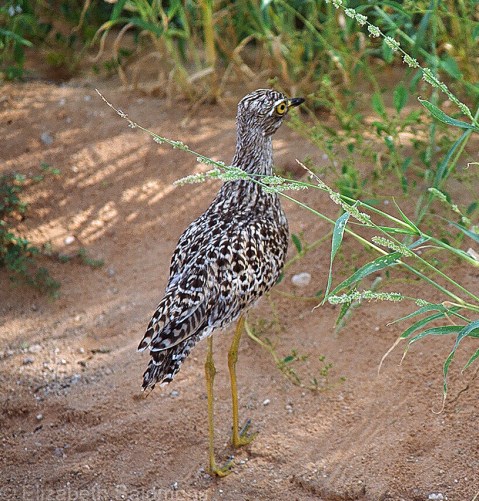
Here’s another bird whose name I enjoyed: the Spotted Thick-knee. I like its Afrikaans name even more: Gewone Dikkop.
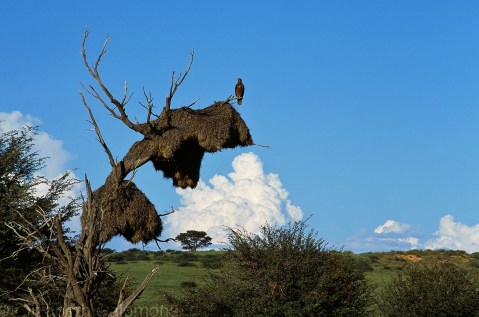
I don’t have a photo of the Sociable Weaver ― in fact, I don’t think I ever saw one ― but we saw lots of their nests. Part of the sparrow family, they reside in large colonies ― hence, their name ― and build magnificent nests like these to live in.
Yellow Mongoose
One reason why I was so enamoured with lions on my Kalahari safari is because they really are just really, really big cats. I live with two (much smaller) cats, so I should know.

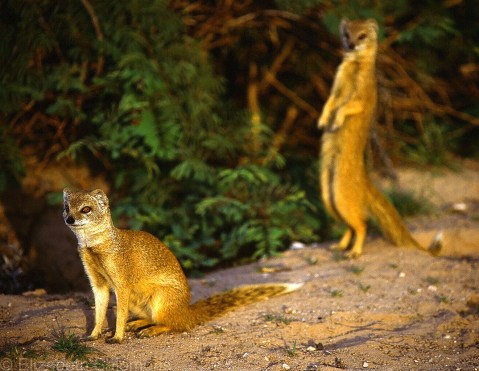
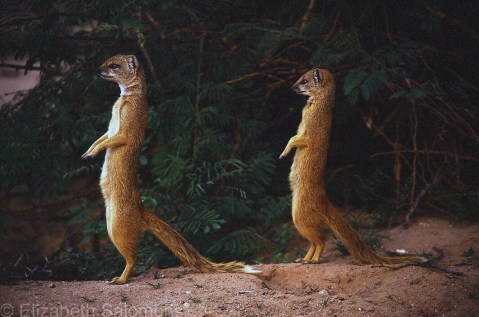
Another animal that reminded me of my cats is the yellow mongoose. I entertained myself one evening at camp taking photos of these fellows. Yellow mongoose are about the size of a kitten, and have just about as much personality. They never stop moving. Not for a second.
Cheetah
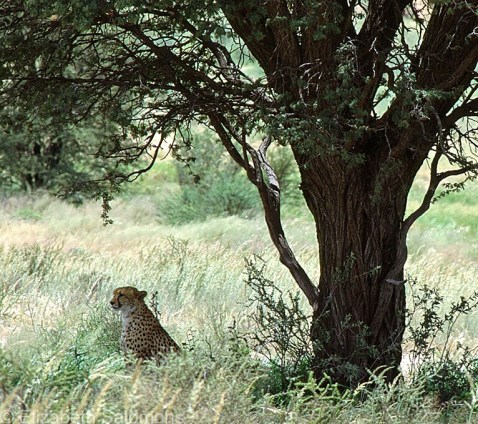
This is a cheetah. It’s not the best of photos, but I thought I should include it in my Kalahari series because apparently I was pretty lucky to see a cheetah on my first ever safari. We came across this one on our fifth day out, and my German safari companion was ecstatic. It was the first cheetah she’d seen in all her years of going on safari.
There were actually two cheetahs under this tree, but one lay down in the grass just as we spotted them, so it’s not visible in the photo. (Which made me wonder, then: exactly how many animals had we not seen over the previous four days because of the tall grass?)
Two bits of trivia about the cheetah: its coat is covered with nearly 2000 black spots. And it can sprint at a speed of 100 kilometres an hour, making it the fastest mammal on land.
Lion
And now … what you’ve all been waiting for. (At least, I sure have!) I’m talking about what most people think of when you say you’ve been on safari; I’m talking about meeting the King of the Beasts.
As excited as I was about seeing lions on our Kalahari safari, I had fully prepared myself for the eventuality that I might not see a single one. I mean, it’s not like going to the zoo. What you see in the wild is (ahem) wildly dependent on a wide variety of factors, not the least of which is a whole lot of luck.
But! It turns out we were lucky and on only our second morning out, we saw our first lion. Here he is.

It was my turn in the very back of the car, which meant, although I had a great view of the fellow, I had to take my photos through a window that did not open. Even so, I was beyond thrilled.
It took us a while to spot the guy. We had stopped by the side of the road to look at a herd of gemsbok. Several minutes went by, and then one of our German safari companions spoke up. “There is a lion in the grass directly in front of us about 20 metres,” was all she said, but I’ll never forget the tone of her voice: calm and quiet and tense, all at the same time.
That’s when I realized what sharp eyes she had. The rest of us had been too focused on the gemsbok to notice what was right under our noses. We stayed where we were, keeping our voices low because the car windows were open. Every so often Mr. King of the Beasts would lift up his head ― to let the gemsbok behind him know he’s still there, our guide told us.
That was lion # 1. Little did I know he would be only the first of many.
On the morning of our third day, I was eating my breakfast and enjoying the view from the shelter of our unfenced campsite. Off to my right, in the distance, I noticed some sandy-coloured rocks. To myself, I thought, “The biggest rock kinda looks like a lion.” I imagined a pair of eyes, but dismissed the idea as too much wishful thinking, and didn’t say anything to the others. This rock was maybe 100 metres from where I was standing.
A few minutes later, my friend and I were in our tent, packing up our stuff as we were moving camp that day, when I heard our guide yell, “Lipid!” (At least, that’s what I heard.) But my friend understood.
“Leopard!” she said, and we both raced out of the tent. I pretty much tripped over my own two feet, and then wasted more time running for my cameras, which were over by the shelter in the exact opposite direction from where everybody else was running. By the time I looked over to where our guide was, all I saw was him pointing. I didn’t see any of the cats, but he had seen four lions and a leopard.
And that’s when the penny dropped. I ran back to where I had seen the “rock” earlier. It was gone! I told everyone, and some of the group were a bit disgusted with me for not sharing what I’d seen (honestly, it was so far away it was really hard to know what I was looking at), but they were soon over it. I endured quite a bit of teasing for the rest of the day about how I didn’t know the difference between a rock and a lion. Later, it dawned on me that the lion had been watching me just as carefully as I had been squinting at her. She had stood sooooo still that she really did look like a rock. Except for, you know, those eyes.
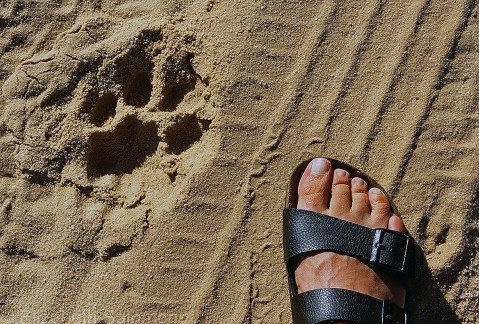
After all that excitement, we went looking for their tracks in the road. They were … big.
On our fourth day, we saw what I’m calling lion # 3. She was lying beside the road, sleeping. Eventually she sat up and struck a lovely pose for me.

On our fifth day, our guide noticed lion tracks by the side of the road. We drove on slowly, all of us looking carefully in the meadows beside the road.

And then, there they were, three of them in the distance (lions # 4, 5, and 6).
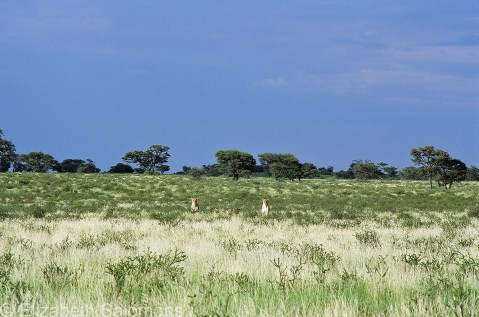
Here are a few more shots taken with my zoom lens.


On our last day of the safari, we hit bonanza in terms of lion-sightings: eight in total. The first two were too far away for photographs. I was the first to spot this one (lion # 9), which is a considerable accomplishment considering the company I was in. (I took this photo with my zoom lens. The lion was maybe 200 to 250 metres away from us, and to the naked eye, she was no bigger than a large cat.) Our guide said this lion and the previous two were getting ready for a hunt — he could tell by the way they had positioned themselves on the edge of the dune.

And then we came across a family: lions # 10 to 14. Here’s dad …

… and here’s several shots of mom and the three cubs (one cub is off camera).


The most thrilling night of our safari was one of the nights we were camped in an unfenced campsite (which we did twice, both times on the Botswana side of the park) and we listened to the lions roar. Every hour or so we’d hear them, and they were getting closer and closer as the evening went on. I didn’t quite get the goosebumps you read about people experiencing when they first hear a lion roar in the wild, but it was probably the most thrilling experience of my camping life.
That night, around 3:30 a.m., my friend had to get up. This meant waking up our guide and waiting for him to say it was OK for her to leave our tent. He didn’t wake up when she called out his name a few times (although she woke up the Germans — which we heard all about the next morning), so I suggested she shine her flashlight on the SUV where our guide was sleeping.
“Is there a problem?” came his South African–accented voice, eventually. My friend told him what she needed, and he opened the door of the SUV and jumped down to the ground in his bare feet. (This, after he’d warned us every single night after the sun went down that we could not wander through camp wearing sandals or flip flops because of the scorpions.) He slowly shone his flashlight across the meadow beside our campsite.
After a long minute, he finally said, “It’s OK.” My friend scrambled out of the tent, did her business, and returned to our tent, after which the entire camp could finally go back to sleep.
The next morning when I got up, our guide told me that he had woken up every hour to take a look around because he was hearing lots of animals in the grassy plain we were camped next to. I never thought to ask if the animal sounds woke him up, or whether he simply had a good internal alarm clock. At any rate, I was glad to learn our guide was taking our safety seriously.
I hesitate to say that my Kalahari safari wouldn’t have been as extraordinary an experience without seeing 14 lions ― because the safari really was, as a whole, so much more than the extraordinary sum of so many extraordinary parts ― but I will say this: you should all put seeing lions in the African wild right at the top of your bucket list.
The top, people.


 There and Back Again