Through My Lens: Holiday Wreath
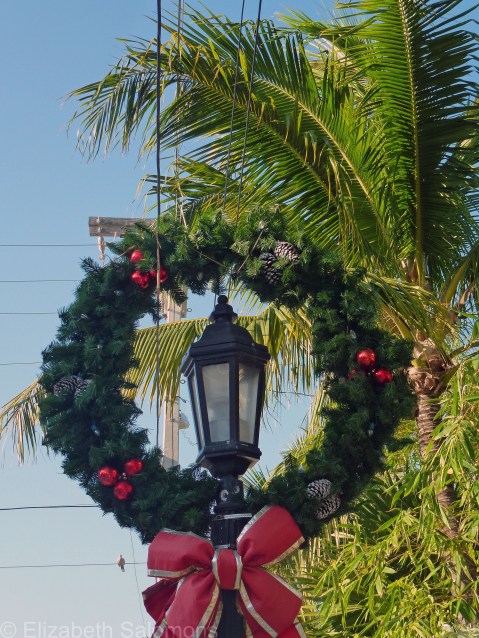
Oh, look! It’s another holiday photo.
I know, I know. You thought I was done for the season ― so did I ― but then I found this photo. I took it two years ago almost to the day when I was exploring Key West, Florida. I liked the incongruity of the various bits of greenery in this shot.
Through My Lens: Holiday Orca

Here’s one more holiday photo to finish out the year. This magnificent orca whale is a new display for 2015. Made by hand in Slovakia, it contains 6000 LED bulbs and was put up in Morton Park at English Bay as part of this year’s Lumière Festival.
A rather spectacular addition to the neighbourhood, don’t you think?
Through My Lens: Robson Square Ice Rink

Robson Square Ice Rink was looking mighty festive tonight. I wasn’t the only one who thought so ― check out the line of people on the left side of the photo. They’re all waiting for their turn on the ice.
Merry Christmas!
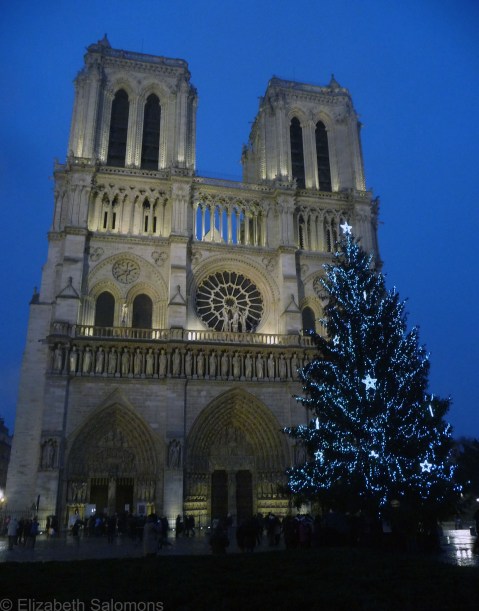
Cathédrale Notre-Dame de Paris
Canyon Lights

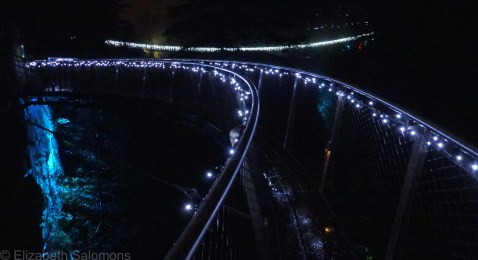
The Capilano Suspension Bridge has been a Vancouver attraction since 1889 when George Grant Mackay, the man who owned the land on either side of the Capilano River, built a footbridge out of cedar planks and suspended it over the canyon using hemp rope. The bridge and the park that has developed around it is still privately owned and, to my mind, far too commercialized and far too pricey for what it offers. There are heaps of forest walks and plenty of other bridges to be accessed for free on the North Shore as an alternative to the Capilano Suspension Bridge. It’s on those walks and to those bridges where I take my out-of-town visitors who want a taste of the region’s rainforest.
However, sometimes out-of-town visitors have an agenda of their own and you end up tagging along wherever they want to go. I’m easy. I mean, it’s their vacation, right? And who knows? I might learn something new or see something spectacular.
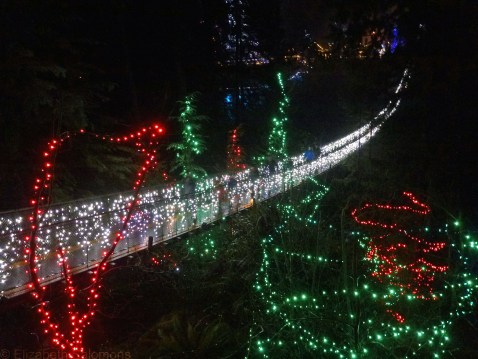
Such was the case when last week a friend of mine in town for the holidays wanted to see the Canyon Lights at the Capilano Suspension Bridge. In its tenth season, these light displays are part of the park’s massive efforts over the past decade to draw in more and more visitors.
And here was the surprise for me: the Canyon Lights are tasteful and magical, and I highly recommend them as a Vancouver tourist attraction if you happen to be visiting during the holiday season.
Here, take a look. (Click on any photo to open up the slide show.)


Capilano comes from Kia’palano, the name of a Squamish chief during the early 1800s. It means “beautiful river.”

One last note: if you have a fear of heights, Capilano Suspension Bridge might not be the place for you. But here’s a pro-tip: in the dark, you can’t see how high up you are!
Through My Lens: Prague Christmas Angel

Of course, the bonus about getting to spend the winter in Paris are mini-breaks on the European continent.
Which I experienced one December weekend five years ago when I easyJetted off to Prague for the weekend.
Which is when I took this photo.
Parisian Cafés
Every year around this time, I get homesick for Paris, but this year, my mind has been on Paris far more than usual.
I’m sure it’s obvious why: the media coverage on that city has been pretty much nonstop since the Paris attacks a month ago. Attention ramped up again this past weekend when 195 nations at the 2015 United Nations Climate Change Conference, or COP21, adopted what’s being called the Paris Agreement.
In short: all eyes ― not just mine ― are on Paris right now. And so, bear with me as I write (yet) another post on my second-favourite city in the world.

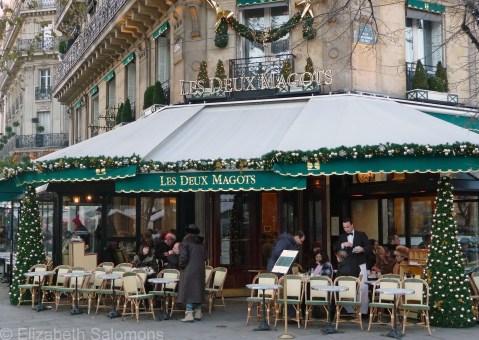
Whenever I think back to my winter in Paris, I think of the impressive light displays put up to celebrate the holiday season. The many elaborately decorated Parisian cafés were particularly impressive, with nothing ever done in half measures. (Is that a French thing? Or a “keeping up with the Joneses” thing? I dunno, but I sure enjoyed the results.)

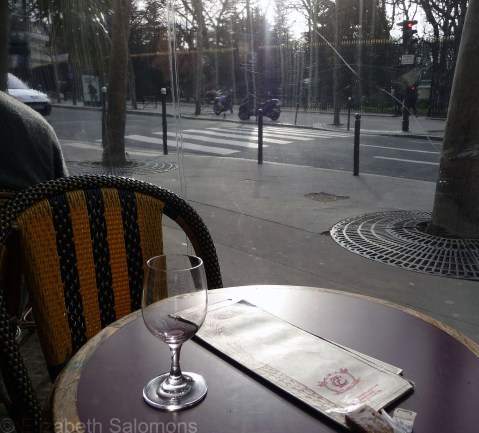
Parisian cafés are special places. In the mind of most visitors to Paris, there is nothing more French than sitting down in a café and ordering un café or un verre de vin. One quickly learns ― and adapts to the idea ― that your one drink buys you the table for as long as you want it.

Which could be hours. Whether you sit there alone, reading or writing or people-watching, or sit there with your family or friends, it doesn’t matter. You will not be rushed. Time stops.

Because they serve beer and wine in addition to all manner of caffeine, Parisian cafés are, technically speaking, café-bars. They also have complete kitchens, which means you can get a three-course meal any time of day. (Cafés are open from morning until late at night, whereas Parisian restaurants generally close for the afternoon.)

As an oftentimes solo traveller, what I especially like about Parisian cafés is the lack of stigma to eating alone, which has not been my experience in other European countries.
The oldest café in Paris is Le Procope in the 6e arrondissement. It opened for business in 1686, shortly after coffee was introduced to the French. My New World brain can’t quite fathom a restaurant that’s been around since a century before the French Revolution.

In time, Parisian cafés became the centre of French discourse and intellectual life, the place where politics and art and philosophy were discussed. Today, there are more than 12,000 cafés in Paris ― one on every corner, it seems, in some arrondissements.

The Paris attacks of last month were horrific and shocking. What was especially horrific and shocking is that Parisians were attacked while enjoying the very essence of what makes them Parisian: having a drink in a café.
Just as I cannot imagine Christmas in Paris without dazzling light displays, I cannot imagine a Paris where fear and trauma have overtaken the café experience. I hope and pray that the magic I felt five Decembers ago in the City of Light is still there. And my Christmas wish for all Parisians is simply this: that they spend the holiday eating and drinking and laughing and loving.
In other words, that they have a Joyeux Noël.

The West End
I can’t let last month slip by without acknowledging that my neighbourhood, Vancouver’s West End, was awarded at the beginning of November the title of Great Neighbourhood in the fifth annual Great Places of Canada competition. (The contest is sponsored by the Canadian Institute of Planners, the same folks who bestowed the title of Great Street of Canada on Lacombe, Alberta, a couple of years ago.)
What makes the West End so great, according to the jurors of this year’s contest? They selected it because of its walkability and its diversity, and for the natural beauty that is its heart and soul: Stanley Park and the beaches of English Bay.
In short: it’s a community that rates high on the livability scale.
About that walkability: the main streets lining the edges of the neighbourhood allow easy access into and out of the West End for vehicles ― both public and private ― but what’s unique about the neighbourhood are the numerous parkettes, round-abouts, and one-way streets used to discourage traffic on residential streets. More than 40 percent of the population walks to work ― that’s a higher percentage than anywhere else in Vancouver. West Enders also typically walk to access their services, whether it’s their grocery or produce store, their butcher, fishmonger, or baker, the liquor store or pet store, or a doctor, dentist, or hairdresser. (Your every need met within a ten-minute walk!)
About that diversity: the West End, in particular Davie Village, is home to Western Canada’s largest LGBT community. Almost half of the neighbourhood’s 45,000 residents are between the ages of 20 and 39, a demographic reflected in the high number of residents (80 percent) who rent their homes. That, and a large concentration of Asian language students, makes for a high turnover in residents.
Despite being a transient population, the West End has more children than many areas of Vancouver traditionally considered family neighbourhoods. Those children are educated in two elementary schools and a high school that celebrated its 100th anniversary in 2014. The West End is also home to a large concentration of seniors (evident by the number of times I have almost been mowed down by one of them on a scooter). They have their own community centre at Barclay Manor, a heritage house in the centre of the West End.
Vancouver’s West End is bordered by West Georgia Street to the north, English Bay to the south, Burrard Street to the east, and Stanley Park to the west. As is all of Vancouver, the West End is unceded Coast Salish territory that was logged and developed after the arrival of the Canadian Pacific Railway. By the 1890s, it was home to Vancouver’s elite. When those elites crossed False Creek and began to settle in Shaugnessy, the West End became the transient community ― peopled with new arrivals to the city and the country ― that remains its defining characteristic to this day. Robson, Denman, and Davie streets became the business hubs, and apartments buildings were built: low-rise ones in the 1920s, ’30s, and ’40s, and multi-storey towers from the late 1950s on. Even so, many of the original houses from the late 1800s are still in use, creating an interesting architectural mix of heritage and modern buildings.
With everything it has to offer as a great place to live, work, and play, the West End is not without problems, however. Its housing is the least affordable in the city, yet the median annual income of its residents is far below that of Vancouver as a whole. St. Paul’s Hospital is being relocated some three kilometres away, leaving no acute care facility in the entire downtown peninsula. This is a worrisome issue in a city where a major earthquake that could happen at any time is likely to collapse all of the bridges that provide access to the downtown peninsula.
Development continues at lightning speed, and the buildings are becoming taller all the time. In a three-block stretch of Davie Street alone, three five residential condo towers are being proposed ― that’s a lot of construction in my near future only steps from my door.
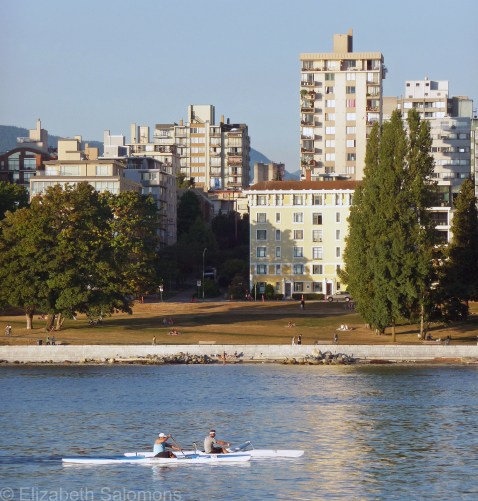
But for all that, I wouldn’t live anywhere else. And so, here’s a photo that shows everything I love about my neighbourhood: natural beauty, architectural diversity ― and my own beach (that I, um, share with several thousand neighbours).
Through My Lens: Freezing Fog
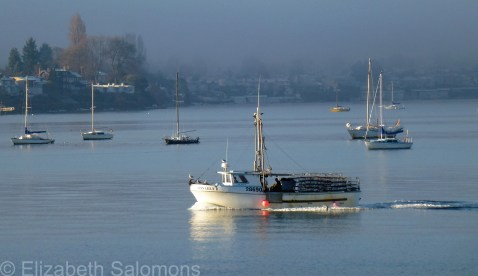
The meteorologists call it freezing fog.
I call it get outside and take some photos.
Dishing: Ask for Luigi

Here’s what happens when you visit a review-worthy restaurant shortly before leaving on your summer holidays: the blog post you wrote sits in your draft folder for months and months until you completely forget about it. We ate at Ask for Luigi on a beautifully hot summer evening last August. Here is what I wrote the next morning.
Note to the host of Ask for Luigi: ignoring the woman for the guy she’s with is not smart in the current century, especially when the gentleman in question is crouched down and clearly pre-occupied with his phone.
That ten-second encounter almost put me off, but I set my ego aside and told the host my name and the number in my party. Ask for Luigi takes walk-in guests only, but anyone not accommodated in the first seating ― we managed to snag the last table ― is texted when their table is ready.
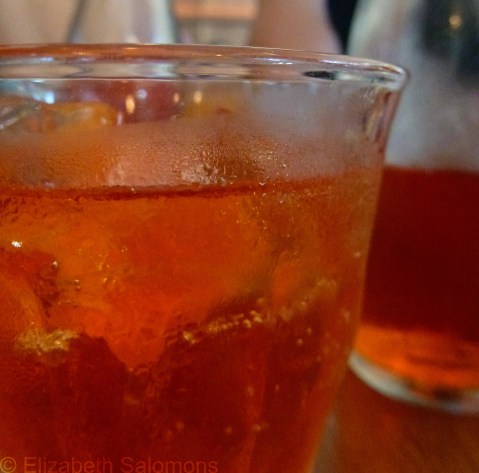
Voted one of Vancouver’s best new restaurants when chef and co-owner J.C. Poirier opened in late 2013, Ask for Luigi is one of the bright spots in Vancouver’s transforming Railtown. Once we were seated, the service was beyond attentive ― our table was wiped down after each course and the reflexes of our server were quicker than all three of us combined when yours truly clumsily knocked over her Spritz ― the Venetian-style aperitivo made with Aperol, Prosecco, and soda water that is the only option for a before-dinner drink.
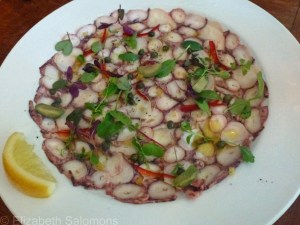 The antipasti orders came almost too quickly ― with only 36 seats the emphasis seemed to be on turn-over ― but nothing was going to make us wolf down these delectable platters of perfection. We savoured every bite of anchovy-infused octopus carpaccio, sliced paper thin and liberally sprinkled with baby basil. Luigi’s famous golf ball–sized meatballs were dense and chewy. Smothered with a rich, smooth, crimson tomato sauce and accompanied by toasted
 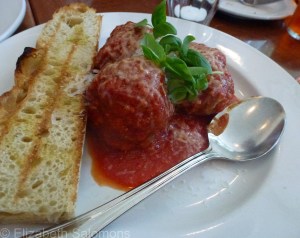 Tuscan-style bread, they were marred only by the crunch of eggshell in my first bite. Geometrically correct cubes of crispy pork ciccioli, moist and wet on the inside, crunchy on the outside, were served with canary-yellow saffron aioli and deep-fried shishito peppers — a sweet green pepper about the size of my little finger. About one in ten shishito peppers are spicy — my sister was the lucky one in our group.

On to the next course. Tagliatelle with rabbit and olives was flawless, the olive taste subtle but present, and the shredded rabbit liberally coated with a creamy sauce. The rye penne, on the other hand, was overcooked, although not the creamy egg yolk placed on top, nor the gently sautéed broccolini and perfectly crisped guanciale. The pasta special ― conchiglie with garlic sausage, pale kernels of organic corn, and black summer truffle ― was the surprise of the night with its spicy kick and sweet taste of summer. All pasta is made fresh daily and served family style. (Gluten-free options are available.)

Two courses would be enough to fill any sane person, but we soldiered on. The vanilla-bean panna cotta was particularly creamy and made complete by almond biscotti and delicately stewed prunes. Chocolate budino ― a flourless cake with 70 percent chocolate ― was as intense as you would expect a flourless cake with that much chocolate to be. A mini loaf of warm olive oil cake, topped with a quenelle of rich ricotta cheese, was nestled on a bed of glazed orange slices.

The rustic décor was pleasing ― the desserts were served on mismatched china and the wine in small juice-sized glasses ― but pity the poor sods stuck in the back corner, too far from the wide-open windows or floor fans to get any respite from the August heat. Extra entertainment (in addition to yours truly spilling her drink at the start of the meal) was provided when my dining companions recognized a well-known actress sitting behind my right shoulder ― although, she wasn’t so famous that they were sure of her name. Each then whipped out their respective smart phones to check if they were right, while I remained focus on photographing our food.
We’ll go back to Ask for Luigi, but I’m thinking only if we can squeeze into the first seating again; I’m not convinced it would be worth an hour or more wait.
Note: The benefit of waiting three months to post a review is that I can change my assessment: I have decided I do want to go back to Ask for Luigi, regardless of the wait time, as long as I am with people whose company I enjoy. (Which is usually what happens when I eat out, so I should be all right.)