

Through My Lens: Père Lachaise Métro Station
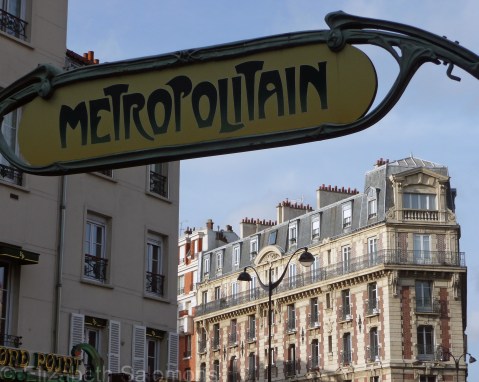
No sense fighting it. I’ve got Paris on my brain this week. So here’s another photo from the City of Light.
This was taken by the entrance to the Paris Métro at Père Lachaise.
E. Dehillerin
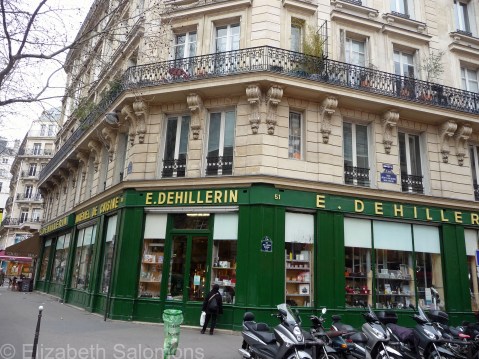
There is one scene in Julie & Julia that cracks me up every time I watch the film because it’s so far off from the truth. It’s when Julia Child, Simone Beck, and Louisette Bertholle are (supposedly) shopping in E. Dehillerin, the famous cookware store that has been supplying French chefs with the tools of their trade since 1820. The store in the movie is pristine and light and airy, with lots of room for Julia Child to wildly swing her shopping basket.
That scene wasn’t filmed in the actual store, as anyone who has ever shopped at E. Dehillerin can tell you. The actual store is much darker and dingier and more cramped than the one shown in the film.
In the words of David Lebovitz, the only way to enter E. Dehillerin is to “brace yourself and step inside.” My sister and I stumbled upon it quite by accident one afternoon in December 2010, moments after we had stumbled ― also by accident ― into Saint-Eustache, a magnificent church in the 1er arrondissement.
Here’s how I described my introduction to Dehillerin in the journal I kept that winter:
We came around a corner and there was heaven: E. Dehillerin, which I had read about. It’s the cookware store in Paris where all the pros shop, including (it’s been said) Julia Child.
But it was massively packed; I’ve never been in such a crowded store. The basement was dusty and musty and filled with massive industrial-sized stock pots (and not as crowded as upstairs).
Upstairs, I tried to look at the knives, but you could barely get past anyone to get near the counter where they were displayed. (And “display” is a bit generous. They were simply plunked in wooden bins of various sizes and in various groupings.) We got out of there and decided on lunch in a place in Rue Montorgeuil.
A week later, I returned, this time with a friend who was spending Christmas with my sister and me. Not only did I want her to experience the store for herself, but I had decided I was going to buy me some knives as a Christmas present to myself. We wandered in and out of several cookware and bakeware stores that morning ― they are all congregated near E. Dehillerin because there used to be a giant market nearby where all the Parisian restaurateurs used to shop for their daily menus. The market is long gone, but the shops ― and the restaurants ― remain.
Dehillerin was insanely crowded on my second visit as well and my friend and I quickly gave up on my plan to buy some knives.
But, I was determined. I did some online research and learned that persistence was the only way to get results when shopping at E. Dehillerin. And so, I returned.
Back to my journal:
January 29. Saturday. I still wanted my knives from Dehillerin and, as they are closed on Sundays and I was leaving on Monday, this was the last possible day I could buy them. I’d put it off as long as I could as it seemed so intimidating, given everything I’d read about the place, and how crazy crowded it had been on my two previous visits. But … I persevered. In I went, and it seemed a bit crowded at first, but then all of a sudden it emptied out and I had all the room I wanted to pick out the knives I wanted.
I checked the price of one in the book at the end of the aisle, went back to the bins of knives, decided on another knife and then thought, “Oh, I don’t care how much it costs. This is the one I want.” That was the 20 cm chef knife. I then chose a 10 cm paring knife, and a sharpening steel, and took them to the table where they wrapped your purchases.
The clerk said something to me in French. When he realized I hadn’t understood a word, he said, “English?” “Yes,” I replied. He then explained that the sharpening steel I had selected was too small for the size of my knife. For only a few euros more, I could get the right-sized steel made by the same company. I said, “OK,” he went to grab the right-sized sharpening steel, looked up the codes in his book posted on the pillar at the end of the aisle, wrote them down on a slip of paper and handed it to me.
I took the slip of paper to the woman behind the counter and she took my payment. Two knives and a sharpening steel for 86 euros. Earlier that month, I had checked the prices of knives in the housewares department at Galeries Lafayette and a chef knife there went for 100 euros alone.
So, very pleased with myself, I took the receipt back to the table, another clerk jammed each knife tip into a wine cork and then wrapped the knives in brown paper. Off I went, the happy owner of some proper kitchen knives at last. The fact that I bought them in Paris, and that they have the Dehillerin name engraved on the blade, is a bonus.
That afternoon is one of my favourite shopping memories while travelling.
No, wait. It is one of my favourite shopping memories ever. And the best part? I get to take an imaginary walk through Dehillerin every time I use those knives.
Which is every day.

Reel Life: Julie & Julia
 I had the opportunity this past week to introduce some friends to the film Julie & Julia. I was secretly pleased when they selected that DVD out of the pile I had brought, but I had no idea when I grabbed it at the last minute that most of the group had never seen the film.
Julie & Julia was Nora Ephron’s last film and stars the legendary Meryl Streep and the charming Amy Adams. It was Ephron’s producer who had the brilliant idea to combine into one screenplay two memoirs published around the same time. Julia Child’s My Life in France is about her life in post-war France, and Julie and Julia: 365 Days, 524 Recipes, 1 Tiny Apartment Kitchen evolved from Julie Powell’s blog about cooking her way through Julia Child’s Mastering the Art of French Cooking in post-9/11 Queens, New York. Beyond their names, Julie and Julia had in common the love and support of a devoted husband, a love of food, and the need to find some meaningful work to fill their days.
Early in the film, Julie Powell’s husband declares that “Julia Child wasn’t always Julia Child” ― and that’s precisely what makes the film so entertaining. Although I’m as fascinated as the next traveller about the daily routine of life as a New Yorker, the depiction of Julie Powell’s long subway commute and soulless work cubicle ring a little too close to home. But when the action switches to France, you’re transported to another time and place to witness the transformation of Julia Child, ex-pat American wife, to Julia Child, chef, author, and TV star.
Julia Child’s introduction to French food ― mere hours after she arrives in France ― is sole meunière. The epiphany she experiences in the look, smell, and taste of that first meal is, for me, the essential moment of the film. And it reminded me of the moment when I had my own epiphany about French cuisine. It was in a small restaurant in Perpignan where two friends and I shared a meal after a long day of sight-seeing. I ordered a tomato salad. It looked so simple ― a single layer of tomato slices on a small plate, sprinkled with an herb vinaigrette ― but I knew with my first bite that I was tasting something unlike anything I’d ever tasted before. The French don’t make simple tomato salads; they create spectacular tomato salads.
As much as my friends enjoyed Julie & Julia, they were a little more circumspect than I about the film; one remarked that she wouldn’t have reacted nearly as well as Julie Powell if the first words out of her partner’s mouth after disappearing for two days following a heated argument were, “What’s for dinner?”
As for me, whenever I’m homesick for French food, I’ll be (re)watching Julie & Julia.
Through My Lens: The Alcázar of Seville (aka Dorne)
As per usual, I was late to the party in discovering only recently how entertaining Game of Thrones is ― years after the rest of the planet. Now that I’m a fan (better late than never!), and now that I’ve had a week to recover from last Sunday’s Season 5 finale, I thought I’d make a connection between the TV show and travel.
Because Game of Thrones has some awesome filming locations.
It’s filmed in a few places that are on my bucket list (Croatia and Iceland), and in a few places where I’ve already been (Northern Ireland and Spain).
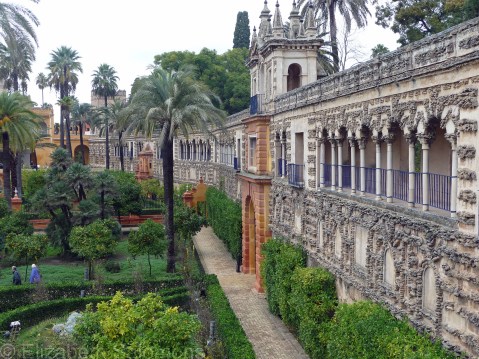
A new location that debuted this past season was the Alcázar in Seville, Spain. It was put to good use standing in for the Water Gardens, the palace of the rulers of Dorne.
Alcázar comes from the Arabic word al-qasr, which means “the castle.”
The Cloisters
As you may have, um, noticed from this year’s Lenten series, I’m rather partial to cloisters. The simple truth is: I just can’t get enough of them.
So, given my love of cloisters, why were my expectations of The Cloisters ― a branch of New York’s Metropolitan Museum of Art ― so low? I didn’t bother to make the trek all the way to Fort Tryon Park until my fourth visit to New York; even then, I debated whether or not to make the effort. (Though, in the end, I was glad I did as I decided the park alone is worth a visit. As you can see here.)

The thing is, I’d always been under the impression that the buildings that make up The Cloisters are all reconstructions. Purist that I am, I figured since I’ve seen many a real cloister ― in France, and Spain, and Italy ― why would I want to see a mere imitation?
Turns out I was completely misinformed. The Cloisters aren’t reconstructions; they’re the real deal. (And let that be a lesson to me: I didn’t do my homework before dismissing The Cloisters and almost passed on what is a marvellous opportunity for anyone in the vicinity of New York who cannot get themselves over to Europe.)

The Cloisters had its origins in the private collection of American sculptor George Grey Barnard, who lived in Paris for more than a decade in the late nineteenth century. In the decade before World War I, he got into the habit of collecting and bringing home with him pieces of medieval architecture from French villages. John D. Rockefeller bought the collection from him in 1925, and later donated it to the Metropolitan Museum of Art. Rockefeller also donated to the city of New York the land that now makes up Fort Tryon Park.

Open to the public since 1938, the museum is a chronologically arranged ensemble of remnants from five French abbeys: Saint Michel de Cuxa, Saint Guilhem le Désert, Trie-sur-Baïse, Froville, and Bonnefont-en-Comminges. In addition to the buildings, there are more than 2000 works of art, including illuminated manuscripts, stained glass windows, and tapestries.
Here, take a look.


If medieval history is your thing, I highly recommend a visit to The Cloisters.
As for me, I can’t wait to go back.

Through My Lens: San Jeronómo Monastery Outtake

The thing is, when you troll through dozens of photos to find the ones you want to post for a Lenten series on cloisters, you’re bound to end up with more photos than you could possibly use.
Here is another look at the Cloister of the Monasterio de San Jerónimo in Granada, Spain.
Through My Lens: Roman Jar

I’m yearning for La Dolce Vita this weekend―but I know it will be some years before I’ll have a chance to quench that yearning.
In the meantime, I thought I would share with you one of my favourite photos. I took this at the Castel Sant’Angelo in Rome.
West End Farmers Market
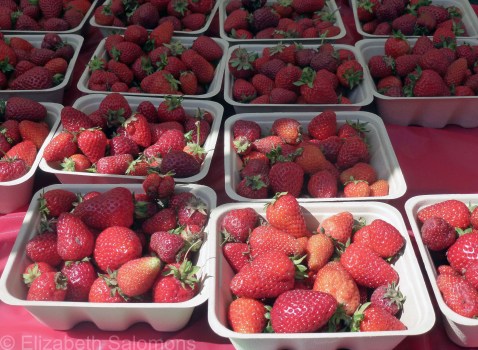
I know summer has well and truly arrived when the West End Farmers Market returns.

As it did today.

And it’ll be here, every Saturday, until the end of October.
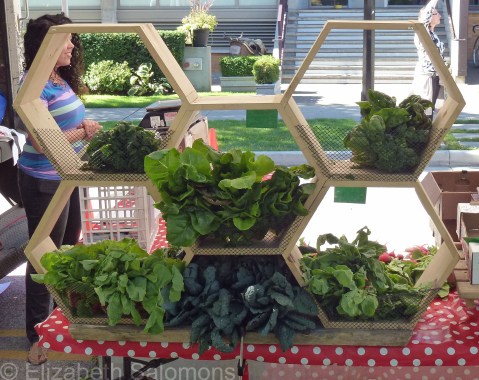
Oh joy, oh bliss. Shopping at your local farmers market is the best way to maintain a 100-mile diet.

Besides the West End Farmers Market where I shop (located alongside Nelson Park), Vancouver has six other summer markets. (There are also two winter markets.) You can buy fresh produce, cheese, baked goods, meat, poultry, and fish, and artisan products such as olives or fruit jams or soap. Vancouverites spend $8 million a year at their farmers markets and support 265 local farmers and artisans in doing so.

The best part? Everything tastes like summer. Truly.
Go on. What are you waiting for?

Through My Lens: Lunch Break

It’s that time of year.
What time of year?
It’s the time of year when we Canadians maximize every second of our short summers by spending as much time as possible outdoors.
Did you know that studies have shown workers are more satisfied with their jobs if they eat their lunch sitting on a park bench instead of in a café or (shudder) at their desks?
This chap is Lunchbox Joe. He’s enjoying his break in Edmonton’s Sir Winston Churchill Square.
Get outside, people!


 There and Back Again