
Through My Lens: Water Lily

I took this photo of a water lily last weekend while walking around Stanley Park’s Beaver Lake with some friends.
As beautiful as they are, water lilies are threatening the lake’s biodiversity. Beaver Lake is slowing filling in with sediment, thanks in no small part to the fast-growing invasive species. Plans to dredge the lake are in the works.
Through My Lens: Cheakamus Lake

Today’s photo is of another lake, but this one is much closer to home. I hiked out to Cheakamus Lake just this afternoon. It’s located in Garibaldi Provincial Park, just outside of Whistler.
What a view.
Through My Lens: Lake Louise

I would hazard a guess that Lake Louise is the most visited ― and most photographed ― lake in all of Canada. Because it’s so popular, the crowds can be, well, a bit overwhelming.
Crowds or no crowds, this view always takes my breath away.
Dry Island Buffalo Jump

Speaking of cruising the Alberta countryside, there is one drive that my dad and I took a couple of summers ago that I enjoyed immensely. We drove about 100 kilometres southeast from Red Deer to Dry Island Buffalo Jump.

Dry Island is a small badlands area straddling the Red Deer River.

The small plateau in the centre of the badlands is Dry Island.

Buffalo jumps are natural cliff formations that First Nations hunters used to help them kill buffalo. The hunters up above would drive the animals over the cliff to the hunters waiting below.

The other neat-to-know fact about Dry Island is that it was the site of an important paleontological discovery: that of part of the Eotriceratops xerinsularis. (And if you memorize the spelling of the names of all the dinosaurs discovered in Alberta, you are a long ways to winning your next spelling bee.)

Through My Lens: Granaries

I was catching up with my cousin’s wife the other day by email, and she told me that she and her husband (my cousin) are enjoying their topless Friday evenings.
Nope ― it’s not what it sounds like.
They’re cruising the Alberta countryside in their red convertible.
I was jealous. But not of the red convertible.
I was jealous because there is nothing quite as beautiful as the Alberta countryside in the summertime.
Team USA
There are an awful lot of Americans wandering around town this weekend.
How do I know they’re Americans?
Well, they are wearing a lot of Stars and Stripes. On their T-shirts. On their caps. Even on their footwear. That American flag is everywhere. And if they aren’t sporting a flag on their clothing, they’re dressed in red, white, and blue.
Why so many more American tourists in town than is usual for a July 4 holiday weekend?
It likely had to do with a certain soccer match that Vancouver hosted today at BC Place.
Yup, it’s a World Cup summer once again. Congratulations, USA!
To commemorate the victory of Team USA, here’s a photo of the biggest American flag I have ever seen. I photographed this one hanging on the building that houses the New York Stock Exchange on my last visit to New York.


Through My Lens: Père Lachaise Métro Station
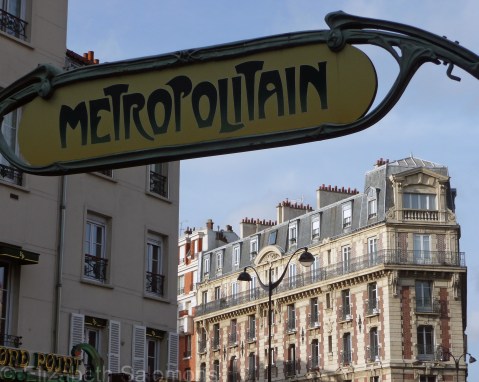
No sense fighting it. I’ve got Paris on my brain this week. So here’s another photo from the City of Light.
This was taken by the entrance to the Paris Métro at Père Lachaise.
E. Dehillerin
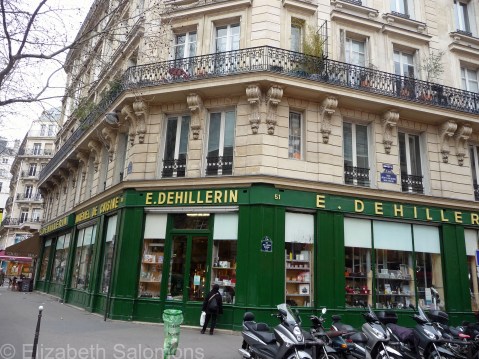
There is one scene in Julie & Julia that cracks me up every time I watch the film because it’s so far off from the truth. It’s when Julia Child, Simone Beck, and Louisette Bertholle are (supposedly) shopping in E. Dehillerin, the famous cookware store that has been supplying French chefs with the tools of their trade since 1820. The store in the movie is pristine and light and airy, with lots of room for Julia Child to wildly swing her shopping basket.
That scene wasn’t filmed in the actual store, as anyone who has ever shopped at E. Dehillerin can tell you. The actual store is much darker and dingier and more cramped than the one shown in the film.
In the words of David Lebovitz, the only way to enter E. Dehillerin is to “brace yourself and step inside.” My sister and I stumbled upon it quite by accident one afternoon in December 2010, moments after we had stumbled ― also by accident ― into Saint-Eustache, a magnificent church in the 1er arrondissement.
Here’s how I described my introduction to Dehillerin in the journal I kept that winter:
We came around a corner and there was heaven: E. Dehillerin, which I had read about. It’s the cookware store in Paris where all the pros shop, including (it’s been said) Julia Child.
But it was massively packed; I’ve never been in such a crowded store. The basement was dusty and musty and filled with massive industrial-sized stock pots (and not as crowded as upstairs).
Upstairs, I tried to look at the knives, but you could barely get past anyone to get near the counter where they were displayed. (And “display” is a bit generous. They were simply plunked in wooden bins of various sizes and in various groupings.) We got out of there and decided on lunch in a place in Rue Montorgeuil.
A week later, I returned, this time with a friend who was spending Christmas with my sister and me. Not only did I want her to experience the store for herself, but I had decided I was going to buy me some knives as a Christmas present to myself. We wandered in and out of several cookware and bakeware stores that morning ― they are all congregated near E. Dehillerin because there used to be a giant market nearby where all the Parisian restaurateurs used to shop for their daily menus. The market is long gone, but the shops ― and the restaurants ― remain.
Dehillerin was insanely crowded on my second visit as well and my friend and I quickly gave up on my plan to buy some knives.
But, I was determined. I did some online research and learned that persistence was the only way to get results when shopping at E. Dehillerin. And so, I returned.
Back to my journal:
January 29. Saturday. I still wanted my knives from Dehillerin and, as they are closed on Sundays and I was leaving on Monday, this was the last possible day I could buy them. I’d put it off as long as I could as it seemed so intimidating, given everything I’d read about the place, and how crazy crowded it had been on my two previous visits. But … I persevered. In I went, and it seemed a bit crowded at first, but then all of a sudden it emptied out and I had all the room I wanted to pick out the knives I wanted.
I checked the price of one in the book at the end of the aisle, went back to the bins of knives, decided on another knife and then thought, “Oh, I don’t care how much it costs. This is the one I want.” That was the 20 cm chef knife. I then chose a 10 cm paring knife, and a sharpening steel, and took them to the table where they wrapped your purchases.
The clerk said something to me in French. When he realized I hadn’t understood a word, he said, “English?” “Yes,” I replied. He then explained that the sharpening steel I had selected was too small for the size of my knife. For only a few euros more, I could get the right-sized steel made by the same company. I said, “OK,” he went to grab the right-sized sharpening steel, looked up the codes in his book posted on the pillar at the end of the aisle, wrote them down on a slip of paper and handed it to me.
I took the slip of paper to the woman behind the counter and she took my payment. Two knives and a sharpening steel for 86 euros. Earlier that month, I had checked the prices of knives in the housewares department at Galeries Lafayette and a chef knife there went for 100 euros alone.
So, very pleased with myself, I took the receipt back to the table, another clerk jammed each knife tip into a wine cork and then wrapped the knives in brown paper. Off I went, the happy owner of some proper kitchen knives at last. The fact that I bought them in Paris, and that they have the Dehillerin name engraved on the blade, is a bonus.
That afternoon is one of my favourite shopping memories while travelling.
No, wait. It is one of my favourite shopping memories ever. And the best part? I get to take an imaginary walk through Dehillerin every time I use those knives.
Which is every day.

Reel Life: Julie & Julia
 I had the opportunity this past week to introduce some friends to the film Julie & Julia. I was secretly pleased when they selected that DVD out of the pile I had brought, but I had no idea when I grabbed it at the last minute that most of the group had never seen the film.
Julie & Julia was Nora Ephron’s last film and stars the legendary Meryl Streep and the charming Amy Adams. It was Ephron’s producer who had the brilliant idea to combine into one screenplay two memoirs published around the same time. Julia Child’s My Life in France is about her life in post-war France, and Julie and Julia: 365 Days, 524 Recipes, 1 Tiny Apartment Kitchen evolved from Julie Powell’s blog about cooking her way through Julia Child’s Mastering the Art of French Cooking in post-9/11 Queens, New York. Beyond their names, Julie and Julia had in common the love and support of a devoted husband, a love of food, and the need to find some meaningful work to fill their days.
Early in the film, Julie Powell’s husband declares that “Julia Child wasn’t always Julia Child” ― and that’s precisely what makes the film so entertaining. Although I’m as fascinated as the next traveller about the daily routine of life as a New Yorker, the depiction of Julie Powell’s long subway commute and soulless work cubicle ring a little too close to home. But when the action switches to France, you’re transported to another time and place to witness the transformation of Julia Child, ex-pat American wife, to Julia Child, chef, author, and TV star.
Julia Child’s introduction to French food ― mere hours after she arrives in France ― is sole meunière. The epiphany she experiences in the look, smell, and taste of that first meal is, for me, the essential moment of the film. And it reminded me of the moment when I had my own epiphany about French cuisine. It was in a small restaurant in Perpignan where two friends and I shared a meal after a long day of sight-seeing. I ordered a tomato salad. It looked so simple ― a single layer of tomato slices on a small plate, sprinkled with an herb vinaigrette ― but I knew with my first bite that I was tasting something unlike anything I’d ever tasted before. The French don’t make simple tomato salads; they create spectacular tomato salads.
As much as my friends enjoyed Julie & Julia, they were a little more circumspect than I about the film; one remarked that she wouldn’t have reacted nearly as well as Julie Powell if the first words out of her partner’s mouth after disappearing for two days following a heated argument were, “What’s for dinner?”
As for me, whenever I’m homesick for French food, I’ll be (re)watching Julie & Julia.


 There and Back Again