
Happy Birthday, Ringstrasse!
I’ve had Vienna on my mind for much of the past few months ― and not only because I recently posted about Salzburg.
It all began with Frederic Morton’s A Nervous Splendor: Vienna, 1888–1889. The book was required reading for my Modern Europe history course a couple of decades ago, and I enjoyed it so much that I later bought Morton’s other book about Vienna: Thunder at Twilight: Vienna 1913–1914.
And then promptly packed both books in a box for one of my (many) moves.
This winter I finally got around to pulling both books off the shelf. I reread A Nervous Splendor and then, for the first time, I read Thunder at Twilight. (I’m about three-quarters of the way through the latter at the moment.) A Nervous Splendor tells the story of the last few months of Crown Prince Rudolph’s life and his suicide, while Thunder at Twilight tells the story of the last few months of Archduke Franz Ferdinand’s life and his murder. Both men were heirs to the Austrian-Hungarian throne until their untimely deaths. The suicide of Rudolph was the beginning of the end for the Austrian-Hungarian empire, and the assassination of Franz Ferdinand in Sarajevo on June 28, 1914 ― we all know what happened after that ― was the nail in the empire’s coffin.
Both non-fiction books read like novels, and both are useful if you want to learn something about the waning decades of nineteenth-century Vienna and the city’s role in the build-up to World War I.
(Coincidentally, I found out just a few days ago that Frederic Morton, an Austrian-American writer, died two weeks ago in Vienna.)
In addition to my Viennese reading, I recently enjoyed Vancouver Opera’s performance of Johann Strauss’s Die Fledermaus, which transported me to 1870s Vienna, if only for a few hours.
And a couple of weekends ago, I saw Woman in Gold, a Hollywood film that far surpassed my expectations, which tells the story of an Austrian-Jew who took the Austrian government to court to get back the paintings stolen from her family by the Nazis.
All of this adds up to an awful lot of Viennese armchair travel. And, except for my reading of the Morton books, all of it was unintentional.
But unintentional armchair travel is a good excuse for posting about Vienna.
Vienna was one of the cities I hit on my first European walkabout by Eurail. Initially I found it rather overwhelming; my travelling companion was ready to leave almost as soon as we arrived.
But there is a spectacular majesty to Vienna that I came to respect before we moved on a few days later and I now think the city is too often overlooked. The seventh largest city in the European Union, sandwiched between Bucharest and Budapest, it gets far less attention from tourists than London, Berlin, Madrid, Rome, and Paris (aka Europe’s Big Five).
At the heart of Vienna’s majesty is the Ringstrasse ― a 5 km ring of boulevards that forms a semicircle through the heart of Vienna. Emperor Franz Joseph I, father of the above-mentioned Crown Prince Rudolph and uncle of the above-mentioned Franz Ferdinand, was much influenced by Napoleon III’s demand that Paris be transformed by Baron Haussmann. In 1857, Franz Joseph ordered that Vienna’s decaying walls be torn down and replaced with a series of grand new buildings.

The Burgtheater was completed in 1888.
And so began one of the largest construction projects ever completed in Viennese history: neo-Gothic, Renaissance, Baroque, and Neoclassical buildings sprouted up along on the Ringstrasse over the next several decades. These include the Vienna State Opera, or Wiener Staatsoper (1869), the Votive Church, or Votivkirche (1879), the Palace of Justice (1881), the Austrian Parliament (1883), the Town Hall, or Rathaus (1883), the University of Vienna (1884), the Imperial Court Theatre, or Burgtheater (1888), and the twin museums of Natural History, or Naturhistorisches Museum (1889) and Fine Arts, or Kunsthistoriches Museum (1891). Only the imperial palace, the Hofburg, is older than the Ringstrasse.
I initially started writing this post about Vienna because of all the recent happy coincidences I described above, but while doing my research, I discovered another happy coincidence: it was 150 years ago today, in 1865, that Emperor Franz Joseph I officially opened the Ringstrasse. Hence, the title of this post.
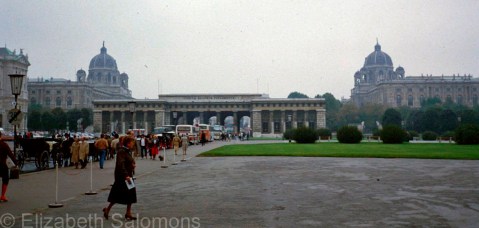
The Naturhistorisches Museum and the Kunsthistoriches Museum are mirror images of each other.
I think Franz Joseph was perhaps a tad premature in opening the Ringstrasse ― it would be some years before the construction of all those grand buildings would be complete and who wants to promenade past a noisy, dusty construction site? Not me and I speak from personal experience. But eventually the “Ring” was to become an enjoyable city promenade for Viennese and tourist alike ― as I learned during my first visit to the city ― and has remained so for 150 years.
All of the world’s large cities have ring roads, but only Vienna has a Ringstrasse.
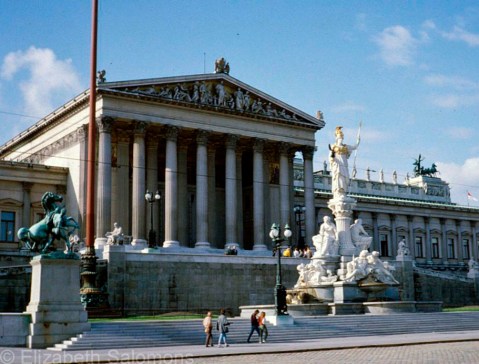
The Austrian Parliament Building is one of the largest buildings on the Ringstrasse.
Hans Christian Andersen
To move, to breathe, to fly, to float,
To gain all while you give,
To roam the roads of lands remote,
To travel is to live.
― Hans Christian Andersen
Through My Lens: Golden Hour at the Palatine

I took this photo from the Palatine Hill, the centremost of Ancient Rome’s seven hills. It overlooks the Forum and is the oldest part of Rome.
My friends and I explored the Palatine ruins at the end of a full day of sight-seeing. The Golden Hour arrived just as we did, and the soft light gave the place a magic quality.
There are hundreds of wondrous and beautiful churches in the Eternal City, some of which have left me speechless and some of which have moved me to tears. But, to my mind, the Palatine is the most sacred and holy space in all of Rome.
Recipe Box: Boeuf Bourguignon
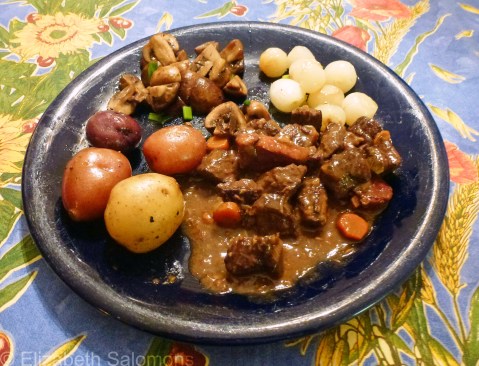
Before we get too far into spring, I need to fill you in on how I spent my non-winter.
(Because when one hasn’t the means for a mid-winter getaway, and there’s no snow to play in, how does one entertain oneself in Vancouver through a long non-winter that is most definitely not summer?)
Me? I entertain myself by taking French cooking classes. That way I enjoy some armchair travel (is it still considered “armchair” when you are run off your feet for three hours?) and learn something new about France.
This winter I chose a class focused on the food of Burgundy, and one of the dishes on the course syllabus was boeuf bourguignon.
Confession: I’ve never actually eaten boeuf bourguignon in France, but a friend made it for a dinner party she hosted in my honour before I headed off to spend the winter in Paris some years ago. It was my first encounter with the braised stew and it was delicious.
Like coq au vin, boeuf bourguignon is a former peasant dish that has made its way into fine dining; cheap (read: tough) cuts of meat are softened to a delicate texture by stewing them in wine.
The classic wine choice for making boeuf bourguignon is Pinot Noir, given that the prevalent grape grown in Burgundy is Pinot noir. My French cooking instructor provided us with BC Pinot to make our stew ― French wine was too dear for his budget. To speed up the cooking time, he had us cut the beef into smaller cubes, and cook the stew on the stove instead of in the oven.
Bon appétit!
Boeuf Bourguignon
3 pounds stewing beef cut into 2-inch cubes
4 garlic cloves, peeled and cut in half
2 bay leaves
2 sprigs fresh parsley
2 springs fresh thyme
2 sprigs fresh rosemary
2 carrots
2 onions
1 bottle Pinot Noir
6 ounces bacon cut into lardons (1/4 inch wide and 1 1/2 inches long)
1 tablespoon olive oil
1 teaspoon salt
1/4 teaspoon pepper
2 tablespoons flour
2 to 3 cups brown beef stock
1 tablespoon tomato paste
2 cloves mashed garlic
1/2 teaspoon thyme
1 crumpled bay leaf
2 tablespoons chopped parsley
brown-braised onions (see below)
sautéed mushrooms (see below)

1. Peel 1 carrot and cut into sticks. Peel 1 onion and cut into quarters.
2. Place the beef in a large non-reactive bowl. Add the carrot, onion, garlic, bay leaves, parsley, thyme, rosemary, and wine. Marinade overnight. (Note: In my humble opinion, marinating the meat is optional. My French cooking instructor taught us to do it, but Julia Child doesn’t bother with this step.)
3. Preheat oven to 450°F.
4. In a large sauce pan, Dutch oven, or cocotte, brown the lardons in butter. Remove from pan.
5. Strain the beef and vegetables, reserving the marinade, then dry the beef cubes with paper towels.
6. Reheat the bacon fat until it is almost smoking, then brown the beef in the fat. (Note: My French cooking instructor tried to get me to stir the beef by shaking the pan with a forward motion to flip the cubes from back to front. It was a heavy pan. But if you can manage it, go for it. It will make you feel like a real chef.)
7. Remove the beef from pan and add it to the bacon.
8. Peel and slice the remaining carrot and onion. Brown them in the bacon fat, then pour out the fat.
9. Return the beef and bacon to the pan and sprinkle with the salt and pepper and flour to coat lightly.
10. Put the uncovered pan in the preheated oven for four minutes. Toss the meat, then return to oven for another four minutes. (This step cooks the flour and gives the beef a light crust. Do not skip.)
11. Remove the beef from the oven and turn the oven down to 325°F.
12. Stir in the reserved marinade (or bottle of Pinot Noir if you didn’t marinate the beef), and enough stock to just cover the meat.
13. Add the tomato paste, mashed garlic, and herbs.
14. Bring to a simmer on top of the stove, then cover and return to oven.
15. Braise the beef for 2 1/2 to 3 hours, checking to ensure the liquid is gently simmering. When the beef is tender, remove from the oven.
16. While the beef is in the oven, prepare the onions and mushrooms (see below).
17. Strain the beef from the liquid.
18. Skim any fat from the liquid remaining in the pan, and simmer for a minute or two. Bring to a boil and reduce to 2 1/4 cups. To thicken, it may be necessary to add beurre manié ― a paste made of equal parts butter and flour. Use a whisk to mix the beurre manié into the liquid.
19. Return to heat and simmer for a few minutes until sauce has thickened, then remove from heat.
20. Return the beef to the sauce to reheat. The onions and mushrooms can be added to the sauce or served on the side. Sprinkle chopped parsley over top and serve with oven-roasted or boiled new potatoes.
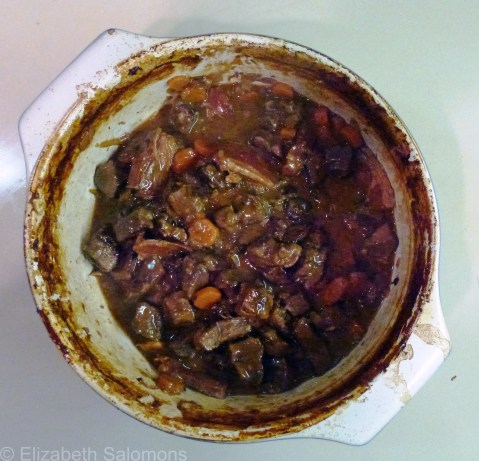
Brown-braised Onions
12 to 18 white onions about 1 inch in diameter, or 24 pearl onions
1 1/2 tablespoons butter
1 1/2 tablespoons oil
1/2 cup stock, dry white wine, red wine, or water
salt and pepper
one herb bouquet (4 parsley springs, 1 bay leaf, and 1/4 teaspoon thyme tied in cheesecloth)
1. Bring a pot of water to boil, immerse the onions for about a minute, drain, then cut off the root and peel.
2. Place a skillet over high heat with the butter and oil. When hot, turn the heat down to moderate and brown the onions.
3. Add the liquid, salt and pepper, and the herb bouquet.
4. Cover and simmer slowly for 40 to 50 minutes until the onions are tender and the liquid has evaporated. The onions should retain their shape. Remove the herb bouquet.

Sautéed Mushrooms
2 tablespoons butter
1 tablespoon oil
1/2 pound fresh mushrooms (cut into quarters if large)
1 to 2 tablespoons minced shallots or green onions (optional)
salt and pepper
1. Place a skillet over high heat with the butter and oil. When hot, turn the heat down to moderate and add the mushrooms. Remove from heat as soon as mushrooms are lightly browned.
2. If using shallots or green onions, add to the mushrooms, and sauté over moderate heat for 2 more minutes.

Happy Birthday to The Sound of Music!

Fifty years ago last month, The Sound of Music had its cinematic release ― and “How Do You Solve a Problem Like Maria?” has been an earworm plaguing moviegoers ever since. I’ve lost count of how many times I’ve watched the film, but I have strong memories about a handful of viewings.
My first memorable viewing was, of course, the first one. It was on our small colour TV in our small family living room with my not-so-small family. I had to be coaxed into watching it ― for some reason, a movie about a not-so-small family in 1930s Austria did not interest me in the least.
My dad promised me I would love it.
Of course, I became an instant fan, besotted, as most kids are, by all those children in funny clothes and by all those catchy tunes.
Another memorable viewing of The Sound of Music was just last fall, when I had the privilege of introducing the film to my then three-year-old niece. She was captivated (if a bit confused) by the sight and sound of Mary Poppins singing “Do-Re-Mi” and her response when the last “So-Do” sounded was instantaneous.
“Again!” she commanded from her perch on my couch. I dutifully obeyed and rewound the film to the start of the song. When it was finished, she again called out, “again!”
You get the picture.
It took my sister, who arrived halfway through the movie, to do what I wasn’t able to ― convince my niece to continue watching past “Do-Re-Mi.” (Note that, being responsible aunts, we turned the TV off after the wedding scene and told her that was the end of the movie ― no need to traumatize a young child with scenes of goose-stepping Nazis.)
“The Lonely Goatherd” and “So Long, Farewell” proved to be big hits as well and that afternoon made me realize how timeless The Sound of Music is. My niece was just as enthralled with the film as I had been all those decades earlier.
My most recent viewing of The Sound of Music was a couple of weeks ago when I saw it for the first time ever on the big screen. I was shocked at the packed movie theatre ― as full as if the film were a new release ― and at how compelling I found the nearly three-hour film ― as if I were watching it for the first time. The entire audience burst into applause at the end.
But my most memorable viewing was in the city of Salzburg, where much of The Sound of Music was filmed. My friend and I were backpacking around Europe, making all the usual stops ― including Salzburg ― and doing all the usual touristy things ― including the obligatory “Sound of Music” tour of the filming locations. After the tour, we were dropped off at the youth hostel that hosted a daily screening of the film and we watched and laughed along with the rest of our tour group when all of the Salzburg locations we had just visited showed up on screen.
I live in Vancouver (aka Hollywood North) and am used to seeing my town turned upside down by film crews. For the past two weeks, one of the main routes out of the downtown core was closed to vehicle traffic during business hours to allow for the shooting of a scene from Ryan Reynold’s next action flick. Vancouverites put up with this kind of nonsense because we know how lucrative a successful film industry can be.
I suspect that the residents of Salzburg are just as OK with the tourist dollars that The Sound of Music has brought them. But my best guess is that none of them had any idea that the film would turn out to be one most commercially successful motion pictures of all time ― or that the hoards of pop-culture tourists such as myself would still be beating a path to their door some 50 years later.


Freighters in English Bay
English Bay (aka the waiting room to Canada’s largest and busiest port) always has a dozen or more freighters anchored in it. The ships wait there, sometimes for days, until it’s their turn to load or unload their cargo.
Because they are always there, I think of the freighters in English Bay as part of my landscape. I don’t pay much attention to them other than sometimes using them to add interest to a photo.
Until this week. On Wednesday night the M/V Marthassa, a Greek-owned bulk carrier on its maiden voyage from Korea, was anchored in the bay waiting to take on a load of grain when it began leaking bunker fuel. More than two tonnes of the stuff would go into the water before the leak was stopped. Within hours, some of that oil had reached the beaches.
I took a long walk along those beaches today to get a closer look at what was going on and to reassure myself that everything was all right.
It’s not.
But it will be.
This week was a wake-up call for me. I will never again take my beach and my bay ― or the freighters in the bay ― for granted.
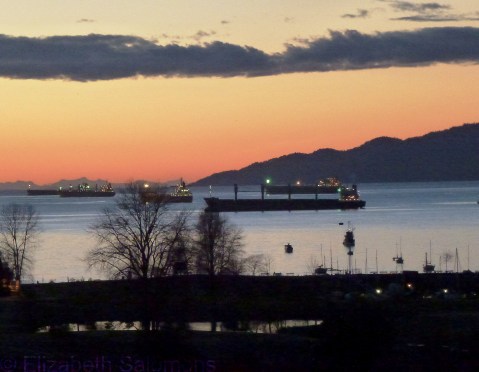
Happy Easter!
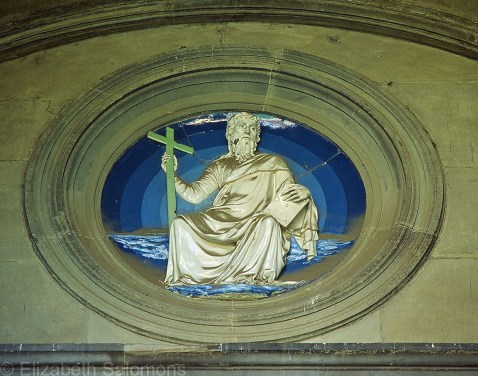
Detail of the Cloister of Basilica di Santa Croce, Florence, October 2007
Through My Lens: Majolica Cloister of Monastero di Santa Chiara
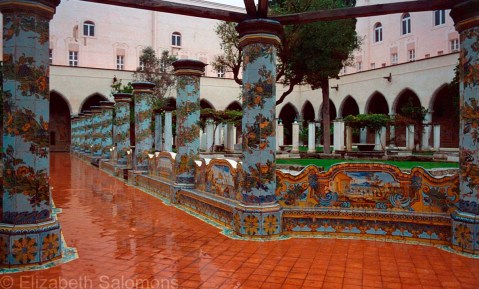
Today’s cloister has a splash of colour, which I thought appropriate considering it is Palm Sunday ― always a joyous day of celebration in the Lenten calendar.
This is the Majolica Cloister of Monastero di Santa Chiara in Naples, Italy, which was built in the fourteenth century as both a Franciscan monastery and a convent of the Order of Saint Clare, also known as the Poor Clares. During the eighteenth century, the garden of the cloister was completely transformed by the addition of the majolica-tiled pillars you see in the photo. (Majolica tiles are common throughout the Mediterranean region.) The pillars line two intersecting pathways that divide the garden into quarters.
It had only just stopped raining when we popped in to take a quick look at this cloister in October 2002. It was far too short a visit ― my friends and I had a train to catch ― but someday I hope to go back and photograph it properly.
Through My Lens: Cloister of the Monasterio de San Jerónimo
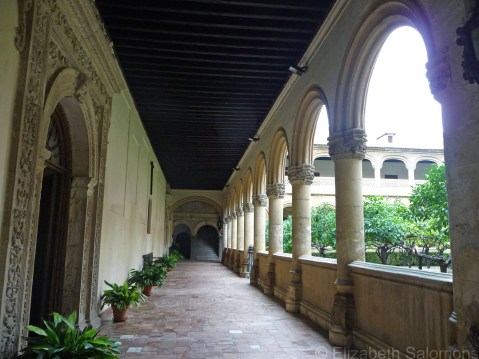
The Monasterio de San Jeronómo is in Granada, Spain. I didn’t realize this Hieronymite monastery had a cloister until I wandered inside to explore ― I was so pleased to see it. I was particularly entranced by the staircase at the end of the walkway in this photo. Carved into the stone above the two arches are the words, “Soli Deo honor et gloria.”
This cloister is my photo choice for the Fifth Sunday of Lent.
Happy Birthday, Johann Sebastian Bach!
The Germans threw a party today in Eisenach, the birthplace of my favourite composer, Johann Sebastian Bach. That’s because today is Johann Sebastian’s 330th birthday. This house ― known as Bachhaus ― is a museum dedicated to the man; at one point, it was thought he was born here, although now it is believed that his birth house is no longer standing.

I visited this museum in 1998 with my dad. We were on walkabout through Germany and France and came to Eisenach because of the Martin Luther connection; the Bach connection was a bonus (for me).
What we didn’t realize until we arrived and were looking for a place to stay is that Eisenach is in the former German Democratic Republic (aka East Germany). Which meant no one in the town spoke English. I managed to get us a room by telling the woman at the tourist information centre that we wanted ein Zimmer, zwei Nächte (one room, two nights). She congratulated me on my, ahem, German.
But it got really comical the next morning when the owner at the pension where we stayed insisted on chatting to us throughout breakfast in German ― even after we told him we could not understand him. Dad had studied German a bit in college, but it wasn’t enough to help us out. The pension owner offered to speak to us in Russian, but we assured him that we understood even less Russian than German.
And so, Dad and I nodded politely at our host while we drank our coffee and ate our bread and cheese. He was a compulsive talker ― that much was obvious ― and eventually he resorted to sign language. We kept nodding.
By the time Dad and I left for our day of sightseeing, we were exhausted. Even so, it was the loveliest and friendliest of introductions to Eisenach.


