
Through My Lens: The Pantheon
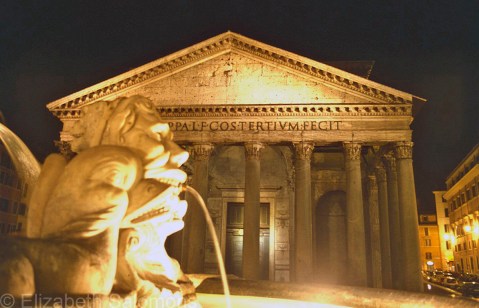
Today is Palm Sunday, and we’re moving on to Rome. Rome is also known as the Eternal City ― the ancient Romans called it that because they thought the Roman Empire would go on forever. (Look how that turned out.)
One of my favourite Roman churches is this one, the Pantheon. I like it simply because it is so ancient ― almost 2000 years old.
For more on the Pantheon, check out the photo I posted a couple of years ago.
Palais Garnier
Here’s one last opera house before I turn the channel and move onto other topics. This is Opéra National de Paris, commonly known as Palais Garnier. “Garnier” was the name of its architect. “Palais” is for all the bling.

Palais Garnier is located at Place Opéra. Six major boulevards come together at Place Opéra, and there’s also a major metro station. In other words: there’s lots going on here.
And did I mention the bling on Palais Garnier? Here’s a closer look.

Vienna State Opera
Since I’ve been writing about some rather tenuous links between my travels and opera for the past month, I thought I’d rifle through my photos of opera houses.
And hey! Look what I found. This is the Vienna State Opera. (That’s “Wiener Staatsoper” in Austrian.)
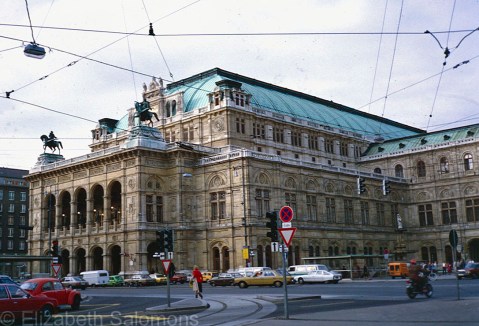
I’ve been debating with myself whether or not to post this photo as I don’t have a lot to say about this particular opera house. Other than I once took a tour of it. A very long time ago.
I like the photo, though. And I like the intersecting wires at the top of the photo. Usually I don’t like power lines in my photos, but they look all right here. I like the geometrical touch they add to the opera house. Appropriate, I think, since music is all about math.
Right. Enough with the tenuous links.
I read somewhere once that Vienna is London meets Paris. I can see it. Like London, Vienna was once the capital of a monarchy-ruled empire. It has that aura of imperialism that capital cities of empires tend to have. And, like Paris, it’s got those grand boulevards, which, I’d hazard a guess, were modelled after the ones that Haussmann built.
Through My Lens: Basilica Cattedrale Patriarcale di San Marco
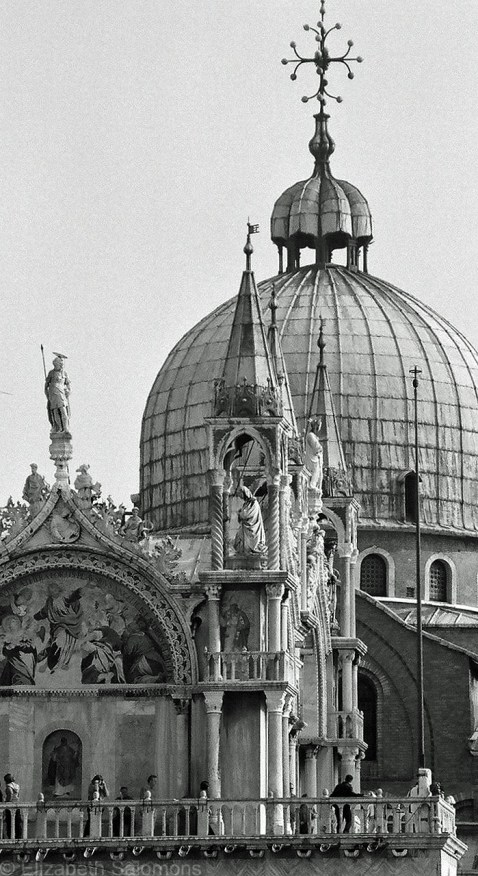
Basilica Cattedrale Patriarcale di San Marco ― that’s a mouthful, isn’t it? In English, it’s the Patriarchal Cathedral Basilica of Saint Mark, commonly referred to as Saint Mark’s Basilica. With features typical of both Italian and Byzantine architecture, this Venetian cathedral is east meets west.
I came across this photo last weekend while I was rummaging through the collection of black and white photos I shot on my last trip to Italy. It’s my photo choice for today, the Fifth Sunday of Lent.
Through My Lens: Basilica di San Domenico

Today we’re leaving Florence and moving on to Siena.
This is the Basilica di San Domenico. I’ve written before how I whiled away a summer afternoon on its stone steps, people-watching. But, to the best of my memory, I didn’t go inside the church on that afternoon or any other. That’s kind of sad, on one hand, but it gives me a reason to return to Siena, on the other.
I took this photo in October 2007. I’m not sure why I was shooting in black and white that day, but I was, and so, here it is, a black and white photo of one of Siena’s largest churches for the Fourth Sunday of Lent.
Royal Opera House
Regular readers of this blog may have figured out by now how much I enjoy listening to live music. And that I especially enjoy seeking out opportunities to hear live music whenever I travel.
I have my mother to thank for that. She took my sister and me at the tender ages of twelve and thirteen to hear a recital of Bach organ music in the Bovenkerk of Kampen, the Dutch town where we happened to be living at the time. The sounds of the organ’s principal pipes reverberating in the centuries-old Gothic arches high above us made quite an impression on me (as did how cold we got sitting in an unheated stone church on a crisp evening in late November).
Something about that night stuck with me and, to this day, Bach remains my favourite composer. So much of a favourite that I even named my cat after him. Upon our family’s return to Canada, I was motivated enough to continue my music studies for another six years, soon switching from piano to pipe organ. I doubt my mother had any idea what a couple hours of Bach organ music could do to me.
But enough about Bach. Let’s get back to the other guy. You know, Mozart. My post the other week on Mozart in Prague reminded me of another memorable opera experience I’ve had, this one of hearing Rossini’s The Barber of Seville at London’s Royal Opera House (aka Covent Garden).
I’ve written before how the opera at Covent Garden is completely within reach of the budget traveller, so, unless you really cannot stand opera (and I won’t hold that against you), there is no reason not to go. The website for the Royal Opera House is easy to use and the nifty thing about ordering tickets online is that you see the view of the stage you will have from the exact seat you’ve selected before you commit to your purchase. How cool is that?
What’s particularly fun about the cheap seats (once you’ve caught your breath from climbing waaaaaay up into the rafters of the building) is what a terrific view you have of a truly remarkable building. And ― bonus ― you have a bird’s-eye view of the performance. I witnessed the dramatic entrance of the barber (that would be the Barber of Seville) as he ran all the way down the aisle from the back of the auditorium to the stage ― something the people sitting at the front of the orchestra level missed because all the action took place behind them.
Sadly, I have no photos of the interior of Covent Garden ― that will have to wait until my next visit to London. Here, though, is a picture of its exterior, which dates back to 1858. I took this photo after stopping by the box office to pick up my ticket that I had purchased weeks earlier before leaving home. It was the last time I saw the beautiful, Italian-made leather wallet I had bought a few years earlier in Rome ― less than a half hour later, I would reach into my bag to realize it was gone.
But that’s a story for another post.

Through My Lens: Basilica di San Miniato al Monte

My experience visiting this church, the Basilica di San Miniato al Monte, was probably the most unique of any visit I have ever made to a European church. It was late in the afternoon, and my friend and I stumbled upon the basilica almost by accident after taking dozens of photos of the amazing view over the city of Florence from Piazzale Michelangelo. (Go back to the First Sunday of Lent if you want to see one of those photos.)
Basilica di San Miniato al Monte is located just a few steps further up the hill from Piazzale Michelangelo. We wandered in and were immediately overwhelmed by the music. Gregorian chant, to be precise. It was mesmerizing, and took all of our attention during our entire visit. The monks were singing in the crypt, located below the raised choir, and there were maybe a dozen tourists scattered about, listening to them.
I had read how the monks who live in the monastery next door sing each afternoon during Vespers, but had completely forgotten about it until we just happened to enter the church at precisely the right hour. If you’re wandering about Florence in the late afternoon and want a once-in-a-lifetime musical experience, go listen to these monks.
Basilica di San Miniato al Monte is my photo choice for today, the Third Sunday of Lent.
Through My Lens: Detail of Il Duomo di Firenze
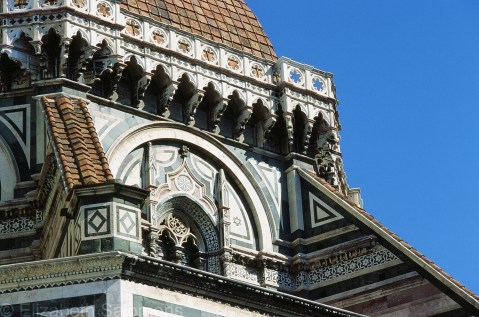
For the Second Sunday of Lent, here’s a detail of the colourful stonework of the Duomo in Florence.
Mozart in Prague
I was at the Vancouver Opera again last weekend, enjoying a superb performance of Mozart’s Don Giovanni. This opera premiered a couple of centuries ago at the Estates Theatre in Prague, a city that loved Mozart and that Mozart loved in return. He was treated like a rock star whenever he came to town. Don Giovanni was commissioned by an Italian living in Prague when he saw how popular Mozart was in that city.
The Estates Theatre also happens to be where I first saw Don Giovanni. In fact, seeing Don Giovanni at the Estates Theatre in Prague was my first ever live opera experience. My friend and I treated ourselves to box seats because they set us back a mere $20 ― it was quite the introduction to live opera. If you enjoy music and you happen to be in Prague, I highly recommend checking it out.
I don’t have any photos of the Estates Theatre, but if you were to walk down the street in the photo below, the theatre would come into view just as you round the corner. Can’t you picture this street on a clear, crisp October night in 1787, with gown and cape–clad Praguers arriving at the Estates Theatre in their horse-drawn carriages? Then, with a little imagination, picture them sweeping en masse into the newly built theatre to witness a grand spectacle: the newest (some say best) opera from Wolfgang Amadeus Mozart, directed by the Maestro himself.
Go on. Imagine.

Through My Lens: Il Duomo di Firenze
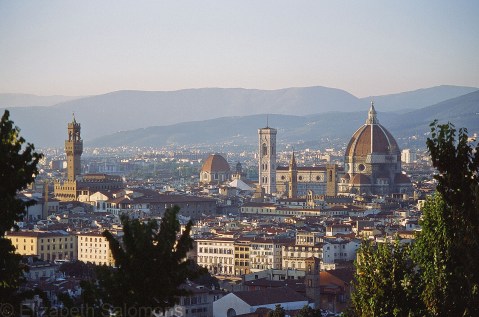
Once again we’ve arrived at the Season of Lent. It’s much later than usual this year (which also seems to be the case with the arrival of spring in most parts of Canada).
As is my tradition, I’m going to take you on a photographic tour of some European churches. This year it’s Italy’s turn.
First up, for the First Sunday of Lent, is the Basilica di Santa Maria del Fiore. In English, that’s the Basilica of Saint Mary the Flower. In Florence, it’s referred to simply as the Duomo, which is Italian for “cathedral.”
I took this photo of the Duomo from Piazzale Michelangelo, which overlooks the city of Florence and the River Arno. At the far right, you have Brunelleschi’s dome and then, to the left of the dome, is Giotto’s Campanile. The smaller dome to the left of the Campanile isn’t part of the Duomo ― that’s the Medici Chapel.


