
Armchair Traveller: The Sweet Life in Paris
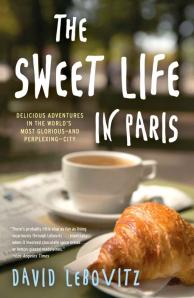 Are you still searching for the perfect Christmas gift for the armchair traveller in your life? Perhaps you could use a suggestion for your own holiday reading. Either way, here’s a book recommendation for you: The Sweet Life in Paris by David Lebovitz.
I discovered David Lebovitz’s writing through his blog called, appropriately enough, Living the Sweet Life in Paris. But even if I had never heard of the guy (or his blog), I would have grabbed the book off the store shelf on the merit of its subtitle alone: Delicious Adventures in the World’s Most Glorious ― and Perplexing ― City.
David Lebovitz is a San-Francisco-pastry-chef-turned-cookbook-writer who starts life over in Paris following the unexpected death of his long-time partner ― a move he describes as “an opportunity to flip over the Etch A Sketch” of his life. Once in Paris, his writing shifts and his books expand from simply recipes to an examination ― centred around food, of course ― of all the ups and downs of living in Paris.
The Sweet Life in Paris is the result. It’s a book of short essays about daily life in Paris, followed by an appropriate recipe. Some of the links are tenuous, like when Lebovitz follows a description of French plumbing woes with a recipe for a meringue dessert called Floating Island. (The connection between the two? He recommends not flushing the meringue down the toilet if it doesn’t turn out.) Others are bang on, like his recipes for Chocolate Mousse that accompany the story of how he discovered the secret to dealing with French bureaucrats is to bribe them with free copies of his cookbooks.
Lebovitz’s credibility shot up when I read his recommendation that, if you don’t like anchovies, be sure to try them fresh in Collioure on the Mediterranean coast. I’ve eaten fresh anchovies in Collioure ― they would convert any non-believer.
But while Lebovitz’s descriptions of food in The Sweet Life in Paris are mouth-watering, as are his recipes, what I appreciate most about this book is his ability to see the funny in the incredibly frustrating idiosyncrasies of Parisian life. I’m with him 100% as he puzzles over why European washing machines take two hours to wash a load of laundry that would take North American machines a mere 40 minutes. Most of all, I wish I’d known his system for navigating the aisles of a Parisian supermarket before I spent a winter in Paris:
I hold [my basket] in front of me as I walk, like the prow of a battleship, to clear the way. That doesn’t always work, as Parisians don’t like to move or back up for anyone, no matter what. So sometimes I hide my basket behind me, then heave it forward at the last moment; the element of surprise gives them no time to plan a counteroffensive, and when the coast is suddenly clear, I made a break for it.
I lost count of how many times I had to sidestep, trip over, or squeeze past Parisians who refused to budge an inch in the narrow aisles of Monoprix or Carrefour. Now I can’t wait to go back and try out Lebovitz’s technique.
Even if you’ve never been to Paris and don’t know the difference between a pastry brush and a pastry blender, pick up a copy of The Sweet Life in Paris. It’s good for the laughs.

Through My Lens: Vancouver Christmas Market
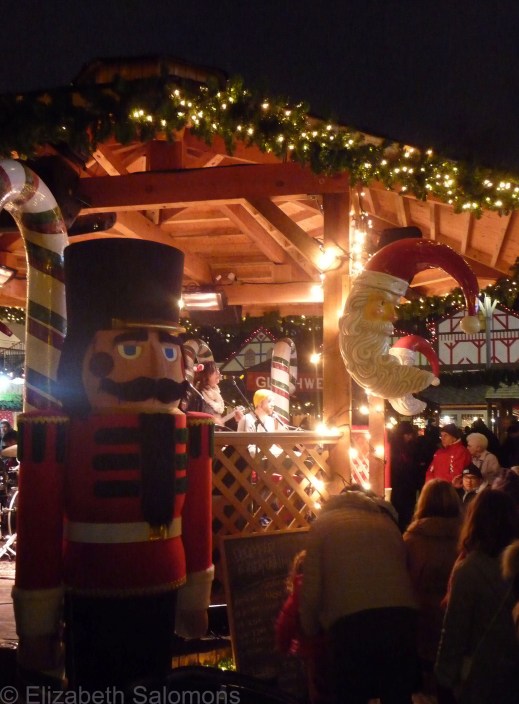
The Vancouver Christmas Market isn’t anywhere near as magical as any of the Christmas markets I’ve seen in Europe. But it does give me a chance to play around with my camera.
Long Walk to Freedom
“What counts in life is not the mere fact that we have lived. It is what difference we have made to the lives of others that will determine the significance of the life we lead.” — Nelson Mandela
Nelson Mandela’s long walk is over and he is forever free. South Africa ― indeed, the entire world ― is now mourning his passing and celebrating his life.
Mandela was an ordinary man who responded to an unjust world in extraordinary ways. In the plethora of this week’s news coverage coming out of South Africa and the tributes for Mandela pouring in from around the world, the words of one Canadian TV journalist stood out for me. He reminded us that it is difficult today to imagine how the very idea of a peaceful outcome to the end of South Africa’s apartheid regime seemed like pure fantasy more than 30 years ago.
Indeed.
Mandela showed remarkable grace in finding a way to forgive and demonstrated remarkable political skills that were instrumental in birthing a new South Africa. Without him, I doubt I would have ever travelled to what for me was one of the most beautiful and most complicated countries I have ever visited.
Today was a National Day of Prayer and Reflection in South Africa. South Africans gathered in churches and mosques and synagogues to reflect on and give thanks for the man they call “Tata” ― the isiXhosa word for “father.”
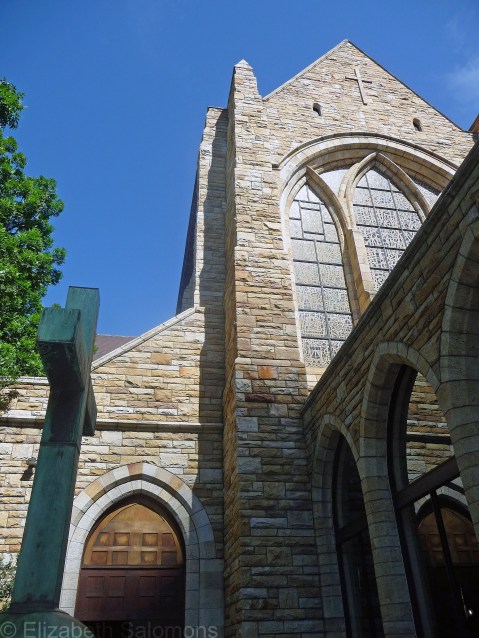
One of the places where South Africans gathered was St. George’s Cathedral in Cape Town. St. George’s is known as the People’s Cathedral for its role in the resistance against apartheid. It was one of the few places during the apartheid regime where people of all races were free to worship together and it was here in 1989 that Archbishop Desmond Tutu first referred to South Africans as the Rainbow Nation. I visited this cathedral in 2011, which is when I took this photo.
If I could have been anywhere on the planet today, I would have chosen this church, this city, this country.
Red Deer Murals
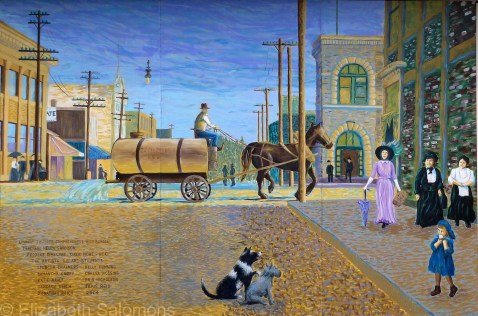
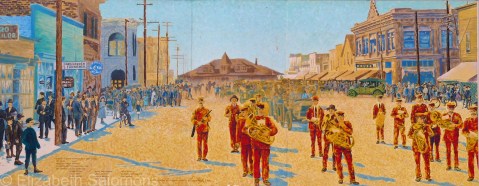
I was pleasantly surprised to discover during my visit to Alberta last month that the city of Red Deer also has a set of murals scattered around its downtown core. Like the Anacortes murals I photographed back in October, most of these are based on old photographs and all of them offer a glimpse of Red Deer’s history through the years.
Here, take a look.


Lacombe
I used this month’s long weekend (November 11 is a stat holiday in Alberta and BC), plus a few of my vacation days, as an opportunity to fly to Alberta for a bit of family visitation. On one afternoon of that extra-long weekend, I was driving through the town of Lacombe with my dad en route to visit my various aunts and uncles and I thought to myself, “What a pretty little town this is!”
I don’t know the town of Lacombe very well, even though a whole passel of my relatives still live there and even though I spent a good chunk of my summers in the Lacombe area when I was growing up. That’s because we always parked our family tent trailer on the dairy farm of my aunt and uncle and there were far too many fun things to do on the farm for any of us kids to want to go into town. (I highly recommend spending summers on a dairy farm when you’re a kid.)
Anyways, the very same day (is that a weird coincidence or what?) that my dad and I were driving around Lacombe, its Historic Main Street (50th Avenue) was selected by the Canadian Institute of Planners as Canada’s Great Street for 2013. (Who knew there was a Canadian Institute of Planners? Not me.) The story made the local TV news that night, and it gave me an excuse to go back the next day and take some photos for this blog.
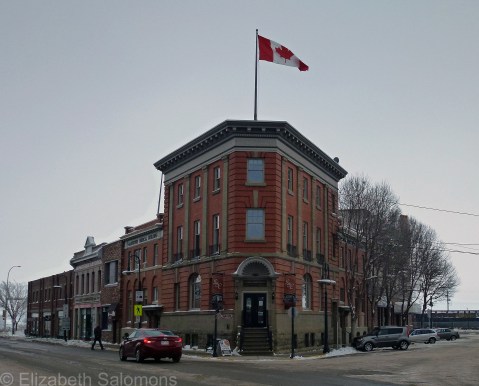
The architectural style of the buildings on Lacombe’s 50th Avenue is Edwardian ― that’s the style that was in vogue during the first decade and a bit of the last century. Lacombe’s Flatiron building (see above photo) was opened in 1904 and is the oldest flatiron in the province.
Lacombe started out as a boxcar train station on the Canadian Pacific Railway. It was incorporated as a village in 1896 and as a town in 1902. In 2010, it became Alberta’s 17th city (and, with of population of 11,000, its smallest).

Queen of Nanaimo
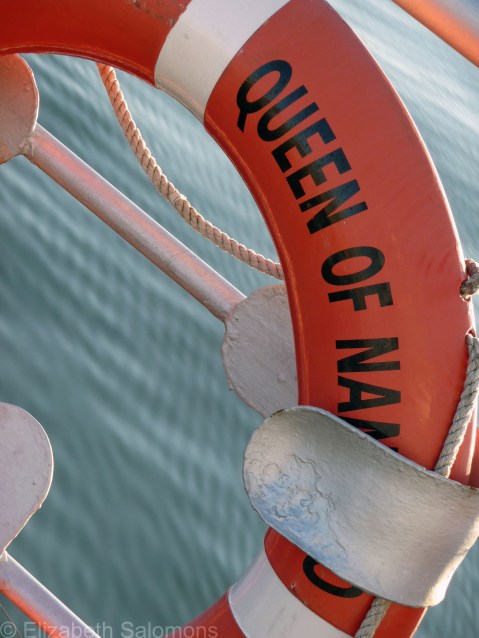
I can’t leave off my tour of the Gulf Islands without posting a photo taken on a BC ferry. That’s because, for me, half the fun of a Gulf Island getaway is getting there.
The Queen of Nanaimo is the workhorse of the Gulf Islands. The ship is almost 50 years old, but it’s the one that does the daily milk run from Tsawwassen to Galiano to Mayne to Pender to Salt Spring and back again.
Almost a month ago, during this season’s first wind storm, the Queen of Nanaimo was blown off course and ran aground near Mayne Island. It sustained enough damage to be put in dry dock for two weeks, which meant that Gulf Island residents wanting to travel to Vancouver had a six-hour detour over Swartz Bay on Vancouver Island.
BC Ferries are the Gulf Islands’ highway and it’s easy to take them for granted ― until sailings are cancelled and you want to get from here to there.
Hornby Island
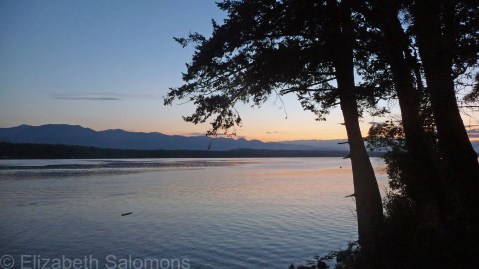
The last island on my tour of BC’s Gulf Islands ― until I have a chance to explore some more, that is ― is Hornby Island.
Hornby is part of a group of islands known as the Northern Gulf Islands (as opposed to the Southern Gulf Islands that Pender, Salt Spring, and Galiano are grouped with). It’s a bit of a hike to get to Hornby from Vancouver: you first take a ferry from Horseshoe Bay to Nanaimo on Vancouver Island, then drive up island for about an hour, hop on another ferry at Bulkley Bay that takes you to Denman Island, drive across Denman, and then, finally, take yet another ferry to get to Hornby. (Denmanites refer to their island as the “bridge” to Hornby because most tourists and campers whiz across it without stopping.)
All told, it’s a good half-day trek. My friends and I went to Hornby on a long weekend, but, even with three days, the trip still felt rushed. If you are coming from Vancouver, I highly recommend going to Hornby only if you have at least four or five days, ideally a week, to make the travel time and ferry expense worth your while.


Hornby Island has a year-round population of 1000 and its size of 30 square kilometres makes it one of the smallest of the Gulf Islands. It’s named after Rear Admiral Phipps Hornby, a Brit, who was the Commander of the Pacific Station in the 1850s. The island’s Mount Geoffrey is named after his son.
Like the rest of the Gulf Islands, Hornby offers hiking, wine-tasting, and studio tours. It is also popular with cyclists and mountain bikers. The beach at Tribune Bay is beautiful and I added it to my list of favourite beaches as soon as I set eyes on it. I’m looking forward to spending a lot of time on that beach when I return to Hornby Island.
Golden Gate Bridge
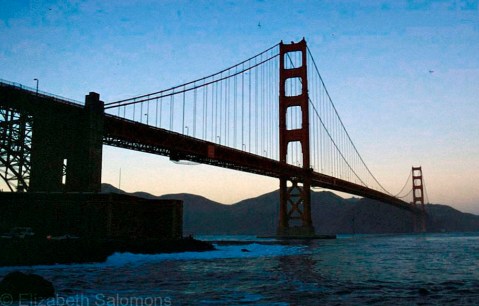
The first time I saw the Golden Gate Bridge, I was in a plane. Only its two towers were visible; the rest of the bridge was hidden in the fog. I found out later that fog is a common weather phenomenon in San Francisco and the two towers of the Golden Gate Bridge are often as much as you ever see of it from an airplane.
I didn’t get any closer to the bridge that time ― or see anything of the city ― as I was merely on a stop-over on my way to somewhere else.
The second time I saw the Golden Gate Bridge, I was in a car driving over it. I’d been visiting a friend in the Sonoma Valley and, after a couple days of touring wineries and wine-tasting, we decided we should spend a day in San Francisco. When you drive from the Sonoma Valley to San Francisco, you enter the city by crossing over the Golden Gate Bridge.
I couldn’t stop marvelling at the bridge; I may even have giggled. My first thought was probably, “Wow!” I know for sure my second thought was, “The Lions Gate Bridge is just a toy compared to this one!”
The Golden Gate Bridge opened in 1936, and I like to think of it as the Lions Gate’s older, more grown-up sister. At six lanes, it’s twice as wide as the Lions Gate and it’s a kilometre longer. Those three additional lanes are what impressed me ― it feels more like an expressway in the sky than a bridge.
It I don’t know if the Golden Gate Bridge would have impressed me as much had I not been so familiar with driving over the Lion’s Gate Bridge. But I do remember I asked my friend to drive over it again, just for the thrill of it.
Happy Birthday, Lions Gate Bridge!

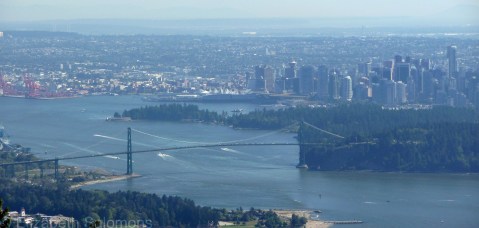
The Lions Gate Bridge is having a birthday, and it’s a big one. It was on November 14, 1938 ― 75 years ago today ― that the bridge was first opened to vehicle traffic. The Guinness family (yes, that Guinness family ― the one that brews the beer) wanted a bridge across the First Narrows of Burrard Inlet to provide access to the land on the North Shore they were hoping to develop. (The area was both then and now known as the British Properties.) To help move things along, the Guinness family offered to pay for the bridge to be built, and the City of Vancouver found itself with an offer it could not refuse.

It took 18 months to build the Lions Gate Bridge, its construction came in under budget, and, at the time of its opening, its 1.8 km length made it the longest suspension bridge in the British Empire. It is named after the Lions, the twin mountain peaks on the North Shore that face the city. Two Art Deco–style lions guard the approach to the bridge’s south end.
In 1955, the Guinness family sold the bridge to the province for exactly the same amount that they spent on building it ― a mere $6 million. The Guinness family also paid for the lights that have adorned the bridge’s cables since 1986, as a gift to commemorate Expo 86.

More than 60,000 cars cross the Lions Gate Bridge each day, a number it was never designed to accommodate and which has often led to it being called “Canada’s most scenic traffic jam.” By the 1990s, the bridge was showing its age and serious consideration was given to replacing it. Instead, it was restored and given a seismic retrofit, and its deck was replaced, all at a cost of more than $100 million. All work was done in 12 months between 2000 and 2001 without any disruption of daytime traffic ― no small feat in a city where traffic is easily snarled when any one of its bridges is closed. In 2004, the Lions Gate Bridge was designated a National Historic Site of Canada.


 There and Back Again