
Mozart in Prague
I was at the Vancouver Opera again last weekend, enjoying a superb performance of Mozart’s Don Giovanni. This opera premiered a couple of centuries ago at the Estates Theatre in Prague, a city that loved Mozart and that Mozart loved in return. He was treated like a rock star whenever he came to town. Don Giovanni was commissioned by an Italian living in Prague when he saw how popular Mozart was in that city.
The Estates Theatre also happens to be where I first saw Don Giovanni. In fact, seeing Don Giovanni at the Estates Theatre in Prague was my first ever live opera experience. My friend and I treated ourselves to box seats because they set us back a mere $20 ― it was quite the introduction to live opera. If you enjoy music and you happen to be in Prague, I highly recommend checking it out.
I don’t have any photos of the Estates Theatre, but if you were to walk down the street in the photo below, the theatre would come into view just as you round the corner. Can’t you picture this street on a clear, crisp October night in 1787, with gown and cape–clad Praguers arriving at the Estates Theatre in their horse-drawn carriages? Then, with a little imagination, picture them sweeping en masse into the newly built theatre to witness a grand spectacle: the newest (some say best) opera from Wolfgang Amadeus Mozart, directed by the Maestro himself.
Go on. Imagine.

Through My Lens: Vancouver Olympic Cauldron
Vancouver’s Olympic Cauldron was lit today to celebrate Canada’s gold medal in men’s hockey. Some claim it’s the only gold medal that matters to Canadians.
I think the athletes who won the other nine gold, ten silver, and five bronze medals for Canada would beg to differ, but, yes, we Canadians are a bit hockey mad and never more so than during the Winter Olympics.

Merry Christmas!

English Bay, Vancouver
Happy Birthday, Christ Church Cathedral!

And it’s yet another birthday post, this time for Vancouver’s Christ Church Cathedral. The congregation worshipped together for the first time 125 years ago today at 720 Granville (which, funnily enough, is now the site of a Starbucks) and was made the Cathedral Church of the Diocese of New Westminster of the Anglican Church of Canada in 1929.
Although Christ Church is not the oldest congregation in Vancouver, it does worship in Vancouver’s oldest church building. That would be the stone building standing at the corner of Burrard and West Georgia. It was constructed on land bought from the Canadian Pacific Railway, but for several years the congregation didn’t get much beyond finishing the basement, which was nicknamed the Root House. When the CPR objected to what they called an eyesore, the current building was built in the Gothic Revival architectural style. The exterior is sandstone, its ceiling is cedar, and the beams and floor are made from old growth Douglas fir. The building was dedicated in February 1895.

Christ Church is located right in the centre of Vancouver’s downtown district. In the 1970s, the congregation voted to tear down the existing building and replace it with an Arthur Erickson–designed high-rise tower, but public opposition was so strong that in 1976 the cathedral was declared a heritage building. The building has been renovated six times; its most recent renovation was completed in 2004 with the installation of a new Kenneth Jones organ. The congregation had plans to build a bell tower, but before it had the chance to do so, the city passed a by-law restricting church bells. Christ Church is the only church in downtown Vancouver without a steeple.
A special treat this Christmas season is the almost life-sized nativity figures on display in the west alcove of the church; these are on loan from the Hudson’s Bay and are the same nativity figures that used to be displayed in the store’s windows at Christmas time. They were carved in Italy in the 1950s and belonged to Woodward’s before they were passed on to The Bay. Christ Church Cathedral asked to borrow them this Christmas season as the congregation begins a year-long celebration of its 125th anniversary.
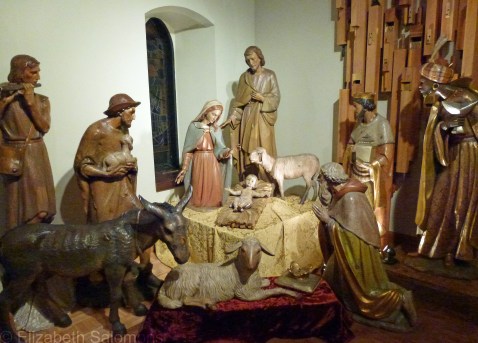

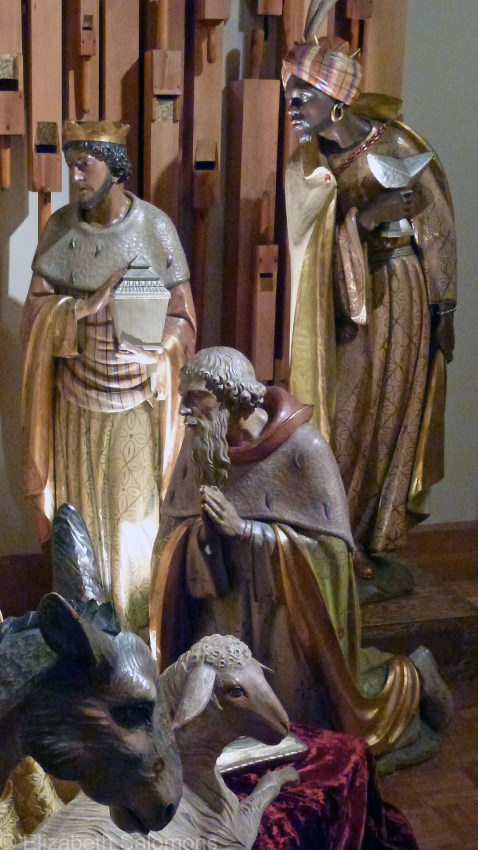
I’ve been to the cathedral for many a worship service ― these photos were taken last night after the Festival of Nine Lessons and Carols ― as well as several concerts and author readings for which the cathedral is a popular venue. After arriving very early many years ago to get a good seat to hear Timothy Findley read from his newest novel (and, as it turned out, only months before his death), I eavesdropped while a woman seated behind me explained to her companion that Christ Church was known as the church of lawyers because the funerals for the city’s most powerful lawyers are typically held there. It was one of the more bizarre bits of trivia I have ever heard about the cathedral.
But then, I like to think that there are 125 years’ worth of weird and wonderful stories to be told about Christ Church Cathedral. If only its walls could talk.

Through My Lens: Vancouver Christmas Market
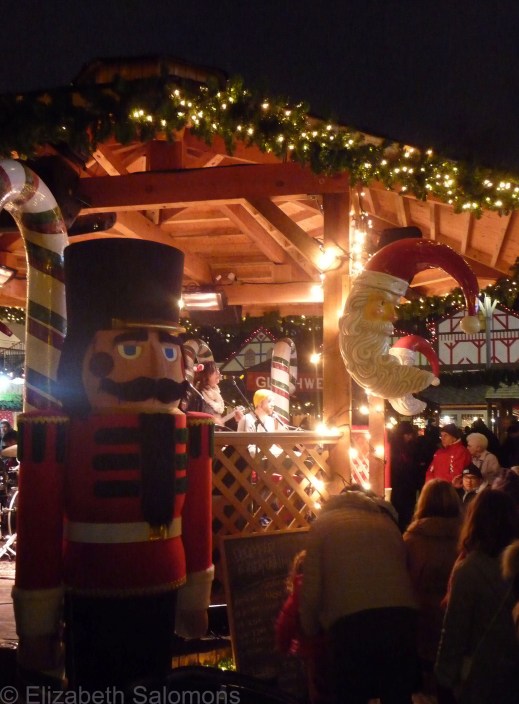
The Vancouver Christmas Market isn’t anywhere near as magical as any of the Christmas markets I’ve seen in Europe. But it does give me a chance to play around with my camera.
Happy Birthday, Lions Gate Bridge!

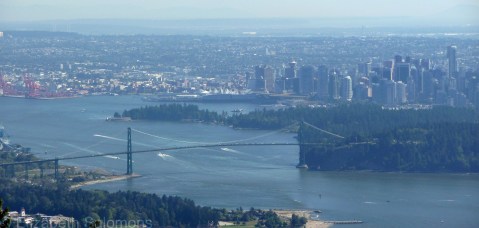
The Lions Gate Bridge is having a birthday, and it’s a big one. It was on November 14, 1938 ― 75 years ago today ― that the bridge was first opened to vehicle traffic. The Guinness family (yes, that Guinness family ― the one that brews the beer) wanted a bridge across the First Narrows of Burrard Inlet to provide access to the land on the North Shore they were hoping to develop. (The area was both then and now known as the British Properties.) To help move things along, the Guinness family offered to pay for the bridge to be built, and the City of Vancouver found itself with an offer it could not refuse.

It took 18 months to build the Lions Gate Bridge, its construction came in under budget, and, at the time of its opening, its 1.8 km length made it the longest suspension bridge in the British Empire. It is named after the Lions, the twin mountain peaks on the North Shore that face the city. Two Art Deco–style lions guard the approach to the bridge’s south end.
In 1955, the Guinness family sold the bridge to the province for exactly the same amount that they spent on building it ― a mere $6 million. The Guinness family also paid for the lights that have adorned the bridge’s cables since 1986, as a gift to commemorate Expo 86.

More than 60,000 cars cross the Lions Gate Bridge each day, a number it was never designed to accommodate and which has often led to it being called “Canada’s most scenic traffic jam.” By the 1990s, the bridge was showing its age and serious consideration was given to replacing it. Instead, it was restored and given a seismic retrofit, and its deck was replaced, all at a cost of more than $100 million. All work was done in 12 months between 2000 and 2001 without any disruption of daytime traffic ― no small feat in a city where traffic is easily snarled when any one of its bridges is closed. In 2004, the Lions Gate Bridge was designated a National Historic Site of Canada.
Castel Sant’Angelo

Vancouver Opera has just finished its run of Puccini’s Tosca for which it received rave reviews. I got to see it on opening night and enjoyed it immensely. I’ve been looking forward to hearing this particular opera for many years ― and not only because I have yet to meet a Puccini opera I didn’t love.
No, I’ve been wanting to hear Tosca ever since the friend who introduced me to opera told me how, at the end of the opera, Tosca jumps to her death from the ramparts of Castel Sant’Angelo. Why did this make such an impact on me? Because my friend told me the story of Tosca’s demise when we were standing on the ramparts of Castel Sant’Angelo. (There’s nothing like context to make opera come alive!)
If you’re wondering how high those ramparts might be, here’s a photo of the Tiber that I took when I turned around after taking the above photo.

Another interesting detail about Tosca: Act I is set in the Church of Sant’Andrea della Valle. My friends and I discovered this bit of trivia when we wandered into the church, which just happened to be located on the same street as our Roman hotel. Lesson learned: you never know what awaits you inside a Roman church.
Through My Lens: Foggy Vancouver
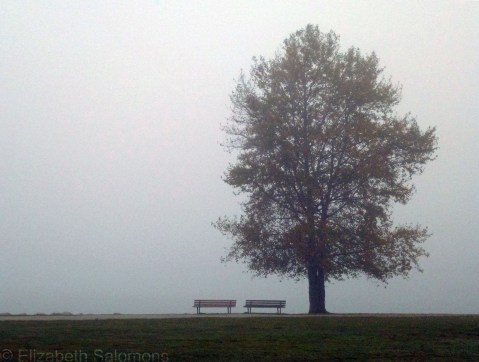
Vancouver has been awash in a pea-soup thick fog the past few days. It’s supposed to lift tomorrow. Apparently the sun is out there somewhere.
Here is a photo I took this afternoon at Vanier Park.
Happy Birthday, Stanley Park!
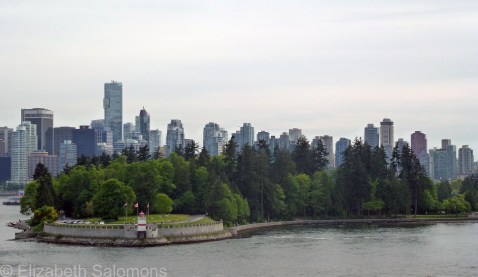
Stanley Park turns 125 today. The city threw a big party in the park last August to celebrate the occasion, but its actual birthday is today, as it was on September 27, 1888, that the park was first officially opened to the public.
At 1000 acres, Stanley Park is the largest of Vancouver’s parks, and also its most popular. It contains an estimated 500,000 fir, hemlock, and cedar trees, and has three beaches, a lake, a lagoon, an 8.8-km seawall, and many more kilometres of walking trails that meander through its interior.
It’s named after Lord Stanley of Preston, Governor General of Canada from 1888 to 1893.
University of British Columbia
The last school I want to show you on my tour of schools I’ve photographed is the University of British Columbia. Like Simon Fraser University, UBC is situated a ways away from the hustle and bustle of the city centre ― its main campus is located at the western tip of Point Grey, a peninsula to the west of Vancouver’s toniest neighbourhoods.
UBC is a hodge-podge of architectural styles. For one, it’s got your neo-Gothic. This is the Chemistry Building, one of the first three buildings constructed on the Point Grey campus. That was back in 1925.

For another, it’s got your Brutalism. The Buchanan Tower was built in 1972.

And it’s got your postmodernism. This is the Koerner Library, which was designed by Arthur Erickson and completed in 1997.

UBC is fond of combining architectural styles when it builds additions to existing buildings. The Main Library, another of the three buildings constructed in 1925, morphed into the Irving K. Barber Learning Centre in 2008. The neo-Gothic centre is the original building, now surrounded by a postmodern glass structure.
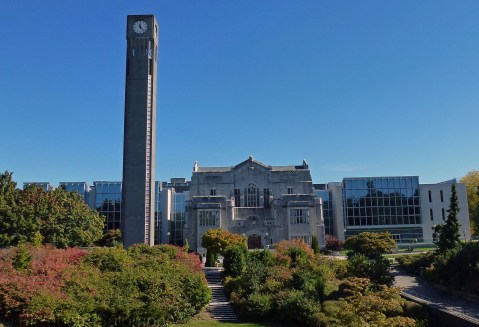
Here’s a look at it from another angle.

Four wings were added to the Chemistry Building between 1959 and 1989. This is a corner of one of those wings, built in the Brutalist style.
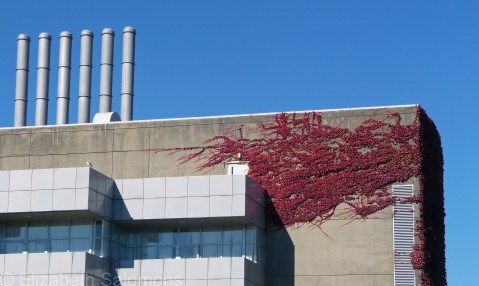
And this postmodern structure is an addition to the Henry Angus Building, which houses the Sauder School of Business. The addition, which opened in 2012, is wrapped around the original building, which was built in 1965 and expanded in 1976.

With 50,000 students, UBC is Canada’s fourth largest university and the largest in Western Canada. These days, the Point Grey campus is one massive construction site. In the past year, work was completed on a new trolley bus loop, upgrades to primary pedestrian corridors (which for some reason I have yet to figure out are called “malls” here), and a new fountain in Martha Piper Plaza. Building construction currently underway includes a new Student Union Building, the new Centre for Brain Health at UBC Hospital, and expansion of the UBC Bookstore. A new building that will house the Faculty of Education is scheduled to break ground this winter.
UBC’s Class of 2016 fittingly calls itself the Class of Construction.


 There and Back Again