
Panegyri on Serifos
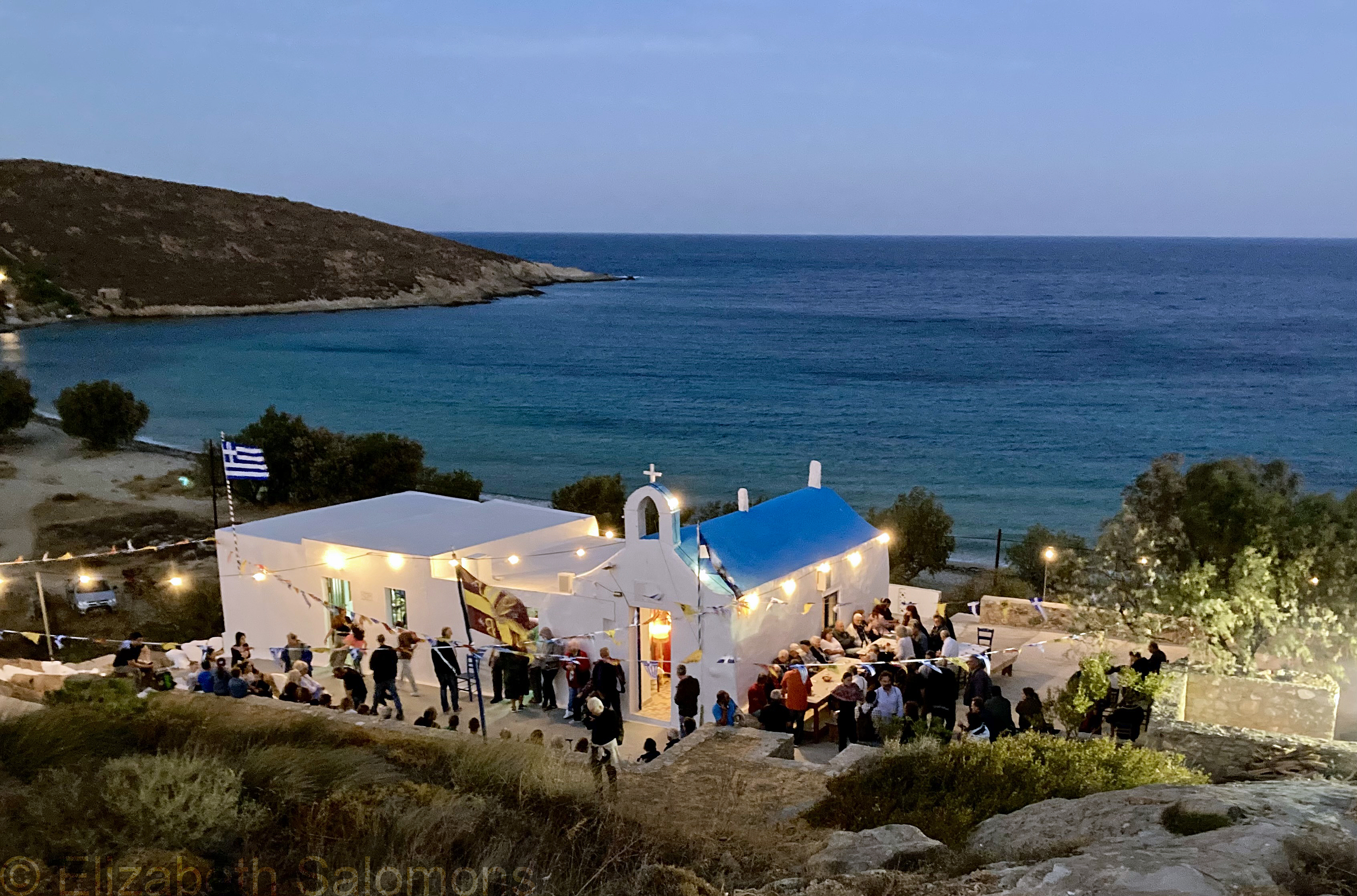
It hadn’t even been 24 hours since my arrival on Serifos and I was already on my way to a party. My home exchange partner had invited me to a panegyri.
Truth be told, I dithered about whether to go. Who would I talk to? How would I get home? That was the introvert in me talking. But the traveller in me was desperate to go. And in the end I went because I could hear in my head the voice of my dearest friend, saying, “What do you mean you didn’t go?”
Panegyria are a centuries-old tradition in Greece. The word comes from the Greek word pan (meaning all) + ageiro (meaning to gather). Originally, they were large gatherings dedicated to the worship of a deity, but, over time, they have shifted to celebrating Christian Orthodox saints.
Panegyria are especially common in rural communities and on the islands where local families take on the responsibility of maintaining and caring for the many small churches. As each saint’s day is celebrated, the family responsible for the church dedicated to that particular saint hosts a community feast, complete with live music and dancing.
Tourists are always welcome. On my first visit to a Greek island (decades ago, when I was travelling the European continent on a train pass), my friend and I ended up at three such festivals within four days.
The panegyri I attended on Serifos was at the church of Agios Ioannis (Saint John the Apostle). We were too late for the religious service, but made our way into the chapel anyways, just for a moment, where we left a donation and my home exchange partner lit a candle.

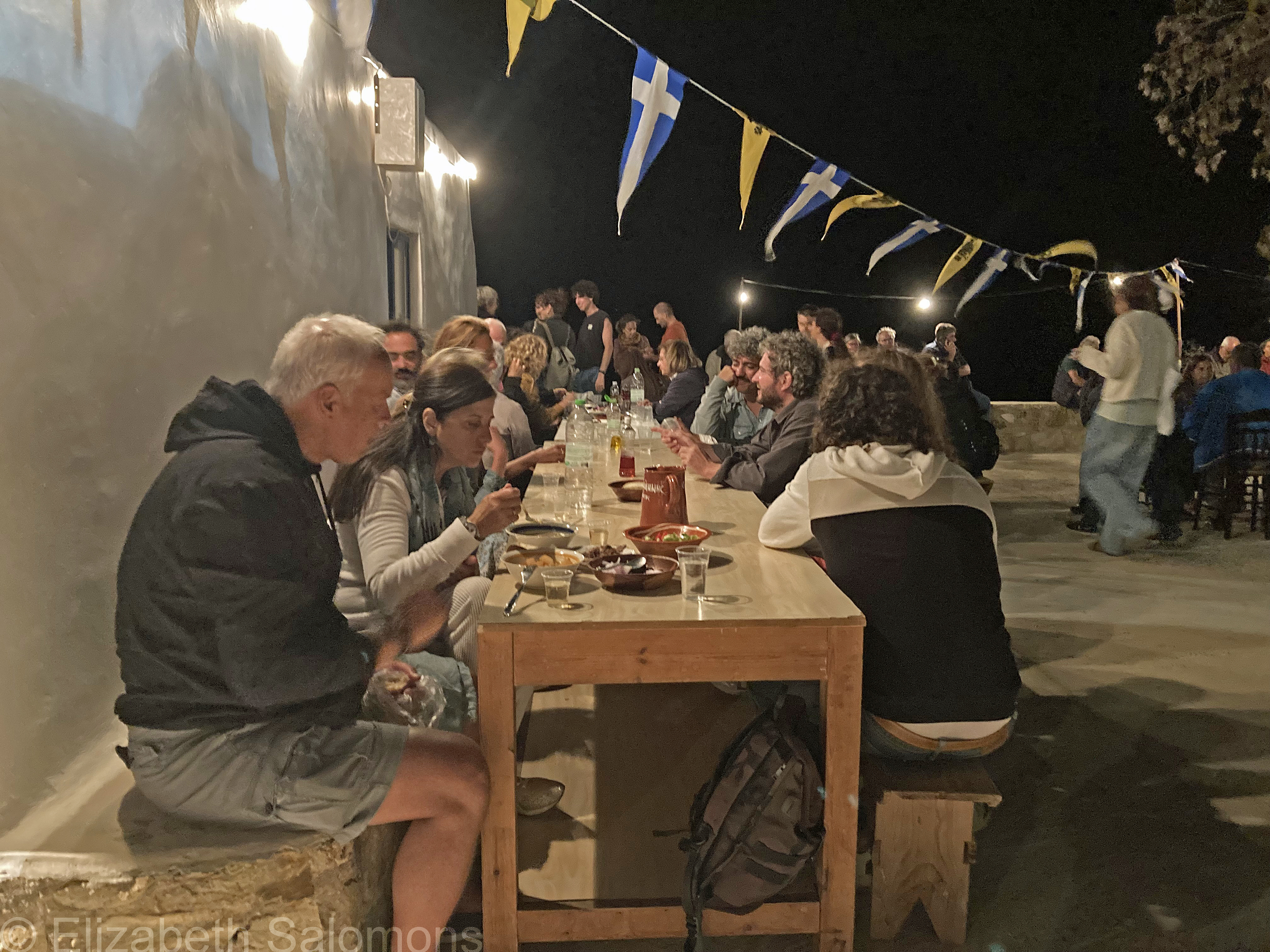
Outside was a table where everyone ate in shifts; my home exchange partner introduced me to her friends and we stood and chatted until it was our turn to eat. There was wine, potatoes, some kind of grilled meat, fava bean soup, and lots of bread. It was clearly a family affair with the men grilling the meat, the women running the kitchen, and the children serving the food.
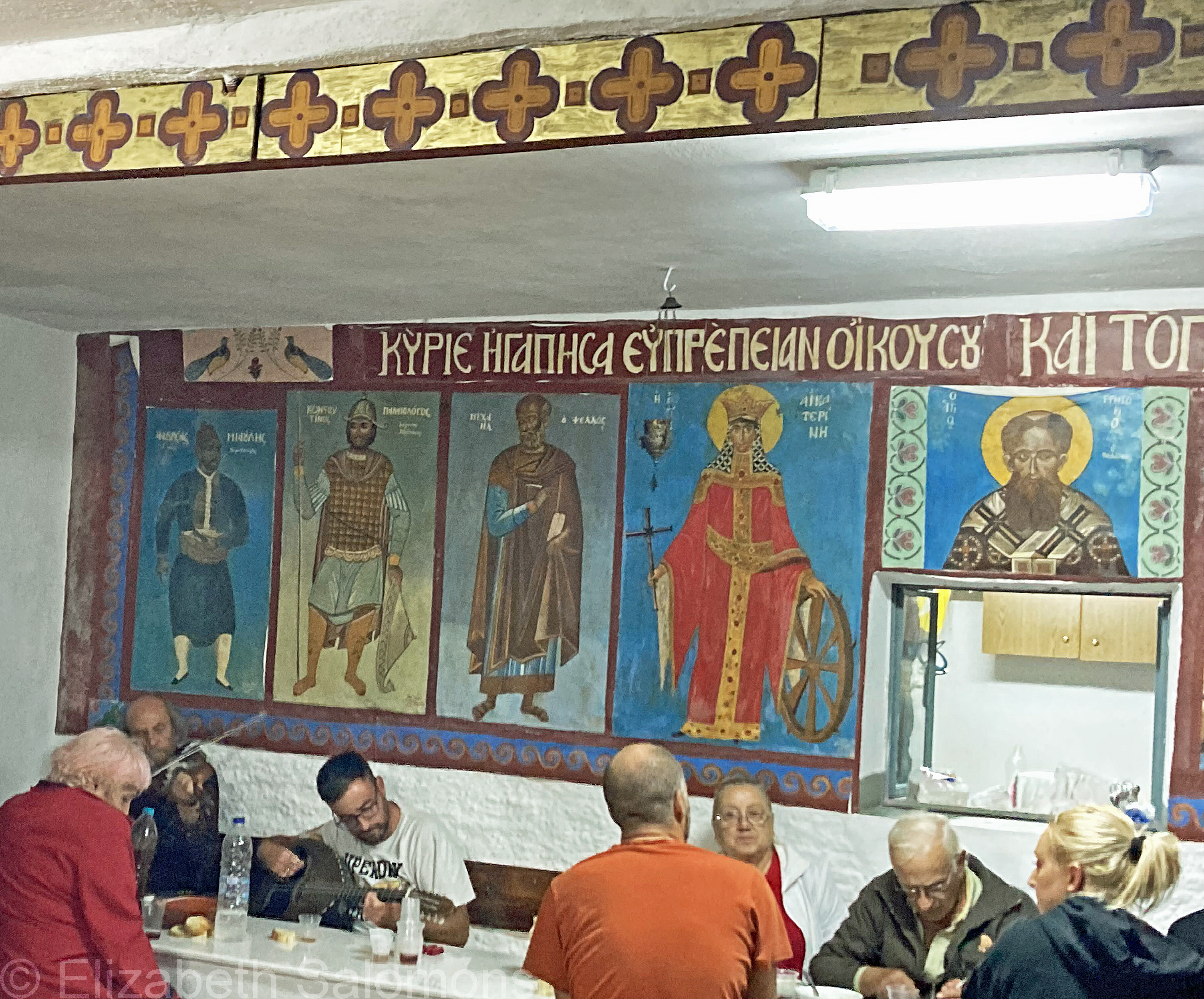
Eventually the music started up in the portion of the building next to the kitchen and we moved indoors to listen. Someone played a violin, another a bouzouki. The songs were long and when they ended, there was lots of applause. The musicians would rest for a bit, then the bouzouki player started picking out another tune and it would all start up again.
It was quite late when my home exchange partner turned to me and laughed at the fatigue she could clearly see on my face. She jumped up and said she would find me a ride home. And a few minutes later, as I walked up the hill to the main road with the Serbian couple who were willing to give me a lift (they were also staying in the Chora), a group of young women, clearly tourists, passed us on their way down. They thought they had missed the panegyri. I assured them they hadn’t, but they were alarmed that they couldn’t hear any music.
“The music is indoors,” I said. “Go on down, you can’t miss it.”
Nor had I — and I was so glad I hadn’t.
Royal Hawaiian Mai Tai
Speaking of historical Hawaii, one of the places I insisted we go while on Oahu was the Royal Hawaiian Hotel. This illustrious hotel, now part of the Marriott chain, has stood on Waikiki Beach since 1927. It’s one of those hotels you can only dream about ever staying at. Happily, though, the dining options were within our budget and we enjoyed mai tais and poke at the outdoor Mai Tai Bar overlooking the beach.
Full disclosure: I don’t even like rum, but I lost count of how many mai tais I enjoyed during our week in Hawaii.
(What can I say? When in Rome … )

Dishing: Paul
After the upheaval of the past few years, I am still marvelling at what a treat it is to be able to meet up with friends in restaurants again. Such a little thing, really. And yet such a big thing.
And so it was that I found myself on Robson Street for a lunch date yesterday. Paul is as ubiquitous in Paris as Starbucks is in Vancouver and I was thrilled when I heard that a location of this longtime French institution was coming to my home city.
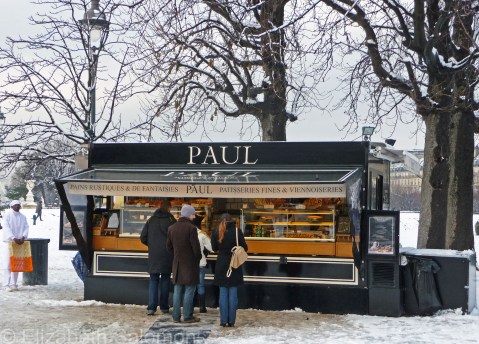
Paul in the Jardin des Tuileries
The bakery and café’s Vancouver location — the only one in all of Canada — has been open since 2021, but yesterday was my first visit (because, you know, pandemic).

Paul on Robson Street
You have to suspend disbelief to think you are in Paris, though. Although my crêpe aux champignons et aux épinards (mushroom and spinach crepe) was excellent, the size of the pastries we perused in the display case on our way out were supersized, not small and delicate the way they are in French bakeries. And the seating area was light and airy with tables quite far apart, not squished together as they are in Parisian cafés.
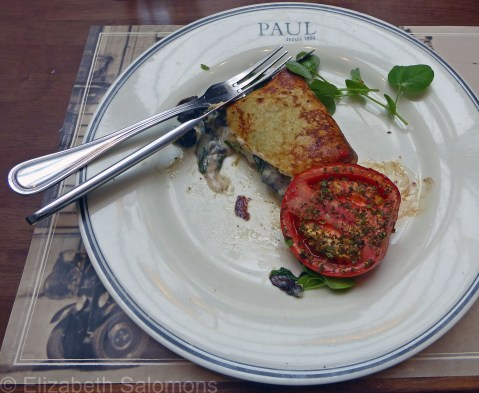
But the service was very Canadian and it was a wonderful way to while away a couple of hours with a friend. I will be back.
Recipe Box: Gazpacho
In my tour through Spain these past almost eleven (!!) months, I haven’t been talking about the food. That’s been rather intentional — there were so many memorable meals I could have written about that it would have taken me off on another tangent altogether.
Those meals were so memorable that I made sure to pick up a couple of cookbooks to take home with me. One is filled with recipes of typical Spanish dishes and the other contains only tapas recipes. (Both are published in English — let’s just make that perfectly clear!) But when it came down to deciding which recipe, of all the Spanish dishes I like to re-create in my own kitchen, to write about here — well, that was a near impossible choice.
In the end, it was last summer’s heat dome that decided it for me. Gazpacho is a life-saver when the temperature hovers near 40ºC and as soon as I saw what was headed our way back in June, I whipped up a batch to sustain me through that crazy week.
Confession: the first time I was served gazpacho I really didn’t see what the big deal was. I was at a small dinner party here in Canada, and the host came out with a large bowl of finely chopped cucumbers, tomatoes, and peppers all mixed together. Gazpacho, she called it. And so, many years later when my sister and I were enjoying a round of tapas on our first night in Córdoba, I was taken aback when the gazpacho arrived.
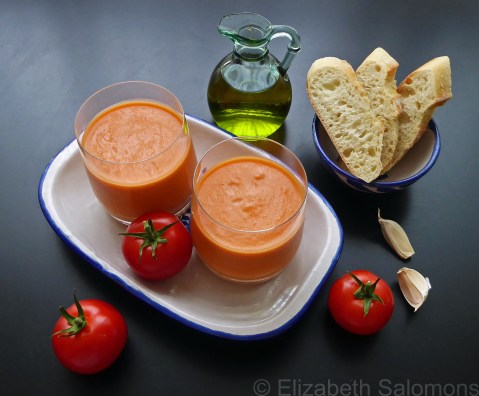
“This is gazpacho?” I said to my sister, pointing to my glass. It was beyond delicious and a world apart from the cold, sad mixture of vegetables I’d been led to believe was gazpacho. But, in case you are confused, gazpacho is not merely a thick version of V8 juice. It’s so much more than that.
My sister laments that she can no longer buy gazpacho by the carton the way she could when she lived in Spain. She now satisfies her craving with this recipe, which she claims is the closest to the gazpacho she had in Spain. And since we were always served gazpacho in a glass in Spain, I serve it that way here in Canada. Yes, it’s soup, but it’s perfectly quaffable.
And it’s the best meal to have when you’re in the middle of a heat dome.
Gazpacho
3 pounds ripe tomatoes, cored and roughly chopped
1 small cucumber, peeled, seeded, and roughly chopped
1 medium green bell pepper, cored and roughly chopped
1 small red onion, minced
2 medium garlic cloves, minced
1 small serrano chili, seeded and minced
kosher salt
several slices day-old baguette
1/2 cup extra virgin olive oil
2 tablespoons sherry vinegar*
1. Place in a large bowl two-thirds of the tomatoes and half of the cucumber, bell pepper, and onion. Add the garlic, chili, and 1 1/2 teaspoons of the salt. Combine well and set aside.
2. Toss with 1/2 teaspoon of salt the remaining tomatoes, cucumber, pepper, and onion, and place in a fine mesh strainer over a medium bowl. Set aside for one hour, then transfer to the bowl with the rest of the vegetables.
3. Add the baguette slices to the liquid drained from the vegetables. Soak for one minute, then add the bread and any remaining liquid to the vegetables. Toss well to combine.
4. Transfer half of the mixture to a blender and process several minutes until completely smooth. With the blender running, slowly add 1/4 cup of extra virgin olive oil. Strain soup through a fine mesh strainer into a large bowl, then repeat with the remaining mixture and olive oil.**
5. Stir in the sherry vinegar and season to taste. Transfer to a pitcher, cover, and refrigerate overnight before serving.***
Notes:
*Use the best sherry vinegar you can find. I’ve learned that a poor-quality vinegar will make your gazpacho pretty much undrinkable.
**Some recipes call for setting aside some of the chopped vegetables to use as a garnish if you like. I don’t like, so never do.
***The flavours need time to blend, so don’t skimp on the waiting time. Several hours is the minimum.
Recipe Box: Ratatouille
When I was flying back from New York the other month, I watched a couple of episodes of Anthony Bourdain’s show Parts Unknown on the plane, including the episode he shot in Newfoundland. (If you haven’t seen it, do. It’s hilarious and oh-so-Canadian.)
A world without Anthony Bourdain is all the poorer, I thought as I looked out my window somewhere over the American Midwest. The celebrity chef, travel writer, and TV personality died six months ago today. I had this sad anniversary in mind while working on my last post about Le Bernardin. Eric Ripert was a close friend of Anthony’s, and he appeared on his shows many, many times. They were together in France, filming an upcoming episode of Parts Unknown, when Anthony died.
The first Anthony Bourdain show I ever watched was an episode he filmed in Provence for No Reservations. My sister had recommended his show to me; I had never heard of the guy and had absolutely no expectations. But I went to YouTube, clicked on the episode — and have been a fan ever since.
One line of dialogue in the episode about Provence always stuck in my memory. Anthony was preparing a meal for his new Provençal friends and he was quite nervous about messing it up. He set his dish of ratatouille down in front of them, they tasted it, nodded politely, and then said, “It’s true that your ratatouille is very handsome.” After much laughter, Anthony asked what he got wrong. They replied, “You didn’t miss anything. It’s just … not a ratatouille.”
I remember laughing out loud at that point. Food is so much a part of the travel experience, and we try our best to replicate what we eat elsewhere when we are back home again, but most of the time we fail. It’s never quite the same. Rewatching the episode now, after the dozens of Anthony Bourdain TV shows I’ve watched since, I marvel at his self-awareness. It’s a rare quality that few celebrities (and, to be honest, men) possess.
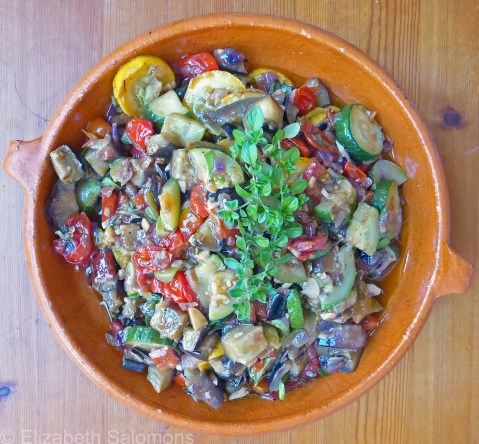
A traditional dish from the south of France, ratatouille is essentially stewed vegetables. Like many French dishes, its origins are simple: it was a way for peasants to use what they had readily available in their gardens.
Last summer, I made a lot of ratatouille. It was a very good year for zucchini at my local farmers market and every weekend, I came home with bags of the stuff — all shapes and all sizes. And whenever I saw my sister, I was given bowls of tomatoes and handfuls of basil and thyme from her garden. What better dish to make than ratatouille when you have more fresh vegetables and herbs than you know what to do with?

This recipe is based on several versions, including Anthony’s. Vary the quantities according to your own preferences. I like to use cherry tomatoes, but if you use full-size tomatoes, you probably want to peel and seed them. If your squash are on the larger size, quarter the slices. Make sure your eggplant is on the smaller side as you want each cube to have a bit of the skin. And, most importantly, cook each vegetable separately to help retain their shape and texture.
I’m sure what follows is also “not a ratatouille,” but in my humble opinion it tasted all right.
Bon appétit!

Ratatouille
olive oil
1 medium red onion, diced
4 garlic cloves, peeled and chopped
1 1/2 cups cherry tomatoes, halved
1 medium eggplant, cubed
1 large red pepper, seeded and diced
2 medium zucchini, sliced
1 yellow zucchini, sliced
several sprigs fresh thyme
one handful fresh basil, shredded
2 teaspoons balsamic vinegar
salt and pepper
1. In a large, high-sided frying pan, heat several splashes of olive oil over medium to medium-high heat. Add the onion and garlic. Cook until soft, then remove from the pan and spread out on a cookie sheet to cool.
2. Wipe out the pan and repeat with the cherry tomatoes. When they are beginning to soften, smush them with the back of a wooden spoon to release their juices. Cook a little bit longer, then season with salt and pepper. Transfer them to the cookie sheet, keeping them separate from the onions and garlic.
3. Repeat with the remaining vegetables, wiping out the pan, seasoning with salt and pepper, and transferring to the cookie sheet each time.
4. When all the vegetables have cooled to room temperature, combine them in a large mixing bowl. Add the thyme, basil, and balsamic vinegar, and adjust seasoning if necessary. Let the mixture sit at room temperature for 3 or 4 hours before serving to let the flavours blend. Serve reheated or at room temperature.
Dishing: Le Bernardin
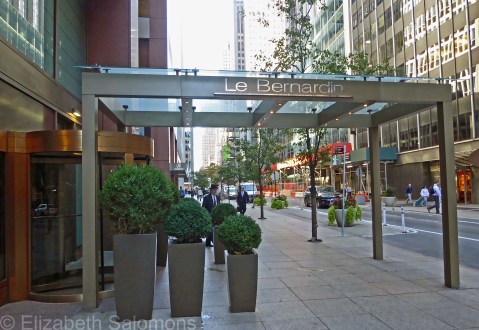
While in New York the other month, my sister and I treated ourselves to lunch at Le Bernardin. This New York institution has maintained its three Michelin stars for the past 14 years and, just last week, it was named the world’s best restaurant by La Liste, a Paris-based ratings organization.
The world’s best.
Hee. It was quite the lunch.
Le Bernardin specializes in seafood, which seems like a natural choice given that the restaurant’s founders, Gilbert and Maguy Le Coze, grew up in Brittany, on the French coast. This brother and sister opened their first restaurant in Paris in 1972, calling it Les Moines de St. Bernardin after a song their restaurateur father used to sing about an order of monks who loved to eat and drink. When Gilbert and Maguy moved to New York in 1986, they simplified the name of their new restaurant to Le Bernardin.
Eric Ripert, who was only 26 when he joined the restaurant in 1991 as Chef de Cuisine, took over as Executive Chef after Gilbert’s sudden death in 1994. He is now a partner in the restaurant. When I got home from New York, I read Eric Ripert’s book, On the Line, which describes the inner workings of the restaurant. Want to know what I learned?
Le Bernardin is a machine.
In order to serve some 1200 dishes every day, 800 pounds of fish are delivered first thing in the morning. All of it is butchered on site — a process that takes six hours. To make 240 sauces each week, the restaurant goes through, per day, 10 pounds of shallots, 5 pounds of garlic, 10 pounds of ginger, and 30 pounds of butter.
(Thirty pounds of butter!?!!)
One neat thing about Le Bernardin, by the way, is that the day’s leftover food is donated to City Harvest, an organization that feeds one million New Yorkers each year.
Le Bernardin is on the ground level of a non-descript office building in Midtown Manhattan with screens hiding the interior from the street. If you didn’t know where to go, you wouldn’t know it was there. But once you are inside, it’s as if you’ve entered another world.
The service was seamless. We lost count, but my sister and I think there were at least seven people waiting on us. And because all staff are full-time, there are no actors moonlighting as servers at Le Bernardin. Instead, you are surrounded by professionals.
The menu consists of three parts: Almost Raw, Barely Touched, and Lightly Cooked. For the three-course prix fixe that my sister and I ordered, we were instructed to order one dish from the left side of the menu (Almost Raw and Barely Touched) and one dish from the right side of the menu (Lightly Cooked). I had Barely Cooked Scallop with Sea Beans and Bonito Butter Sauce and Pan Roasted Merluza with Stuffed Zucchini Flowers and Brazilian Shrimp Moqueca Sauce.
I apologize for the lack of photos. I was too overwhelmed with what I was seeing and tasting to pull out my camera.
When it came to my third course, however, there was no question that I had to document the moment. This is a Golden Hazelnut Sphere with Frangelico Mousse and Praline Ice Cream.

Yes, that is gold leaf on the hazelnut sphere.
I don’t know if New York’s streets are paved with gold, but this I do know: its pastries sure are.
Gouda
In the house where I grew up, we had two kinds of cheese: Dutch cheese … and everything else. And by Dutch cheese, I of course mean Gouda cheese. (Which is pronounced GHOUW-da, with a guttural “g,” not GOO-da. If the “g” is too much for you, think HOW-da, and stress the “h.”)
But the town of Gouda, I learned last week, has a whole lot more to it than just its cheese.

For one, there’s a pretty impressive Stadhuis, or Town Hall, built way back in the middle of the fifteenth century in the Gothic style.

For another, there’s a pretty impressive church, known as the Grote Kerk (Great Church) or Sint Janskerk. At 123 metres, it is the longest church in the Netherlands.

Hugging the church’s perimeter are many tiny little streets filled with tiny old houses.

These streets are a delight to wander through.

Naturally, Gouda cheese does play a big role in Gouda’s tourism, and the city does a fine job of using it to promote itself.

During the summer months, there is a weekly cheese market (which we did not see) that takes place in front of the Waag or Weigh House.
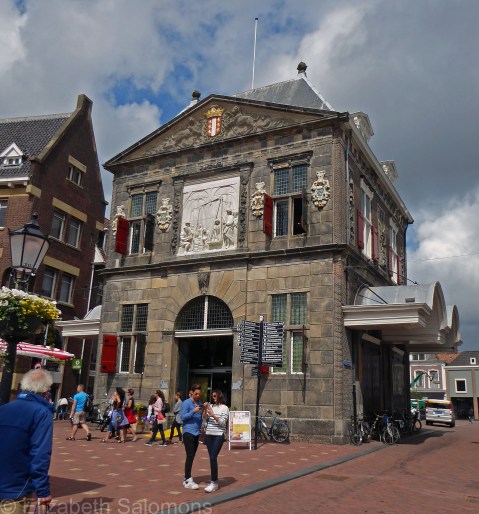
But I did buy some cheese at the regular Saturday market that was going on in the Markt or market square.

People were first attracted to the area around Gouda by the peat that was plentiful in the nearby swampy marshland and which they harvested. This was back in the eleventh and twelfth centuries. By 1272, Gouda was granted city status. It is less than an hour from Amsterdam by train and well worth a visit.
Even if you’re not as crazy about cheese as I am.

Dishing: Bouillon Chartier
So, the all-important question is: when you have less than a week in Paris to impress your nieces with all you know about the City of Light, where do you take them to eat?
In my case, I took them to Bouillon Chartier, which was recommended to me by my Parisian friend. He described it as “an authentic French brasserie” that offered cheap but tasty food and had servers that were rude as … well, I can’t repeat what he wrote on a family blog such as this, but when I read his text to my niece, she raised her eyebrows and said, “Um …”
Needless to say, by this point in her European travels, she was more than a little homesick for polite Canadians.
But we went to Bouillon Chartier anyways. And when we arrived, I recognized the entrance from a travel article I had read some time ago. Bouillon Chartier was a Parisian restaurant I had always wanted to try.
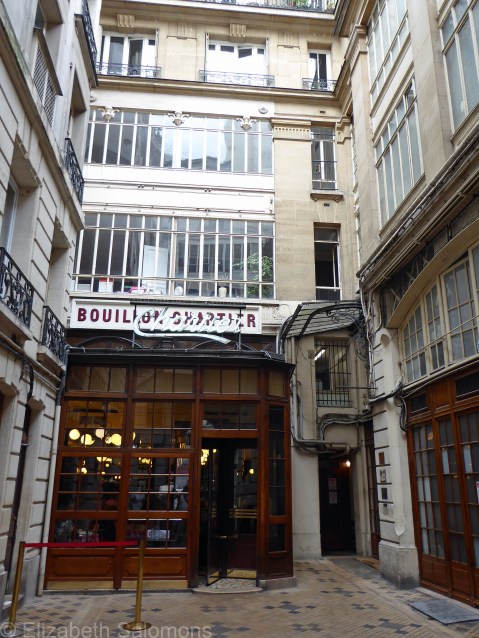
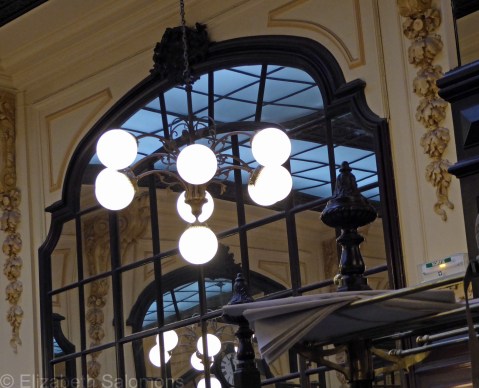
We walked in through the revolving doors and were quickly seated. The décor looked like something out of a Belle Époque movie set, with coat racks set high above a cavernous room lined with mirrored walls and filled with endless rows of tables lit by giant globe light fixtures.

Soon our black-vested, white-aproned waiter came to take our order, which he scribbled down on the paper tablecloth. He was polite, friendly, and extremely patient as I gave him our order in my poorly enunciated French. As soon as he walked away, my nieces turned to me in shock.
“He wasn’t rude!” they exclaimed.
So far, so good. I was hopeful.
But then our food arrived within minutes. “Uh oh,” I thought. “What’s going on here?” We wolfed down every bit of it, however — we were hungry — and some of it was very good, and some of it, well, was not so good.

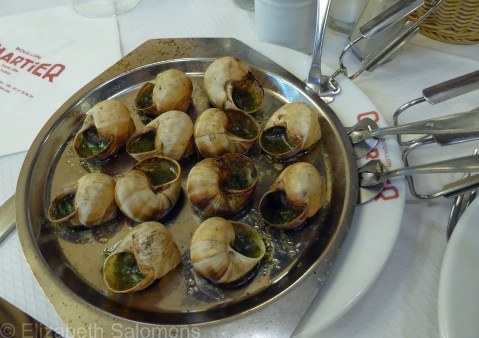
The girls were keen to try the escargot — they were in France, after all — which were served à la Bourguignonne (in the Burgundy style) with heaps of parsley and garlic butter. They went fast, and we used the most excellent bread to mop up every last bit of butter that remained.
I had confit de canard (duck), which I have to say was a bit tough. My pasta-loving niece ordered spaghetti bolognaise, which she told me later had been cold, and my oldest niece ordered poulet fermier rôti avec frites (roasted chicken with fries), which apparently was unseasoned.
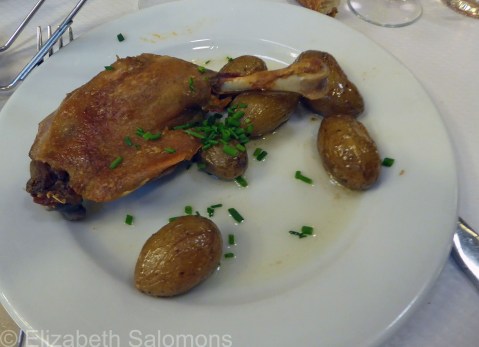
So much for impressing my nieces with excellent French cuisine. However, as I already said, we all of us cleaned our plates and you can never go wrong with French bread and wine. We decided not to have dessert as our next destination was a pâtisserie. Our waiter added up our bill on the paper tablecloth, and that was that.
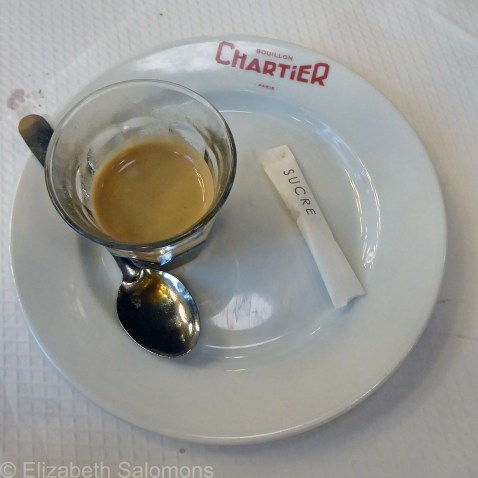
Bouillon Chartier, I’ve learned, is indeed a Parisian institution, as my Parisian friend promised me it was. Parisians and tourists alike flock here, and when we left, there was a line leading out of the courtyard all the way to the boulevard. I’m told the line moves fast, and given how quickly we were served, I believe it.
Bouillon means “broth” and was first served in 1855 by a butcher who wanted to provide cheap food for the workers at Les Halles, the original French fresh food market that was moved to the suburbs in the 1970s. The word came to mean the establishment serving the broth, and by 1900, there were more than 250 of these types of restaurants. Only a handful remain today. One of those is Bouillon Chartier, which was opened in 1896 by two brothers named Frédéric and Camille Chartier. Over its lifetime, it has had only a handful of owners. The food hasn’t changed in a hundred years and it is still cheap — the three of us ate for much less than we would have at our neighbourhood brasserie.
I expect I will give Bouillon Chartier another try the next time I am in Paris. My nieces have a lifetime of travelling ahead of them, and I have no doubt one day they will taste French cuisine as only the French can prepare it.
But I also know they will never forget their lunch at Bouillon Chartier in Paris.
Recipe Box: Stuffed Provençal Vegetables
After cleaning up from our day of harvesting grapes, my friends and I met our hosts, Paul and Miriam, and our new German friends, Nils and Juliana, in the parking lot of the gîte. We got in our car and they got in Nils and Juliana’s car and off we drove to Jean-Louis’ place, which was just a short way down the road.
Jean-Louis introduced his wife (who worked in a bank and was dressed rather smartly), his mother-in-law (whom we had met earlier that day and whom we knew had been busy in the kitchen preparing our dinner), and his youngest daughter (whom I guessed to be about eight years old). After aperitifs were poured, we made ourselves comfortable in the large and spacious but homey living room.
The conversation that evening was mostly in French, with Jean-Louis’ wife and Paul as our main storytellers. Despite my limited French skills, I was able to follow along thanks to the animated way they both talked as well as Paul’s effort to speak slowly and carefully. It wasn’t long before we were invited to take our seats at the expansive wooden farm table in the next room.
I was seated next to the grandmother. As I was feeling the effects of the aperitif and also highly conscious of the fact that I was the only registered driver on our rental car (which I wasn’t 100% sure was properly insured, thanks to a communications snafu at the rental counter when we had picked up the car a week earlier), I came up with what I thought would be an ingenious way of managing my liquor intake for the rest of the evening: I would sip my wine very slowly.
But the grandmother was much too smart for me. When we were into our second course and she saw that I was still nursing my first glass of wine, she asked (in French) if I didn’t like the wine. I assured her (in French) that I thought the wine was excellent. I also realized that I needed to drink up to avoid offending my hosts. Which meant that, for the remainder of the evening, the minute my glass neared the halfway mark, the grandmother topped it up.
Dinner consisted of a simple green salad with olive oil to start, served with three types of bread. We were encouraged to wipe off our plates after every course with the bread, something I’ve noticed my French friends do automatically. The main course was zucchini, peppers, mushrooms, and tomatoes, all stuffed with a mixture of ground beef and herbs. A cheese course followed, more bread, coffee, then dessert, which consisted of fruit flans, one of which was quince, baked on cookie sheets. Brandy to finish off the evening. We ate until we could eat no more. Even Nils looked to be in pain when they tried to get him to take a third helping of the fruit flan.
The party finally broke up around midnight. As I rummaged around in my bag for the car keys, I told my friends I was slightly drunk, but thought I was OK to drive the short distance back to the gîte. However, no sooner had I poked the nose of the car into the road when one of my friends pointed out that another vehicle was approaching. I quickly reversed the car. “OK, maybe not so OK,” I muttered.
When I finally decided it was safe to pull into the road, I pointed the car in the direction we had to go. I drove very slowly and finally the gîte pulled into view. Paul and Miriam were waiting for us in the parking lot because they were worried we had gotten lost.
“That wasn’t the problem,” I said and I told them about my evening sitting beside the grandmother. And the next morning when we all said our good-byes, Nils apologized for feeling a bit hung over. He blamed the grandmother. “Oh, me too!” I said. “I had the exact same problem!”
I have tried several different recipes in an effort to replicate the stuffed vegetables we ate that night. With some tweaking, the following is the best I can come up with. It still doesn’t taste as good as I remember, but it’s a fair copy.
Bon appétit!
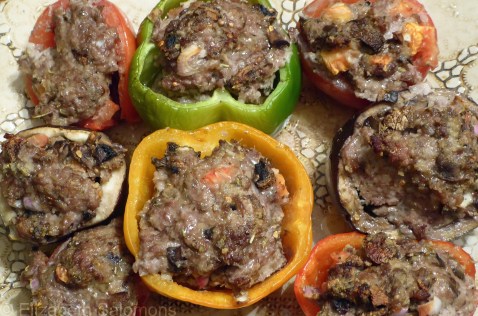
Stuffed Provençal Vegetables
1/4 cup bread crumbs or panko
1/4 cup milk
1 pound ground pork
1 pound ground beef
4 shallots, minced
2 cups mushrooms, diced
1 tablespoon Herbes de Provence
salt and pepper
2 red peppers
2 orange peppers
2 green peppers
1 eggplant
4 medium tomatoes
1. Preheat oven to 350°F.
2. Pour the milk over the bread crumbs or panko and set aside.
3. Cut the tops off the peppers and tomatoes and remove the seeds. Cut the eggplant in half lengthwise and scoop out the flesh. Alternatively, cut the eggplant horizontally into thirds and scoop out the flesh, making sure you don’t scoop all the way through so that you leave a base for each piece of eggplant. Arrange the vegetables in a baking pan.
4. Combine the pork, beef, shallots, mushrooms, Herbes de Provence, salt, pepper, and moistened bread crumbs or panko. Mix to combine.
5. Fill each vegetable with a generous amount of the meat mixture. (The meat will shrink as it cooks.)
6. Bake for about 1 hour or until meat is cooked through and vegetables are soft.
Note: The tricky part to this recipe is that the different vegetables vary in how quickly they will cook. The tomatoes need the least amount of time, while the eggplant needs the most. Other vegetables that could be stuffed include zucchini or large mushrooms.
Dishing: The Pear Tree
Back when I lived in Toronto, I used to joke that I never went north of Eglinton if I could help it. Here in Vancouver, I make similar jokes about how I do everything I can to avoid travelling to bridge-and-tunnel land. These kinds of comments can easily get you into trouble with certain folks (as in: the ones who live north of Eglinton or in bridge-and-tunnel land). They are also the folks who know that there are many excellent reasons to venture out of the downtown core.
 The Pear Tree is one of those reasons. Ranked 49th in the 2015 list of Canada’s 100 Best Restaurants, it has been serving quality, classic food in Burnaby Heights for almost two decades. Was it the sole reason I trekked all the way out to North Burnaby the other weekend? Not entirely. But the offer from my sister and her husband of a nice dinner out (who am I to turn down a free meal?) as a thank you for hanging out in Solo so I could watch over their house and feed their cats while they were on walkabout in Southeast Asia was all the incentive I needed to spend an hour Skytraining my way east.
Upon arrival we were immediately seated by a young hostess who took our coats ― and then promptly disappeared. (Seriously. We never saw her again.) But in no time at all we were sipping cocktails and studying the menu in earnest. We made our selections with care.
And then.
And then we sat back and enjoyed ourselves. There wasn’t a wrong step with any of the dishes.
The highlight of my evening was my first course: Orange Caramelized Scallops with Double-Smoked Bacon Risotto. Creamy and full of flavour, the risotto was neither too bland nor too cheesy. I was a wee bit worried that the citrus flavour would overpower the scallops, but there was just a hint of it. The dish is also available as a main course.

Orange Caramelized Scallops with Double-Smoked Bacon Risotto
I ordered the Twice-Cooked Fraser Valley Belly with White Bean Cassoulet so I could compare it to the cassoulet I so fondly remembered from a long-ago visit to Carcassonne, France. The Pear Tree version was nothing like the Carcassonne version. (No surprise there, to be honest, and I would have been disappointed if it had.) The pork belly was crisp, but moist; if you like your bacon well-cooked, this is not the dish for you as you will likely be turned off by the fattiness of the pork belly. The meat lay on a bed of white beans and green pea puree.

Twice-Cooked Fraser Valley Pork Belly with White Bean Cassoulet
Roasted steelhead and grilled pork tenderloin were the choices for my sister and her husband and there were no complaints at our table. As we all tucked into our main courses, our waiter brought us a plate of lightly dressed fresh greens to share.

Pan Roasted Lois Lake Steelhead served with Pommes Dauphine and Butternut Squash

Chargrilled Pork Tenderloin with Bacon-Crusted Salsify and Potato Pave

Stilton with Candied Nuts and Toasted Brioche
We finished our meal with a cheese course of stilton and candied walnuts, but it was the arrival of our trio of desserts that drew gasps from our neighbours. No wonder ― they looked spectacular. I had the Chocolate Ganache with a Crisp Nut Base, Salted Caramel, and Orange Chocolate Sorbet. Now here’s a revelation: salted caramel is the perfect companion to deep rich chocolate. Even so, my favourite part may have been the nut-based crust.

Chocolate Ganache with a Crisp Nut Base, Salted Caramel, and Orange Chocolate Sorbet
The Vanilla Crème Brulée with a Crisp Brandy Snap was the creamiest crème brulée I’ve tasted in a long while. I loved how the vanilla flavour was front and centre.

Vanilla Crème Brulée with a Crisp Brandy Snap
But the star of the night was the Fresh Lemon Tart with Lemon Sour Cream Sorbet. I say this because it was the dessert with the most dramatic presentation with its tower of spun sugar. I happen to think that lemon tarts have long been underrated ― the fresh lemony taste of this one only confirmed my belief.

Fresh Lemon Tart with Lemon Sour Cream Sorbet
When we were finally sated and I had heard all about my sister and her husband’s travels, we got up and I moved towards the coat closet beside our table. But Stephanie, co-owner and front of house, had already placed them on a table in the lounge. How did she know which coats were ours without a coat check tag?  This is a mystery to me. (Remember, the hostess who took our coats upon our arrival had long disappeared.) Stephanie’s husband, co-owner and chef Scott, stood beside her and chatted with us as we put on our coats. It was a homey touch, as if our hosts were seeing us to the door the way they would in their own home. For me, that personal touch was the most impressive moment of an impressive evening.
Which means I may be trekking out to Burnaby Heights more often in the future.


 There and Back Again