
The Pantheon
On one of my trips to Rome, I arrived 24 hours before my friends so I could have a day to wander around on my own. First thing that first morning, I set out from my hotel, eager and excited to begin exploring. Within minutes, I stumbled around a corner into Piazza della Rotunda and found myself staring up at the Pantheon in complete awe.
At that moment, it hit me with a massive thump. I was in Rome. And Rome is really, really old.
I’ve done a fair bit of wandering around Europe, in countries like England, France, and the Netherlands, and I am always struck by the amount of history. Compared to Canada, there is an awful lot of it in Europe.
But Rome! I know I’m stating the obvious, but Rome is in a category all its own. It’s not just old ― it’s ancient.
The Pantheon was built by Marcus Agrippa in 27 BC as a temple to all the gods of Rome, was rebuilt by Emperor Hadrian about 150 years later, and has been used as a church since the seventh century. It’s awesome inside ― a perfect circle ― and contains the tombs of Victor Emmanuel II, first king of a united Italy, and Raphael, Renaissance artist, among many others. The only daylight to enter the structure is from the oculus at the top of the dome.
The inscription on the pediment reads “M. AGRIPPA. L. F. COS. TERTIUM. FECIT.” Later that same visit, one of my friends, a linguist, translated the Latin for us: “M Agrippa, son of Lucius, consul for the third time, built this.” She burst into laughter when she reached “built this.” Agrippa, mighty Roman general, was no different than the child who writes their name on the schoolwork they take home to Mom or Dad.
Now, every time I return to Rome, the first thing I do is revisit the Pantheon to remind myself of where I am and how awesome a place it is. I don’t ever want to lose that feeling.

Florence
Florence. Firenze. Birthplace of the Renaissance. Home of Leonardo, Michelangelo, Botticelli, and the Medicis. Site of Brunelleschi’s Dome and the Ponte Vecchio. A major stop on the Grand Tour of every young Englishman during the seventeenth and eighteenth centuries. One of the most-visited European cities in this century.
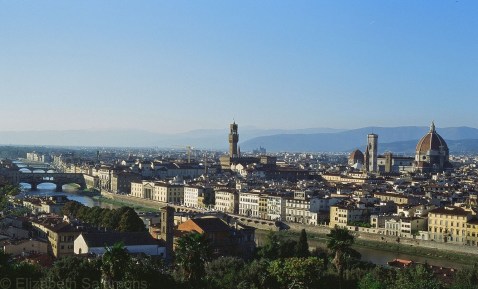
Florence from Piazzale Michelangelo
Florence is intense. And not just because of all that art and history. Its historical centre is small, easily covered on foot, and jam-packed with tourists.
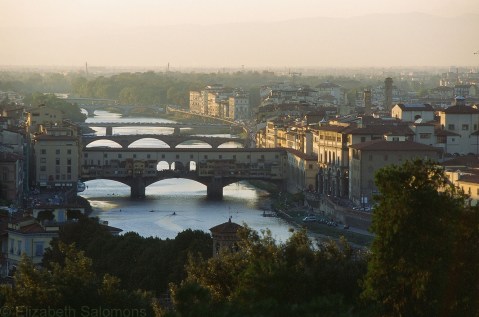
The Arno from Piazzale Michelangelo
The key to enjoying Florence is to not resent the crowds ― everyone is there for the same reason you are. If you can, visit Florence in the off season. And, if that’s not possible, get up early, and explore as much of the city’s piazzas and narrow streets before the rest of the world is up and about. You won’t regret it.

Copy of Michelangelo’s David in Piazza della Signoria
Reel Life: Stealing Beauty
 I once watched a TV mini-series about Leonardo da Vinci with my mother when I was far too young to stay up so late. She sometimes let me do that — watch TV with her long after my younger siblings had been sent to bed — but only if she saw I was genuinely interested in what she was watching.
This time, I was. That mini-series planted the seed of my life-long interest in the art and history of Renaissance Italy.
I was also captivated by the landscape. “Where’s Tuscany?” I asked.
“Italy,” replied Mom.
I knew then that one day I would go to Italy. It was the first time I was motivated to travel by images I saw on-screen, but it certainly wouldn’t be the last.
Every time I watch Stealing Beauty, I want to book myself on the next flight to Florence. Liv Tyler, in a break-out role, plays Lucy, a 19-year-old American visiting friends of her late mother. They live an idyllic life in a renovated farmhouse somewhere near Siena. Lucy has travelled to Tuscany to have her portrait done by the resident artist, although she suspects it’s really just an excuse for her father to send her to Italy for the summer.
Her mother’s friends have opened their home to all sorts of hangers-on: Jeremy Irons plays a dying playwright, Jean Marais a former art dealer gone senile, Rachel Weisz and Joseph Fiennes — before they became Rachel Weisz and Joseph Fiennes — play the adult children of Sinéad Cusack’s character, the matriarch of the place. Her husband, played by Donal McCann, is the artist. When he explains why he has forsaken wet, damp, chilly Ireland for Tuscany, he says it’s all about the work, the “great tradition of art in these hills” — a homage to the artists of the Italian Renaissance if there ever was one.
All of the characters talk about Lucy — and her dead mother — behind her back. Lucy, however, is interested in only two things: reconnecting with the neighbour boy she fell in love with four summers earlier, and learning the identify of her real father. This last undertaking comes about because Lucy discovers a cryptic entry in her mother’s journals that hint at Lucy’s conception through a one-night affair one summer in Italy when her father was elsewhere.
Film critics didn’t think much of Stealing Beauty, particularly in comparison to some of Academy Award–winning director Bernardo Bertolucci’s other ground-breaking work (including Last Tango in Paris and The Last Emperor). I saw the film only a few months after my own mother’s death and first thought that’s why it resonated with me so loudly — in particular, a short scene involving an ambulance that caught me by surprise when it made me burst into tears in the middle of the dark theatre.
But every time I watch the film I am awestruck, so I think my enthusiasm for it is much more than simply being able to relate to the film’s portrayal of grief. Stealing Beauty is a film with an affecting but realistic screenplay, first-class acting, great music, seductive cinematography, and one of the most beautiful settings possible. In short: it’s a picture-postcard of Tuscany. If you want to find out how enchanting a summer in Italy can be, watch this film.
Through My Lens: Feed the Birds

I love the Italian word for “child” — bambino. And I love how the Italian language makes an ordinary pigeon sound so … well … unordinary with a word like piccione (say: pee-CHOH-nay).
We’re still in Piazza San Marco. Still people-watching.
Through My Lens: Venetian Waiter
Another piazza, another waiter. This time we’re in Piazza San Marco (St. Mark’s Square) in Venice. It’s a terrific spot for people-watching.


La Dolce Vita
My sister is getting married this month, and she and her soon-to-be husband are planning a honeymoon to Italy later this summer. I figure that’s as good a reason as any to focus this month’s posts on Italy. (As if I need an excuse to write about Italy.)
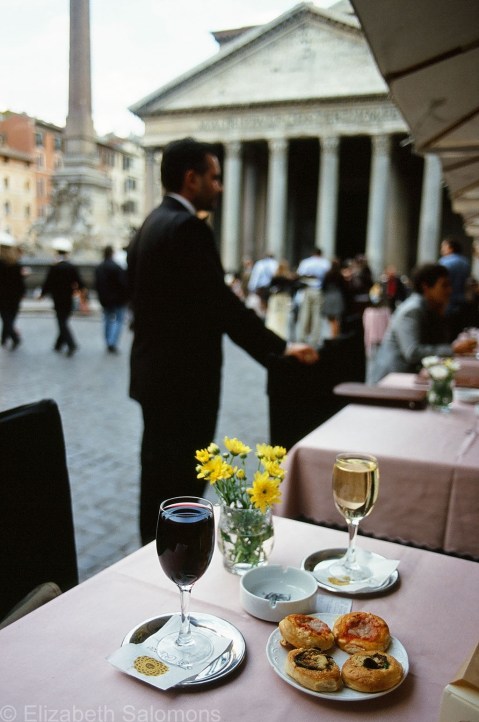
For my first post: a photo of what I consider to be the essence of la dolce vita (the sweet life): a piazza, a glass of vino, and an Italian waiter to serve you. I took this in Piazza della Rotonda on our last day in Rome, October 2007.
Beyond Amsterdam
Today being Koninginnedag (Queen’s Day), the national holiday of the Netherlands, I think it’s time I wrote something about the country that all four of my grandparents left to start new lives in Canada.
Many years ago, I was standing in line at Amsterdam Centraal Station, the city’s main train station, waiting to change some money. (This was back in the olden days, before ATMs.) An American came up behind me, asked if I spoke English, and we started chatting, as backpackers do, about where we’d been and where we were going. I explained to him that I was nearly finished my trip, and was going to spend a couple of weeks in the Netherlands before returning home to Canada.
“A couple of weeks!” he said.
“I have some relatives to visit,” I explained.
“Oh! Well, that’s good,” he replied. “Because there isn’t much to see here.”
“Oh?” I said. He then began to tell me about the Red Light District, which I quickly gathered was about all he had seen of Amsterdam.
“But have you seen anything else of Holland?” I interrupted him.
“Is there more to see besides Amsterdam?” He sounded surprised. “What?”
“Uh, well … there’s the whole country,” I said.
“Oh! Is it pretty? Are there mountains?”
I was struggling to come up with a polite response when, just then, it was my turn at the change window. The conversation ended rather abruptly as I turned my back to him. “Idiot,” I muttered to myself. “Are there mountains?”
I know the Netherlands isn’t high on most people’s lists of countries to visit. Nor do I expect it to be. But I do want my readers to know that, for a tiny nation, the Netherlands has a whole lot of country if you take the time to venture beyond Amsterdam. I took this photo one day in August 2007 when I was cycling outside of Zaandam, a town just north of Amsterdam.
No mountains. Just a lot of flatland. Beautiful, isn’t it?

Through My Lens: Cherry Blossom Time
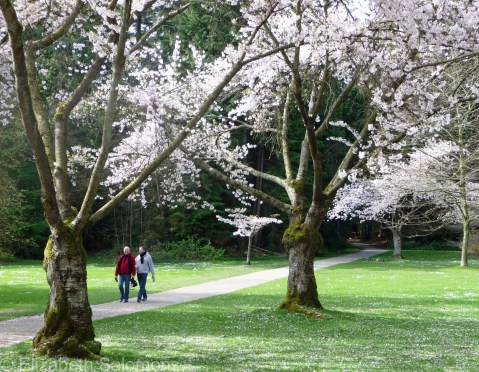 Vancouver has almost 40,000 cherry trees that burst into bloom every March and April. It’s my favourite time of year.
Armchair Traveller: C’est la Vie
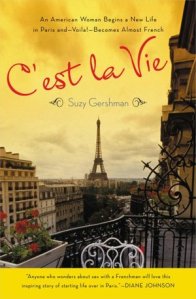 On my first-ever visit to Paris, I navigated the sidewalks as if I was playing a game of hopscotch. There was doggie-doo everywhere you looked (or, to be more precise, everywhere you stepped but didn’t look).
Fourteen years later, I was back in Paris, this time with my dad. The doggie-doo situation was much improved. But we chuckled together one night at dinner when we realized the incredibly stylish and well-manicured French matron dining alone at the table next to us had a small canine companion lying at her feet. We were most definitely not in Kansas anymore!
I thought about that dog the first time I read C’est la Vie by Suzy Gershman, which I read shortly before reading Almost French. C’est la Vie and Almost French nicely bookend each other because both are written by women who move to Paris at the urging of a man. And ― once each author is settled and starts to feel “almost French” ― each adopts a small dog (how French of them) that they take with them everywhere (how very French of them!). In Gershman’s case, this includes La Galerie at Hotel George V. Clearly a dog’s life in Paris is no hardship at all.
Other than that, however, the two authors are quite different from each other. One is young and Australian, the other is middle-aged and American. One is starting a relationship, the other is mourning the end of a relationship.
Suzy Gershman moves to Paris six weeks after the death of her husband, who has died only six weeks after being diagnosed with Stage IV lung cancer. She calls herself the Runaway Widow, and she lives in a hotel while searching for an apartment she can call home. This proves more difficult than she expects, but eventually she finds one in the 17e arrondissement. She then proceeds to set up house.
Gershman’s day job is writing shopping guides for cities all over the globe. Hence, she goes into incredible detail when describing the shopping she does to furnish her apartment. It’s natural she writes about what she knows, but the book is missing the in-depth analysis of French culture that I so enjoyed in Almost French. If Almost French is steak et frites, C’est la Vie is tarte tatin. Both add different elements to the meal, but, if I have to choose, I’m a meat-and-potatoes kinda gal.
However, I will be eternally grateful to Gershman for introducing me to Monoprix, the combination grocery-department chain store where I did most of my shopping when I was living in the 20e arrondissement. It was my favourite place to shop and I still miss it.
Armchair Traveller: Almost French
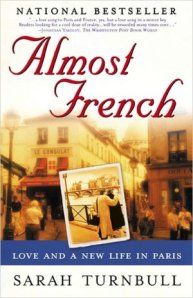 One of the women in my Book Club is going to France with her family this summer. She knows I read a lot of travel memoirs, so at our last meeting she turned to me and asked, “Can you recommend some books about France?”
Can I recommend some books? About France? (Is the Queen English?)
Almost French was my favourite of the shelfful of books I devoured before my last trip to Paris. The author, Sarah Turnbull, is an Australian journalist who meets a French lawyer when they are both in Bucharest for work-related reasons. A couple of months later, she takes him up on his invitation to visit him in Paris ― and never leaves.
Travel memoirs written by wealthy retirees who move to Provence (or Tuscany … or Greece … or …) and fix up old farmhouses are a dime a dozen. For that reason alone, I found Almost French refreshing because it was written by someone my own age living in a large city. I also enjoyed it because it was written by someone from a country with enough cultural and historical similarities to my own for me to relate to her observations about the differences between Australia and France.
But mostly, Turnbull’s memoir stands out from the dozens I’ve read because it is so painfully honest. She is open and frank about the daily grind and frustration and loneliness of adjusting to a new life in a new country. Travel memoirs are usually quite humourous ― often, I suspect, to deflect some of the pain that is always part of adjusting to life in a new and often confusing culture. And Turnbull’s book does have its funny moments. But she uses her stories of linguistic and cultural misunderstandings as an opportunity to write what amounts to a sociological study of the Parisian mind-set ― and she does so in a very real and down-to-earth manner.
For instance, her descriptions of various dinner parties are an obvious opportunity to talk about the French love and passion for food. But she uses these evenings as a window on everything French ― from politics to gender relationships to social habits to the proper way to present and serve a meal. Her weekend visits to the countryside with her French lawyer to visit his father lead to a treatise on how sentimental the French are about the countryside. And she becomes adept enough at reading the French psyché to understand that “Ce n’est pas possible” doesn’t always mean “It’s not possible.”
Another reason her memoir is so distinctive is that her experiences, although specific to Paris in the mid-1990s, are universal. Anyone who has picked up her life and started over in another country, or (dare I say it?) another region of Canada, will be able to relate to her book. Cultural differences between two regions of the same country might be subtle but significant enough to make you ask, “Where am I?” And although I lived in Paris for only three months, Turnbull’s descriptions of Parisians brought smiles of recognition to my face.
By the time she reaches the end of her book, Sarah Turnbull has lived in France for six years, and proves herself almost French by adopting one of the most clichéd of Parisian lifestyle choices ― she gets herself a little dog with as much personality as any French chien.
If you’ve ever contemplated moving to a foreign country, or have already done so, I highly recommend you read Almost French.


