
Canada 150: Peggy’s Cove

Oh, look!
It’s the last month of 2017 and I’ve reached the last province on my Canada 150 tour (with apologies to Nunavut and to Newfoundland and Labrador — both are on my bucket list, but I have yet to visit either). I took this photo in Peggy’s Cove, a small community on the coast of Nova Scotia just outside of Halifax.
I’m still on leg two of my cross-Canada road trip. It was a pretty memorable road trip, as far as road trips go, as I was travelling with four siblings and two parental units. Anyone who has ever travelled in large familial groups knows of what I speak.
There were a lot of personal firsts for me on this family vacation, like travelling in convoy (when we were little, we could fit in one vehicle — not so much as adults) and getting up at the crack of dawn so I could photograph an East Coast sunrise. And my first ever lobster, bought fresh off the dock, and cooked on a camp stove.
At this particular point in my family’s history, our respective places of residences were scattered across three provinces, so we were about as pan-Canadian a family as we could be. It was rare for us to be in one place all together, so there were lots of family photos taken, to the delight of some and the annoyance of others, including a whole whack on the rocks at Peggy’s Cove.
Peggy’s Cove is a pretty photogenic place to take a family photo. It has lots of rocks and some fishing shacks and a picturesque lighthouse.
And lots of tourists. By the busload. It was pretty crazy.
I’m just happy they didn’t get in the way of my photo.
Canada 150: Prince Edward Island
We ARE rich,” said Anne staunchly. “Why, we have sixteen years to our credit, and we’re happy as queens, and we’ve all got imaginations, more or less. Look at that sea, girls — all silver and shadow and vision of things not seen. We couldn’t enjoy its loveliness any more if we had millions of dollars and ropes of diamonds. — Anne of Green Gables, Lucy Maud Montgomery
Everything I know about Prince Edward Island I learned from Anne of Green Gables, so it’s only natural that I start this post off with a quote from the book.
My time on Prince Edward Island (while on leg two of my cross-Canada trip) was short (way too short), but I remember that the Island was beautiful and green and red and … so very, very small. (It is the smallest Canadian province in both population and area — five PEIs would fit inside Vancouver Island. So yeah … small.)
I really hope I get back there some day.
Another claim to fame (besides Anne) for Prince Edward Island: it hosted the Charlottetown Conference of 1864. Delegates from Prince Edward Island, New Brunswick, and Nova Scotia came together to discuss forming a union of their three colonies. But the Canadians crashed the party and got them to consider making it a foursome (the colony of Canada being the fourth). The 1864 conference was followed by more meetings and, eventually, Confederation in 1867, although PEI ended up backing out and waited until 1873 to become a province of Canada. Even so, Charlottetown is called the Birthplace of Confederation.
This photo was taken (I think) somewhere on the Island’s north shore, which faces the Gulf of Saint Lawrence. Prince Edward Island is famous for its red soil, which is caused by a high concentration of iron oxide.

Happy Birthday, NHL!

It’s Grey Cup Sunday in Canada, a day when some of us go a little wacky over that game played with a pigskin. I only mention it because this year’s game (held in Ottawa) was the 105th Grey Cup and I like to acknowledge significant anniversaries on this blog.
Oh, and I also mention it because it is a game always played in late November. Most often outside. And this year, in a blizzard.
No, seriously. They couldn’t keep the field clear. Players were sliding all over the place. Camera operators, too. And the half-time show? Shania Twain was brought out to centre field by dog sled. And then escorted to the stage by a Mountie.
Canadian enough for you? Hee.
But now I am going to change the channel and talk about the other most Canadian professional sport.
I’m talking about hockey. Of course.
Another hee. I’ve been waiting a long time for an excuse to post these photos. And today I have one: it’s the 100th birthday of the National Hockey League.

For my non-Canadian readers, just know that Canada is a hockey-mad country. And if you visit Canada during playoff season — you know, what the rest of the world calls spring — you will see for yourself just how hockey mad we are. Sixteen NHL teams play four rounds of best-of-seven series … it goes on forever.
If you still don’t believe me, how about this? A hockey rink has been built on Parliament Hill for the upcoming holiday season as part of the Canada 150 celebrations. (Except, um, no hockey sticks or pucks allowed, so maybe not so much hockey rink as ice rink, despite the boards surrounding it.)

All of this is to say that it would be most un-Canadian of me to let today go by without acknowledging the date in some way. A hundred years ago today, the owners of the Montreal Canadiens, the Montreal Wanderers, the Ottawa Senators, and the Quebec Bulldogs got together and agreed to form a hockey association they named the National Hockey League. At that time, the best players earned $900 a season.
The league had a bit of a rough go at first. The Wanderers pulled out before the first season was over because their arena burned down and Quebec pulled out before the first season even started because they ran out of money. Enter a Toronto team that had no name (eventually known as the Toronto Maple Leafs).
The first games were played on December 19, 1917. Toronto lost to the Wanderers by a score of 10 to 9 and the Canadiens beat the Senators 7 to 4. Some of the rules then in place: no forward passing and no zones. It took less than a month for the first rule change: allowing goalies to drop to the ice when making a save. (Initially, they were instructed to remain upright. Yeah, good luck with that.)
The nameless Toronto team took home the Stanley Cup in 1918, beating the Vancouver Millionaires of the Pacific Coast Hockey Association in a best-of-five series, although Lord Stanley’s Cup didn’t become the official league trophy until the 1926–27 season.

Last summer, one of my German friends asked me about “ice hockey.” When I gave him a funny look, he corrected himself.
“You don’t call it ice hockey in Canada, do you?” he asked.
“Yeah, no,” I said. “There’s only one kind of hockey we care about in Canada. And it goes without saying which one we mean.”

Canada 150: Hopewell Rocks

I’m nearing the end of my Canada 150 series, but it’s only now that I’ve reached leg two of my cross-Canada road trip. (Remember, I’m the one who doesn’t think it’s cheating if you break a cross-Canada road trip down into manageable chunks. Leg one of my road trip was from Vancouver to Toronto; a few years later I did Toronto to Cape Breton (that would be leg two); and a year after that was leg three, when I drove from Edmonton to Inuvik.)
On the way from Toronto to Cape Breton, we stopped off at Hopewell Rocks. These sea stacks are on the New Brunswick side of the Bay of Fundy. The Bay of Fundy is known for its tidal ranges, which are the highest anywhere in the world — sometimes as much as 16 metres or the height of a four-storey building. Those powerful tides have eroded the soft sandstone along the shoreline of the bay and created these rock formations.
We didn’t stick around long enough to watch the tide to come in, but if we had, we would have seen how only the tops of these rocks are visible at high tide.
Canadian National Vimy Memorial
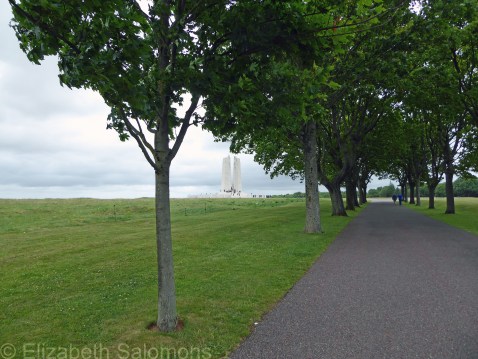
I’m going to start this post off with a bunch of numbers.
Here’s one: 11.
Every year, at the eleventh hour of the eleventh day of the eleventh month, we remember.
Here’s another number: 3598.
That’s the number of Canadian soldiers who lost their lives at Vimy Ridge, a battle that was commemorated with 100th anniversary ceremonies last April. Another 7000 soldiers were wounded.
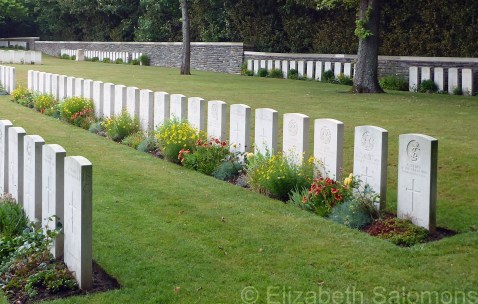
And here’s one more number: 1.
That’s the number of graves my nieces and I set out to look for last summer when we visited Canadian Cemetery No. 2 at the Canadian National Vimy Memorial. It’s a big cemetery, but we found the grave in minutes.
The grave we were looking for was this one.
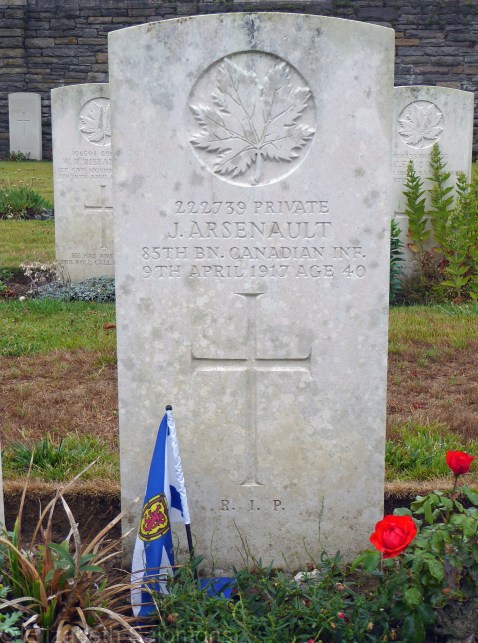
This Cape Breton soldier was the great-grand-uncle of the wife of a friend of a friend of mine. How many degrees of separation between that soldier and me? I told my nieces it was five and they were all over the idea that they were the sixth degree. More numbers. Whatever the degree of separation, knowing that I knew someone who knew someone who was related to a Canadian soldier buried at Vimy Ridge gave all of us a personal connection to those horrific events of 100 years ago.
I have more numbers. The Vimy Monument stands at the highest point of Vimy Ridge — the piece of land that was fought over by 200,000 soldiers — and the 100 hectares surrounding the ridge were given to Canada by a grateful France in 1922 so that the monument could be built.
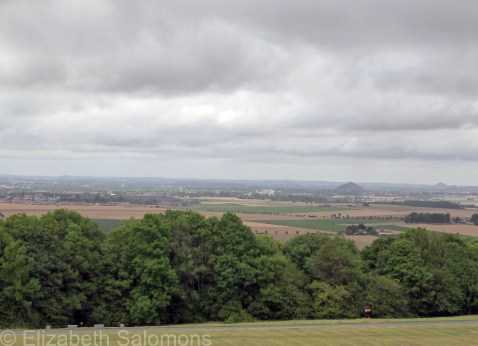
On the Vimy Monument are carved the names of 11,285 Canadian soldiers who died in France, but have no known grave.
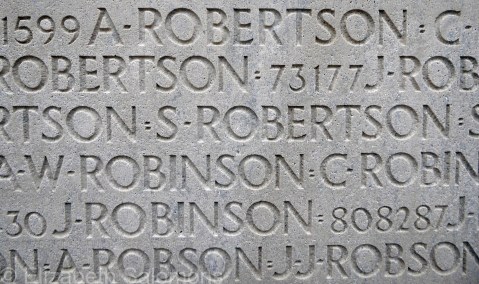
Because many of the soldiers’ bodies at Vimy were never recovered (it was and still is too dangerous to walk over No Man’s Land because of the unexploded ordnance), the entire memorial site is considered a cemetery.
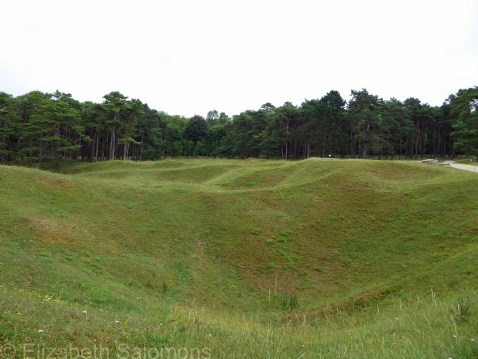
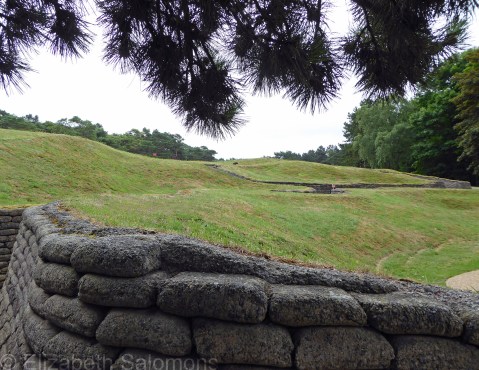
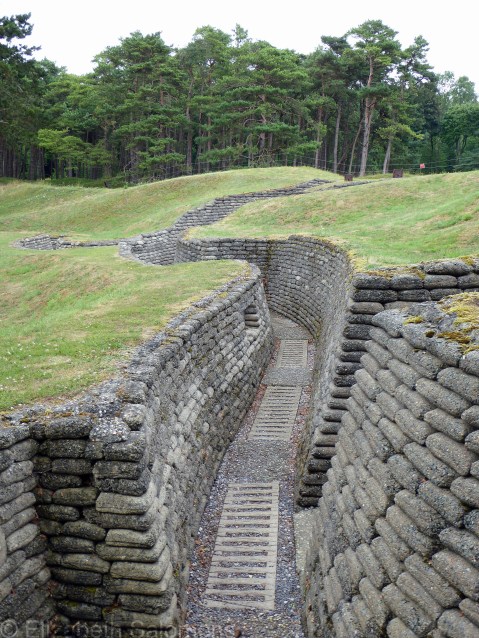
Here’s a surprising number: 25. That’s the number of metres between the Canadian and German lines — about the width of a NHL hockey rink. You can see for yourself how short that distance is when you stand in one of the reconstructed trenches.
The guides who take you into the underground tunnels at the Canadian National Vimy Memorial are all Canadian university students. Those tunnels served two purposes: they protected the Canadian soldiers as they moved ever closer to the German lines, and they allowed the soldiers to plant the underground mines that were set off just before the battle began.
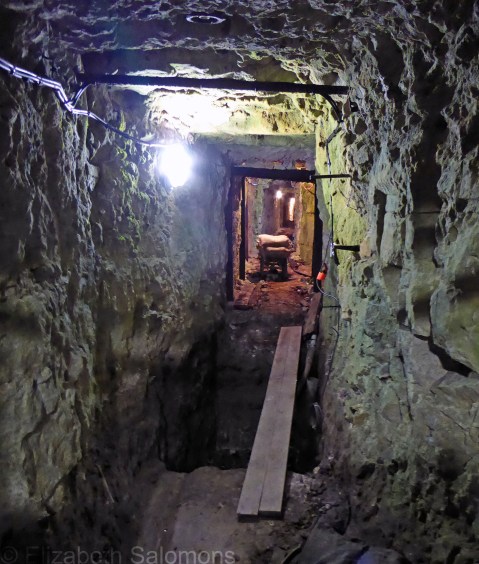
Not all of the mines exploded, which is why there is so much unexploded ordnance. The grass is kept short by grazing sheep that are too lightweight to set off the mines.
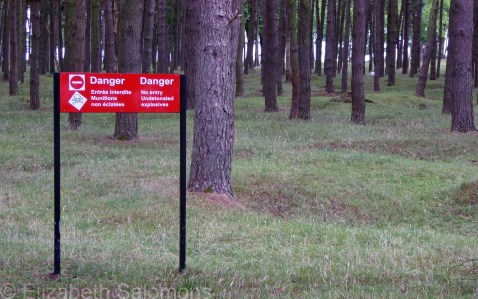
It is believed there are 10 miles of tunnels at Vimy, dug by miners who had the necessary experience in tunneling underground. Although you can’t go into the tunnels without a guide, you are free to wander about the rest of the memorial site as you will.
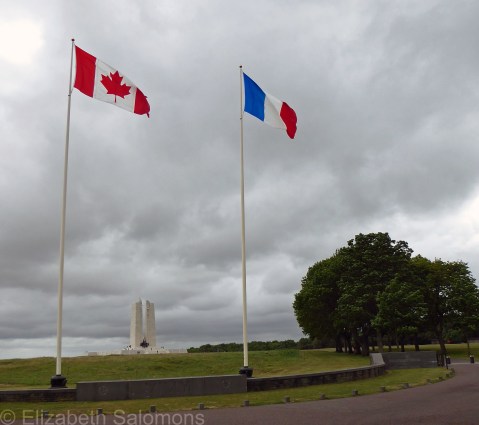
The Vimy Monument itself is striking. Designed by Canadian sculptor Walter Seymour Allward, it took 11 years to build and was dedicated in 1936. Allward said the image of the twin pylons, which represent Canada and France, came to him in a dream.
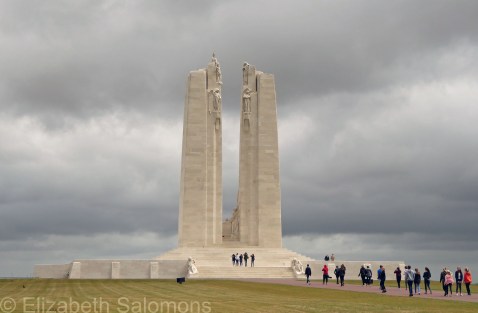
On the monument itself are 20 allegorical sculptures so poignant and moving that I’m going to let the pictures speak for themselves.


And here is one final number: 2.
That’s the number of hours it takes to get from Paris to the Canadian National Vimy Memorial by car (about the same by train and taxi).
As to the value of a visit to Vimy Ridge, I have no more numbers.
That is immeasurable.
Canada 150: Quebec City
At the start of my Canada 150 series, way back when, I said that a cross-Canada train trip should be on the Travel Bucket List of every Canadian. I myself haven’t quite completed that, but I came pretty close when I took the train from Vancouver to Quebec City.
It took me four days to cross five provinces. I was a student, so I had more time than money and back in those days taking the train was cheaper than flying. But still, it was the cheap seats for me, which meant I did not have a sleeping berth at night. When I finally disembarked, the conductor joked that I was starting to look like part of the furniture.
But travelling slowly across three-quarters of the country was so worth it. It gives you a sense of the scale of our country, and an appreciation for the regional differences.
Another way to appreciate regional differences is to spend a good chunk of time in other parts of the country. I travelled to Quebec City that summer to study French. The French didn’t much stick, but my perception of Quebec was changed forever.
It was the 1980s, the height of the Quebec sovereignty movement and the middle of a decade of constitutional conferences and accords that were the aftermath of the federal government repatriating Canada’s Constitution without Quebec. Yes, that’s a mouthful and I won’t get into explaining it here because if you’re old enough, you lived through it, and if you’re too young to remember, there are books you can read. But I mention it to explain the context for my summer.
My goal that summer, besides learning French, was to get to know the province of Quebec, so to speak. As a history major, I knew all about Canada’s two solitudes, but history doesn’t really, truly come alive until you walk its streets. And here’s what I learned: the difference between Quebec and the rest of Canada isn’t just its language, but also its culture and its history.
Language is obvious, of course. But it’s because of that language difference that Quebec has its own music scene, its own TV and film stars, and its own literature. I read a lot, but I can’t remember the last time I picked up a novel by a Québécois author. I think we English-speaking Canadians could do a lot better in appreciating and acknowledging Quebec culture.
And then there’s the history. What I most remember about that summer is realizing exactly what je me souviens means to Quebeckers. Its literal translation is “I remember” and it is the province’s motto. It’s said to refer to how Quebeckers will always remember their culture, their traditions, and their history. But when I saw one of those sound and light shows for tourists of a model-sized re-enactment of the Battle of the Plains of Abraham, the penny dropped for me. Je me souviens means “I remember 1759.”
The Battle of the Plains of Abraham took place on September 13, 1759. The British soldiers, led by General James Wolfe, climbed up the cliffs from the Saint Lawrence River to the Plains of Abraham at Quebec City, taking the French troops, led by the Marquis de Montcalm, completely by surprise. It was all over within an hour. The French loss marked the turning point of the Seven Years’ War. France gave up control of its colony in New France, but was allowed to keep two small islands off the coast of Newfoundland (Saint Pierre and Miquelon) and its holdings in the West Indies (the islands of Guadeloupe and Martinique).
Keep in mind that New France at that time consisted of present-day Labrador, Quebec, Ontario, Manitoba, and what is now the American Mid-West from the Great Lakes south to Louisiana. It was a far larger land mass than Britain’s Thirteen Colonies. Some historians like to draw a straight line between France losing New France and the American Revolution a few years later.
I’m getting lost in the history here, I know. But the point I want to make is this: if Montcalm had not lost the Battle of the Plains of Abraham, if France had not ceded its holdings in New France to the British, if the American Revolution had not been fought, if the Loyalists had not moved north into Canada, there is a pretty good chance that Canada would be a French-speaking nation. So when someone in Quebec says “je me souviens,” they are remembering all that.
I put all these thoughts into a short essay I read aloud to my French class on our last day of classes that summer. We met on the Plains of Abraham, of all places, for a class picnic and after I finished reading my essay, my teacher said to me, “Tu pense comme une Québécoise.”
You think like a Quebecker.
I don’t know about that, but I do know that my summer in Quebec City gave me a better understanding of how Quebeckers see their place in Canada.
I don’t have a photo of the Plains of Abraham, but here’s one of Notre-Dame-des-Victoires, a small church in the Lower Town of Quebec City. It is less than two kilometres from the Plains of Abraham and was almost completely destroyed by the British bombardment that preceded the battle in 1759.

Canada 150: Montreal
I wasn’t going to include Montreal in my Canada 150 series. Truth is, I haven’t spent a lot of time there and I don’t know the city well at all. But as I was thinking about my infrequent visits, it suddenly dawned on me. The last time I was in Montreal was on a May long weekend, and the city was deep into its 350th birthday celebrations. And this year, on May 17, Montreal celebrated its 375th birthday.
Gulp. It’s been 25 years since I’ve visited the home of my first love. (That would be the Montreal Canadiens.)
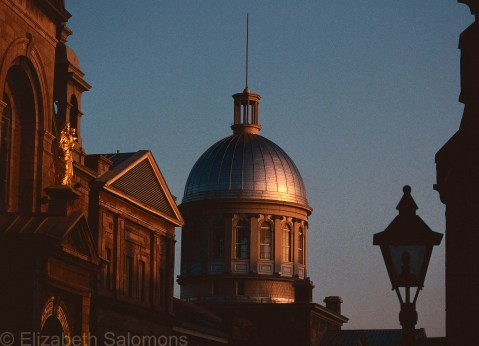
This photo is of the Marché Bonsecours (Bonsecours Market). Opened in 1847, it was the main public market of Montreal for more than a century. Today it houses restaurants and shops and a reception hall.
Canada 150: Ottawa
So, here’s a thing. In putting together my Canada 150 series for this blog, I realized that I actually remember the last time Canada threw a big party for its birthday.
That would be Canada’s Centennial, way back in 1967. (I know, I know. I’m dating myself.)
I was in Ottawa, our nation’s capital, with my family, and I remember watching the Changing of the Guard at Parliament Hill while sitting on my dad’s shoulders. I remember crying, because I was frustrated that I could not see over other people’s heads.
(I don’t know what it says about me that my earliest memory is of being frustrated, but there it is.)
I took this photo of the Changing of the Guard at Parliament Hill many years later. Fully grown, at almost 5 feet 10 inches tall, I’m happy to say I no longer have any trouble seeing over other people’s heads.

Through My Lens: English Bay Morning
Now I’m really back.
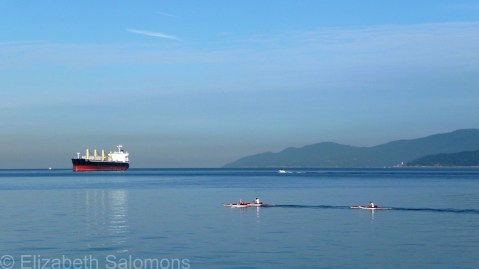
Back in Vancouver, that is. After three months away, I’m so happy to see my English Bay again.
Isn’t it beautiful?
Don Valley Brick Works

And … I’m back.
Back in Canada, that is.
After 10 days on walkabout in southern Germany and Belgium, I have my feet firmly planted once again on Canadian soil. It’s good to be here.
My week in Toronto is mostly about work, and I have to remind myself I’m still allowed to play tourist in a city I know so well.
Which is why I’m posting this photo. The friend whose home is my home when I’m in Toronto has been telling me about her new favourite place for months now, and she showed it to me last Saturday afternoon. The Don Valley Brick Works is an old quarry and brick factory that provided most of the bricks for Toronto’s oldest and finest buildings for over a hundred years. It ceased production in the 1980s and has been converted into a park and cultural centre since my last visit to Toronto.
I love city parks, and this one’s a gem.


